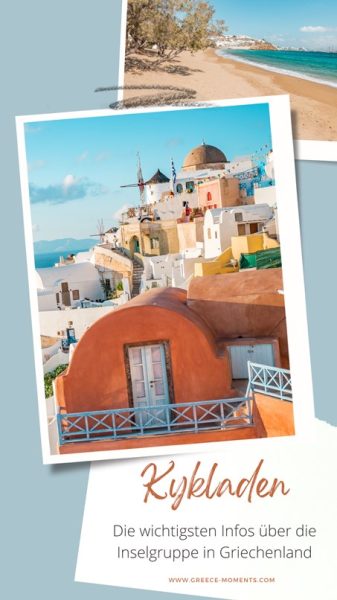

The Cyclades Islands are the epitome of the blue and white paradise. Hardly any other Greek archipelago attracts holidaymakers so magically. Greek visitor magnets such as Oia on Santorini, Naoussa on Paros or Chora on Mykonos with their enchanting Cycladic architecture are definitely among the most beautiful spots in all of Europe!
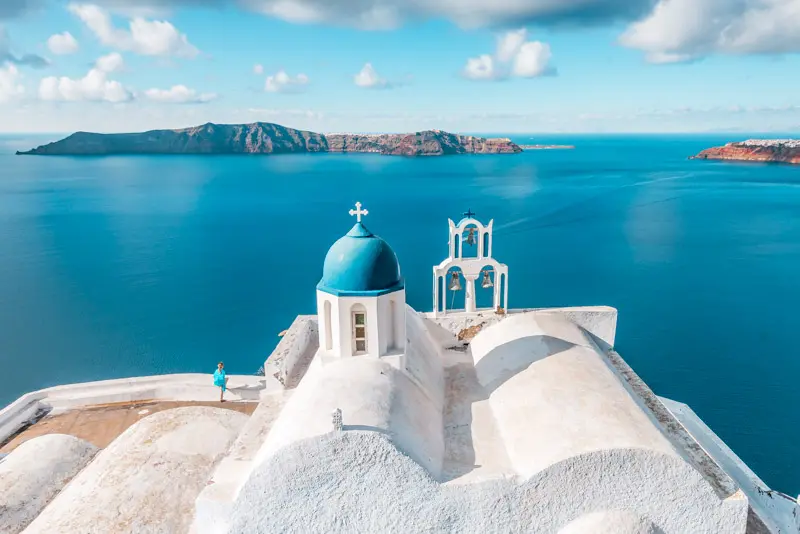
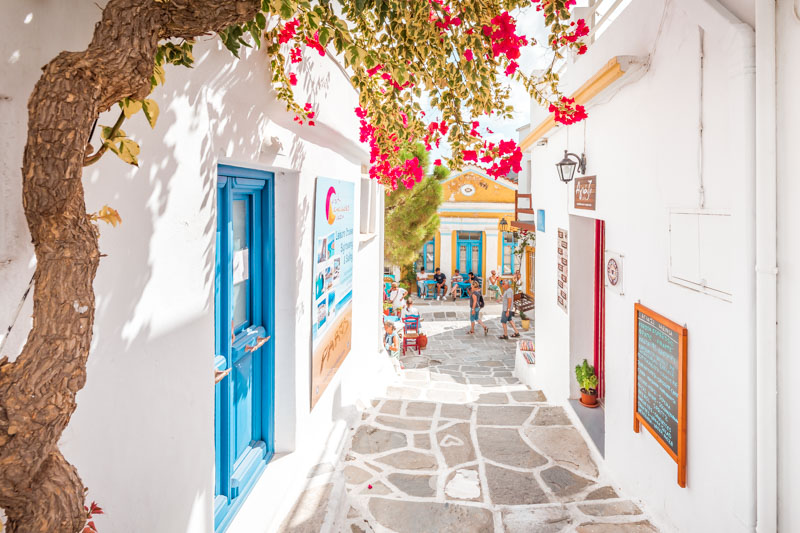
Anyone who has ever passed through the whitewashed alleys of Mykonos or Naxos can feel the magic of the Cyclades. But the islands offer much more than just picturesque places. Countless dream beaches and bays inspire sun-drenched holidaymakers. Nature lovers enjoy peaks up to 1,000 m high, which plunge into the deep blue sea.
Then there is the all-surrounding light, nowhere else is it said to be brighter than in the Cyclades. The white churches scattered throughout help many travelers feel close to heaven. It is the places of silence and islands far away from the crowds, such as Syros or Andros, that will remain in your memory forever after a trip to the Cyclades.
Welcome on a journey of discovery to one of the most dazzling Greek island worlds, from the Greek party island to the hermit island, everything is there. Welcome to the Cyclades! In this article, we will introduce you to the individual islands, including Insider tips for your Cyclades holiday.
10 facts about the Cyclades Islands
- 100 large islands, small islets and reefs make up the Cyclades
- 22000 inhabitants live on the Cycladic main island of Syros
- 300 years the Cyclades were occupied by the Ottomans
- 4 inhabited islands belong to the Small Cyclades
- 5 white windmills stand above Mykonos’ Little Venice
- 65 tons weighs the marble temple gate Portara on Naxos
- 7 hours takes the ferry crossing from Piraeus to Santorini
- 8000 Catholic Greeks live on the island of Syros today
- 900 mm of precipitation falls annually in the mountains of Andros
- 1004 meters is the highest Cycladic mountain Zas (Naxos)
#1 The main islands of the Cyclades
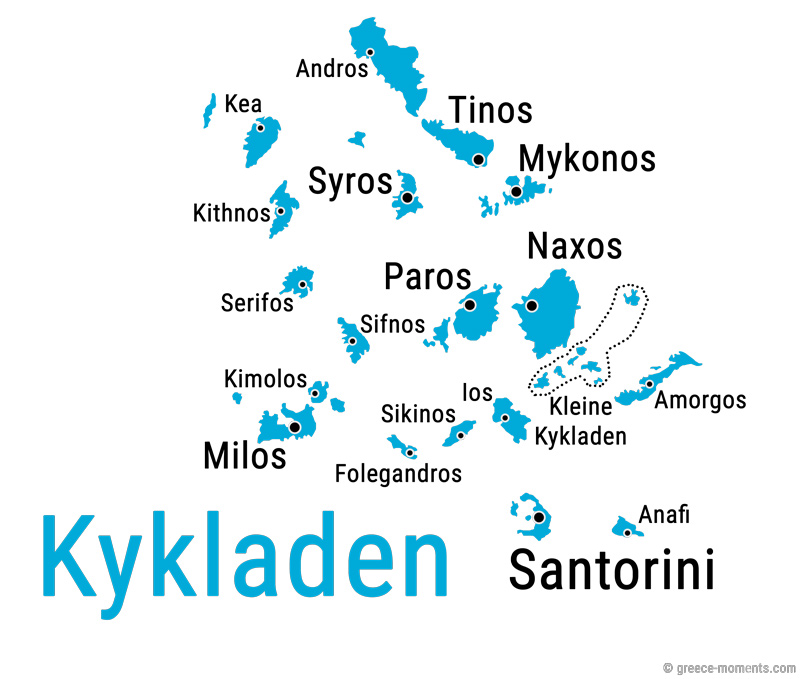
Several hundred large and small islands, as well as rocky reefs belong to the Cyclades, of which not even 30 are inhabited. The main islands are Naxos, Milos, Mykonos, Paros, Santorini, Syros and Tinos. The Cyclades are arranged almost in a circle, which is probably where their current name comes from, because “kyklos” means something like circle in Greek.
In ancient times, the mini-islet of Delos, only 3 km from Mykonos, was considered the center of the archipelago. Today the town Ermoupoli on Syros is the capital of the Cyclades. The largest islands in terms of area are Andros and Naxos (380 and 390 km² respectively), which are also considered the greenest islands. Mykonos and Santorini, on the other hand, are quite small and barren.
Typical for the Cyclades are the white chapels that look like splashes of color in the arid landscape. There are said to be 365 places of worship on Mykonos, one for each day of the year. The Holy Island of Tinos even has over 1,000 churches! The still active volcanic islands of Milos and Santorini are scenic. Paros and Mykonos are popular islands of the international jet set.
The Cyclades archipelago was a separate administrative area (prefecture) until 2010. Like the Dodecanese archipelago, it now belongs to the South Aegean region. More information about the Greek islands and other destinations in Greece can be found here: Greece Regions
1. Andros
⤷ 9,200 inhabitants ⭔ 380 km² area ⇆ Arrival by ferry
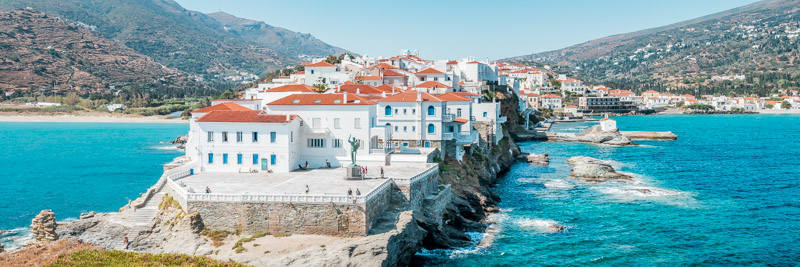
Andros is the northernmost Cycladic island and is quite green in relation to other islands. With a 300 km long network of trails, Andros is considered a Greek hiking Eldorado. To this day, international tourism on Andros is limited. In the vernacular, the island is considered an island of seafarers and captains, and many Greek shipowners come from here.
⤍ Travel tips for the Cycladic island of Andros:Andros Highlights
2. Amorgos
⤷ 1,970 inhabitants ⭔ 126.3 km² area ⇆ Arrival by ferry
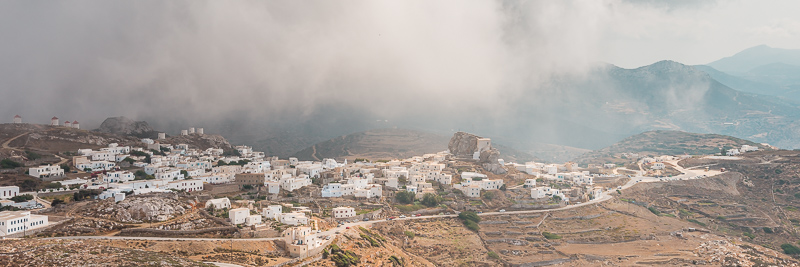
Too Amorgos has so far been spared from mass tourism. The mountainous island is still largely original and some places are literally in a deep sleep. Even the mainland Greeks rave about Amorgos in the highest tones. Greece connoisseurs have long since discovered the island for themselves.
⤍ Travel tips for the Cycladic island of Amorgos: Amorgos Highlights
💡 Cyclades Island Hopping: Get on the ferry and off to the Aegean Sea! Our guide Island Hopping Cyclades takes you to 8 islands, shows you the best highlights, beautiful beaches, cozy tavernas, great accommodations and explains how you can organize an island hopping on your own. More information and excerpt here: Cyclades Guide

3. Ios (Nio)
⤷ 2,000 inhabitants ⭔ 108.6 km² area ⇆ Arrival by ferry
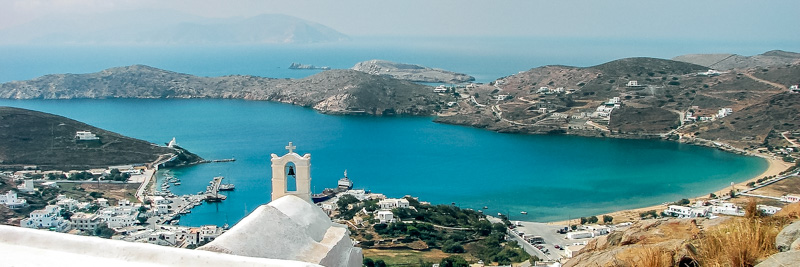
Ios (also called Nio) is one of the central Cyclades and is located between Naxos and Santorini. Like many other Cyclades islands, Ios can only be reached by ferry. Over the decades, the island has become a party island. In summer, numerous young people (especially Scandinavians) flock to the small island and party until the early hours of the morning.
⤍ Travel tips for the Cycladic island of Ios: We haven’t visited Ios yet!
4. Kea (Tzia)
⤷ 2,450 inhabitants ⭔ 148.8 km² area ⇆ Arrival by ferry
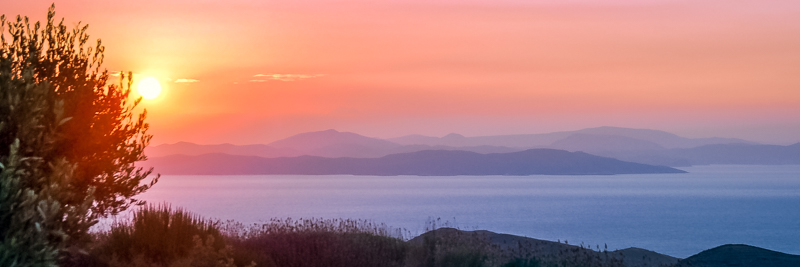
Kea, usually referred to as Tzia by the Greeks, is located in the extreme Northwest of the Cyclades. The island is only 20 km from the mainland. The main town of Ioulida with its fortress hill and colourful houses knows how to inspire. The main attraction of the island remains the “Lion of Kea”, a marble sculpture from the 6th century BC.
⤍ Travel tips for the Cycladic island of Kea: We haven’t visited Kea yet!
5. Mykonos
⤷ 10,100 inhabitants ⭔ 105.8 km² area ⇆ Arrival via international airport JMK
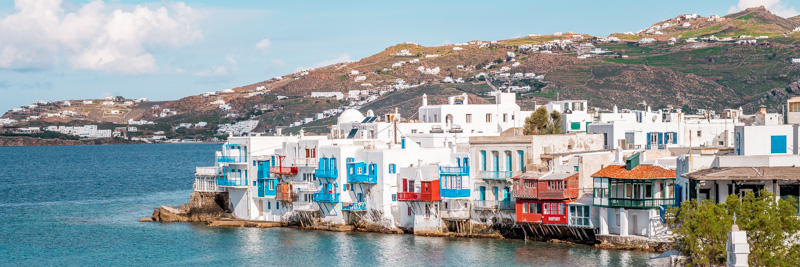
As early as 1961, Jackie Kennedy, wife of former President JFK, visited the island. Since then, Mykonos has been on the road to success! While in the beginning it was hippies who camped on the island’s dream beaches, today people from all over the world are drawn to Mykonos. Night owls in particular get their money’s worth – Mykonos is THE Party Island of Greece!
⤍ Travel tips for the Cycladic island of Mykonos: Mykonos Highlights

6. Milos
⤷ 4,970 inhabitants ⭔ 167.6 km² area ⇆ Arrival via national airport MLO or ferry

Milos is one of the most fascinating islands in Greece. Through commercials and music videos (including on Sarakiniko Beach), the island has become world-famous in recent years. Since then, numerous travel enthusiasts and influencers from all over the world have been making a pilgrimage to the volcanic island in the summer. If you like it quieter, it is better to visit the Island of Colors in the low season.
⤍ Travel tips for the Cycladic island of Milos: Milos Highlights
7. Naxos
⤷ 17,900 inhabitants ⭔ 389.4 km² area ⇆ Arrival via national airport JNX or ferry

Naxos, the largest Cycladic island, is located in the heart of the archipelago and convinces with a varied landscape and the picturesque main town of Chora with its Venetian fortress. In addition, the island has the probably the most beautiful beaches of the Cyclades (More on this here: Naxos Beaches). The only downer: In addition to Tinos, the summer wind Meltemi blows one of the strongest here.
⤍ Travel tips for the Cycladic island of Naxos: Naxos Highlights
8. Paros
⤷ 13,700 inhabitants ⭔ 198.4 km² area ⇆ Arrival via national airport PAS or ferry
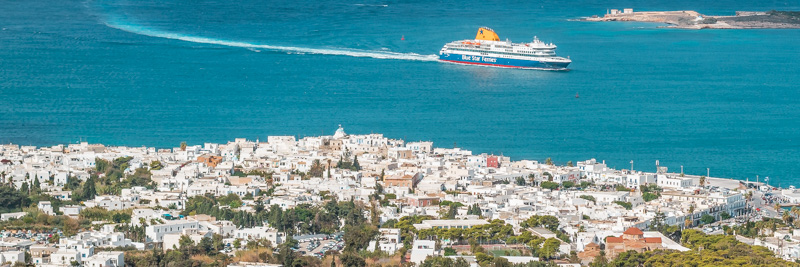
Paros has developed in recent years from an island insider tip to a Cycladic shooting star. The manageable island offers everything a holidaymaker’s heart desires. Whether a walk through Parikia and Naoussa by the sea or through the mountain village of Lefkes, the picturesque villages enchant right away. In addition, there are dozens of wonderful Paros Beaches.
⤍ Travel tips for the Cycladic island of Paros: Paros Highlights
9. Santorini
⤷ 15,500 inhabitants ⭔ 92.5 km² area ⇆ Arrival via international airport JTR
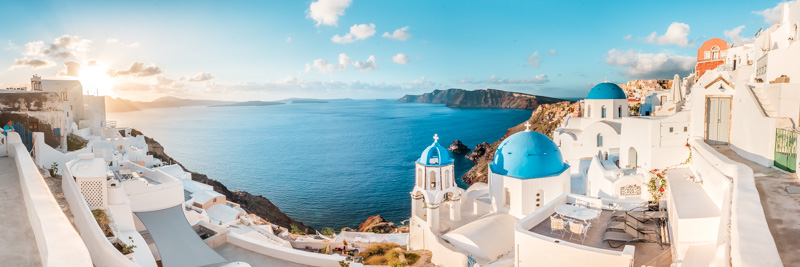
For many holidaymakers, Santorini is the most beautiful island of the Cyclades. Hardly any other island decorates so many travel catalogues with photo motifs. On the edge of the volcanic crater, which is flooded by the sea, are the villages of Oia and Fira with their white sugar cube houses. The Mecca for Greece fans is in great demand, in summer several cruise ships are anchored and at sunset the alleys of Greece burst with water. Oia in Santorini at the seams.
⤍ Travel tips for the Cycladic island of Santorini: Santorini Highlights

10. Serifos
⤷ 1,400 inhabitants ⭔ 76.2 km² area ⇆ Arrival by ferry

Serifos is one of the Western Cyclades Islands and is hardly known to international tourists, although the gleaming white capital Chora is one of the most beautiful places in the country. Here you will still find the original Cycladic flair without much hustle and bustle. In summer, some mainland Greeks seeking peace and quiet are drawn to the island.
⤍ Travel tips for the Cycladic island of Serifos: Serifos Highlights
11. Sifnos
⤷ 2,600 inhabitants ⭔ 78.3 km² area ⇆ Arrival by ferry

Sifnos is located below Serifos and is one of the quiet Cyclades Islands. The island is known for its millennia-old pottery craft. Even today, you can buy original pottery in the ceramic workshops. Mountainous Sifnos offers a handful of charming villages, but hardly any beaches, so the island remains an insider tip so far!
⤍ Travel tips for the Cycladic island of Sifnos: Sifnos Highlights
12. Syros
⤷ 22,000 inhabitants ⭔ 84.0 km² area ⇆ Arrival via national airport JSY or ferry
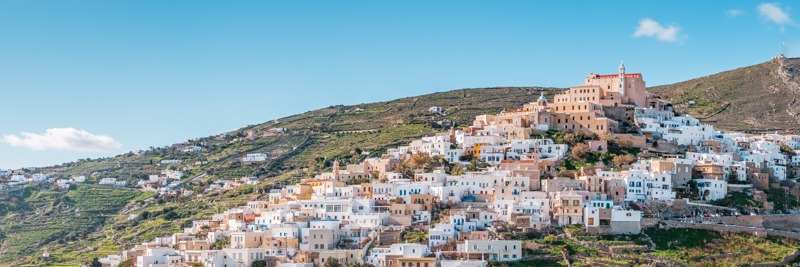
Syros is the most populous island in the Cyclades and the administrative centre of the South Aegean region. The so-called Queen of the Cyclades knows how to inspire, although it is hardly known internationally so far. Ermoupoli, the island’s capital, is a bustling mini-metropolis with a cosmopolitan flair. In contrast, the tranquil Ano Syros, the medieval capital of the island, is enthroned behind it.
⤍ Travel tips for the Cycladic island of Syros: Syros Highlights
13. Tinos
⤷ 8,600 inhabitants ⭔ 196.9 km² area ⇆ Arrival by ferry
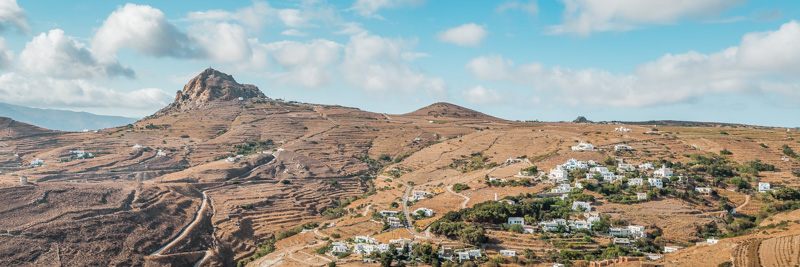
Almost every Greek has already set foot on the barren island, because here is the country’s most important Marian pilgrimage site (Panagia Evangelistria Megalochari). To this end, the Sacred Island of Tinos probably the most beautiful Cycladic villages! There are said to be 50 gleaming white places, many of which are located around the striking island mountain Exomvourgo.
⤍ Travel tips for the Cycladic island of Tinos: Tino’s Highlights
Are there any more Cyclades islands?
In addition to the islands already mentioned, there are a good dozen other inhabited islands, as well as many uninhabited islands and rocky reefs. Particular attention is paid to the so-called Small Cyclades, an idyllic mini-archipelago between Naxos and Amorgos. Here, the clocks tick differently, rest and deceleration are the order of the day.
Small Cyclades Archipelago:
- Donousa ⤍ 167 inhabitants ⭔ 15.5 km² area ⇆ Arrival by ferry
- Iraklia⤍ 141 inhabitants ⭔ 18.3 km² area ⇆ Arrival by ferry
- Koufonisia⤍ 399 inhabitants ⭔ 25.4 km² area ⇆ Arrival by ferry
- Schinoussa⤍ 227 inhabitants ⭔ 8.9 km² area ⇆ Arrival by ferry
Other inhabited Cyclades islands:
- Anafi ⤍ 271 inhabitants ⭔ 40.6 km² area ⇆ Arrival by ferry
- Antiparos ⤍ 1,211 inhabitants ⭔ 45.4 km² area ⇆ Arrival by ferry from Paros
- Delos ⤍ 24 inhabitants (summer) ⭔ 3.5 km² area ⇆ Arrival by ferry from Mykonos
- Folegandros ⤍ 765 inhabitants ⭔ 32.5 km² area ⇆ Arrival by ferry
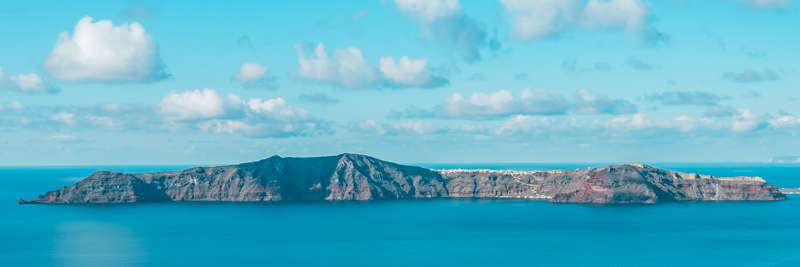
- Thirasia⤍ 319 inhabitants ⭔ 9.2 km² area ⇆ Arrival by ferry from Santorini
- Sikinos⤍ 273 inhabitants ⭔ 43.3 km² area ⇆ Arrival by ferry
- Kimolos ⤍ 910 inhabitants ⭔ 55.8 km² area ⇆ Arrival by ferry from Milos
- Kythnos ⤍ 1,456 inhabitants ⭔ 99.9 km² area ⇆ Arrival by ferry
#2 Travel tips for the Cyclades
The Cyclades are one of the most important countries in the world. Dodecanese Islands among the top destinations in Greece. If you want to visit one of the main Cyclades islands in summer, you should be prepared for a high number of visitors. For those seeking peace and quiet, a stay on a lesser known island is recommended, here you will find the typical Cycladic architecture, too.
What are the most popular Cyclades Islands?
Santorini, Mykonos, Naxos, Paros and Milos are the most popular islands of the Cyclades. At the same time, they are also among the most popular islands in Greece. For these islands, a Cyclades holidays in the low season. Then the beaches are not so crowded, the accommodation prices are much lower and you can go on a discovery tour without much hustle and bustle.
What are the insider tips among the Cyclades?
Anafi, Antiparos, Folegandros, Kythnos, Kimolos and Thirasia as well as the islands of the Small Cyclades are considered real insider tips among the Cyclades. On these islands, you will be rewarded as a holidaymaker with a lot of originality and authenticity. The lengthy journey by ferry (fortunately) prevents the rush of crowds.
⤍ Very readable travel reports about the Cycladic insider tips Anafi, Thirasia & Co. can be found on the website Sheep & Ouzo from our blogger colleague Silvia: sheep&ouzo
When is the best time to visit the Cyclades?
Best time to visit the Cyclades Islands depends primarily on your preferences. If you are a sun worshipper and planning a pure beach holiday, then you should visit Mykonos, Paros & Co. in the main tourist season from July to August. At this time, temperatures rise to over 30 degrees during the day. Only the sea and the Meltemi wind provide cooling.
If you can do without the extreme heat in summer and do not have school-age children, it is better to choose spring or autumn as your travel time. For us personally, the low season is the ideal one Travel time in Greece. Active holidaymakers enjoy the mild temperatures. Even a beach holiday is still possible, in October the sea is still pleasantly warm.
💡 Meltemi in the Cyclades:The Meltemi wind blows from the north-west and provides pleasant cooling on hot days in summer. It starts at the end of June in the Cyclades and is strongest in July and August with winds of 7 – 8 Beaufort. Usually the wind flattens out again after a few days. At the beginning of September, the Meltemi period is over again. From wind force 8, ferry traffic can come to a standstill for hours or even a day. On Tinos, the Meltemi blows the strongest.
Do you have any recommendations for hotels in the Cyclades?
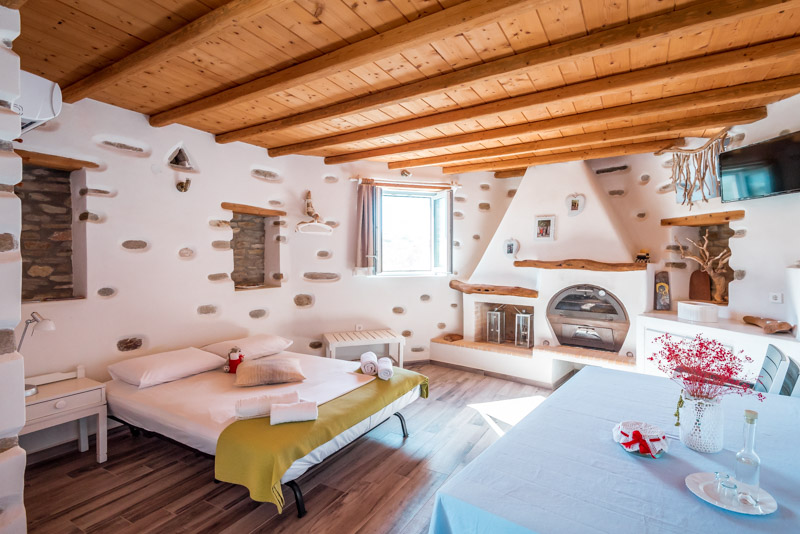
As advocates of sustainable tourism, we recommend family-run hotels and holiday apartments. Numerous old stone houses have been lovingly converted into holiday homes or apartment complexes. Particularly attractive are Cycladic-style accommodation with whitewashed walls with decorative stone elements and stylish brick furniture.
→ Cheap Cyclades Holiday Homes by the way, you can find it on Booking.com*: show all hotels & apartments*
We personally have already stayed in the following accommodations and can recommend them without hesitation (links to Booking.com* or Airbnb):
- Andros: Votsalo Seaside Villas*
- Amorgos: Skopelitis Village*
- Mykonos: Melangel Suites*
- Naxos: Naxian Vacation with sea view*
- Paros: Little Cottage
- Santorini: Dimitris Apartment
- Syros: Aeolia Apartments*
- Tinos: Villa Aerino*
For all Cyclades holidaymakers who are looking for the all-round carefree package, there is also a selection of all-inclusive resorts as well as exclusive star hotels on the popular Cyclades islands. On portals such as Check24* and Holidaycheck* there are suitable offers for your Greece Package Holidays in the Cyclades.
➲ To offers for package tours*

→ Enclosed we have the Best Cyclades Hotels on the islands of Mykonos and Santorini:
💡 Help with the Cyclades holiday planning: You don’t know where to start and how to go about planning your holiday in the Cyclades? No problem, benefit from our years of experience with traveling to Greece and let us help you. We advise you on all your questions and concerns, even via video chat. You can book your consultation here: Travel Advice Greece
#3 Popular Cyclades Attractions
The Cyclades offer an enormous wealth of unique sights and interesting places, from ancient sites to medieval fortresses and monasteries to enchanting beaches. If we list all Cyclades sights, it would go beyond the scope of this article.
Archaeological site in Delos

Delos In ancient times, it had one of the most important trading ports in the entire Mediterranean and was considered the center of the Cyclades due to its location. Several tens of thousands of people lived on the mini island next to Mykonos. Today, Delos is one of the most important archaeological sites in the country and is virtually a huge “open-air museum” in the middle of the Aegean Sea.
➝ You can find more information about the island of Delos in our separate article: Delos
The Caldera of Santorini

About 3,600 years ago, there was a gigantic volcanic eruption that left behind a unique natural spectacle – a volcanic crater flooded by the sea, today’s Caldera of Santorini! On the steep edges are picturesque villages such as Oia, Fira or Imerovigli, which form a dream backdrop with the deep blue sea.
➝ The caldera can be wonderfully explored on a trip by sailboat. Information at: Santorini Tours
Chozoviotissa Monastery in Amorgos
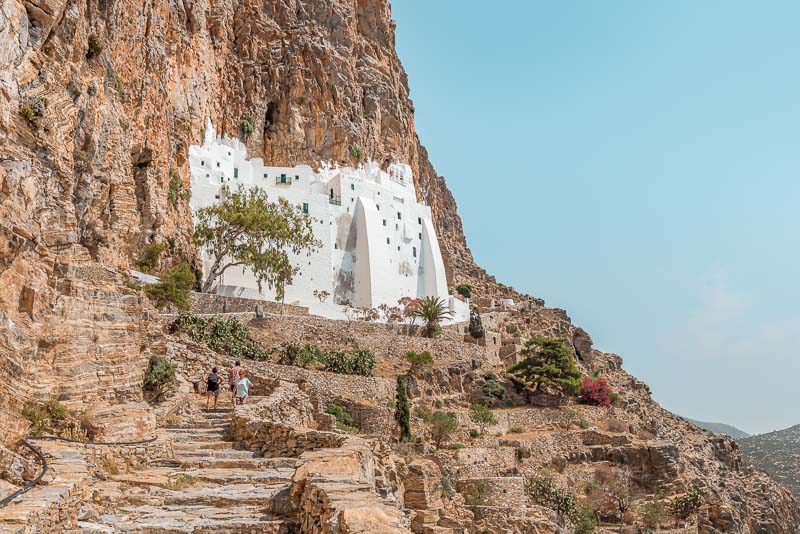
On the steep cliffs of Amorgos, 300 m above sea level, lies the second oldest monastery in Greece. The snow-white church literally sticks to the sand-colored rock. It was founded in the 9th century by monks from Palestine and has been farmed continuously ever since. The religious pilgrimage site is a grandiose Cyclades highlight!
➝ More information about Chosoviotissa can be found in our separate post about the Amorgos Monastery
Panagia Evangelistria in Tinos
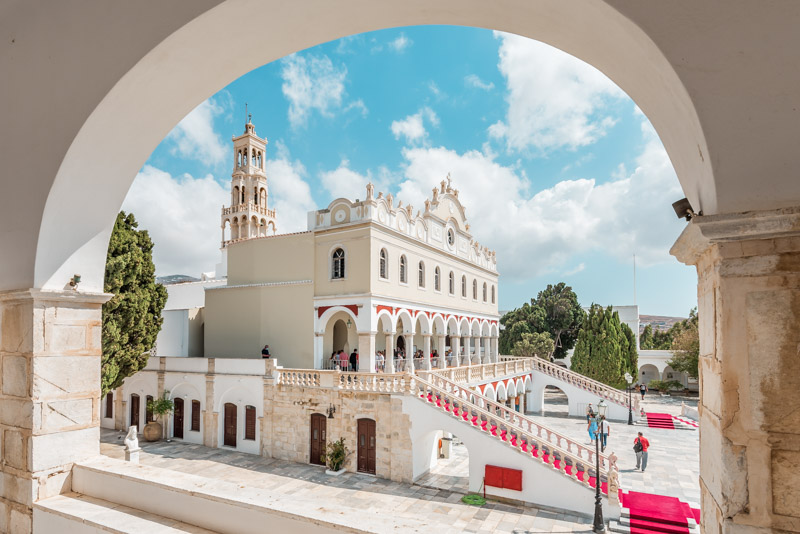
There is also an important pilgrimage site on Tinos. The Church »Panagia Evangelistria Megalochari« is a veritable Orthodox Mecca. During the Greek War of Liberation against the Ottomans, a nun found a precious centuries-old icon of the Virgin Mary, which decisively inspired the Greeks’ struggle for freedom!
Portara of Naxos

That Portara of Naxos is one of the unsolved mysteries of Greece. The marble gate, which weighs over 65 tons, seems to be the last remnant of a huge temple of Apollo. Why the temple was never completed has been disputed by historians for decades. The scenery is impressive, especially in the evening!

Sarakiniko beach in Milos
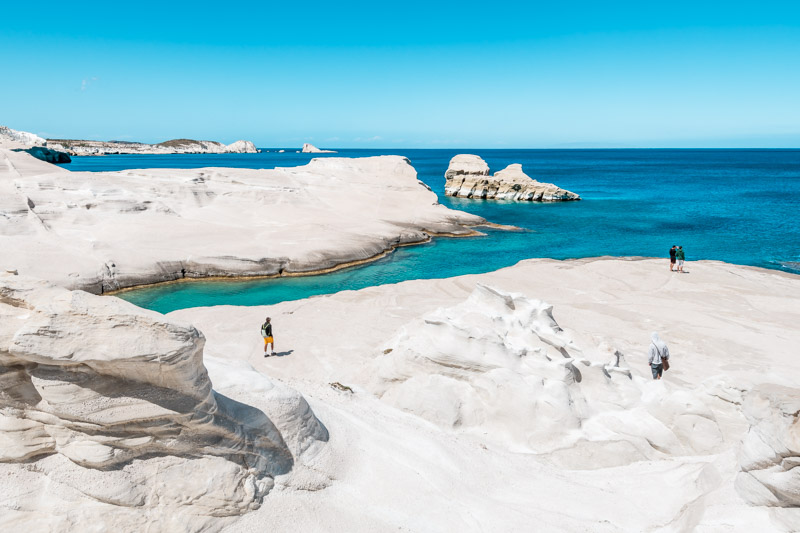
Due to the varied volcanic landscape, Milos is also known as the “Island of Colours”. The beaches on Milos are red, grey, beige and sometimes snow-white, including the Sarakiniko Beach. The mesmerizing lunar landscape became known worldwide through the 2016 summer hit of Kungs vs Cookin’ on 3 Burners – This Girl.
➝ You can find all the information and the most important tips for visiting the lunar landscape in this article: Sarakiniko Milos
Tourlitis Lighthouse on Andros
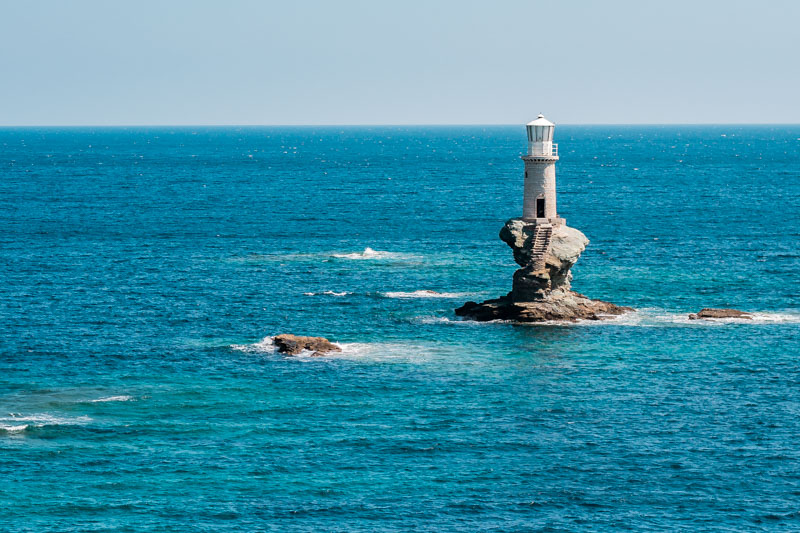
Almost like a fairy tale, the bizarre rock needle and lighthouse lie in the sea just a few meters from the mainland. Almost destroyed in the Second World War, it was finally restored in 1990 and has since been considered a landmark of Andros, the island of seafarers and shipowners. From the capital’s Kastro you can enjoy the best view of the gem.
Windmills in Little Venice on Mykonos
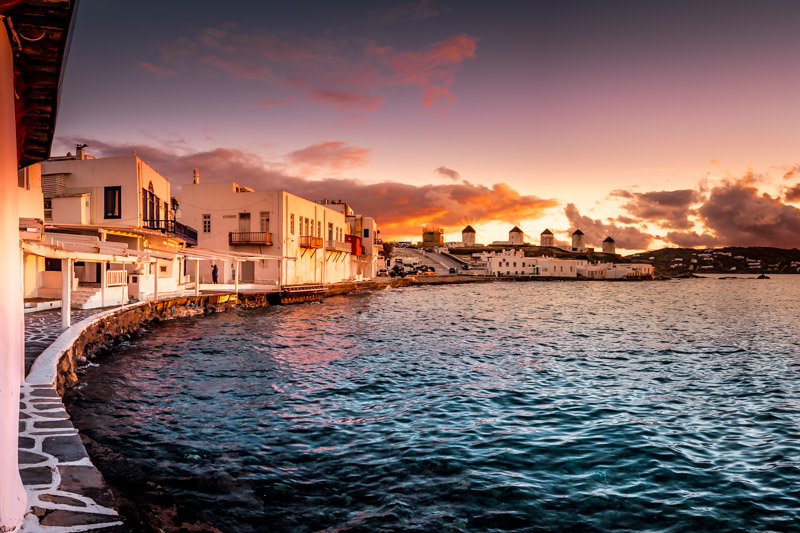
The Windmills of Mykonos in the Little Venice district are among the most popular Sights in Greece. The atmosphere at the windmills at sunset is particularly picturesque, and the rush for a souvenir photo of the pretty scenery is correspondingly large.
➯ You can find more information about the popular district in our separate article aboutLittle Venice Mykonos
#4 Getting to the Cyclades Islands
The most convenient way to travel to the Cyclades would be by direct flight from Germany. Mykonos and Santorini have an international airport. Cheap flight deals are available from as little as 50 EUR per flight. You can get to all other Cyclades islands by ferry. Mykonos and Santorini are ideal starting points for island hopping.
➝ Almost all flight routes and the cheapest flight offers for the Cyclades can be found at our partner Skyscanner*:➲ Go to Skyscanner search for Mykonos* ➲ Go to Skyscanner search for Santorini*There are direct flights to the Cyclades from the following German airports:
- Direct flights to Mykonos from: Berlin, Düsseldorf, Frankfurt a. M., Hamburg, Cologne, Munich, Stuttgart
- Direct flights to Santorini from: Berlin, Dusseldorf, Hamburg, Cologne, Munich, Stuttgart
There is also direct flight to Athens (Watch on Skyscanner*). Many European airports fly to the Greek capital. From here you can take a domestic flight to the islands of Milos, Naxos, Paros and Syros in about 40 minutes. Alternatively, you can take the ferry from the ports of Piraeus, Lavrio (e.g. to Kea, Kythnos) and Rafina (e.g. to Andros, Tinos) to the Cyclades.
⤍ More information about flights and saving tips for the Cyclades can be found in our article: Flights to Greece
By ferry to the Cyclades Islands
You can only reach most of the Cyclades islands by ferry. Large and small ferries operate daily, as well as numerous excursion boats between neighbouring islands in summer. The Cyclades have a reliable ferry network of different shipping companies. All inhabited islands are visited several times a week.
→ All the necessary information for the Arrival by ferry can be found in this article: Ferries in Greece
The following ferry companies connect the Cyclades Islands:
- Blue Star/ Hellenic Seaways ⤍ Car ferries connect most of the Cyclades
- Seajets ⤍ Fast catamarans connect almost all Cyclades islands
- Golden Star ⤍ Catamarans and car ferries between the Northern Cyclades
- Almost Ferries⤍ Catamarans and car ferries between the Northern Cyclades
- ZanteFerries⤍ Car ferries connect the Western Cyclades
- Minoan Lines⤍ Car ferries between Piraeus, the Cyclades and Crete
- Local ferry companies ⤍ small ferries, including Paros ⇆ Antiparos, Santorini ⇆ Thirasia
➝ Search for ferry connections and book Ferry tickets for the Cyclades through our partner Ferryhopper*:
➲ To the ferry search on Ferryhopper*
Prices for ferry crossings vary depending on the route and ferry company. As a rule of thumb, approx. 10 EUR per passenger per hour of travel time. Ferry tickets for fast catamarans are more expensive than for car ferries. If you want to travel to the islands with your own car, we recommend our article: Getting to Greece
#5 Island hopping in the Cyclades
On a Cycladic island hopping you can get to know part of the picturesque island world in an adventurous way. The numerous Ferry connections in the Cyclades allow quite flexible hopping from island to island. If you don’t have so much time at your disposal, it’s better to plan fewer islands and travel more intensively.
⤍ More travel tips and information on the topic can be found here: Island hopping Greece
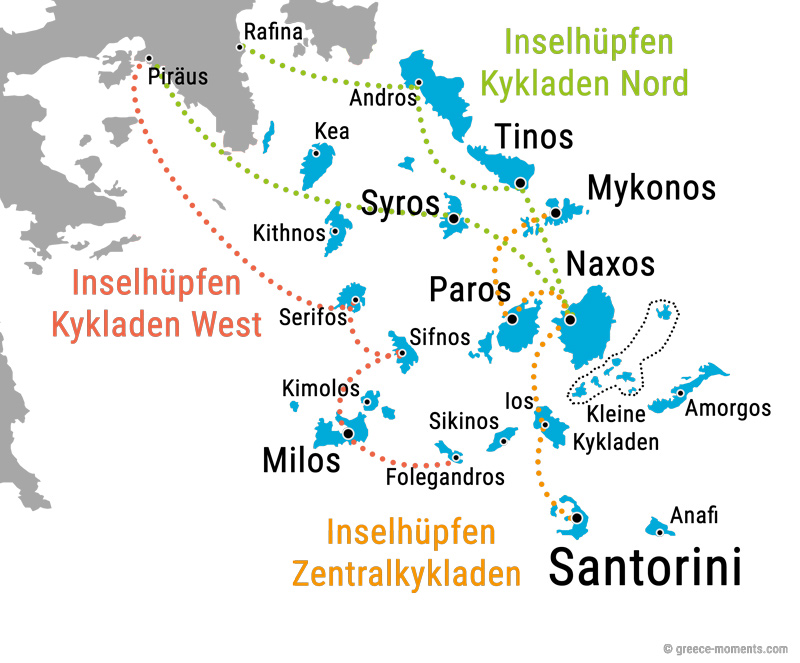
The Cyclades have an extension of about 150 km. From Andros in the north to Anafi in the south, you will need at least eight hours by ferry. Due to the predefined ferry connections, there are three main island-hopping routes, namely to the Northern Cyclades, Central Cyclades and the Western Cyclades.
-
- from Athens or Rafina port to ⇆ Andros ⇆ Tinos ⇆ Syros ⇆ Mykonos
- Optional islands: Naxos, Paros
⤍ Island Hopping Route Central Cyclades
-
- from the island of Mykonos to ⇆ Paros ⇆ Naxos ⇆ Ios ⇆ Santorini
- optional islands: Amorgos, Small Cyclades
⤍ Island hopping route West Cyclades
-
- from Athens or Lavrio port ⇆ Serifos ⇆ Sifnos ⇆ Milos ⇆ Folegandros
- Optional islands: Kea, Kythnos, Kimolos
A minimum stay of three days per island is recommended. On larger islands such as Andros, Tinos, Paros and Naxos, a stay of 5-7 days makes sense. Otherwise, many highlights on your Greece island hopping will remain hidden from you. Small islands such as Antiparos, Thirasia or Kimolos can be seen on a day trip.
#6 History of the Cyclades Islands
Numerous myths and legends entwine around the islands and so the Cyclades look back on a long history. In Greek mythology, the island of Delos was the birthplace of the god Apollo and Zeus, the father of the gods, is said to have spent his childhood on Naxos. Wind god Aeolos is still up to mischief on Tinos today in the form of the Meltemi…
On islands close to the mainland, such as Kea and Andros, the first settlements were established as early as the Neolithic Age. On the Peloponnese even an 11,000-year-old obsidian stone from Milos was found. Enclosed we describe the most important historical events. Nevertheless, each Cycladic island has its own history, which you can philosophize about for hours with the islanders 😉
nearly 9,000 BC ➯ Oldest known settlement on Kythnos near Maroulas
around 4,000 BC ➯ Finds of clay vessels on Saliagos near Antiparos and on Kea (Kephala)
around 3,500 BC ➯ Traces of settlement and graves on Naxos near Grotta (Grotta-Pelos culture)
from 3,000 BC ➯ Beginning of the Cycladic high culture (marble idols): important finds on Paros, Syros, Keros (Small Cyclades), among others
around 2,000 BC ➯ Occupation of the Cyclades by the Minoans from Crete
around 1,600 BC ➯ Gigantic volcanic eruption on Santorini (Minoan eruption)
Ancient life in the Cyclades
1,500 – 1,000 BC ➯ Invasion of the Mycenaeans from the mainland and later Ionian immigrations Antiquity
from 800 BC ➯Delos becomes a place of worship (center of the Cyclades), maritime trade flourishes
8th – 6th century BC ➯ Peak of marble mining on Naxos, Tinos and Paros, new temples and the Kouri are built on Naxos
around 550 BC ➯ Start of construction of the Temple of Apollo on Naxos including the marble gate Portara
6th – 5th centuries BC ➯ Persian Wars: Shift in the balance of power between islands and mainland
The Cyclades in the Roman and Byzantine Empires
around 150 BC ➯ The Cyclades belong to the Roman Empire: Delos rises to become the largest slave market in the Aegean, 10,000 inhabitants live on the small island
380 AD ➯ Christianity is proclaimed the state religion, churches and monasteries are partly built on ancient temples
395 ➯ Collapse of the Roman Empire, the islands now belong to Byzantium
6th – 9th centuries ➯ Attacks by pirates and Saracens, Byzantine fortresses are built and mountain villages hidden from the sea are founded, the unfortified Delos is completely abandoned
from the 11th century ➯ First Crusades: robber barons and mercenaries under the Latin flag plunder the islands
Venetian and Ottoman occupation
12th – 13th century ➯ Collapse of the Byzantine Empire: The Venetians take over the islands and build defensive towers (pyrgi) and castles
14th – 15th centuries ➯ Attacks by the emerging Ottoman Empire
from the 16th century ➯ Successive conquest of the Cyclades by the Ottomans under Admiral Barbarossa, Catholic Tinos is conquered in 1714 as the last Greek island
1821 – 1828 ➯ War of Independence against Ottoman Rule
30.01.1823 ➯ Discovery of the Marian icon on Tinos: miraculous strengthening of the Greeks in the liberation struggle
1832 ➯ The Cyclades are now part of the newly founded Greek state
Modern events in the Cyclades
1833 ➯ Ermoupoli on Syros is named capital of the Cyclades
until the end of the 19th century ➯ Intensive shipbuilding and shipping industry on Andros, Mykonos and Syros
7 May 1912 ➯ Ottoman rule ends after 400 years of Italian occupation 1920s/30s ➯ Larger waves of immigration (e.g. to Syros) of Greek refugees from Asia Minor
15.08.1940 ➯ The Greek ship “Elli” is sunk by the Italians off Tinos
1941 – 1944 ➯ Second World War: The German Wehrmacht occupies Greece, Milos is not liberated by the Allies until May 1945
1956 ➯ Oia on Santorini is completely destroyed by an earthquake
1961 ➯ The First Lady of the USA, Jackie Kennedy, visits Mykonos
1967-1974 ➯ Greek military dictatorship with exile camp on Gyaros
1990s ➯ The great tourism boom in Europe spills over to the Cyclades
2001 ➯ The euro (€) replaces the drachma (∆ρ) as the currency medium
2009–2015 ➯ The economic crisis leads to significant social cuts. The number of tourists is declining, but Mykonos and Santorini are still booming.
#7 Cyclades travel guide for your holiday
Are you planning a longer holiday on one of the Greek Islands or an extended Cycladic island hopping? To plan your trip, you can use high-quality travel literature. Extensive travel guides are available for Naxos, Mykonos and Santorini. The other Cyclades islands are part of the content of the island group guides. Click on the links to Amazon* and get more information:
Cyclades Travel Guide:
- Our Cyclades travel guide: Island hopping Cyclades
- Michael Müller – Cyclades Travel Guide*
- Travel Know-How – Naxos and Paros Travel Guide*
- Charter Guide Cyclades: Andros, Mykonos, Naxos, Santorini, Milos*
Naxos Travel Guide:
Mykonos Travel Guide:
Santorini Travel Guide:
- Michael Müller – Santorini Travel Guide*
- Travel Know-How – Santorini Travel Guide*
- Marco Polo – Santorini Travel Guide*
Hiking guide Cyclades:
- Amorgos, Naxos, Paros, Andros, Eastern & Northern Cyclades: 56 hikes*
- Naxos & Small Cyclades Islands: 36 hikes*
FAQ about the Cyclades Islands
Which is the most beautiful island in the Cyclades?
Santorini is often described as the most beautiful island in the Cyclades – and rightly so, because the caldera with the villages of Oia and Fira is truly spectacular. Even die-hard Greece lovers like us cannot dispute that. But every island has its own charm: Milos delights with its colorful volcanic landscape, Naxos with its rustic mountain villages and dream beaches, and Tinos with its 50 bright white villages. But what we will remember most are the unassuming places where the Greeks themselves go on vacation, such as Syros or Andros.
Which Cycladic islands can be reached by direct flight?
Only Mykonos and Santorini have international airports with direct flights from Germany (Berlin, Munich, Düsseldorf, Hamburg, Cologne, Stuttgart, and Frankfurt). Naxos, Paros, Milos, and Syros also have national airports from which there are domestic flights from Athens (flight time: 40 minutes). All other Cycladic islands can only be reached by ferry, sometimes even with detours via Athens, Naxos, and the Small Cyclades. The most convenient way to get there for island hopping is a direct flight to Mykonos or Santorini.
Which Cycladic islands are insider tips?
Anafi, Antiparos, Folegandros, Kythnos, Kimolos, Thirasia, and the Small Cyclades (Iraklia, Schinoussa, Donousa, and Koufonisia) are real insider tips. Serifos, Sifnos, Amorgos, Andros, and Syros are also still quite authentic. Fortunately, the lengthy journey by ferry prevents crowds of people. Here you can still experience the real Cycladic flair – except in summer, when the Cyclades are bustling with activity everywhere.
Which is the cheapest Cycladic island?
The Cyclades have a comparatively high price level. The cheapest are Tinos, Syros, Thirasia, and Anafi (with only a few accommodations), Sikinos, and Amorgos. There, you can find accommodations in the off-season starting at €45–57 per night, plus local taverns with fair prices and hardly any tourist crowds. Sifnos and Kythnos are also cheaper than Mykonos or Santorini. Milos is often mentioned as an affordable option or even an insider tip, but it has become quite popular and really expensive (on par with Mykonos). You can save a lot in the off-season.
When is the best time to visit the Cyclades?
May/June and September/October are ideal months for traveling to the Cyclades. The air is still pleasantly warm at around 25 °C, the sea is also warm, there are fewer tourists, and hotel prices are lower. In July and August, it gets very hot, with temperatures above 30 °C, and there are lots of tourists. If you mainly want to swim and party, then this is the right time to go. Please note: The Meltemi wind blows strongest in July/August, especially on Tinos and Naxos. In summer, the streets of Mykonos and Santorini are crowded, which is not a pretty sight.
How long should you spend in the Cyclades?
At least three days per island, or better still five to seven days on larger islands such as Naxos, Paros, Tinos, or Andros. For island hopping, we recommend two to three weeks for three to four islands, otherwise too much will remain undiscovered. Small islands such as Antiparos, Thirasia, or Kimolos can be visited on a day trip. We have been island hopping in the Cyclades several times and found that two weeks is ideal.
How do you travel between the Cycladic islands?
You can travel from Cycladic island to Cycladic island by ferry. There are three main routes: Northern Cyclades (Andros, Tinos, Syros, Mykonos), Central Cyclades (Mykonos, Paros, Naxos, Ios, Santorini) and Western Cyclades (Serifos, Sifnos, Milos, Folegandros). The ferry companies Blue Star, Seajets, and Hellenic Seaways connect most of the islands daily. Fast catamarans are more expensive than car ferries. As a rule of thumb, slow ferries cost ten euros per hour of travel time, while catamarans charge a good 50 euros per passenger for an hour. Ferry service may be canceled in wind speeds of 8+ on the Beaufort scale.
Which Cycladic island is perfect for families with children?
Naxos, with its miles of sandy beaches (including Agios Prokopios and Plaka) and fairly shallow waters, is very suitable for families with children. Paros is also ideal: it has beautiful beaches, is manageable in size, and has authentic villages such as Naoussa. It is best to avoid Mykonos (too much partying) and Santorini (too crowded, no real beaches, only cliffs). We also fondly remember Andros, which is ideal for families with its great hiking trails and quiet places.
*Support our blog Greece-Moments
In this post, you will find affiliate links marked with an asterisk (*). If you book or buy something through one of these links, we receive a small commission. For you, the price remains the same. In this way, you help us continue to provide high-quality content for free. Did you like this post and you would like to say thank you? Then just buy us the next Greek coffee ☕️ To the coffee fund
Bookmark this post on Pinterest!