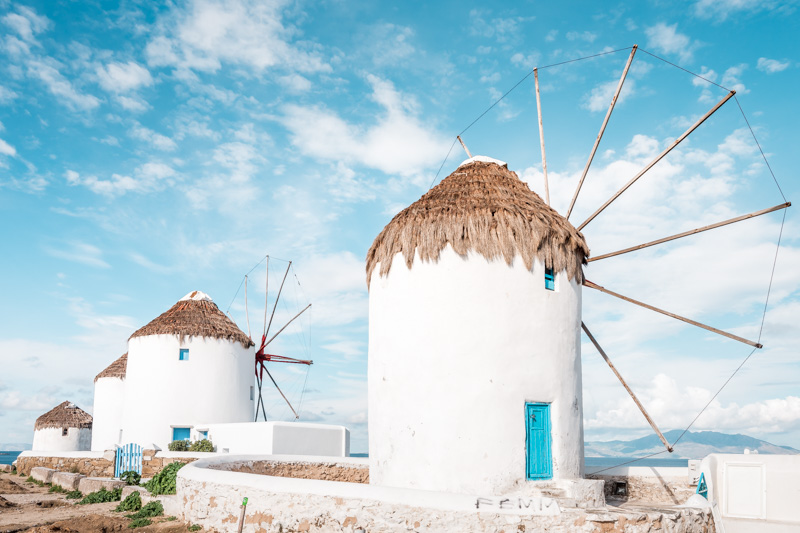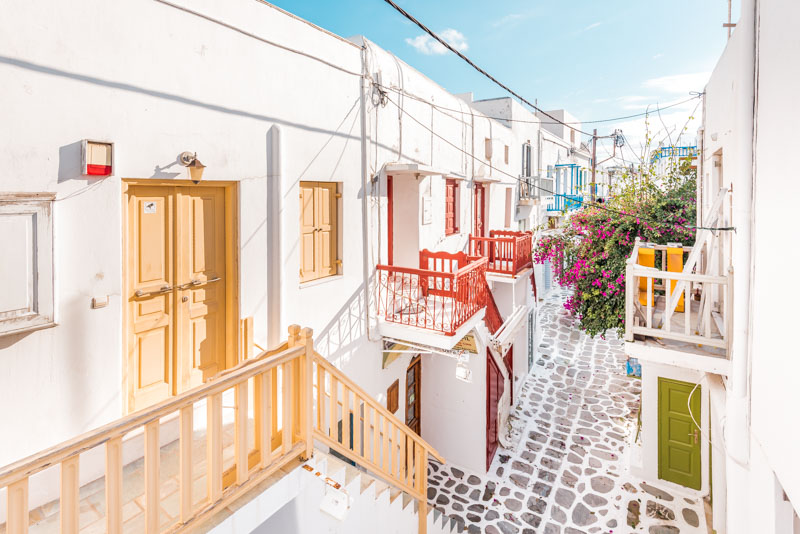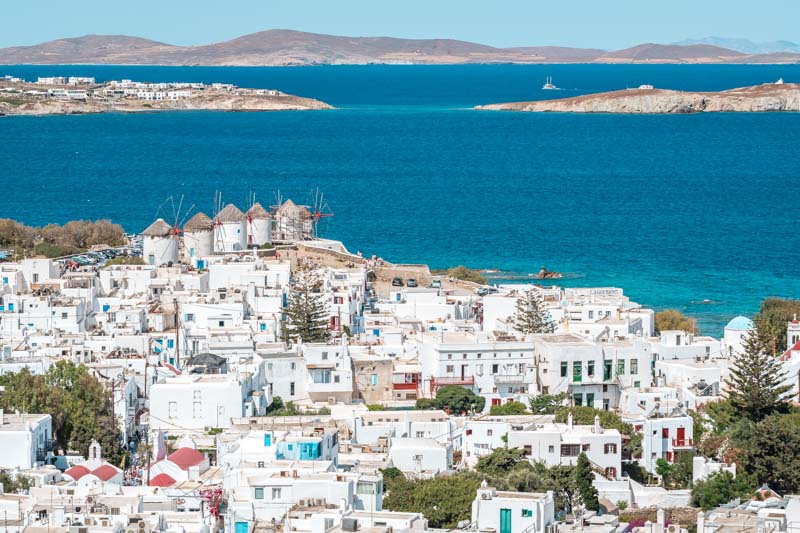

Mykonos does not have many historical highlights to offer, as the island has been dominated by agriculture for centuries. This makes it all the more worthwhile to visit the neighboring island of Delos, which is now one of Greece’s most important archaeological sites.
Since Mykonos itself is well visited even in the off-season, a trip to the historic neighboring island of Delos is one of the few opportunities to escape the crowds.
Tom & Ella

Since 1990, the island of Delos has been a UNESCO World Heritage Site. The combination of an entertaining boat trip along the coast of Mykonos, ancient ruins, and the panoramic view from Mount Kynthos makes Delos an unforgettable experience.
Here is some important information for visiting the excavations on the island of Delos:
#1 What makes Delos so special?
In Greek mythology, Delos is considered a sacred island and the birthplace of the gods Apollo and Artemis. 2,000 years ago, Delos was an influential sanctuary and economic power center in the Aegean Sea. During its ancient heyday, tens of thousands of people called Delos home, most of them wealthy merchants and diplomats.
The island is also located in the geographical heart of the Cyclades, which is reflected in its name: the Greek word “kyklos” means circle, and the surrounding islands are indeed grouped like a ring around sacred Delos. The Cyclades are thus literally “the circling ones,” named after their orientation toward Delos as their center.
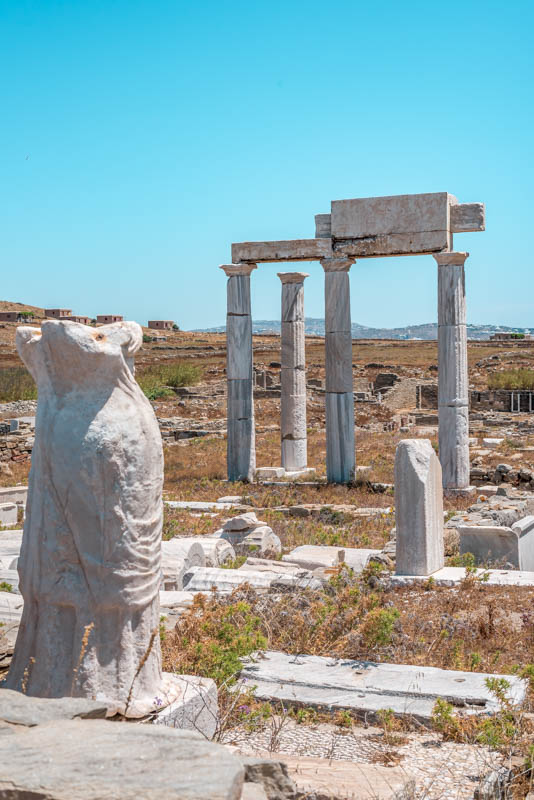

It is astonishing that Delos, which is only 3.5 km² in size, was once a thriving commercial metropolis with large marketplaces, magnificent villas, mythical temples, and bank-like buildings—an ancient Manhattan in the Mediterranean. Later, the Romans used Delos as an important slave market due to its central location. In the Middle Ages, Delos fell into oblivion and served merely as pastureland for centuries.

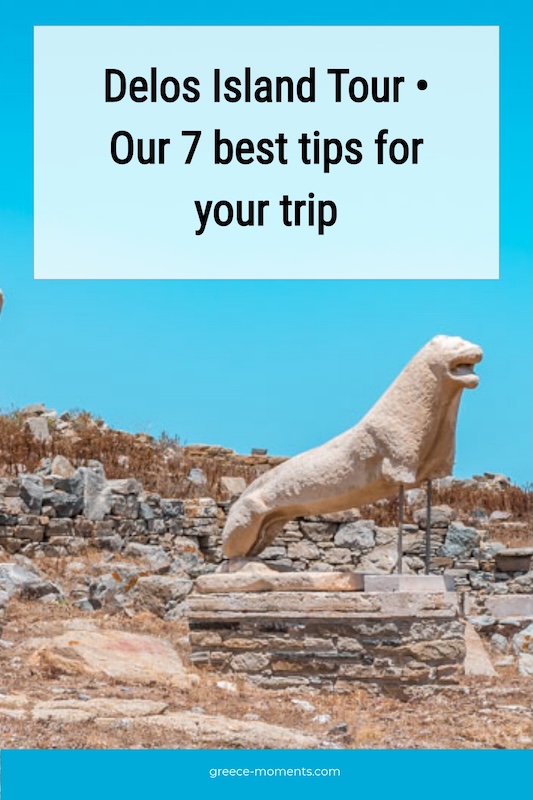
Today, Delos is uninhabited, but it is one of the largest archaeological sites in Greece. Between April and November, the huge open-air museum awakens from its slumber, and numerous history-loving Mykonos vacationers are drawn to the neighboring island, which is only a few minutes away. The highlight of the site is definitely the Lions of Delos, which most people associate with the island.
• Combined tours with a swimming stop at Rhenia
• Sailing trips with BBQ on board
• Skip-the-line tickets available
#2 Getting to Delos
You can reach Delos by excursion boat from Mykonos, Naxos, and Paros. Excursions to Delos from Mykonos depart from the old port of Mykonos Town (Deliana Pier), near the blue and white chapel of Agios Nikolaos. During the season (April to October), several boats run daily between 9 a.m. and 12 p.m. and at 5 p.m. to Delos.
→ Find out everything there is to discover on Mykonos in our separate article: Mykonos Highlights
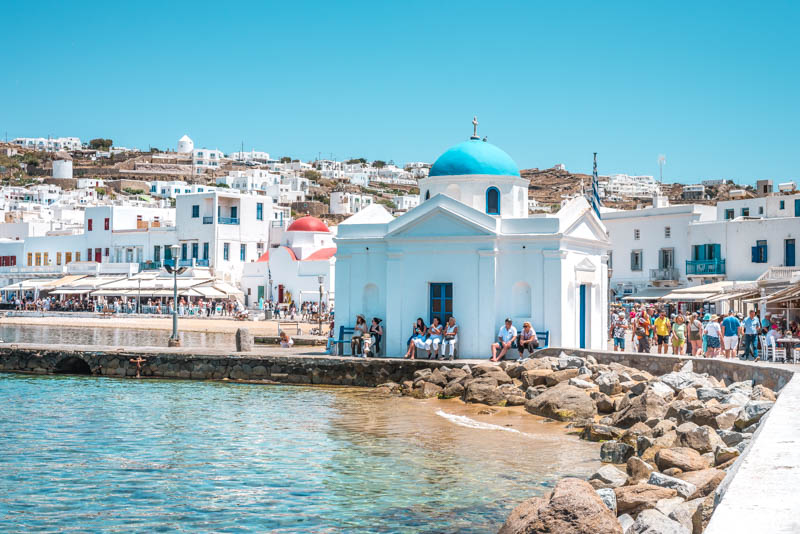
The crossing to Delos takes only about 25 minutes and is organized by the local operator Delos Tours. The ticket office is located directly at the pier. To avoid wasting time waiting at the ticket office on the day of your visit to Delos, we recommend purchasing your ferry ticket either online or at the port the day before.
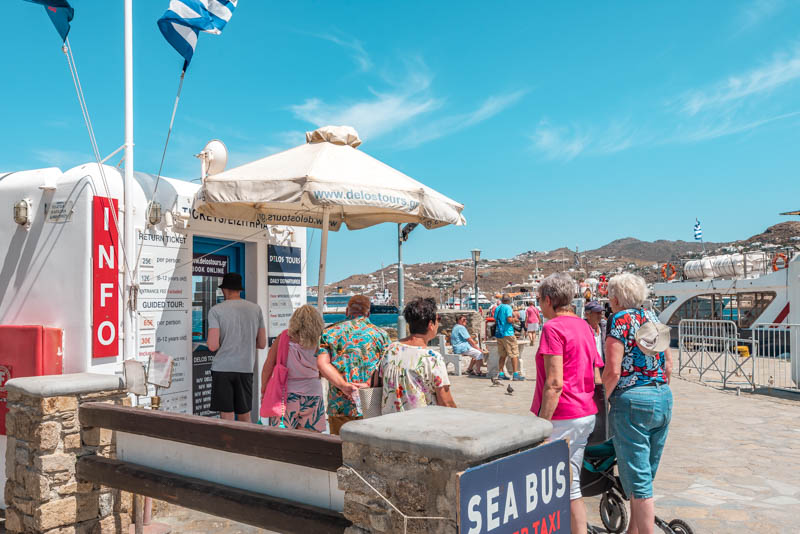
The last return trip takes place before sunset, depending on the season, and in summer at 8 p.m. at the latest. Check with the port of Mykonos or your host for exact times. The entrance ticket for Delos is charged separately, unless you join an organized excursion. You can also visit the island without a guided tour; the ferry to Delos costs €25 for a round trip.
Cost of the ferry to Delos:
- Delos ferry round trip: €25
- Reduced (ages 6-12): €14
- Children under 6 years: free travel
Ferry times from Mykonos to Delos
| Period | Weekdays | Outbound (Mykonos → Delos) | Return trips (Delos → Mykonos) |
|---|---|---|---|
| Apr 1–Nov 30 | Daily | 10:00 | 1:30 |
| Apr 1–Nov 30 | Tuesday–Sunday | 9:00 | 12:00 |
| April 1–November 30 | Tuesday–Sunday | 11:30 | 3:00 |
| Additional trips (May 2–Oct. 26) | |||
| May 2–September 4 | Daily | 5:00 | 8:00 |
| 09/05–09/19 | Daily | 4:30 | 7:30 |
| September 20–October 4 | Daily | 4:00 | 7:00 |
| October 5–October 14 | Daily | 3:30 | 6:30 |
| 10/15–10/26 | Daily | 3:00 | 6:00 |
| 11/1–11/30 | Daily | 10:00 | 1:30 |
Note regarding Delos ferries: The timetables for the Mykonos–Delos route are subject to change due to weather conditions. Departures are always from the old port (Deliana Pier) in Mykonos Town. Taxi boats run from the large ferry terminal in the new port of Tourlos to the old port. For up-to-date information, please visit the Delos Tours website (delostours.gr).

#3 Admission and opening hours of Delos
Delos is open between April 1 and November 30. The boat schedules significantly limit the opening hours. During the high season, Delos is accessible daily from 8 a.m. to 8 p.m. However, the first Delos boats do not depart until 9 a.m. During the low season, the opening hours are reduced to 8 a.m. to 4 p.m. The Archaeological Museum of Delos, located on the island, has the same opening hours.

Please note that the entrance fee for Delos does not include the ferry ticket from Mykonos or the return trip. If you are traveling to Delos on your own, you can purchase tickets for the crossing at the Delos Tours ticket kiosk at the old port of Mykonos. The entrance ticket for Delos is only charged separately at the Delos port ticket office after arrival by ferry.
Ticket prices for Delos
- Delos ticket for adults: €20
- Delos reduced ticket: €10 for seniors over 65
- Free admission to Delos: for EU citizens under 25 and non-EU citizens under 18 upon presentation of ID
- Delos ticket with tour: Secure your ticket here*
Days with free admission to Delos
- April 18 (International Monument Day)
- May 18 (International Museum Day)
- Last weekend in September (European Heritage Days)
- October 28
- First Sunday in November

Delos opening hours
- April 1 to October 31 from 8:00 a.m. to 8:00 p.m.
- November 1 to November 30 from 8:00 a.m. to 4:00 p.m.
Delos closing days
- May 1
- Easter Sunday (varies annually)
There are vending machines and toilettes at the port of Delos and in the Delos Museum. There is no café or tavern on Delos. Swimming is prohibited on the coast of Delos. Dogs are also not allowed on Delos. However, assistance and therapy dogs are permitted upon presentation of the relevant documents. Cats, on the other hand, feel very much at home on Delos. 🙂

As there is virtually no shade on the almost treeless island, it is advisable to visit Delos in the morning during the summer. We strongly recommend sunscreen, plenty of water, and sturdy shoes, especially if you want to climb the 112-meter-high Mount Kynthos with its many steps. We would not explore Delos in flip-flops or bathing shoes, as it is too dusty and bumpy. Besides, you simply cover too many kilometers.

Is Delos open in winter?
No, for normal visitors the archaeological site of Delos is closed in winter. Between December and the end of March, there are also no regular ferries from Mykonos to Delos, as the excursion service is suspended for the season. In rare cases, it is possible to visit Delos in winter for journalistic or archaeological reasons. However, this requires a special permit that must be arranged in advance.

During the winter break, archaeological work, restoration, and maintenance are also carried out regularly, which would not be possible during the high season due to the large number of visitors. You can visit Delos from April 1, when ferry service resumes. The official opening hours apply, which can be found on the website of the Greek Ministry of Culture odysseus.culture.gr.
Admission: €20, reduced €10 (includes museum, excludes ferry ticket)
Ferry ticket: €25, reduced €14 (children under 6 free)
Highest mountain: Kynthos, 112 m
Who is Delos for: Archaeology buffs, photography enthusiasts, mythology fans
Duration of visit: approx. 2–3 hours, including museum and climb up Kynthos
#4 Tours to Delos
Delos is firmly anchored in the Mykonos travel program, and several excursion boats run daily to the neighboring island. Guided tours to Delos start at €79 and are recommended for anyone who doesn’t want to organize much themselves. The tours are offered in various languages and provide a good overview of the history of the site. Alternatively, an exclusive sailing trip to Delos with a BBQ lunch and a stop for swimming at the neighboring island of Rhenia is also worthwhile.
You can book guided activities to the island of Delos with our partner GetYourGuide*:
➲ To the classic half-day tour*
➲ To the mini cruise including Rhenia*

Guided half-day tour to Delos 2026
- Price for adults: from €79
- Price for children aged 6–12: from €30
- Children under 6: often free
- Includes: Round-trip boat trip, admission to Delos & museum, certified guide, wireless guide system, skip the line at the entrance
Guided language tours of Delos:
- English: daily at 10:00 a.m. (from April 1) & 5:00 p.m. (from May)
- French: Sundays & Thursdays at 10:00 a.m. (from April 5)
- Italian: Wednesday 11:30 a.m. (from mid-May)
- Spanish: Tuesday 11:30 a.m. (from mid-May)
- German & Russian: private tours only
Self-guided audio tour for Delos:
- €15 (own smartphone required)

#5 Guided Tours to Delos
The Delos archaeological site covers several square kilometers. You should plan at least 2 to 3 hours for a comprehensive tour. The main paths are well signposted and there is information about the stations in English everywhere. Nevertheless, we recommend a tour guide for Delos or at least an audio guide to understand the significance of the individual buildings. You can book your ticket for Delos with a guide through our partner GetYourGuide:

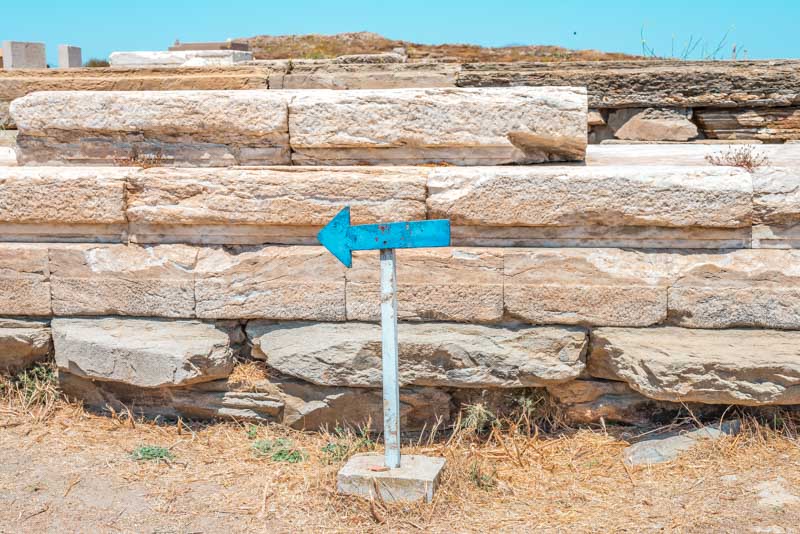
There are no compulsory guided tours on Delos, although arrows make it easier to find your way around the site and provide a walking route for visitors. After our arrival, we immediately turned right towards the ancient theater and then continued up Mount Kynthos. The guided groups usually go in the opposite direction, so we were able to enjoy the first part relatively undisturbed.
Sacred Harbor and Agora
Your walk through Delos begins at the harbor, where boats from Mykonos dock. Interestingly, this was also the location of the ancient harbor of Delos. After purchasing your Delos ticket at the counter, you will arrive at the spacious Agora of the Competaliasts, a large marketplace that was once surrounded by huge colonnades (stoa). Merchants from the Mediterranean region gathered in this square to sell their wares.

Lions of Delos
One of the island’s most famous landmarks are the marble statues of the Lions of Delos in the western part of the complex. Originally, there were probably 9 to 16 life-size lion sculptures here, guarding the Sacred Lake. They were donated in the 7th century BC by the inhabitants of the Cycladic island of Naxos. Today, five marble statues remain, one of which is only a stump.
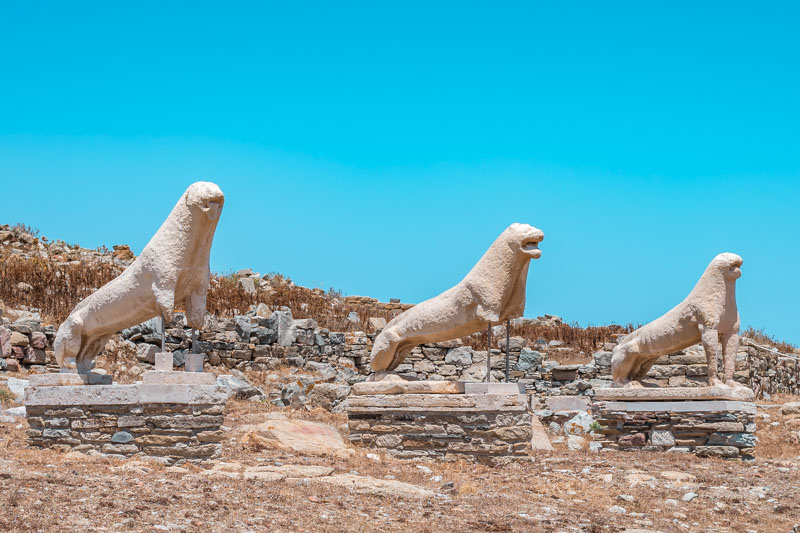
The Delos lions sit enthroned on low pedestals and gaze majestically toward the former Sacred Lake. Their presence lends the excavation site a thoroughly mystical atmosphere. Incidentally, the original marble lions are now in the Delos Museum to protect them from the weather. The ones on site are replicas, but definitely the No. 1 photo opportunity on Delos.
Sacred Lake
The Sacred Lake (Greek: Limni) is now dry, but in ancient times it was a reservoir filled with water. According to mythology, this is where the goddess Leto gave birth to her twins Apollo and Artemis under a palm tree. Because of this, the lake was the spiritual center of the island and was revered as sacred by the Greeks.

In order to curb a malaria epidemic, the lake and the surrounding marshland had to be drained in the 1920s. Only after heavy rainfall in the spring is there still some water in the lake, where a few plants and small trees grow. Inside the biotope is a symbolic palm tree as the birthplace of the twin gods, which unfortunately looked a little stunted during our visit.

Temple of Apollo
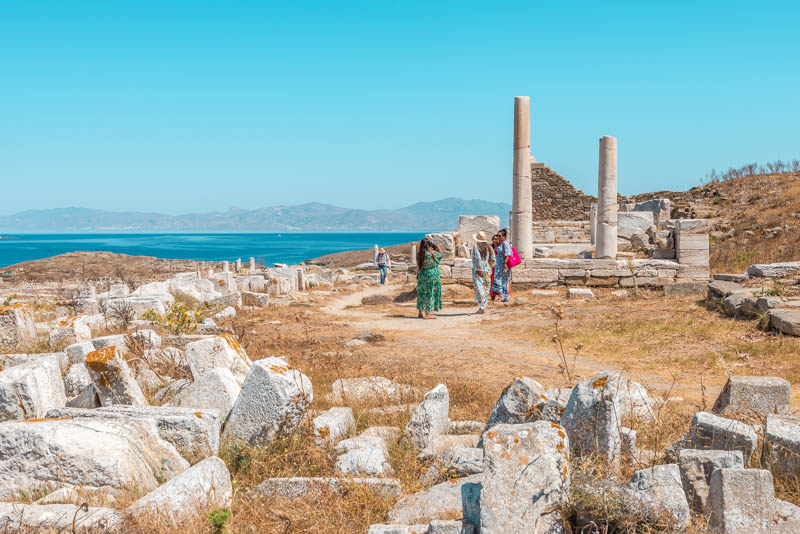
The sanctuary of Apollo was the religious center of Delos. Several temples stood here, of which only the foundations remain today. The largest temple, known as the Great Temple of Apollo, was built in the 5th century BC and housed a monumental statue of the god. Today, little remains of the former magnificent building; it resembles a chaotic field of rubble. Only the base walls give an idea of its original dimensions.

Next to the Temple of Apollo, you will also find shrines to other gods, including Artemis, Dionysus, and even Egyptian deities such as Isis and Serapis. They are all testimony to the multicultural population of ancient Delos. Incidentally, during our visit, it was very amusing to see some cats using the shady marble blocks to take their siesta. For our daughter, the velvet paws were definitely the highlight of the entire site.


Theater district & houses of the rich
The southern part of the island is home to the residential district of wealthy merchants and diplomats. Here you will find magnificent mansions with spectacular mosaic floors of Delos, which are among the most beautiful in all of antiquity. Particularly impressive are the House of Masks, the House of Dolphins, and the House of Dionysus.

The mosaics depict mythological scenes, geometric patterns, and animal representations in bright colors. Despite being over 2,000 years old, many details are still amazingly well preserved. Some of the surrounding houses had several floors, interior courtyards with colonnades, and elaborate water pipes. Even though not much of it remains today, it reminded us of Akrotiri on Santorini.

Ancient theater
Above the residential quarters lies the well-preserved ancient theater of Delos, which could seat around 5,500 spectators. From the upper rows, you have a fantastic view over the entire excavation site and across the sea to the neighboring island of Rhina. In ancient times, theaters were mainly used for performances in honor of Dionysus, the god of wine, fertility, madness, joy, and ecstasy.

Temple of Isis
From the theater, the path continues up to the Temple of Isis on Delos, one of the most unusual buildings in the entire complex. Isis was not a Greek goddess, but an Egyptian goddess who represented fertility, nature, and seafarers. The fact that a temple was dedicated to her on the Greek island of Apollo shows how international and cosmopolitan Delos was in its heyday.

Merchants from Egypt, Syria, and the entire Mediterranean region brought their gods with them on their travels, and the Delians allowed them to do so. The temple was renovated by the Athenians around 135 BC and is still relatively well preserved today, making it a great photo opportunity. From here, the path leads either directly up to Mount Kynthos or slightly downhill to the north to the Delos Museum.
Mount Kynthos
If you’re not tired after all that sightseeing, you can hike up a steep path to Mount Kynthos (112 m) and enjoy a magnificent panorama of the site and the neighboring Cycladic islands. The ascent is mainly via ancient stone steps that have been preserved in their original form. The pilgrim’s path, which is about 700 meters long, is challenging with an average gradient of 15 percent, but can be completed in just under 10 minutes.


At the summit are the sparse ruins of a sanctuary dedicated to Zeus and Athena. The view is impressive: you can see across the entire excavation site and the neighboring islands of Mykonos and Rhenia. On a clear day, you can even see Tinos, Syros, Naxos, Paros, and other islands. The peaceful atmosphere up here is particularly magical in the late afternoon and stands in stark contrast to the vibrant neighboring island of Mykonos.

We climbed the endless steps with our little daughter, who was 3.5 years old at the time. She climbed every single one because we told her that the mighty Zeus had sat on the summit and looked down from above. The father of the gods wasn’t there, but the view amazed even a small child. Sturdy shoes are essential, as flip-flops or sandals make the descent dangerous.

Cave of Cynthus
The Cave of Cynthus (also known as Herakles Cave) is an ancient structure that is partly natural and partly man-made. It is located below Mount Kynthos, and most visitors to Delos pass by the cave as it can only be reached via an inconspicuous path. It was built from massive granite slabs and has a grotto on the rocky slope. A statue of the hero Heracles (son of Zeus) is said to have stood there in the past.


Practical tips for your visit to Delos
On Delos there is hardly any shade and there are no places to stop for refreshments on the island. There are only vending machines with soft drinks and toilets. Therefore, be sure to bring enough water, a few snacks, sunscreen or a hat, and sturdy shoes. The paths are partly uneven and rocky and cannot be “improved” due to their original character.

A visit to Delos in spring (April/May) is particularly recommended. Then everything is in bloom and green on the otherwise barren island. Perhaps there is still some water left in the Sacred Lake from the last rain. As it can get very hot in midsummer, we recommend early boat trips (from 9 a.m.). You can return to Mykonos before the midday heat sets in.
A trip to Delos in the late afternoon is worthwhile in autumn because of the beautiful sunsets and golden light. In general, allow enough time for Delos, as the distances on the site should not be underestimated. You should allow just under two hours for the tour of the main excavation site and a visit to the museum.
If you also want to climb Mount Kynthos, you should allow another 45 minutes (10 minutes up, 25 minutes to linger, 10 minutes down). We would say that history buffs can easily spend the whole day on Delos, provided they have enough food with them.

Visiting Delos with children is entirely possible. Older children can be introduced to Greek mythology and history with the help of audio plays or books. More motivation is needed to spark the interest of younger kids in the dusty paths and scattered marble stones. Delos is not recommended for strollers, as the paths are quite bumpy. For children up to four years old, a baby carrier is worthwhile, especially for the climb up Mount Kynthos.
💡 Is Delos worth a visit? To be honest, Delos is not for everyone. If you’re not interested in ancient sites, you can safely skip this trip – the island is a sprawling field of ruins, mostly consisting of stones and foundation remains. It takes real imagination and a love of history to picture what once stood here. On the other hand, those who are enthusiastic about Greek mythology and antiquity will be fascinated by the birthplace of Apollo and Artemis. In short: history buffs and mythology fans will get their money’s worth. Everyone else is better off staying on Mykonos.
#6 Delos Museum
On the eastern edge, above the main excavation site, is the Archaeological Museum of Delos. It was built in 1904 and is one of the oldest museums in Greece. Anyone who has taken in the ruins outside should definitely not turn back here, because it is only in the museum that you can really understand what you have just seen.

Admission to the Delos Museum is included in the ticket for the excavation site. Nine exhibition rooms await you, and unlike many Greek museums, the exhibits here are really well preserved and impressively presented. Six rooms are dedicated solely to sculptures and reliefs, which is no surprise given the quantity of finds on Delos.
At the beginning of your visit to the Delos Museum, it is worth taking a look at the large architectural model of the entire archaeological site in the entrance area. It shows Delos at the height of the island’s prosperity and suddenly casts the ruins outside in a whole new light.
Right at the beginning, the remains of the giant left hand of the Colossus of Naxos catch the eye. This marble hand alone gives an idea of how enormous this statue must once have been. The first two rooms are dominated by archaic sculptures from Naxos and Paros. Many of them are naked youths with muscular bodies, known as kouroi, which were typical of the time.
The absolute highlight is the original Delos marble lions from the famous Lion Terrace. Today, only copies stand outside on the grounds; the real originals can be admired here inside and are even more impressive up close than one might expect. They once guarded the Sacred Lake, the mythical birthplace of Apollo.

Also worth seeing is the marble group of Boreas abducting the Athenian princess Oreithyia, a masterpiece of Attic art from the 5th century BC. Right next to it are the statues of the Athenian couple Dioskurides and Cleopatra, who once lived on Delos and whose statues were found directly in their former home.
Those interested in Hellenistic painting will find what they are looking for in the seventh hall. There, mosaics and murals from the private houses of Delos are on display, including fine frescoes and everyday objects that bring the life of the former trading metropolis to life. Only here can one understand how luxuriously the people of Delos once lived.
Incidentally, one display case also contains objects with erotic symbols and phallic representations from the sanctuary of Dionysus, which causes some visitors to smile. They were found in the Stoibadeion, a kind of Dionysus temple, on the exterior of which marble phallic statues can still be found today.

Particularly valuable is an ivory plaque from around 1400 BC, which depicts a Mycenaean warrior wearing a boar’s tooth helmet and was found in the Artemision (sanctuary of Artemis). It is one of the oldest finds from the entire excavation.
How much time should you allow for the Delos Museum?
You should allow at least 30 to 45 minutes for the museum. Those who are really interested in antiquity can easily spend more than an hour here. Since the total time on Delos is limited by ferry connections, we recommend planning your visit to the museum towards the end of the day, when the midday heat is at its strongest. The air-conditioned rooms offer welcome cooling and toilets are also available in the museum.
#7 History of the island of Delos
Delos occupies a very special place in Greek mythology. According to legend, the goddess Leto, pregnant by Zeus, was chased across the Mediterranean by the jealous Hera. She was not allowed to give birth anywhere, because Hera had forbidden all countries and islands from granting refuge to the woman in labor.
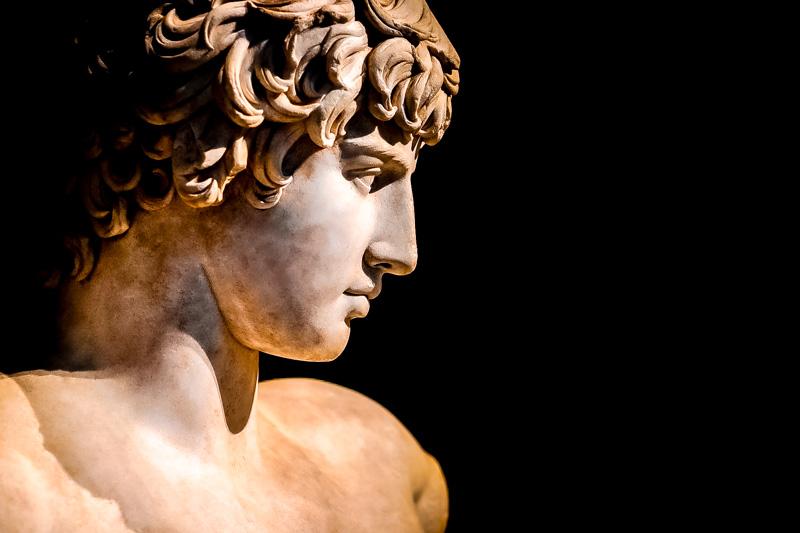
Finally, she found refuge on the island of Delos, which at that time was still adrift and was the only one not anchored to solid ground and therefore not subject to Hera’s ban. There, under a palm tree, she gave birth to the twins Apollo and Artemis. In gratitude, Poseidon anchored the island, which had been drifting until then, to four diamond pillars in the seabed.
💡 Twins of Delos: Apollo was the god of light, reason, and prophecy, and his most famous oracle was in Delphi. Artemis was the goddess of hunting and the moon, as well as the protector of women in childbirth. The myth tells that Artemis was the first of the twins to be born and immediately helped her mother give birth to Apollo. Apollo also had unimaginable powers and is said to have slain the giant serpent Python, who guarded the Oracle of Delphi, as a toddler. It is thanks to the two gods Apollo and Artemis that Delos became so famous and was revered as a sacred place from very early on.
The first large sanctuary was built here in the 7th century BC. During the Archaic and Classical periods, believers from all over the Greek world made pilgrimages to Delos. All the Ionian city-states sent ceremonial delegations with rich offerings. In addition, the Delian Games (Delia), a kind of Olympia in the Aegean, were held here regularly.
The lions of Delos were presented as gifts early on, and more and more temples were built. At a certain stage, Delos was considered so sacred by the high priests that neither births nor deaths were allowed to take place on the island. Those who were close to death were taken to the neighboring island of Rinia, where all the graves were located.


In the 5th century BC, Delos came under Athenian influence and from 477 BC served as the repository for the federal treasury of the Attic League until Pericles had it transferred to Athens in 454 BC.
From the 3rd century BC onwards, Delos developed into one of the most important trading ports in the Aegean. Due to its duty-free status, the small island became a hub between the Black Sea and Alexandria, as well as between Asia Minor and Italy. Initially, mainly grain, wood, and silver were traded, but later other goods such as glassware and marble statues were added.

The many offerings made by pilgrims and the immense income from the temple’s property even gave rise to a kind of banking system that issued bonds at interest. Around 130 BC, an estimated 20,000 to 30,000 people lived on the island of Delos.
With the rise of Rome, the island experienced its darkest hour: Delos became the largest slave market in the Aegean. The ancient geographer Strabo reports that around 150 BC, tens of thousands of slaves were traded daily, mainly Syrians, Bithynians, and Cappadocians who had been reduced to slavery by wars.

In 87 BC, General Menophanes, a commander of King Mithridates, landed with his troops on the defenseless island, murdered and enslaved the inhabitants, and destroyed the sanctuaries. This was followed by further raids by pirates, from which Delos never recovered and slowly fell into decline. According to the travel writer Pausanias, by the 2nd century AD only the guardians of the sanctuaries still lived here.
In Byzantine times (from 395 AD), Delos was finally completely abandoned. Over the centuries, the massive stones of the ancient temples were simply used as quarry stone or building material. On the summit of Kynthos, the remains of a medieval fortified castle, built from the ruins of once sacred buildings, still bear witness to this today.
Systematic excavations began in 1872/73 by the French Archaeological School in Athens, which is still active on Delos today. Only a fraction of the entire island has been explored so far, and yet around 30,000 vessels, statues, and small objects, as well as 8,000 sculptures and 3,000 inscriptions, have already been discovered. Between April and October, some of the site’s employees live on Delos with their families.
→ You can find more articles about the island of Mykonos and numerous travel tips for the Cyclades here:
FAQ about the island of Delos
What is Delos?
Delos is an uninhabited Greek island located about 6 kilometers from Mykonos. It is home to one of the most important archaeological sites in Greece. The island, which is only 4.5 kilometers long, was a sanctuary of the god Apollo and an important trading center in ancient times. Delos has been a UNESCO World Heritage Site since 1990.
How do I get to Delos?
You can reach Delos by boat from the old port of Mykonos Town. The crossing takes less than 30 minutes. Between April and November, boats run several times a day. The cost for Delos is approximately €25 for the round trip plus €20 admission. Tours to Delos are also offered from Paros and Naxos.
How much time do you need for Delos?
You should plan at least 2 to 3 hours for the main sights of Delos, the museum, and the climb up Mount Kynthos. History buffs can also spend four to five hours on the island. Important: Don’t miss the departure times of the ferries to Mykonos.
Is it worth hiring a guide for Delos?
Yes, a professional guide for Delos is definitely worthwhile. Without explanations, the many ruins are difficult to interpret. A guide brings history to life and shows the connections. Guided tours to Delos start at €79.
What are the highlights of Delos?
The lions of Delos, spectacular mosaics in the mansions, the ancient theater, the Sacred Lake, the temples of Apollo, and the panoramic view from Mount Kynthos are the highlights of Delos.
Is there food and drink on Delos?
No, there are no places to eat or drink on the island of Delos. Be sure to bring water and snacks with you for your visit. As shade is scarce, don’t forget your sunscreen or hat.
When is the best time to visit Delos?
The best time to visit Delos is in spring (April/May) because of the beautiful flowers or in autumn (September/October) because of the beautiful light. If you want to visit Delos in summer, you should go early in the morning because of the heat. The atmosphere is particularly magical in the late afternoon.
*Support our blog Greece-Moments
This post contains affiliate links, which are marked with an asterisk (*). If you book or purchase something through one of these links, we receive a small commission. The price remains the same for you. This helps us to continue providing high-quality content free of charge. Did you enjoy this post and want to say thank you? Then simply buy us our next Greek coffee ☕️ To the coffee fund
Save this post on Pinterest!