

By plane to Hellas and off to the beach – that’s how most people imagine an uncomplicated holiday. But discovering Greece by ferry is easier than you think. Over the last 15 years, we have taken the ferry to the Greek islands more than 50 times, and most of the time everything went smoothly.
»Travelling by ferry in Greece is a very special kind of holiday: authentic, relaxed and full of adventure.«
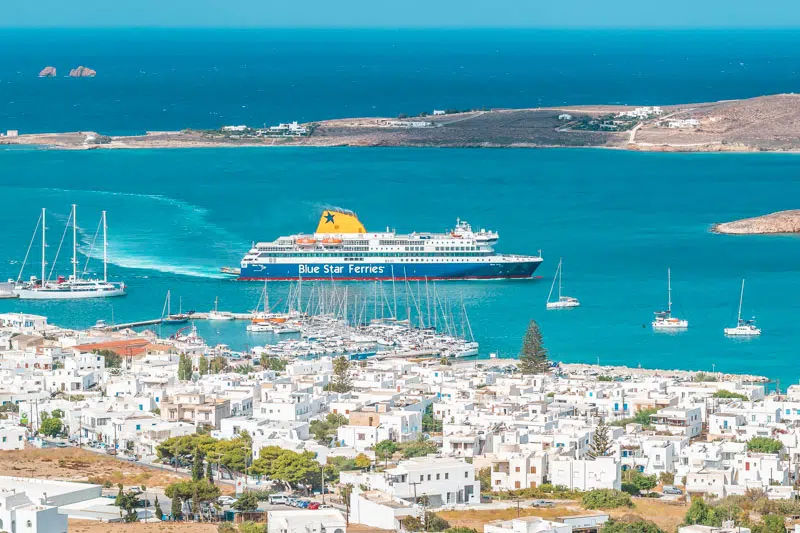
Of the approximately 115 inhabited islands in Greece, not every one has an airport and so you can only reach the small islands away from the crowds by ferry.
As early as 10,000 years ago, people traveled from island to island by ship. Today you can do that too, but much more comfortably, with a sun deck and cafeteria on board.
In this article, we will share our experiences of travelling to the Greek islands by ship and provide comprehensive information on ferries in Greece:
- #1 Ferries in Greece: What you should know in advance
- #2 Book ferry tickets for Greek islands
- #3 Book ferries from Italy to Greece
- #4 How much do ferries cost in Greece?
- #5 Current ferry schedules in Greece
- #6 Check-In, Luggage & Co. at Greece Ferries
- #7 Ferry companies in Greece
- #8 Ferry types: From car ferries to high-speed catamarans
- #9 Our experiences with ferries in Greece
- #10 Island hopping with ferries in Greece
#1 Ferries in Greece: What you should know in advance
Around 20 percent of Greece’s almost ten million inhabitants live on the Greek islands. Only 30 islands are equipped with a domestic or international airport. The others don’t have one, so the ferries in Greece play a crucial role in the everyday life of the islanders.
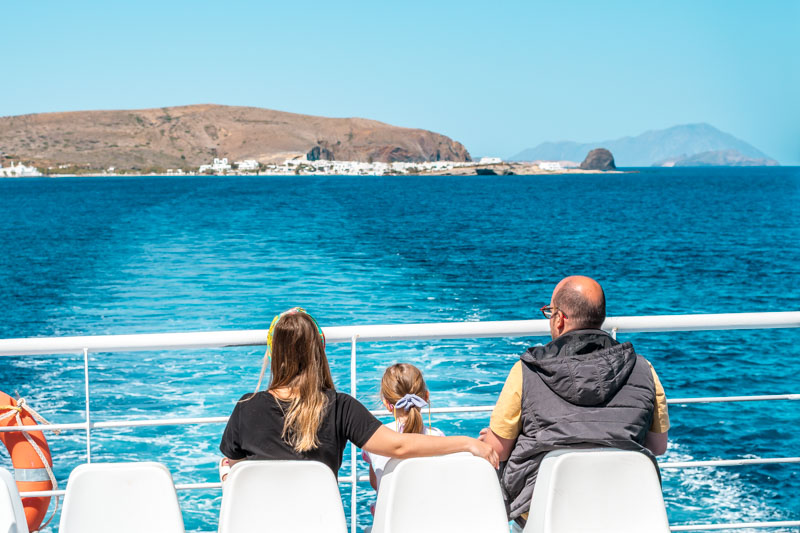
If you don’t necessarily want to spend a holiday on the most popular islands such as Crete, Rhodes, Santorini & Co., then you have to cross to the islands by sea. The ferries not only bring holidaymakers to the Greek islands, but also most food, fuel, medicines and even the mail.
Depending on the region, small, slow passenger ferries run between the islands, but also large car ferries and fast catamarans. The latter offer amazing comfort both outside and inside, but are often more expensive. Modern ferries have different seating categories (deck, air seat, lounge), with the deck seats always being the cheapest.
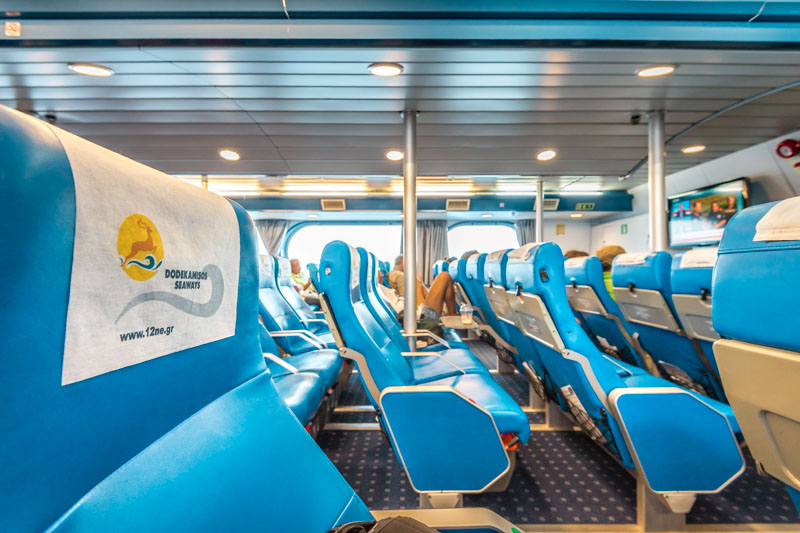
In addition, there are even cafés and restaurants, shops and play areas as well as sun decks with deck chairs on the large Greek ferries – a bit of cruise feeling at a low price, so the ferry ride becomes an experience! With our partner Ferryhopper* you can easily book a Greece Ferry:
➲ Search your ferry with Ferryhopper*
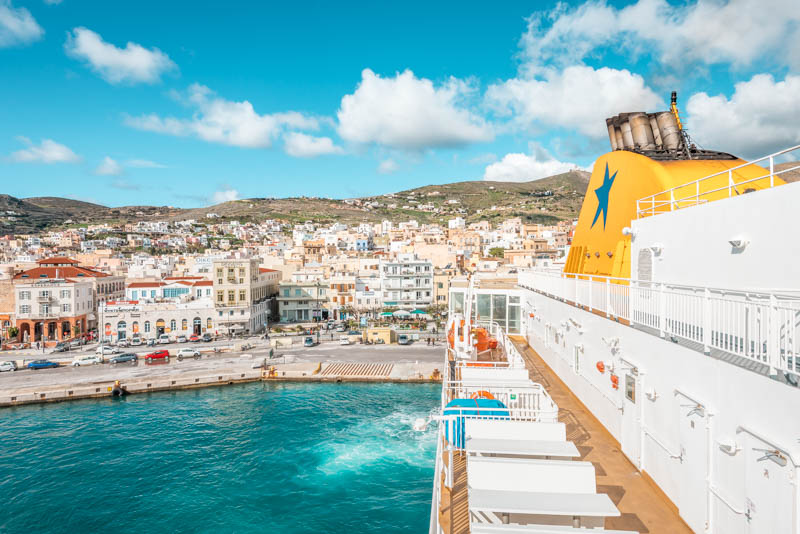
The most important questions about Greece ferries
Where can I book ferry tickets for the Greek islands?
You can purchase your ferry tickets either directly on the website of the respective ferry company or via the Ferryhopper booking portal. The ferry portal offers a particularly simple and clear navigation in several languages.
Where can I find an overview of all ferry connections?
An overview of almost all ferry connections is provided by our partner Ferryhopper*. Simply enter your desired route in the search mask and you will see all available ferry connections between the islands.
Should I book the ferry tickets in advance?
If you are traveling with your own vehicle, it is recommended to purchase ferry tickets to the islands in advance. As a foot passenger, you usually get a ticket at the port on the day of departure. Even without a car, we often book our ferry tickets online only one day in advance.
When will the timetables for the season be published?
The Summer timetables of Greek ferries for the holiday season from April to October are usually published by the end of March of the current year. Yes, unfortunately you have to be patient, and we personally find that nerve-wracking too.
Can I take my rental car on the ferry?
No, taking rental cars on the ferry is usually contractually prohibited. In the event of non-compliance, the insurance cover expires. If in doubt, always ask your rental company in advance if you can take the rental car to another island.
I get seasick quickly – which ferry should I take?
Rule of thumb: The bigger and slower the ferry, the less you notice the swell on the Greece ferry. On car ferries (including Blue Star Ferries) we only noticed a rocking at high wind speeds. High-speed catamarans travel very fast, but even at low winds, they rock considerably.

#2 Book ferry tickets for Greek islands
Booking a ferry to the Greek islands has never been as simple as it is today. A few years ago, you had to go to the ticket offices of the shipping companies or reserve your ferry ticket by phone and then print it out, but today you can do everything online from the comfort of your own home. The ticket will be sent immediately to your e-mail inbox.
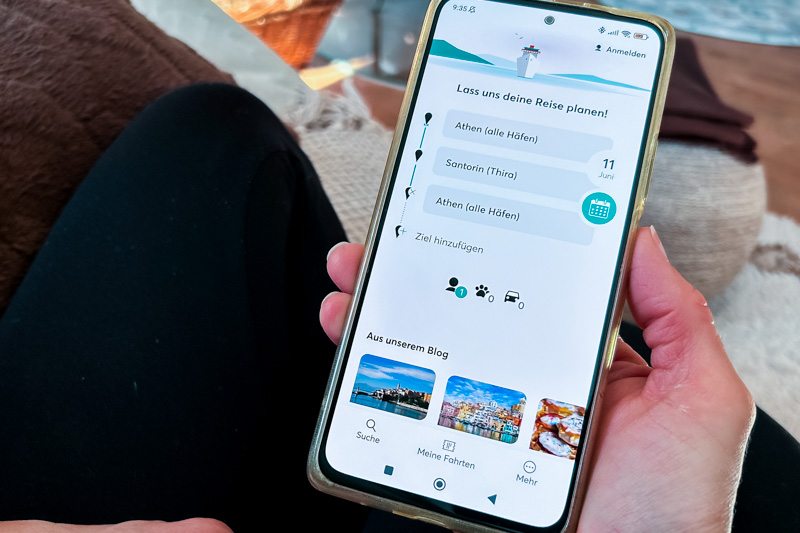
But don’t worry, if you’re not that tech-savvy, you can also book ferry tickets in Greece at the ticket office. In the port of each island, the different shipping companies have their own physical points of sale or Ferry agencies arrange the tickets. You only rarely buy the ticket on the ship, for example with small ferries.
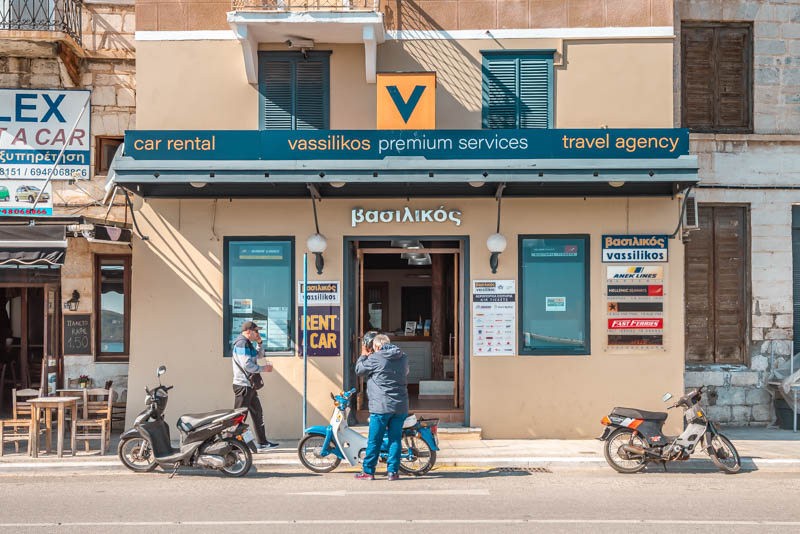
The purchase of ferry tickets at the port is especially worthwhile for spontaneous trips in the off-season, when you want to travel flexibly from island to island as a foot passenger. However, if you want to book a ferry in Greece at short notice, you need patience at the ticket counter, because the Greeks themselves tick similarly, shortly before the departure of the ferry, the tickets are bought at the port.
Also note that in the high season and on important holidays (including Orthodox Easter and Assumption Day 15 August), popular routes are booked up quickly. If you are traveling with your own car during the holiday season, you should book your ticket several weeks in advance.
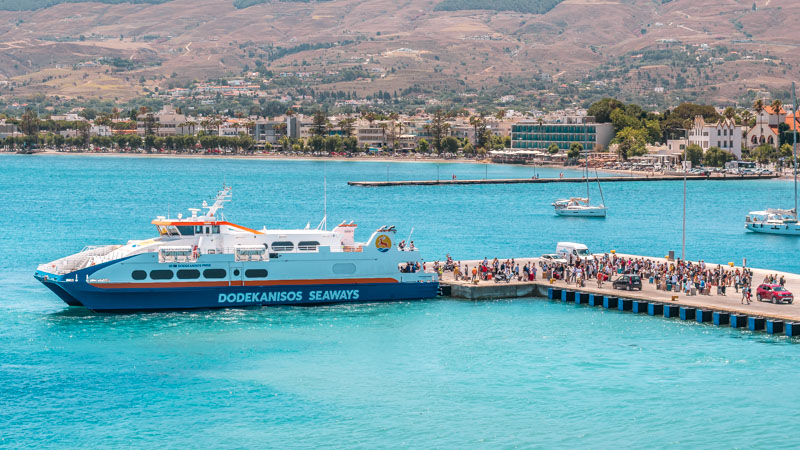
If you want to be on the safe side and travel with a vehicle, you should book tickets for the Greek islands online in advance, that can also be done months in advance. You can either do this directly on the websites of the shipping companies, as long as you know which company is calling at which island, or you can use well-known booking portals such as Ferryhopper*.
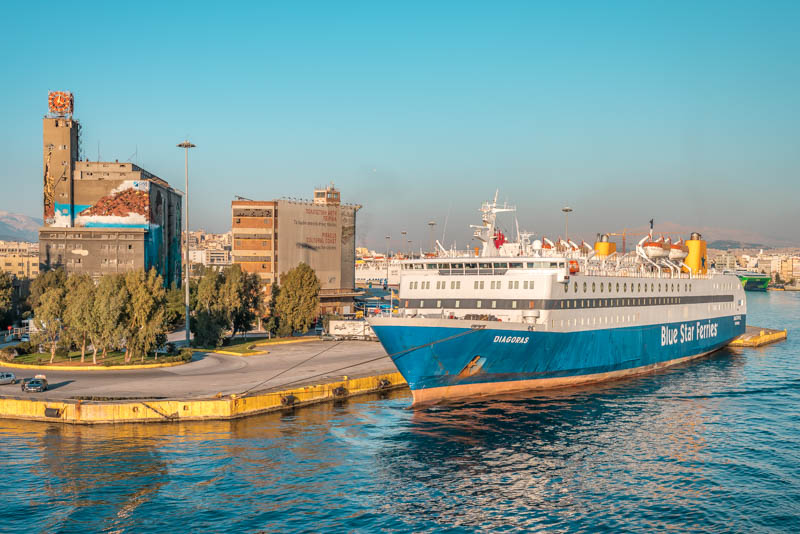
Platform to book ferries for Greece
On platforms like Ferryhopper you get a very good overview of all available routes, times and prices – and all this in your language and with customer service, if desired.
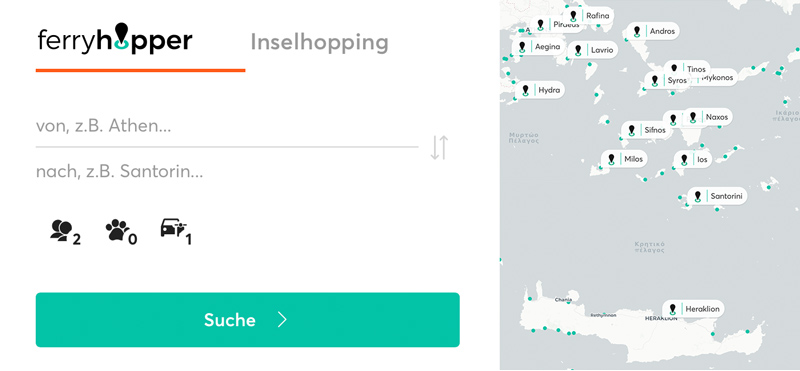
You simply enter your start and destination port as well as the date in the search mask and the booking portal will show you the available ferry connections for Greece. Here you can enter your desired route directly:
Personally, we prefer the Ferryhopper ferry portal. The website is multilingual, user-friendly and clear. Searching and booking ferry routes in Greece is child’s play – try it out now:
Online booking of ferries or ticket counters at the port?
Again and again we are asked: “Should I buy the ferry tickets to the islands at the port or online?”
If you want to be on the safe side and need planning security, you can purchase your ferry ticket online (e-ticket) a few days in advance. If you want to travel spontaneously as a foot passenger, you can also go to the ticket counter at the port. In fact, as a foot passenger, you can get a ticket at short notice even in summer, the ferries in Greece rarely run at the limit.
→ Advantages of booking ferries online in Greece:
- Booking on the go, at any time without waiting
- Time savings in Greece, as there is no need to go to the ticket office
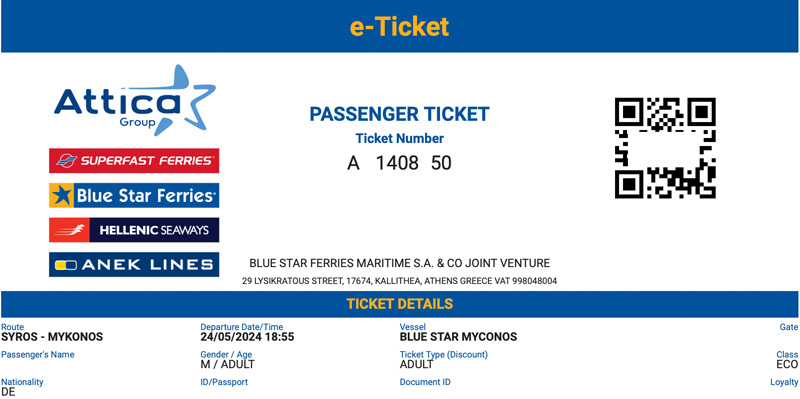
- Ferry ticket comes by app or email (print optional)
- with QR code tickets, no printout is required
- Full overview of prices, times and availability
- If necessary, use of vouchers and discount campaigns possible
→ Disadvantages of booking online tickets for ferries:
- no contact person for queries as in the ticket office
- a small agency fee may apply
- nothing fixed in your hand, “only” a digital ticket
- a certain technical understanding is required
#3 Book ferries from Italy to Greece
If you want to travel to Greece by car or camper, as well as the route via the Balkans, you can also arrive by ferry from Italy.
In Italy, you can choose from various coastal towns for the crossing to Greece. In Greece, you can arrive either in the port of Igoumenitsa or in the Port of Patras. Depending on the season, the islands of Corfu and Kefalonia are also served from Italy.
→ Below you will find an overview of the most important Italian ferry ports from north to south with information on journey times and prices:
- Ancona – Igoumenitsa/Patras/Corfu Crossing approx. 20 hours – Price from 98 € p.p.
- Bari – Igoumenitsa/Patras Crossing approx. 9 hours – Price from 65 € p.p.
- Brindisi – Igoumenitsa Crossing approx. 8 hours – Price from 50 € p.p.
Your ferry from Italy to Greece you can book directly with our partner Ferryhopper*:
➲ Book ferries from Italy here*
→ You can find all information about how to get to Greece via Italy here: Travel to Greece
#4 How much do ferries cost in Greece?
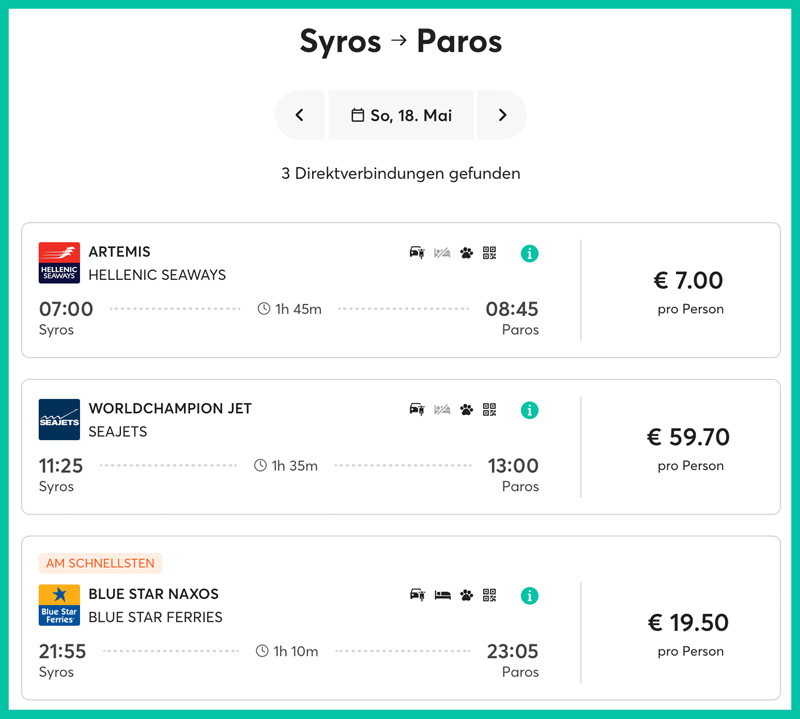
Ticket prices for Greece ferries vary greatly depending on the region and range between €10 and €40 for an hour’s ferry ride as a foot passenger. As a rule of thumb, the more popular the route and the faster the ferry, the more expensive the price. Other factors determining the price of ferry tickets in Greece are:
- Type of ship (old steel ship vs. modern catamaran)
- Speed (passenger ship 22 km/h vs. catamaran 92 km/h)
- Shipping company (local company vs. large international corporation)
- Booking time (early bird offer vs. spontaneous booking)
- Duration (short trip less than 1 hour vs. night trip over 8 hours)
- Route (touristic Cyclades islands vs. insider tips)
For short distances of less than 30 minutes between neighbouring islands, tickets are already available from €6 per person, which are usually subsidised by the municipalities. The further you travel by ferry in Greece, the more expensive the ferry ticket becomes. The longest ferry routes in Greece are from Kavala to Piraeus (27 hrs) and from Piraeus to Kastelorizo (24 hrs) for around €75 each.
The cheapest ferries in Greece are conventional passenger ships and car ferries. The most expensive are the catamarans, even an hour’s ferry ride can cost over €40, but you’ll also get to your destination the fastest. If you are traveling by car or motorcycle, you will of course pay extra. But not all Greece ferries can carry cars.
Examples of ferry prices in Greece
- Athens – Santorini Ferry: Price approx. 50 – 90 € (10 h – 5.5 h)
- Athens – Crete Ferry: Price approx. 45 – 90 € (9.5 h – 8 h)
- Lesvos – Limnos Ferry: Price approx. 20 € (4.5 h)
- Mykonos – Paros Ferry: Price approx. 50 – 60 € (1 h – 45 min.)
- Paros – Naxos Ferry: Price approx. 16 – 33 € (1 h – 30 min.)
- Skiathos – Skopelos Ferry: Price approx. 20 – 30 € (1 h – 15 min.)
- Rhodes – Kos Ferry: Price approx. 25 – 40 € (3 h – 2 h)
- Small Island to Island Ferry: Prices approx. 6 € (30 min.)
If you think that the cheapest ferry ticket is always the slowest, then you are wrong. It also depends on how many piers the ferry serves to your destination and whether it’s a popular route. Ferryhopper* is a great price comparison tool for ferries. It gives you a clear overview of the available routes.
➲ To the price comparison at Ferryhopper*
Tips for booking a cheap ferry ticket in Greece
Discounts for ferries in Greece, similar to airline tickets, you can’t expect. The major shipping companies offer memberships such as Seasmiles where you can get discounts. With all shipping companies, children under 5 years of age travel free of charge. Prices hardly fluctuate and are nearly the same in both low and high season.
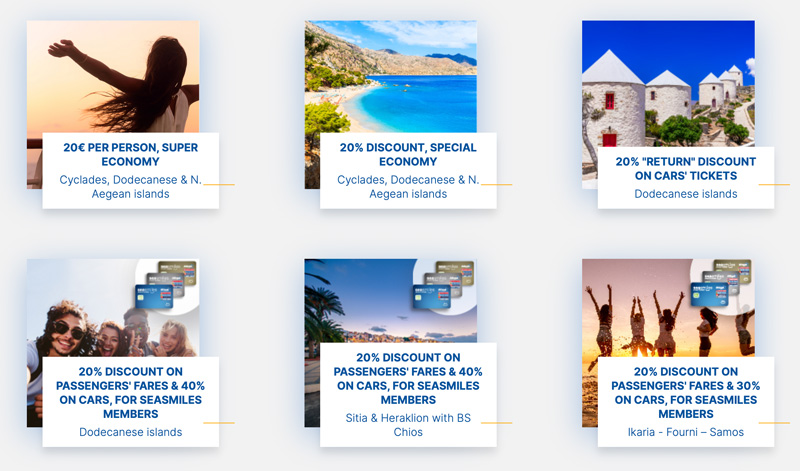
Exceptions are early booking promotions of the Greek ferry companies, which want to use their ships to capacity, especially in the low season. For example, you can expect discounts of up to 30 percent in spring and autumn, but usually only for taking your car with you. Occasionally, however, normal deck seats are also offered at reduced prices (special economy). You can find an overview of current offers here: Ferryhopper Offers*
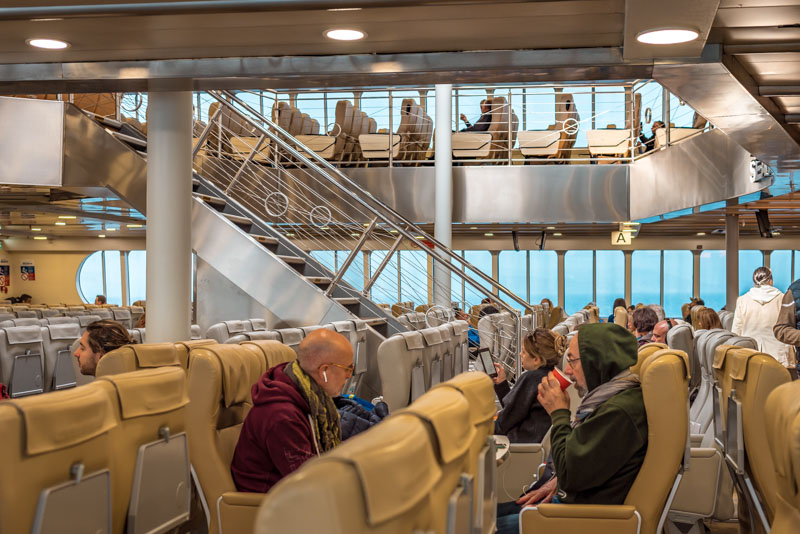
Experienced Hellas fans usually book directly via the website of the respective shipping company, as booking portals can charge a commission. For newcomers to Greece, on the other hand, the Greek ferry network is not immediately manageable. In order to quickly find the cheapest price for a connection, it is worthwhile to book via Ferryhopper.
→ With these tips, you can book cheap Ferries in Greece:
- Use early bird promotions instead of last-minute bookings
- Take advantage of discounts for pensioners, students and children
- Take advantage of discounts on vehicle transport (e.g. Seasmiles on Dodecanese Islands)
- Visit an official ticket office at the port instead of an agency with a surcharge
- Memberships: Collect Seasmiles and get perks
- choose alternative routes, e.g. Piraeus – Crete to Kissamos instead of Heraklion
- For singles and couples: do without a cabin for night trips and choose a deck place
- Use booking portals to compare prices, such as Ferryhopper
Questions about costs for Greece ferries
How much does it cost to take vehicles on Greek ferries?
On the big Greek car ferries, vehicles can be taken along without any problems. The costs vary depending on the route, size and type of vehicle (motorcycle, car, motorhome). Motorcycles cost from 10 €, cars between 25-150 € and motorhomes sometimes over 100 €. The large vehicles are in the main hall, the smaller ones are manoeuvred in the belly of the ship.
If you are travelling with the camper or caravan by ferry to an island, you have to pay a lot, because here you are charged per meter. With the catamarans, the vehicle transport is limited, whoever books first is lucky. Small passenger ferries can carry a maximum of motorcycles or 1-2 cars.
→ With the caravans to Greece? You can find all the important information about it in our article: Camping in Greece

How much does a cabin cost on a ferry in Greece?
A cabin on a Greek ferry costs between €100 and €200 per person, depending on the route. A cabin is a good option if you have a long crossing ahead of you. There are cabins with and without windows, with the latter being cheaper. However, if you are traveling alone, you will have to pay the full price for a 2-berth cabin. Families with children receive discounts for one cabin.
#5 Current ferry schedules in Greece
The occupancy rate of ferries in Greece depends heavily on the country’s tourist season. This is also logical, because masses of people have to be transported from one island to another or to the mainland. Most ferry routes in Greece are operated regularly, sometimes daily, from April to October – this is called Summer timetable.
In the low season, the number of ferry connections in Greece is significantly reduced. The winter timetable only serves the basic needs of locals. While ferries to a Greek island ran several times a day in summer, this can be reduced to once a week in winter.
Some ferries are even stopped completely from November to March, as we ourselves experienced during our stay on Nisyros in December. The new timetable for Greek ferries usually appears in the spring of the new year, after the licenses have been negotiated.
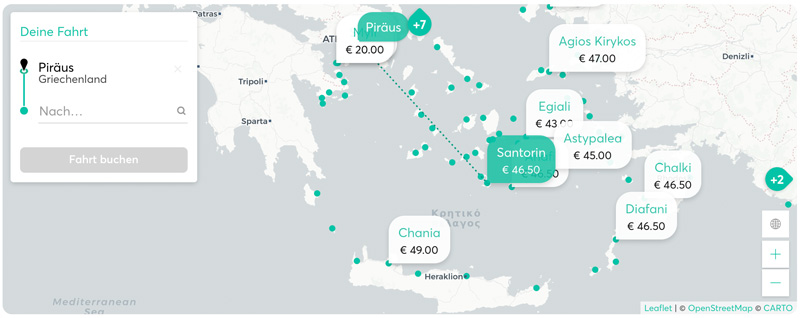
When planning your trip to Greece by ferry, you can also make use of the ferry portals. For example, the Ferryhopper platform shows you the destination ports available from there on a map after entering the starting port. A handy feature, we think! Here you can find the link: To the map with ferry ports*
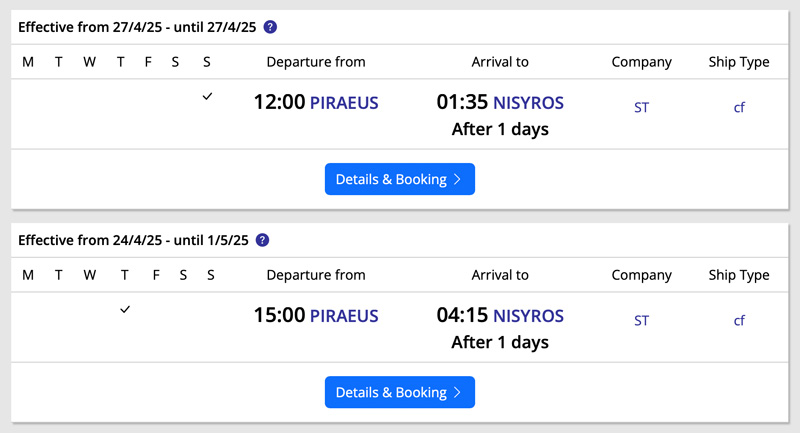
Unfortunately, there is no general overview of the ferry schedules in Greece. The ferry network is too complex and every shipping company today cooks its own soup. On the GTP Tourism Publishing House (Link: greece travel pages) are almost all ferry routes of Greece listed. However, you have to book directly with the provider or on ferry portals such as Ferryhopper*.
Overview of ferry ports in Greece
Piraeus is the largest ferry port in Greece, a good 90 percent of all ferry traffic departs from here, especially to the islands of the Aegean Sea. In addition, there are other port cities spread throughout the mainland, which, depending on their geographical location, call at the other islands such as the Ionian Islands and the islands of the North Aegean.
→ These 10 most important ports connect the Greek islands with the mainland:
- Piraeus → Crete, Cyclades, Dodecanese, North Aegean Islands, Saronic Islands
- Rafina → Andros, Tinos and Mykonos, among others
- Lavrio → Kea and Kythnos, as well as Western Cyclades (Milos, Kimolos, Folegandros)
- Thessaloniki → Limnos and Chios
- Kavala → Limnos and Thassos
- Volos → Skiathos, Skopelos and Alonnisos
- Patras → Kefalonia and Ithaca, as well as Italy
- Kyllini → including Zakynthos and Kefalonia
- Igoumenitsa → Corfu and Paxos, as well as Italy
- Agios Konstantinos → Skiathos and Skopelos
In addition to the large port of Heraklion on Crete, important hubs in island traffic are the ports of the islands of Syros, Naxos, Rhodes and Lesbos. In these ferry ports many ferry lines meet every day and from here you have the possibility to cross over to other island groups, e.g. from the Cyclades to the Dodecanese in the port of Syros.
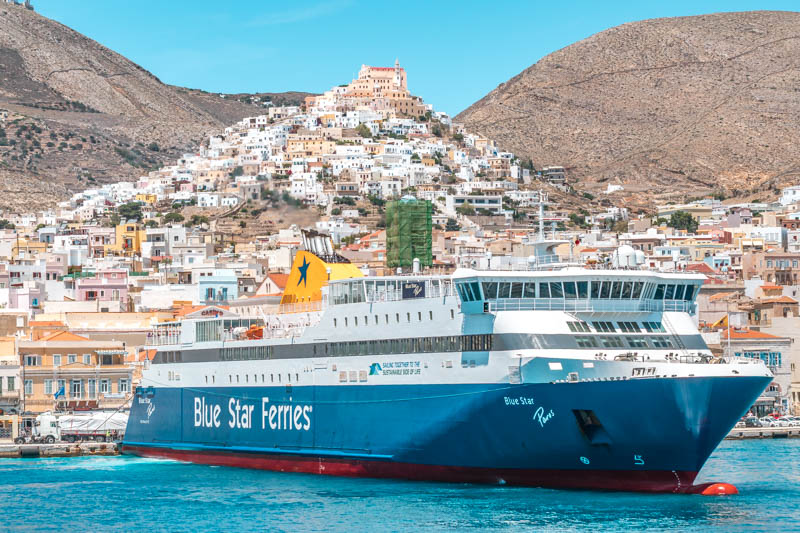
#6 Check-In, Luggage & Co. at Greece Ferries
From our own experience, we can assure you that traveling by ferry in Greece is easier than by plane. Many bureaucratic processes simply do not exist or are not feasible due to the tight schedule. Security checks before the trip and the presentation of identity papers are usually omitted.
Nevertheless, strict regulations apply. This way, the ferry staff can ask for your ticket at any time, even if you are already on the ship. If you do not have a ticket, or whose ticket has expired or is invalid, you will not be transported. If you bought your ferry ticket at the counter or agency office, you are automatically checked in for the island ferry.
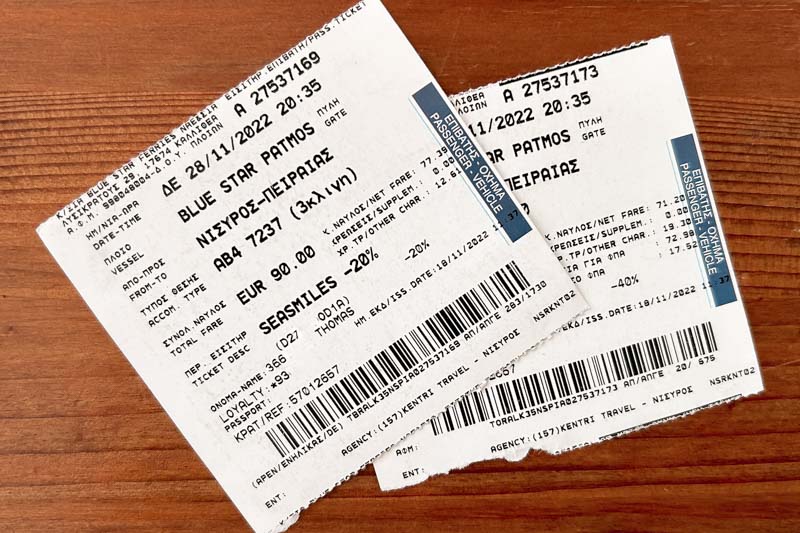
If you booked your ferry ticket online, you must check in online in advance. You will receive the information by e-mail at least one day before departure. The online ticket does not have to be printed out again. But it can never hurt, so you have something tangible with you in an emergency and are already well prepared at home.
Embarkation on the ferry to Greece
If you are a pedestrian, it is sufficient to be at the port about 30 minutes before departure. If you want to take your own vehicle on a Greek ferry you should arrive at least an hour before. The ship’s garage is turbulent, follow the instructions of the staff who will maneuver you to your parking space. “Pame Pame” means something like “Come on, go now!”.

Important note: The ferries in Greece are quite punctual and also leave quickly – 15 minutes mooring time, more is not possible. There are exceptions in summer, when chaos reigns in some ports. So be at the port on time. A ferry won’t wait for you and won’t come back if you’re late.
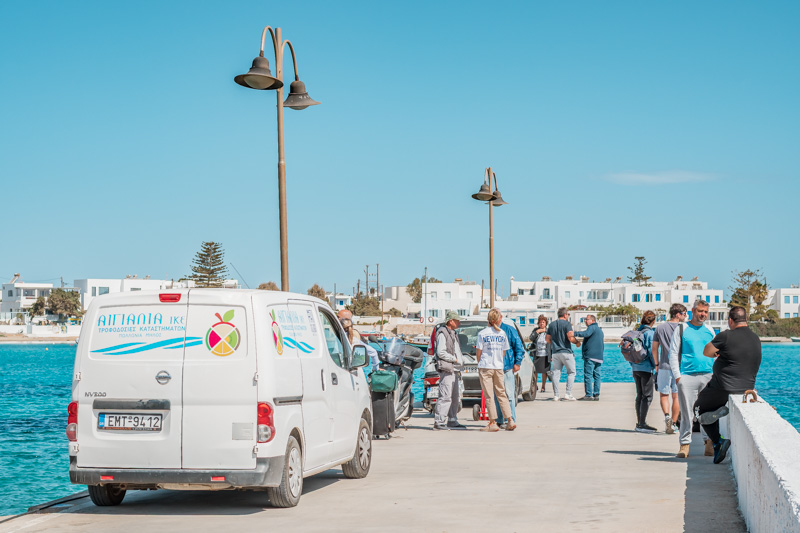
Embarkation starts with the docking of the ferry and after unloading pedestrians and cars, you board the ship via the loading ramp. But watch out for cars and trucks entering. After you have stowed your luggage in the hold at the entrance of the ship (see questions below), your ferry ticket will be checked again and you will be allowed to enter the upper deck. There are usually no fixed seats on ferries.
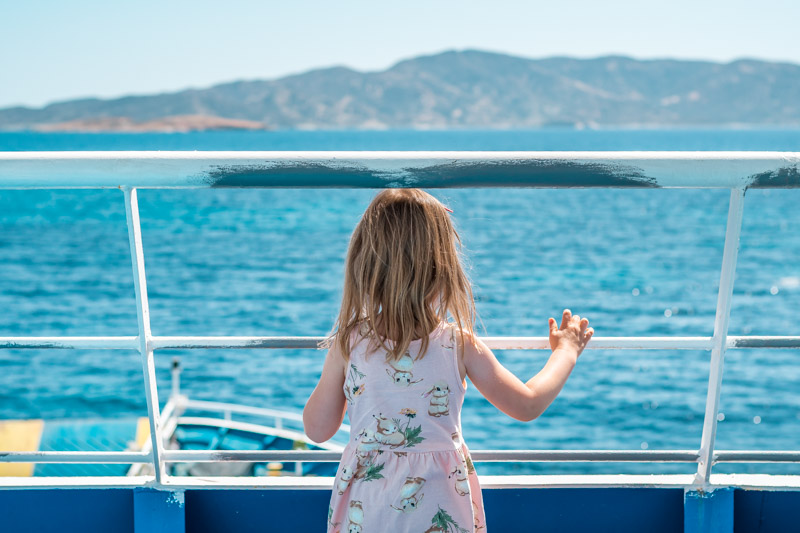
In summer we prefer the outdoor deck on the ferries – fresh wind, sunshine and sea view, also a highlight for the little ones. The interiors are usually completely hypothermic due to the air conditioning and completely overcrowded during the holiday season. If you are hungry, you can have a snack in the cafes on board – the quality of the restaurants (if any) is fine.
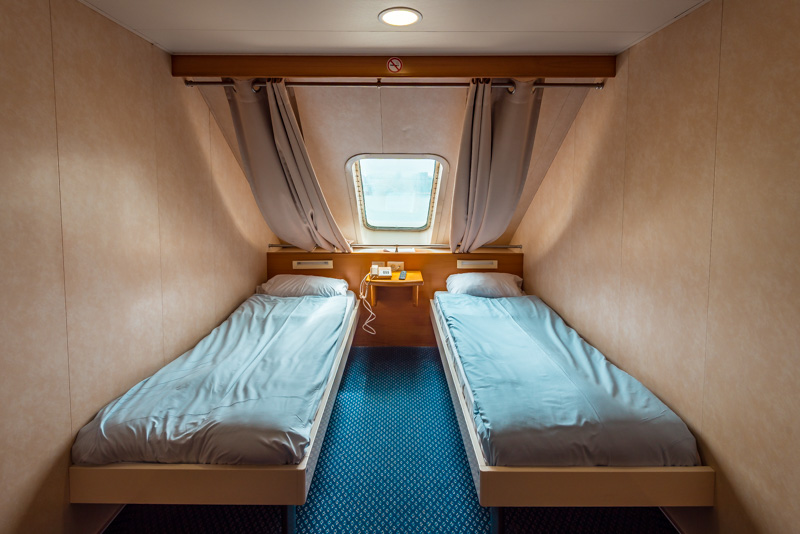
For long night trips, e.g. from Italy to Greece or from the Athens port of Piraeus to the Eastern Aegean (Rhodes and Kos), we recommend to book a cabin on the ferry. This way you travel relaxed and don’t wake up completely exhausted in the morning.
If you have booked a cabin, please contact the reception first and the ship’s staff will accompany you to the cabin. Shortly before arriving at your destination port, there is a loudspeaker announcement in English and Greek that can be heard throughout the ship – then it’s time for you to disembark.
Delays of ferries, storms or strikes
During the summer months, delays to the ferries between the islands can be expected due to the influx of international tourists and Greeks. The crowds of people have to be brought on board and the many cars and trucks in the ship’s belly have to be sorted. And then there are always strollers who arrive too late at the port.
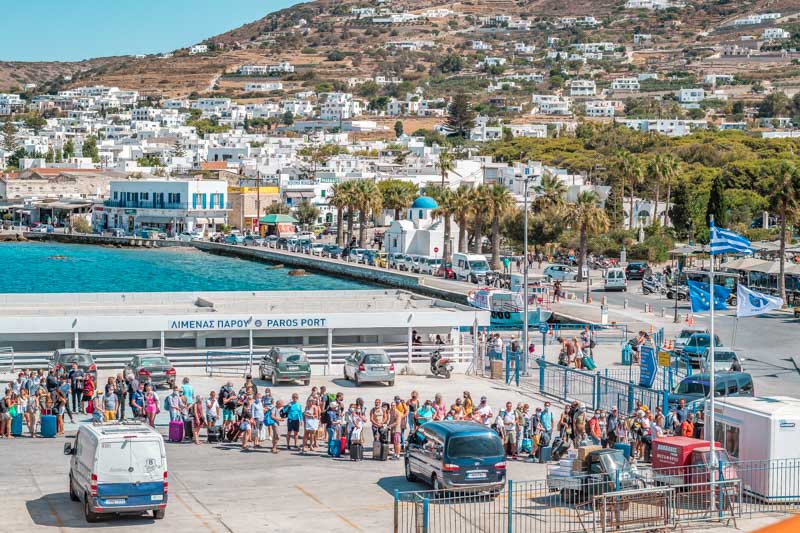
In the low season, the situation is more relaxed, there are enough ferries available for the crossing to the Greek islands. The mooring times are rarely more than 20 minutes. In the event of severe weather or due to strikes, ferries may be cancelled. In these rare cases, you’ll be stuck on the island for a day, but your local host or tour operator will definitely help you.
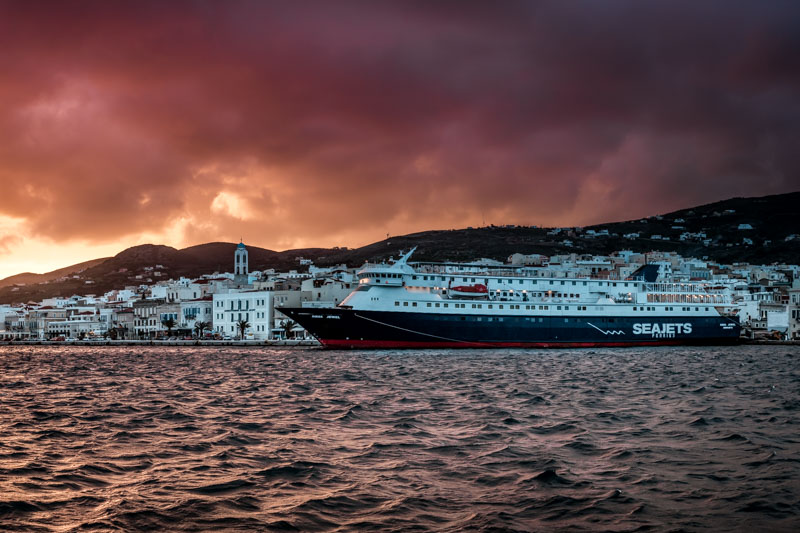
In all these years, we’ve never had a ferry cancellation due to a storm or a strike. If it happens to you, the ferry ticket usually remains valid and rebookings can be made through the ticket office.
Important tip for traveling with the Greek ferries: Never plan the return trip with the ferry and the return flight on the same day, always plan 1-2 days buffer in between.
💡 Wind and Ferries in Greece: Between June and September, the Meltemi blows, a dry, strong north wind that provides pleasant cooling in the summer heat, but also high waves. From a wind force of 7 to 8 Beaufort, the ferries are discontinued for safety reasons, after one day they usually continue. So it’s no wonder that the Greeks are less interested in the temperature than in the wind in summer. The shipping companies will inform you about disruptions by e-mail or SMS in advance. Alternatively, check with the port authorities or your local host before departure.
View Greece Ferries online
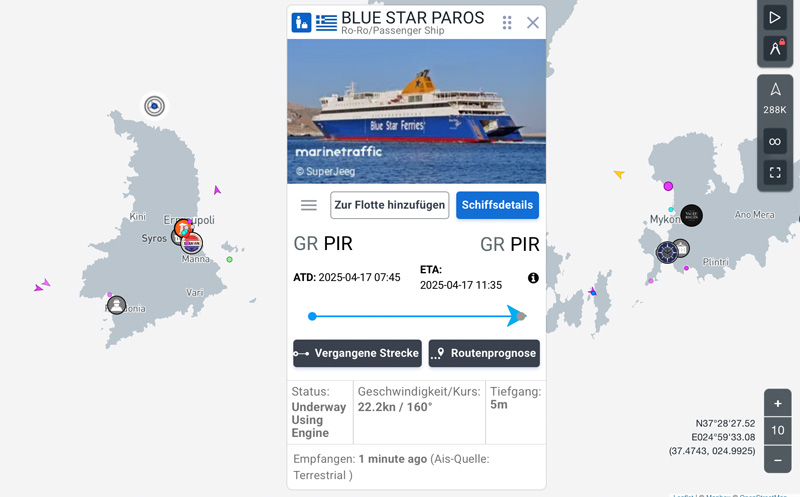
In summer, there may be delays due to the large crowds and the Meltemi. You can check ferry times via an app or online via portals. It is even possible to follow your Greece ferry live. We can recommend Marine Traffic, Vesselfinder and the Ferryhopper App.
Questions about luggage on Greece ferries
How much luggage is allowed on the ferry?
As a rule, one suitcase or one large travel bag as well as hand luggage per passenger (including children) are allowed. On the ferries in Greece, luggage is included in the fare and don’t has to be booked separately. Large pieces of luggage are stowed in the hold (see below), small bags and backpacks can be taken on deck.
Where does the luggage go in the ferry?
After checking in on the ferry, luggage will be stored in a separate area in the ship’s garage. Depending on the destination port, there are different storage compartments so that you can find your luggage when you get off.

For safety reasons, the suitcase spot is in the hold of the ferry. But don’t worry, the luggage area is always guarded by staff. In 15 years of ferry crossings, we have never lost anything, not even a loose bag.
Can I take my pet on the ferry?
Yes, some Greek ferries carry pets free of charge or for a small fee. But you have to register your dog or cat when booking and the necessary paperwork will be checked at check-in. Each ferry company has its own regulations here, which you can read here: Pets on board
There are special kennels or pet cabins on board (not available on all ships) that you have to book in advance and that sell out very quickly depending on the season. If these options are fully booked, you are usually only allowed to stay on the outer deck with your furry friend.

Questions about taking cars on ferries
What do I have to consider as a driver on the ferry?
Before you go with your car on the ferry, you get a sign with your destination stuck under the windshield wipers. This way, the ferry staff in the ship’s garage knows exactly which parking space you will be assigned. Then follow the instructions of the ferry staff (ella – “Come here”, pame – “Go, go now”, stop – “Stop”).
Maneuvering on the big ferries requires a little driving skill. But don’t worry if you don’t dare to do it – in case of emergency, just give the staff the key and they will park for you – Greek help uncomplicated. Shortly before arrival, all drivers are called to the garage and you can usually leave the ferry with your car without much waiting.

Can I take my motorcycle on the ferry?
Yes, you can take your motorbike on the ferry, but there are extra costs for this. On the ferries, the parking spaces at the entrance of the ship’s garage are reserved for motorcycles. Don’t worry, the motorcycle will be secured by the staff with tension straps, but it is advisable to bring your own fastening straps.
Can I take my electric car on a Greece ferry?
Yes, transporting electric cars on ferries is generally permitted. However, since incidents have already occurred, the Greek ferry companies stipulate that the battery must not be full. As a rule, the state of charge of the battery in electric cars must not exceed 40 percent.
#7 Ferry companies in Greece
In Greece, there are about 30 to 40 shipping companies that are active in passenger transport. For years, the most important routes in the Cyclades, Sporades & Co. have been operated by the ferries of the large Attika Group (e.g. BlueStar and Hellenic Seaways) as well as by Seajets.
Every year, the licenses for the ferry connections within the archipelagos are renegotiated and some are awarded to other shipping companies. Enclosed you have an overview of ferry companies in Greece and which islands they will transport you to in 2026 (no claim to completeness):
Ferries to the Cyclades Islands
- Blue Star Ferries – from Piraeus to Syros, Paros, Naxos, Ios, Santorini and Amorgos
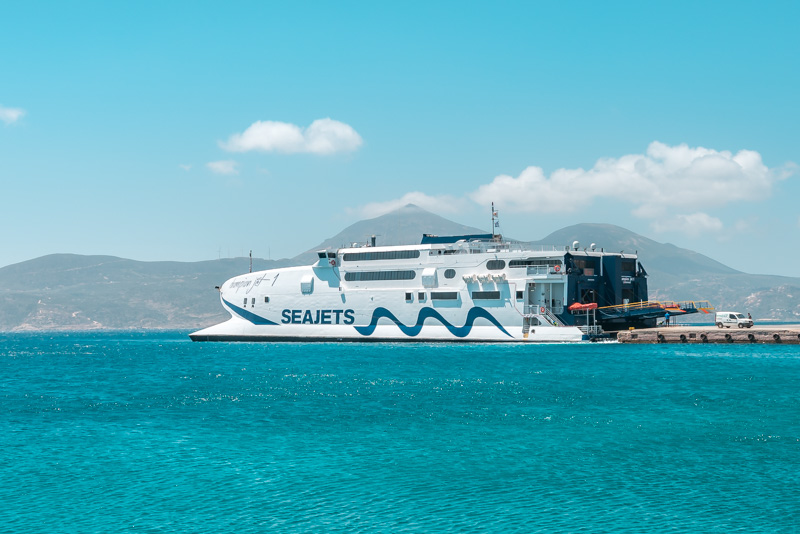
- SeaJets – from Piraeus to almost all Cyclades islands
- Hellenic Seaways – from Piraeus to Syros, Tinos, Mykonos, Paros, Naxos, Ios and Santorini
- Golden Star Ferries – from Piraeus and Rafina to Andros, Tinos, Mykonos, Ios and Paros
- Fast Ferries – from Rafina to Andros, Tinos and Mykonos
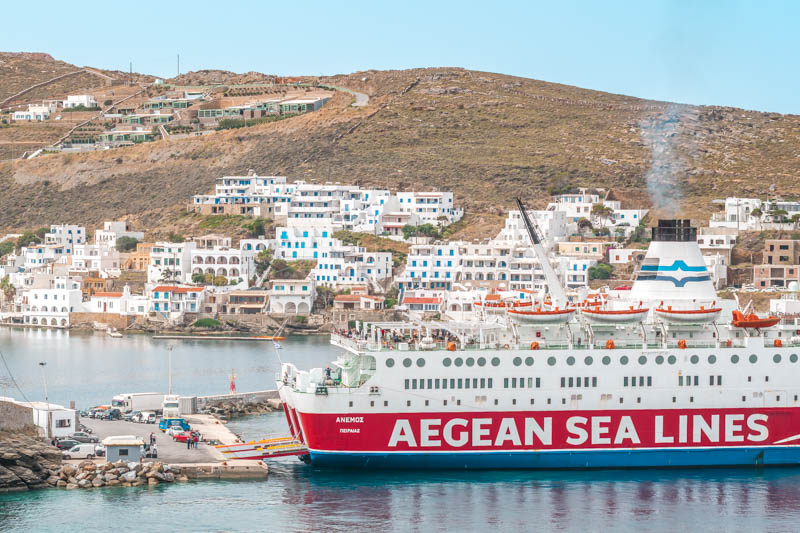
- Aegean Sea Lines – from Piraeus to Kythnos, Serifos, Sifnos, Milos and Kimolos
- Zante Ferries – from Piraeus to Serifos, Sifnos, Milos, Kimolos, Folegandros, Sikinos and Santorini
- Lavrio Ferries – Magic Sea Ferries, Goutos Lines, Triton Ferries, Saos Ferries sail to Kythnos and Kea
➲ Book ferries for Mykonos, Santorini & Co. here*
Ferries to the Dodecanese Islands
- Blue Star Ferries – connects Piraeus with islands such as Patmos, Leros, Kalymnos, Kos, Nisyros, Tilos and Rhodes
- Dodekanisos Seaways – connects all Dodecanese islands: Agathonisi, Arki, Astypalea, Chalki, Fourni, Ikaria, Kalymnos, Kastellorizo, Kos, Leros, Lipsi, Nisyros, Patmos, Rhodes, Samos, Symi, Tilos
- Anem Kalymnou – connects Kalymnos with Kos, Pserimos and Nisyros
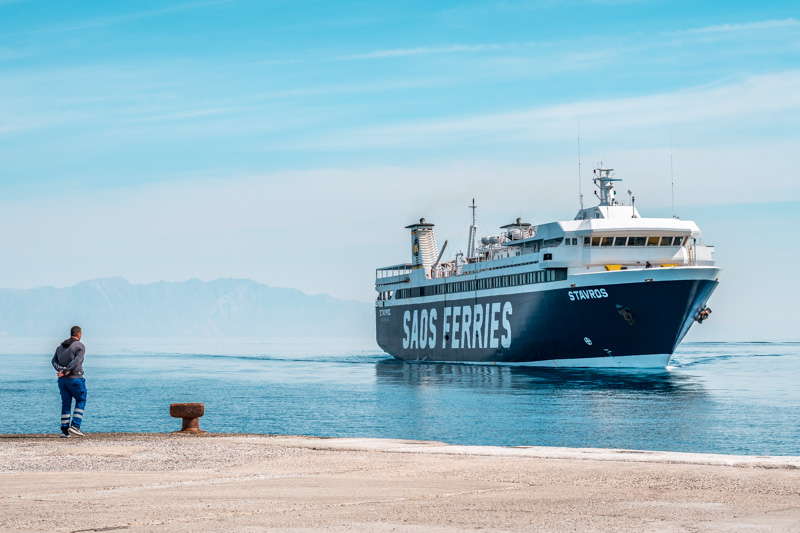
- Saos Ferries – connects part of the Dodecanese Islands with each other
➲ Book ferries for Kos, Rhodes & Co. here*
Ferries to the Sporades Islands
- Seajets – from Volos and Mantoudi to the Sporades (Skiathos, Skopelos, Alonissos)
- Aegean Flying Dolphins – from Volos and Agios Konstantinos to the Sporades Islands
- Anes Ferries – from Mantoudi to Skopelos and Skiathos
- Skyros Shipping – from Kymi to Skyros
➲ Book ferries for Skiathos, Skopelos & Co. here*
Ferries to the Ionian Islands
- Levante Ferries – from Kyllini to Zakynthos and Kefalonia
- Ionion Pelagos – from Kyllini to Kefalonia and Ithaca
- Kerkyra Seaways – from Igoumenitsa to Corfu and Paxos
- Joy Cruises – between Lefkada and islands like Meganisi and Ithaca
- Triton Ferries – from Lavrio to Kythira, Antikythira and Neapoli (Peloponnese)
- Seajets – from Piraeus to Kythira, Antikythira and Gythio (Peloponnese)
- Aspiotis Lines – from Corfu (Avliotes) to the Diapontian Islands (including Othoni)
➲ Book ferries for Zakynthos, Kefalonia & Co. here*

Ferries to the Saronic Islands
- Blue Star Ferries – from Piraeus to Aegina, Poros, Hydra, Ermioni, Spetses and Porto Heli (Peloponnese)
- Alpha Lines – from Piraeus to Hydra, Poros and Spetses
- Hellenic Seaways – from Piraeus to Aegina, Poros, Hydra and Spetses
- Aegina Ferries, San Lorenzo Ferries, Aegean Flying Dolphins – from Piraeus to Aegina
➲ Book ferries for Aegina, Hydra & Co. here*

Ferries to the North Aegean Islands
- Blue Star Ferries – from Piraeus to Chios, Lesvos, Limnos and Samos
- Hellenic Seaways – from Thessaloniki and Kavala to Chios, Lesvos, Limnos and Samos
- Zante Ferries – from Alexandroupolis to Samothrace and Limnos
- Thassos Ferries – from Kavala to Thassos
➲ Book ferries for Samos, Lesbos & Co. here*

Ferries to Crete
- Minoan Lines – from Piraeus to Heraklion
- ANEK Lines – from Piraeus to Chania and Heraklion
- Blue Star Ferries – from Piraeus to Heraklion
- Super Fast Ferries – from Piraeus to Heraklion
- SeaJets – from Piraeus via the Cyclades to Heraklion
➲ Book ferries for Heraklion & Chania here*
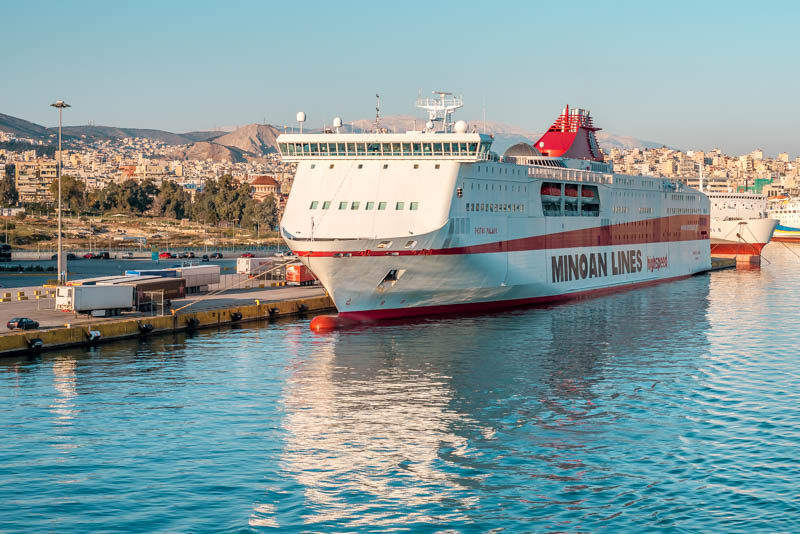
#8 Ferry types: From car ferries to high-speed catamarans
The Greek ferry network is one of the most comprehensive and efficient in the world. There are four main types of ferries for transporting passengers, vehicles, and goods of all kinds. They differ in speed, convenience and price. In the Mediterranean around Greece, especially in the Aegean Sea, strong winds occur at times, which can affect small ferries in particular.
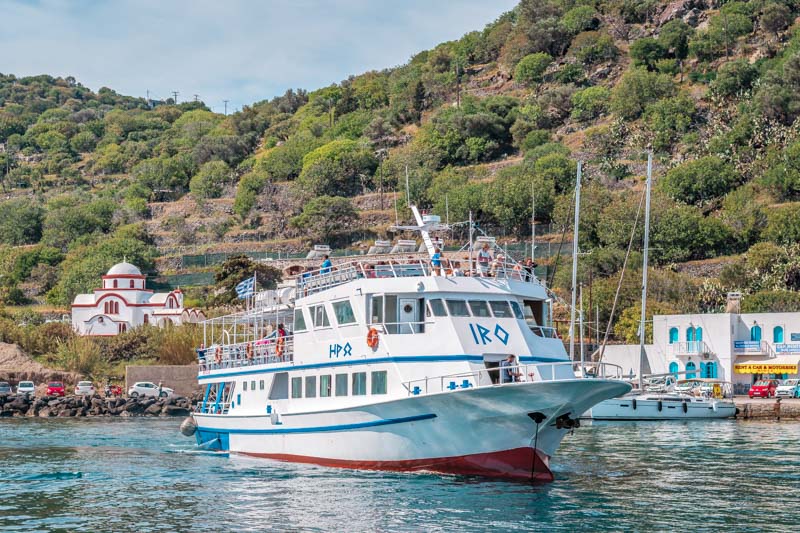
Passenger Ferries in Greece
- relatively slow crossing
- cheapest ferries from Greece
- Ticket purchase on the ship or at the port
- compact design, little comfort with only one seat category
- usually operates between two islands as a supply or excursion ship
- depending on size, quite susceptible to waves
- run several times a week
- only sail up to a maximum of 5 wind forces
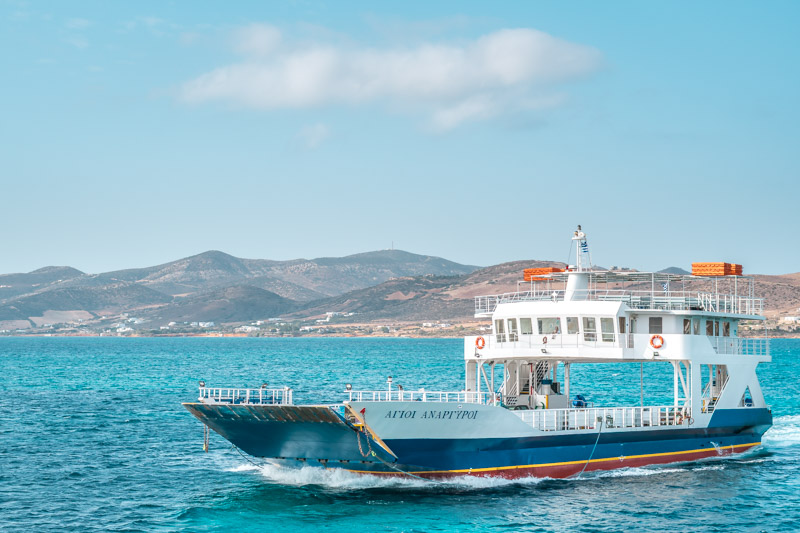
Small Ro-Ro Ferries
- slow speed
- very reasonable ticket prices
- simple comfort, usually only one seat category
- the outdoor area invites you to sunbathe
- open design, thus plenty of storage space for cars
- also called “pantofles” by the locals because of its shape
- operate only between two islands (e.g. Paros-Antiparos, Milos-Kimolos, Kos-Kalymnos)
- Driving fitness only up to wind force 4/5
Large car ferries in Greece
- medium speed
- still inexpensive crossing possible
- Ticket purchase online or at the ticket office at the port
- have cafes, restaurants and sun deck
- different seating categories and even cabins
- Transport of vehicles and goods of all kinds
- even high waves are barely noticeable
- run daily or every 2-4 days, depending on the destination
- depending on the swell up to wind force 8 ready to sail

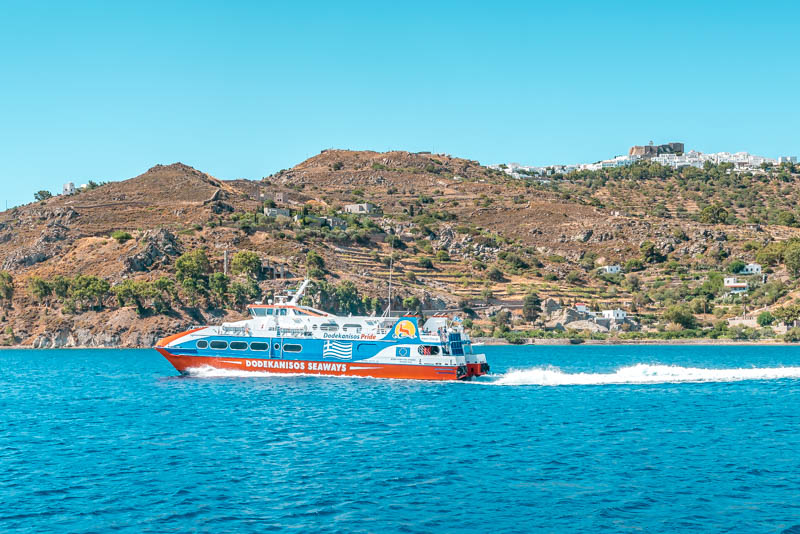
High-speed catamarans in Greece
- high speed
- relatively expensive even for short crossings
- High level of comfort like on an airplane with several seat categories
- Outdoor area uncomfortable while driving
- depending on the size, only a few car parking spaces
- wobbly ride in waves, not for seasick people
- travel between islands almost daily in summer
- Driving fitness only up to wind force 6
#9 Our experiences with ferries in Greece
In all the years we have been traveling from island to island in Greece, we have luckily never made negative experiences with ferries. One of the most important findings was: Never take a flight and a ferry trip in one day. And yes, the ferries don’t always arrive on time, but it is the same with our Deutsche Bahn in Germany.
Despite the many people and the additional load of cars and trucks, it is amazing to us that most Greek ferries almost keep to their travel times. Sometimes, we as passengers had more to do with being at the port on time. This is often overlooked. It is advisable to drive along the route to the port beforehand.
We will never forget a hectic car ride to the port of Piraeus, where we were just the last to get on the ferry. We remember curious ferry crossings to tranquil islands, which are definitely known as Greece Insider Tips. With small boats we went over to Telendos, Kasos & Co. together with the locals, what an experience!
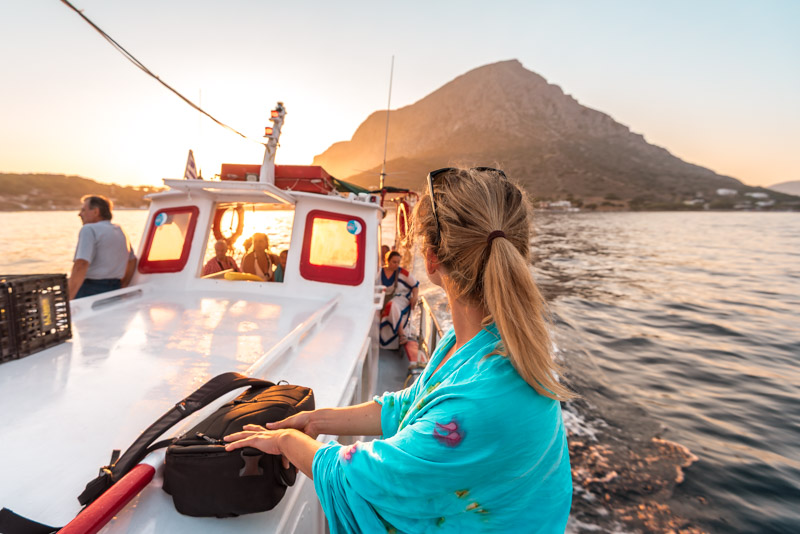
During the low season, we purchase our ferry tickets either on site or a few days before arriving in Greece. There were hardly ever bottlenecks. When we needed a cabin, we always booked it a few weeks in advance. Here the capacity is really limited and with a toddler it is quieter to sleep in a bed at sea than in an armchair.
→ Here you have our Tips for Traveling by Ferry in Greece:
- Flight and ferry ride never in one day, better plan 1-2 days buffer
- Bargain hunters travel with local ferries as foot passengers
- Catamarans are the fastest way to travel from island to island
- Small passenger boats are the coziest way to travel
- Real Greece insider tips can only be reached by ferry
- if possible, travel by ferry in the low season and not in summer
- inform about the accessibility of the port with GoogleMaps
- plan enough time when island hopping in Greece to stay flexible
- if on site: if anything is unclear, it is better to go to the ticket office and get advice
- Use portals such as Ferryhopper.com to display all connections
#10 Island hopping with ferries in Greece
Island hopping in Greece is the supreme discipline of traveling by ferry to the Greek islands. Here you don’t just have to organize a crossing, but combine several stations and find the right accommodations on site. There are hardly any limits to your desire to explore, except of course the availability of the respective ferries.
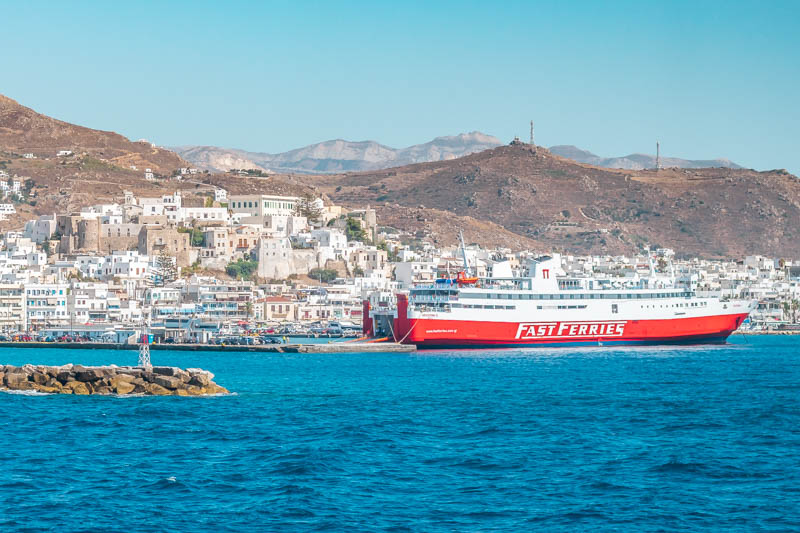
Island hopping usually takes place within a group of islands, i.e. on the Cyclades, the Dodecanese, the Sporades or the Ionian Islands. Depending on your mood and time, you will spend between 2 and 5 days on each island. Afterwards we continue by ferry to the next Greek island. Once you’ve caught the island-hopping fever, you’ll always want to head for new destinations – because every island is a world of its own!
→ In this article you will find detailed tips on island hopping: Island hopping Greece
→ If you want more helpful posts about the Greek islands and lots of Tips for Greece you will find it here:
*Support our blog Greece-Moments
In this post, you will find affiliate links marked with an asterisk (*). If you book or buy something through one of these links, we receive a small commission. For you, the price remains the same. In this way, you help us continue to provide high-quality content for free. Did you like this post and you would like to say thank you? Then just buy us the next Greek coffee ☕️ To the coffee fund
Bookmark this post on Pinterest!


