

Far removed from the international tourist hustle and bustle of the other Cyclades, Serifos lies in the western part of the archipelago. Not much happens on Serifos, and that is precisely what gives this unassuming island its charm. As you stroll through the whitewashed alleys of Chora, you can enjoy the ever-present light and feel as though you’re close to heaven when you see the radiant churches.
People come to Serifos to immerse themselves in the Cycladic atmosphere and relax away from the stress of everyday life.
Tom & Ella
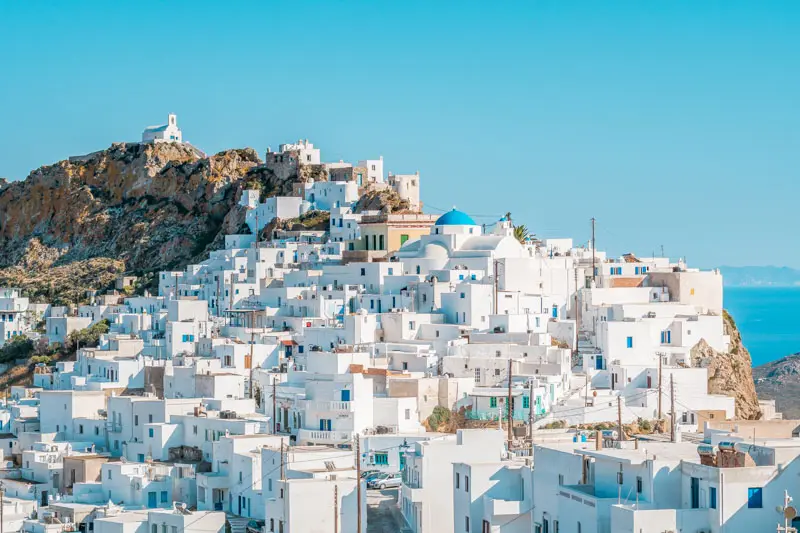
Serifos is compact and not an island for adventurous explorers. The landscape is barren, yet charming with its seemingly endless hills, inviting you to go hiking. In the hinterland, Serifos is largely deserted; only two places are truly bustling: Livadi by the sea and the upper village of Chora, situated above it.
The latter is the epitome of a Cycladic dream come true and, for that reason alone, worth a trip to the island for Greece enthusiasts. In addition, Serifos offers a wide variety of beaches, ranging from golden sand to brown gravel and colorful pebbles, many of which remain deserted even in summer.
Join us on a tour of the island; we’ll show you the spots we particularly loved and what the most popular sights on Serifos are:
#1 Chora: A Postcard Image of Serifos
We visited Serifos as part of our island-hopping trip through Milos – Kimolos – Sifnos – Serifos – Kythnos in May. It’s not easy for this small, 75-square-kilometer island—which remains relatively unknown—to shine alongside Cycladic gems like Milos and Kimolos. Unknown, that is, only to international tourists; mainland Greeks have long appreciated this little island as a weekend and summer getaway.
During the off-season, we found Serifos to be tranquil; the island was slowly awakening from its winter slumber. As you enter the harbor, you’re greeted by a spectacular backdrop; high above the sea, the picturesque Chora practically calls out to you: “Welcome to Serifos!”

A stroll through the alleys of Chora
The postcard-perfect image of Serifos rises 200 meters above the sea on a rocky promontory. The main settlement of Serifos looks as if an artist had painted a sea of white houses into the barren brown landscape; the summit is crowned by a cluster of chapels. Alongside Chora in Astypalea and Patmos Chora, it is arguably the most beautiful hilltop town in Greece.
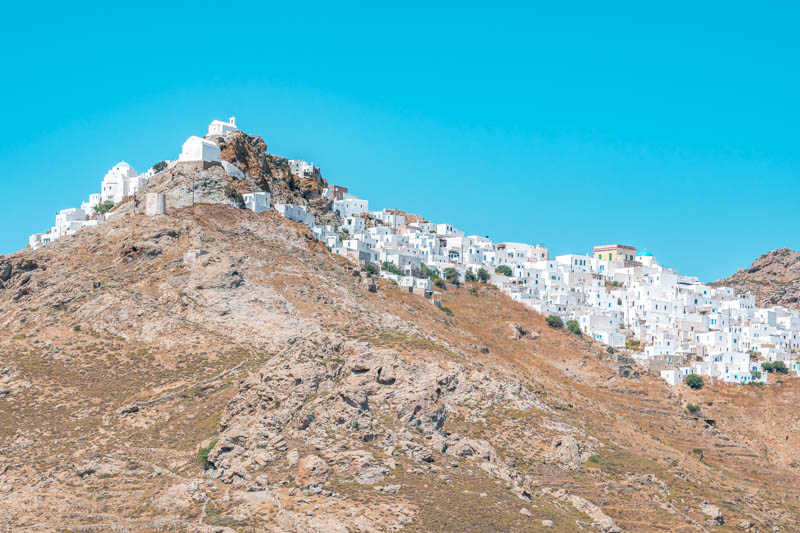
A winding road leads up to the upper part of the village to the free parking lot below the windmills. The village of 400 residents consists of a lower and an upper part, Kato and Pano Chora. Kato Chora, along with the large Evangelistria Church, has remained a neighborhood for the locals; there are no places to stop for refreshments.
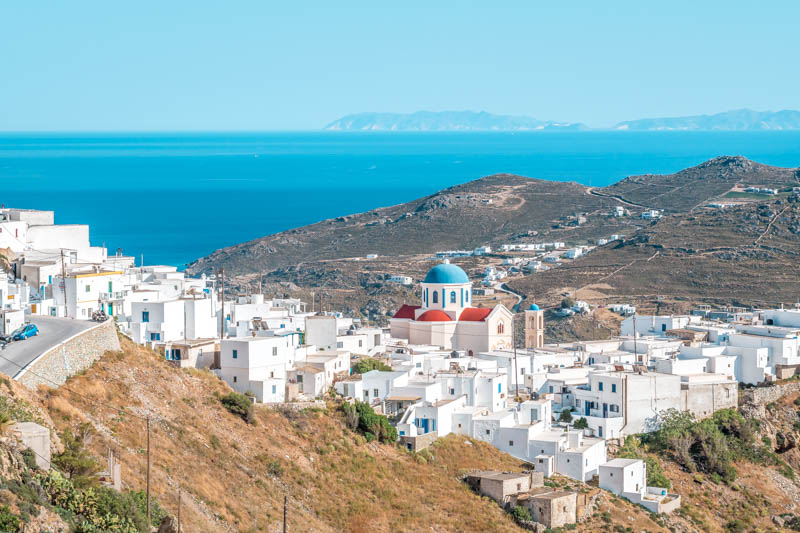
In Pano Chora, on the other hand, life is in full swing; a good dozen taverns, cafés, and especially bars (tip: Vatrachos) are scattered throughout the maze of alleys, joined by unique shops (recommendation: Argilos Gallery Shop) and a few arts-and-crafts stores. In the summer, the local bars turn night into day.
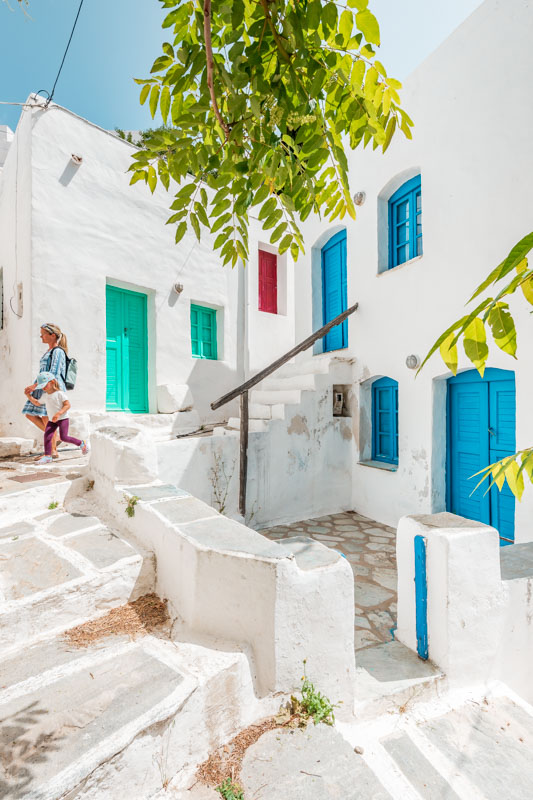
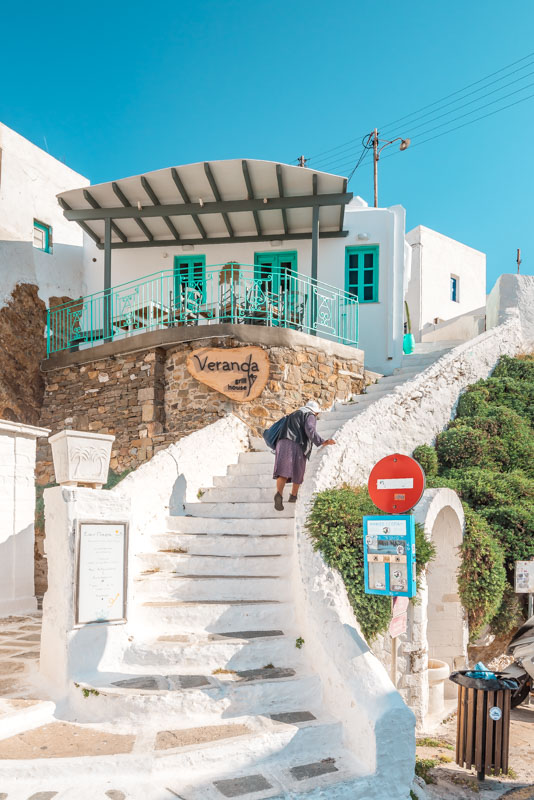
According to the locals, especially in August, Serifos experiences “poly kosmo” on some days—which means a lot of hustle and bustle. The road up to Chora is often congested, and parking spots are hard to find. In mid-May, however, it was very quiet; only a few cafés and shops were open yet, and preparations were still underway everywhere.
💡 Hike to Chora: In the past, only a steep mule trail (200 meters elevation gain, 2 km) led from the sea up to Chora. The picturesque path is still well-preserved; it takes at least 30 minutes to walk from Livadi to Kato Chora. Just below the Agios Isidoros chapel, the trail climbs straight up for a kilometer on whitewashed steps. Caution: You’ll cross the main road repeatedly. Additional hiking trails on the island have been established by the Walking Serifos initiative.
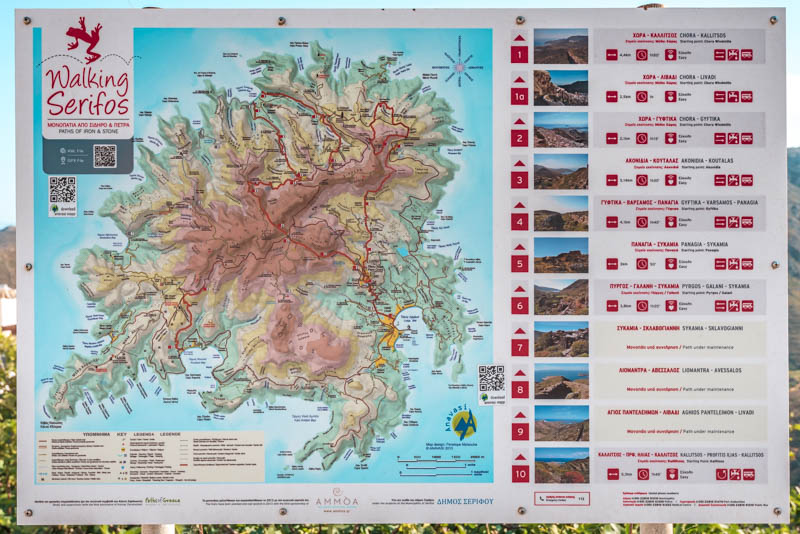
Hiking map from Walking Serifos
From Pano Piatsa to Kastro
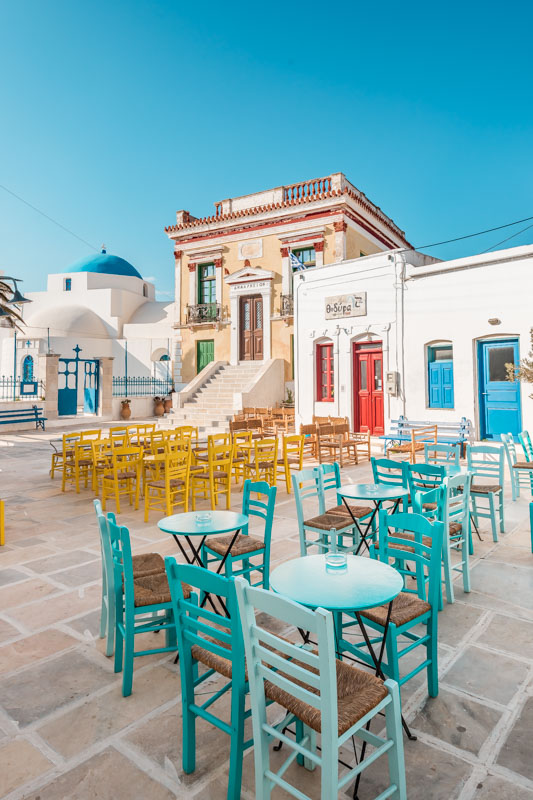
The hub of Chora is Pano Piatsa, the upper village square. It’s a pretty sight with its neoclassical town hall, the blue-and-white church of Agios Athanasios, and the cafés with their colorful wicker chairs. A cool espresso freddo or frappé on the Platia is a must-do during a vacation in Serifos.

Afterward, take a leisurely stroll through the narrow streets, which offer plenty of beautiful photo opportunities. Sometimes you’ll even see mules passing by—they’re used in Chora to transport goods. Chora was founded in the Middle Ages; atop the rock once stood a fortress, also known as Kastro of Chora, which offered protection against impending pirate attacks.
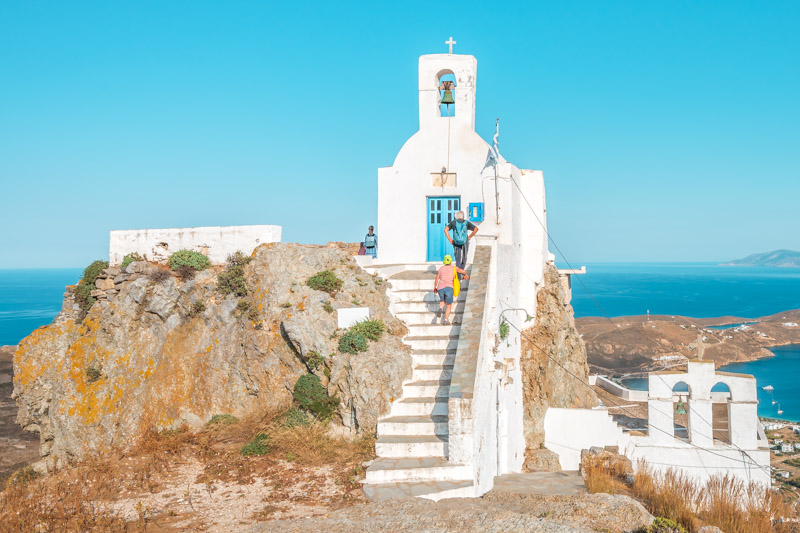
Apart from a few walls, nothing remains of the medieval fortress. Nevertheless, the climb is worth it (signposted “proz kaztro”), as the unobstructed view of Livadi Bay and the Aegean Sea, with the neighboring island of Sifnos, is sensational at any time of day. The surrounding hilltop churches of Ag. Konstantinos, Ag. Barbaras, and Ag. Ioannis lend the scenery a heavenly atmosphere.
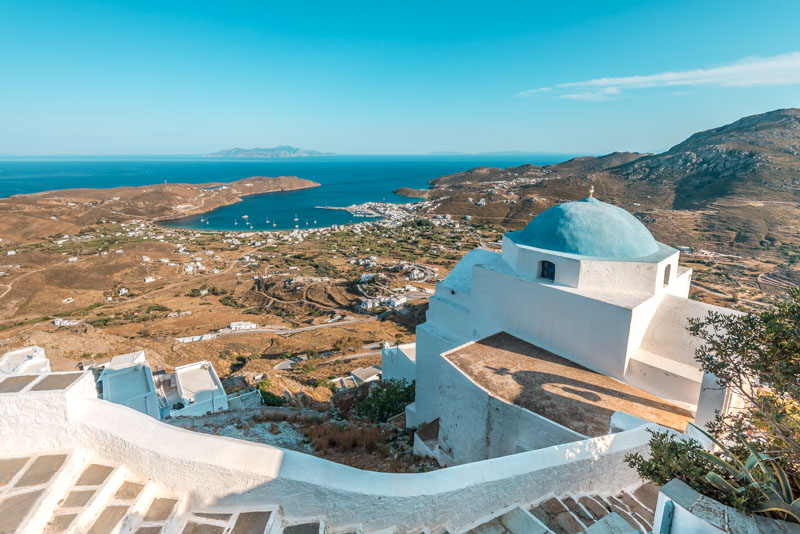
#2 The Port Town of Livadi
Livadi is home to the port of Serifos, where every visitor first sets foot on land. Together with Livadakia and Avlomonas, it is now the island’s largest municipality and also its greenest spot, as Livadi means “fertile meadows.” Founded in 1870 as a port solely for mining shipments, life now thrives in this village of 500 souls.

Numerous taverns, cafés, and bars line Livadi’s long waterfront promenade. Behind them stretch haphazardly built apartment complexes and small hotel resorts. Livadi is not exactly an architectural masterpiece, there is no classic town center, and development occurred too quickly and likely too uncontrollably. Only the long, narrow Livadi Beach has remained largely untouched.
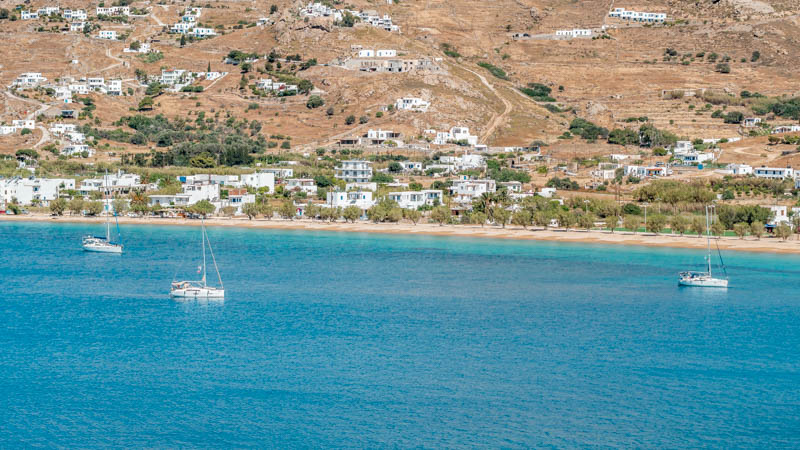
Livadi has experienced a tourism boom, especially in the last 5 years. In search of seclusion, quite a few vacationers have avoided the trendy destinations with mass tourism and increasingly sought out modest islands like Serifos. Nevertheless, most travelers only come to the island in the summer; sailors also appreciate Serifos in the off-season.
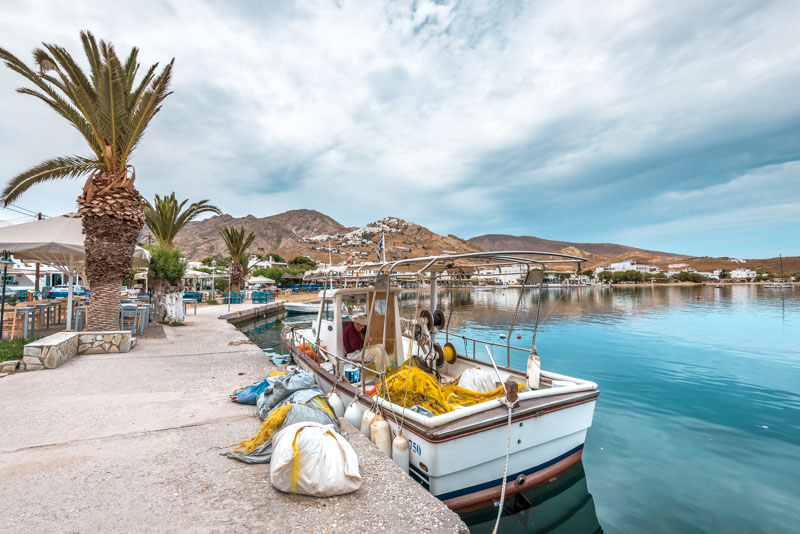
In May, things were still quiet in Livadi, but we were surprised that almost all of the more than 20 taverns and cafés by the sea were open. Too much of a good thing for our taste, but certainly a dream for people who love variety. In the town center, there is nothing special besides a few shops and souvenir stores; the boutique Calle 31 is worth mentioning here.
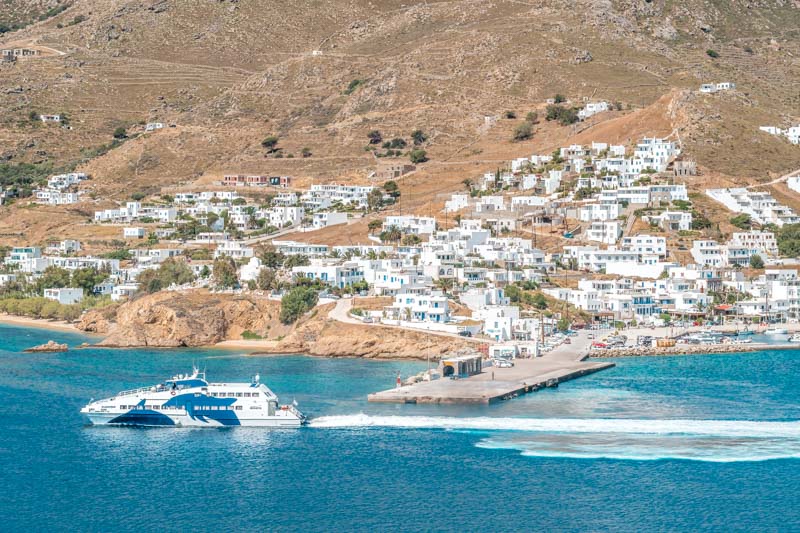
So, in Livadi, there’s not much more to do than stroll along the seafront. History buffs might also visit the Serifos Archaeological Museum (daily 8:30 a.m.–3:30 p.m., closed Tuesdays) behind the Yacht Club Café, which showcases the island’s artifacts in a compact space. Due to the heavy sailing and ferry traffic, we recommend the neighboring Livadakia Beach for swimming.
Relaxing at Livadakia Beach
Livadakia is an extension of Livadi to the south. Most of the buildings date from the last few decades; the settlement, located directly on the sandy beach of the same name, consists mainly of small 2- or 3-star hotels and apartment complexes. The majority of Serifos vacationers stay in Livadakia (our recommendation: Galazio Suites).

It’s understandable that Livadakia Beach, with its golden sand and turquoise sea, is a wonderful place to relax. The Vassilia All Day Beach Bar and the Alexandros Taverna rent out lounge chairs and cater to your culinary needs. From the dune hill at the end of the beach, you can enjoy a beautiful view of Livadi and Chora.
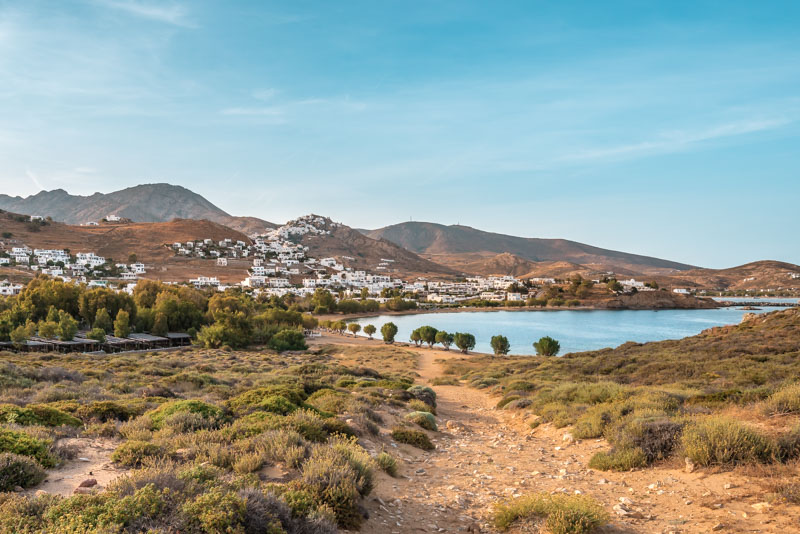
If you continue along the gravel path, you’ll reach Karavi Beach in 5 minutes—a popular nude beach on Serifos that’s unmanaged and therefore rarely visited. The Serifos campground is also located at Livadakia Beach. Once a popular vacation spot for Greek families, Coralli Camping is slowly transforming into the Coralli Seaside Resort. Are the simple times on Serifos coming to an end?
💡 Serifos Book Tip: The Greek Islands travel guide from Lonely Planet includes a chapter on Serifos with numerous travel tips and hiking routes: View on Amazon*
#3 Beautiful Beaches of Serifos
Just a few minutes’ drive east of Livadi lie what are arguably the island’s most beautiful beaches. Due to their proximity to the harbor, Psili Ammos, Agios Sostis, and others are also the most popular. While (almost) all are accessible by car, in summer they are so crowded that finding a parking spot becomes a nightmare. In May, however, these dream beaches of the Cyclades are almost deserted.

Agios Sostis Beach
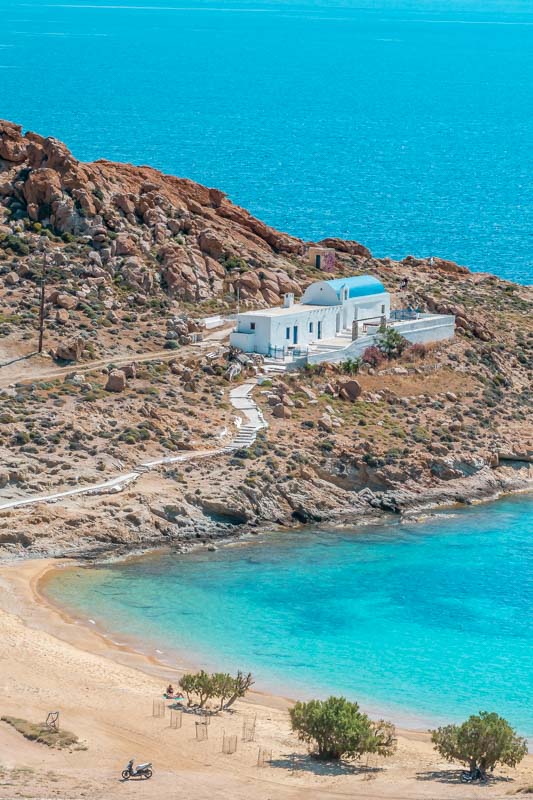
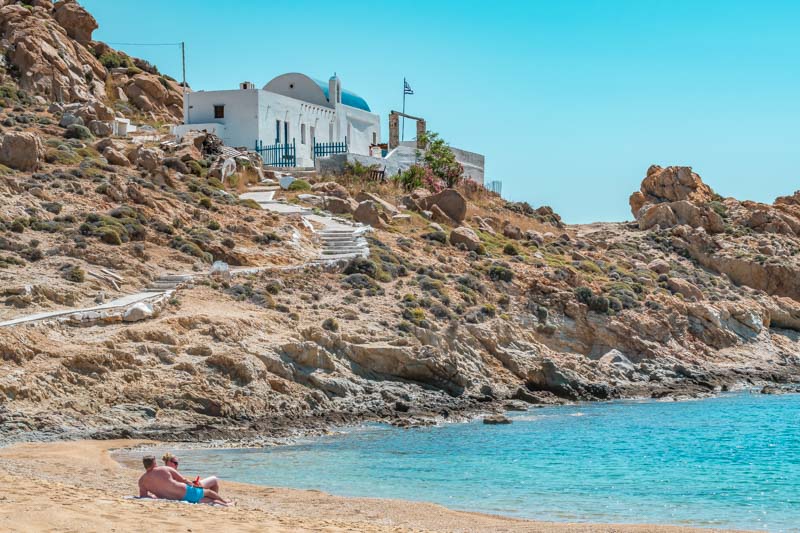
A fairytale bay awaits you at Agios Sostis. Actually, there are two: a narrow strip of sand and gravel connects Serifos to a barren rocky outcrop, atop which stands the eponymous Agios Sostis Chapel. Gleaming white, it rises above the sandy beach, while the crystal-clear sea shimmers in the most beautiful shades of blue—what a photo opportunity!
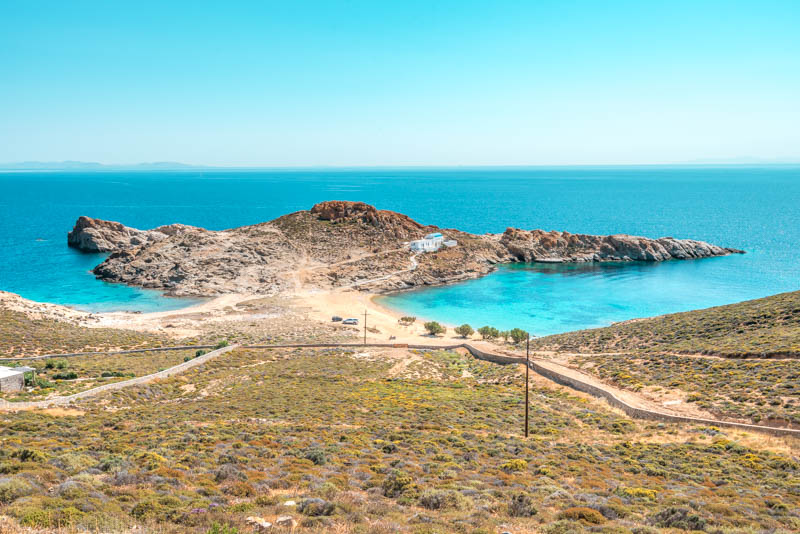
The other beach consists of pebbles; due to its north-facing orientation, all kinds of flotsam are frequently washed ashore. The dirt path down to the double beach is full of holes and ruts, so it’s best to walk down. A few tamarisk trees provide shade; there is no operator at Agios Sostis Beach.
Psili Ammos Beach
Psili Ammos is located just 4 km north of Agios Sostis Beach and is considered by many vacationers to be the most beautiful spot for swimming. At “Fine Sand” (as the beach’s name translates), there is a magnificent dune landscape, along with a row of tamarisk trees by the turquoise-blue sea, creating a paradisiacal atmosphere.
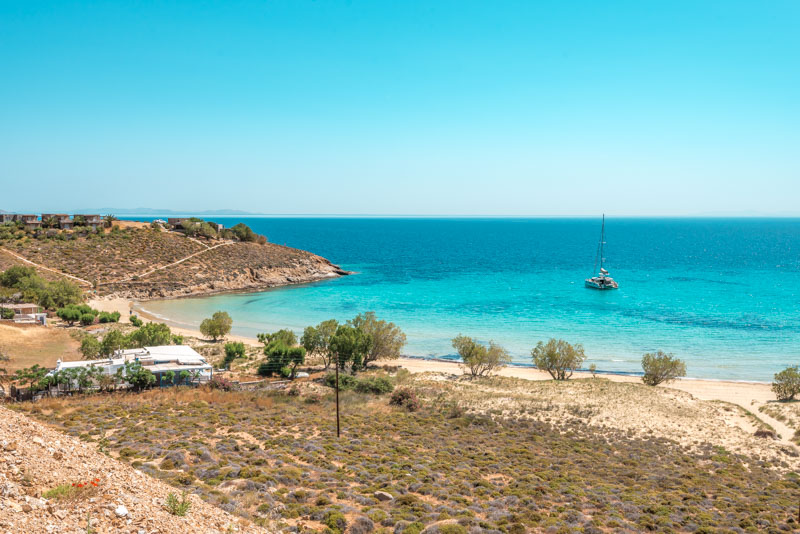
The entry into the sea is shallow, making it a comfortable spot for families with small children. Two taverns (our recommendation: Stefanakos Tavern) cater to your culinary needs on Psili Ammos Beach. Parking is available only at the two taverns or on the main road.
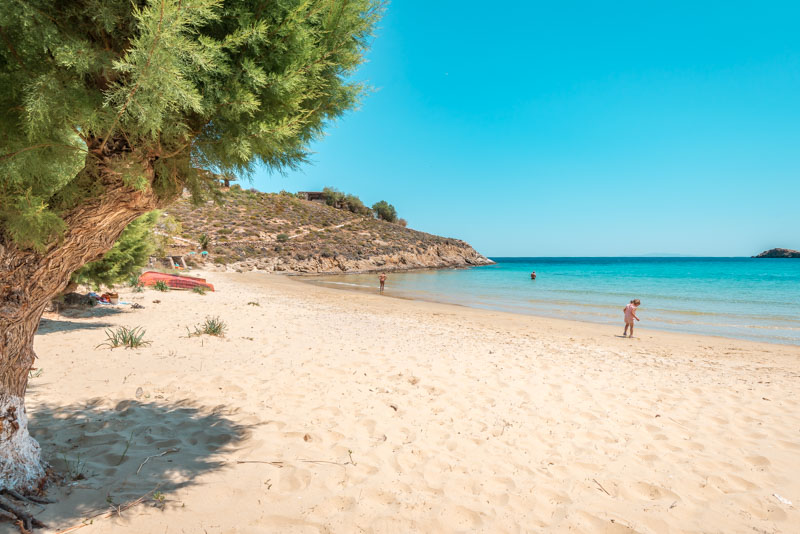
Agios Ioannis Beach
Two turns further along the main road heading north, you’ll reach Agios Ioannis Beach. As with Agios Sostis, the beach is named after a white chapel above it, which is reached by a whitewashed staircase leading down from the road—perfect for a picturesque vacation photo.

Agios Ioannis Beach is the largest of the three eastern beaches. On the southern shore, it consists of fine golden sand; further north, it gradually transitions into gravel. There are no umbrella rentals or taverns, and spots under the tamarisk trees fill up quickly in the summer.
💡 Car rental on Serifos: The island is compact and the paved road network is limited. Nevertheless, it’s worth renting a car for 1–2 days to explore the island and its secluded beaches. Basically, there is only one main road that circles the island and branches off in the middle via Chora to Livadi. You can find out what to keep in mind regarding traffic and car rentals on the Greek islands in our separate post: Car Rentals in Greece
#4 Trip to the Taxiarches Monastery
From Livadi, it’s about a 20-minute drive to the island’s most significant monastery. Passing the beaches of Psili Ammos and Ag. Ioannis, the road winds its way up to an altitude of about 400 meters. Halfway up, the village of Kentarchos, also known as Kallitsos, nestles picturesquely on a mountainside. The small hamlet, which translates to “the most beautiful,” immediately charmed us, but also disappointed us.
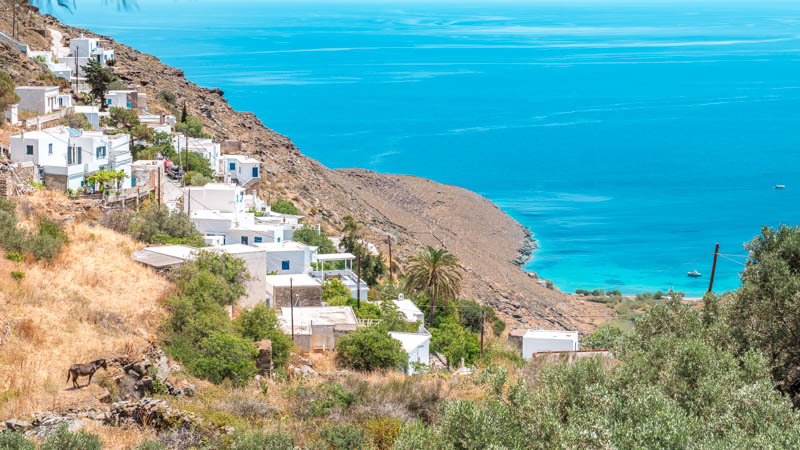
The alleys with their ornate floor patterns have long since fallen silent. Like other settlements in the hinterland of Serifos, the village has been hit hard by depopulation; only a few families, and mostly older islanders, still live here today. We would have loved to have a kafeneion here with a view of the endless blue sea. As it is, Kallitsos remains merely a stopover, which is a shame.

A short while later, you reach the Taxiarches Monastery, which stands out even from a distance due to its fortress-like construction, featuring walls up to 4 meters high and even loopholes for defense. Built in 1572 and dedicated to the Archangels Michael and Gabriel, the monastery possessed great wealth and was repeatedly subjected to pirate attacks.
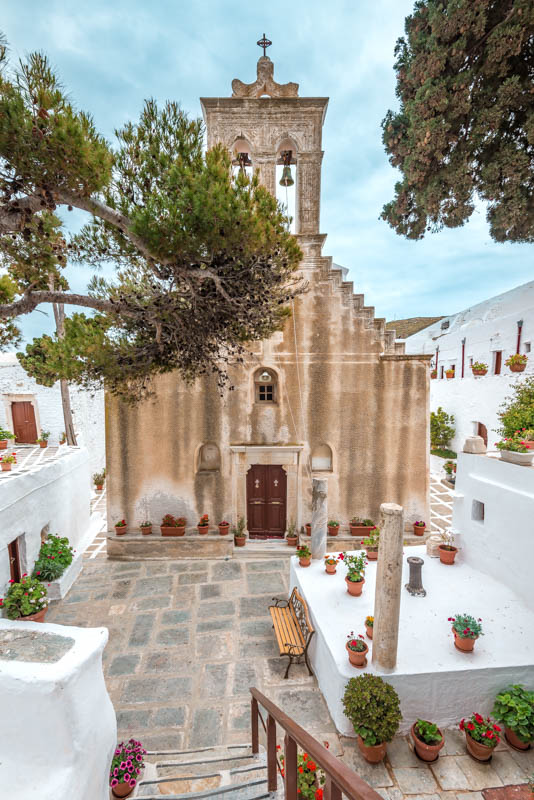

In 1617, a monastery school was established, and over the centuries, the monastery developed into the island’s religious and educational center. At its peak, up to 30 monks lived here. In recent decades, it was inhabited by only one person, Father Makarios, who passed away in 2019. His successor, Father Evdokimos, has since been offering tours of the monastery.
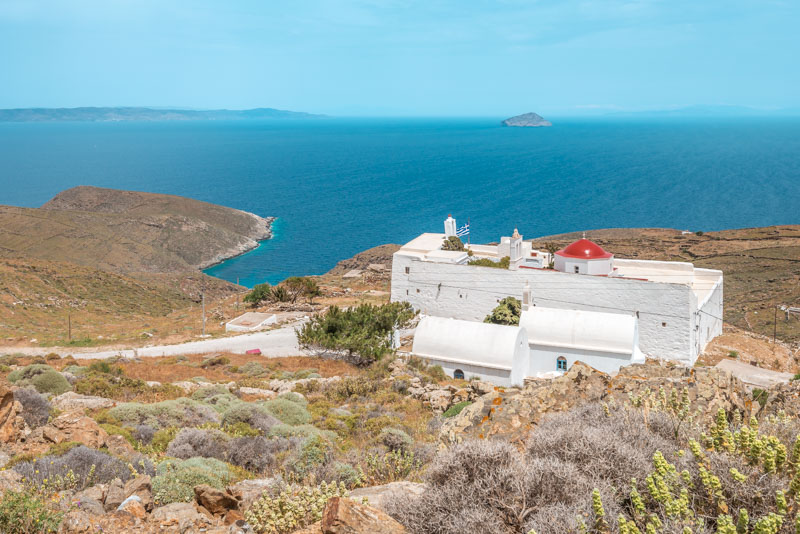
After entering through the monastery gate, you find yourself in front of the three-nave church with its blood-red dome, surrounded by a surprisingly green courtyard. This courtyard invites you to linger, and there are also a few beautiful photo opportunities to be captured. Inside the church are valuable icons and several frescoes from the original building (1447). We were unable to visit the monastery library with its ancient manuscripts.
- Opening hours for Taxiarchis Monastery on Serifos: 9:00 AM–1:30 PM and 4:30 PM–7:00 PM, free admission (donations appreciated)
Photo stop at Panagia Skopiani
About two kilometers before the Archangel Monastery, one of the island’s most beautiful photo spots awaits you: the Panagia Skopiani church. Barely visible from the main road, a whitewashed staircase leads down to the church. Like many churches on Serifos, it is unfortunately closed, but the view of the Aegean Sea and the neighboring islands of Kythnos and Syros makes up for it.
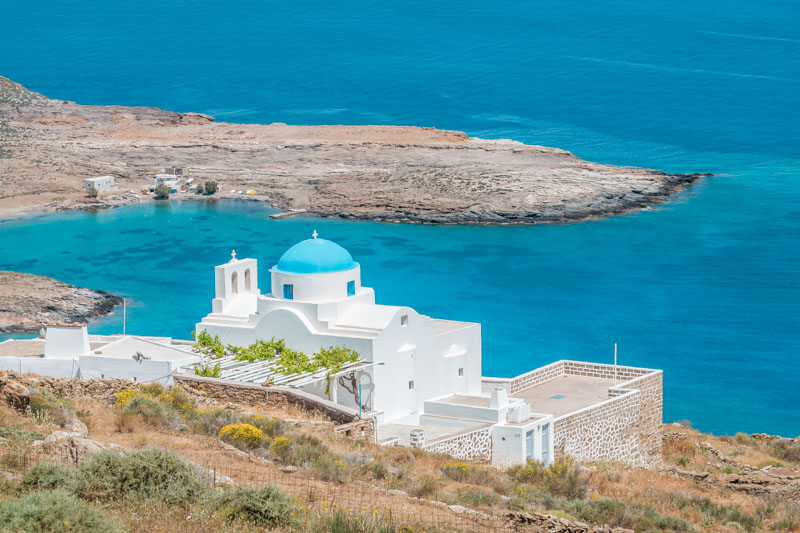
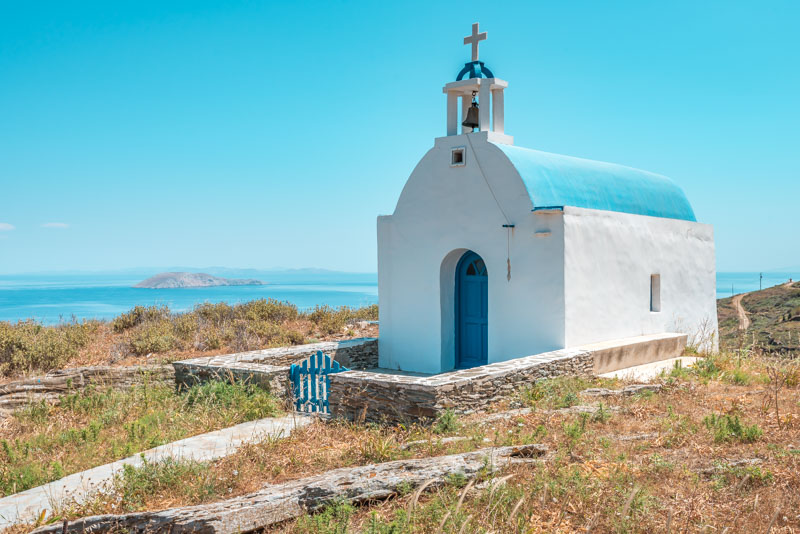
If you have the chance, you can take part in the big church festival on August 14, the eve of the Assumption of Mary. Then the village comes to life for a short time, and the church square is atmospherically lit. Another pretty little church (Agios Minas) stands on the access road to Platis Gialos Beach, also worth a photo stop.
#5 Northern Serifos: Between Vineyards and Solitude
The north of Serifos is characterized by steep mountains with thousands of terraces where vegetables, grains, and wine were once grown. Although viticulture on Serifos dates back to ancient times, many farmers have given up cultivating the steep terraced slopes. The work is arduous; machines are out of place here; everything is done by hand, with only mules and donkeys to help.

According to historian Ludwig Ross, 4,000 tons of wine were still being exported annually at the beginning of the 19th century. After World War II, wine production came to a complete standstill. Interestingly, wild stands of old local grape varieties still exist throughout the island; up to 20 varieties have been identified so far.
Since 2015, the island’s wine culture has been revived at Chrysoloras Winery. Production today stands at 15,000 to 20,000 bottles per year. Nine fine wines, including 7 organic wines, are now available, among them the island’s signature white wine Ksiro Chorio (Greek for “dry village”), an aromatic, dry white wine with low acidity that lives up to its name.

Also worth highlighting are the Oranz Wine, which winemaker Christos ages for several months in large clay amphorae, giving it an orange color and a distinctive flavor, and the rosé wine Charoumenos Vatrachos, translated as “cheerful frog,” a nod to the many frogs on Serifos that are said to spend the winter and spring here.
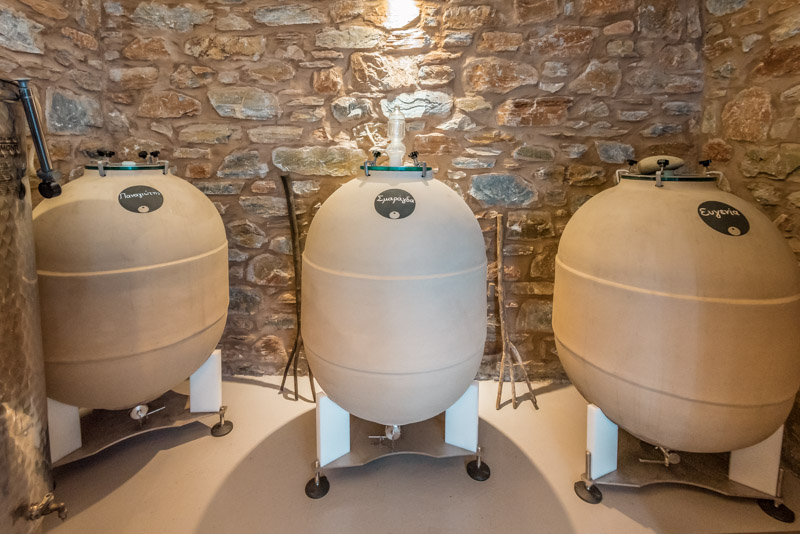
The only commercial winery on Serifos is located about 1 km above the Taxiarchis Monastery. Wine prices start at €12; our favorite was the Aspalathros rosé. A wine tasting includes a small snack platter on the winery’s terrace. Advance reservations are recommended; for more information, visit: Chrysoloras Winery
Lunch Break in Platis Gialos
For a refreshing dip in the cool sea or a lunch break accompanied by the sound of the waves, it’s worth taking a detour to the scattered settlement of Platis Gialos below. A bumpy concrete road leads past farms down to the sea. At Messiano Bay, the family-run tavern Nikoulias serves up delicious food from May through October.
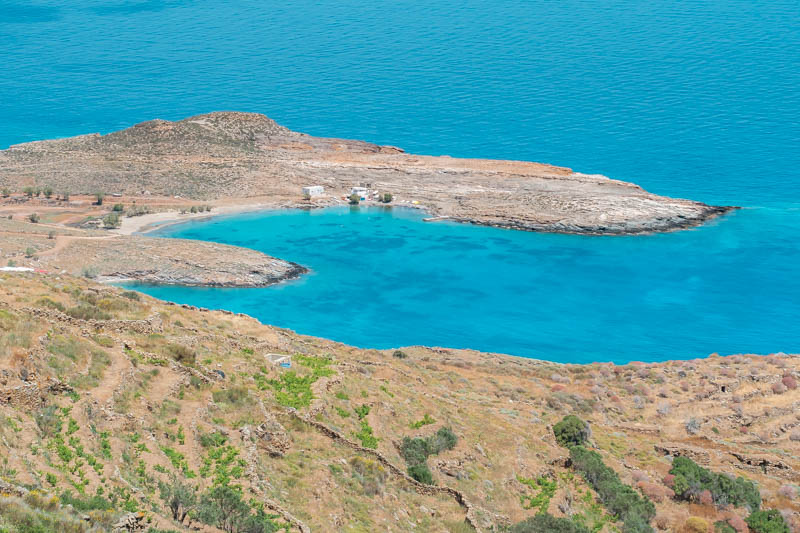
The view of the sea is incredibly relaxing, and in a peaceful atmosphere, typical island dishes such as fennel balls and other traditional Greek fare are served. We have great respect for their willingness to welcome guests in such a remote part of the island. One of the few taverns outside of Livadi or Chorio!

Panagia and Sikamia Beach
There isn’t much else to discover in the north of Serifos. The small mountain villages of Galini, Pyrgos, and Panagia, which nestle closely against the slopes, do have a certain charm, but they lack vitality. Rural exodus is on the rise here; many places are already abandoned, and young people are drawn to Livadi or even further afield to Athens.
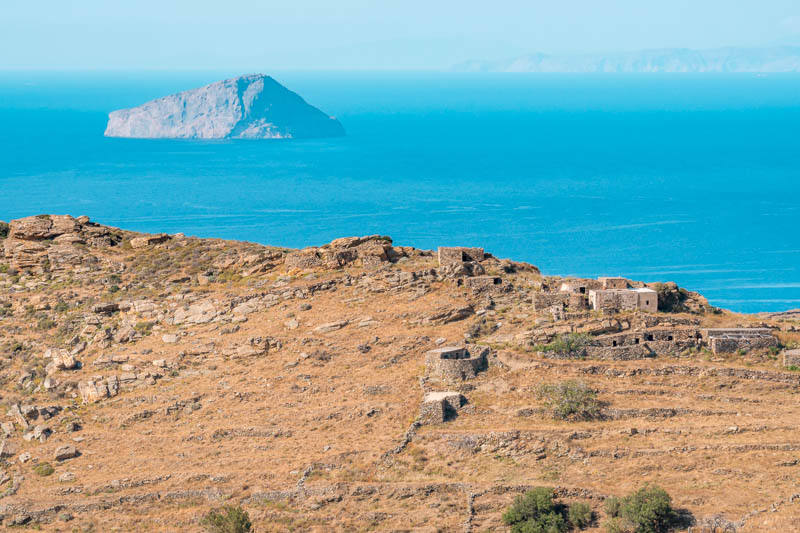
We took a walk through the largest village in the north, Panagia, hoping that Antonia Gerontari’s local kafeneion was still open. Unfortunately, no such luck! There used to be eight coffeehouses in the village. It’s a shame, because the village center is home to the oldest church on Serifos, called Xylopanagia (11th century). The church is locked, and while the pretty square invites you to linger, it has long since fallen silent.
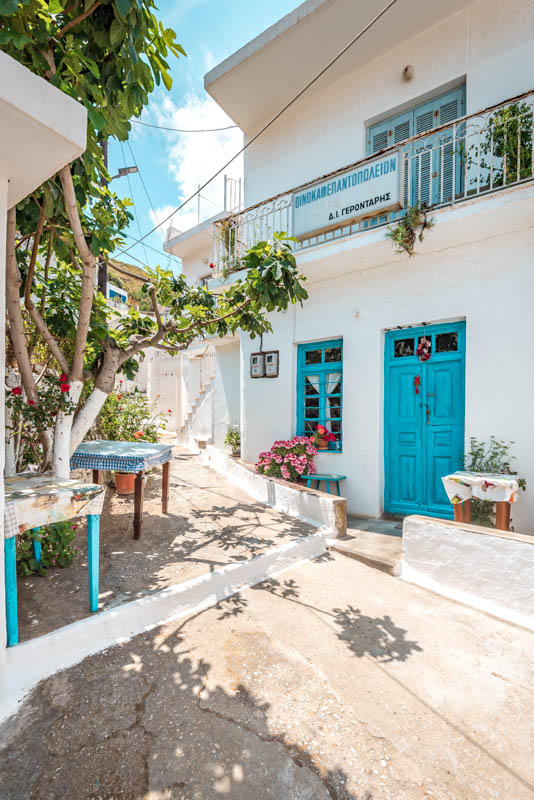
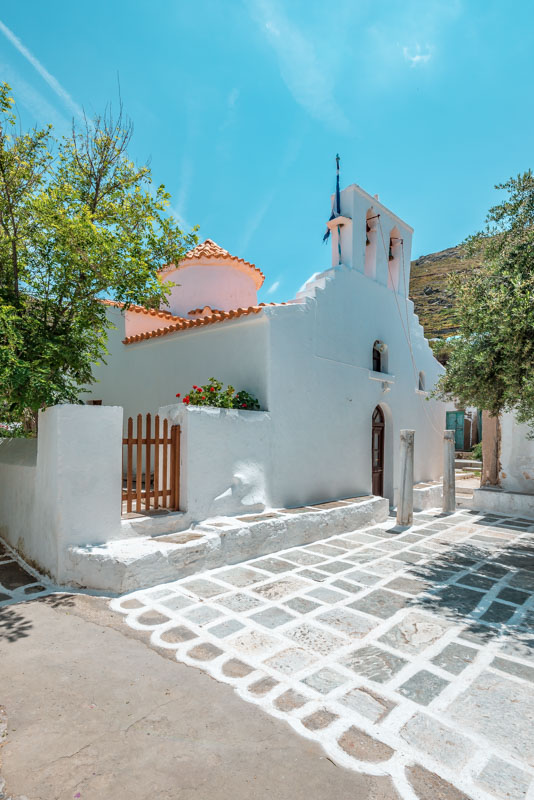
So there’s nothing left to do but head back to Chora or Livadi; at least the road above the ancient terraced fields offers scenic views. Those who love solitude can drive down to the wild Sikamia Beach, where the family-run tavern To Akrogiali tou Vitou opens its doors during the summer months.
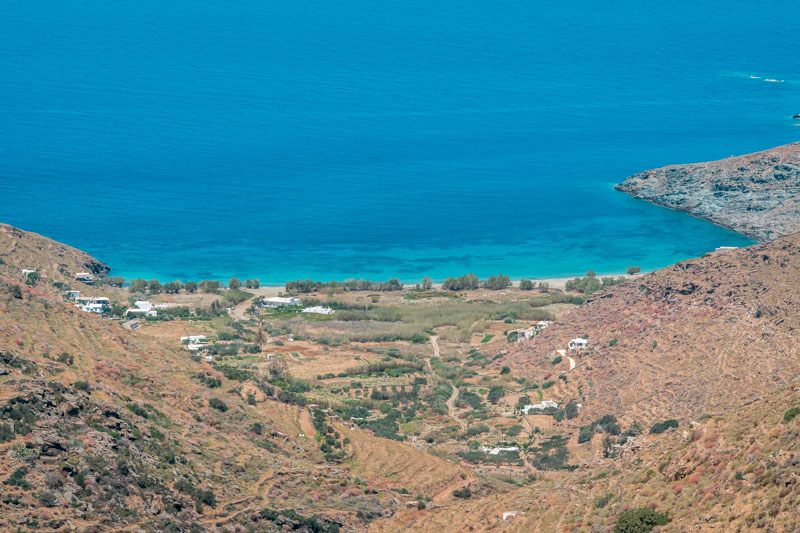
#6 Koutalas Bay
Many treeless hills and quite green valleys, plus a rugged coastline with stunning bays—that’s the west of Serifos. The wind-sheltered anchorages are a paradise for sailors, but water lovers will also find plenty to enjoy on the many beaches. From Livadi or Livadakia, it takes about 30 minutes (15 km) to reach the village of Megalo Livadi in the far west.

The drive is very picturesque, following the coastline with stunning views of the Aegean Sea and the neighboring islands of Kimolos and Milos in the distance. Koutalas Bay, in particular, is a real highlight; three large beaches offer plenty of space even in summer, so everyone can find a quiet spot.

On the beaches of Vagia, Ganema, and Koutalas, which nestle against the bay, simple beach bars open in the summer, serving refreshments and, in some cases, renting out lounge chairs. Most beachgoers, however, seek out a spot under the tamarisk trees or bring their own beach umbrella. During our visit in May, the three beaches (all pebbly) were deserted.
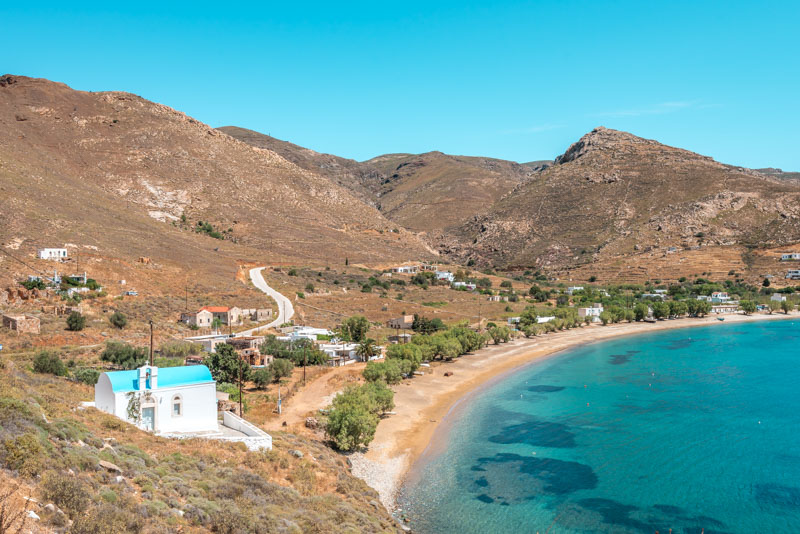
Near Koutalas, you come across the first remnants of mining. Rusty trucks and mine cars stand by the roadside, and not far from the Agia Theodora Church, you can still find the remains of an old loading ramp by the sea. Pits and holes are visible throughout the mountains, appearing like craters in the landscape.

Aspros Kavos: Serifos’ Mysterious Cape
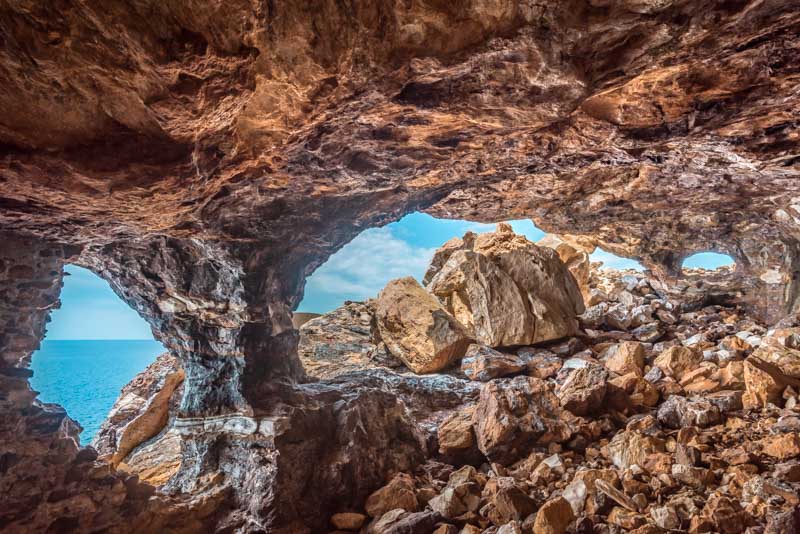
It is a well-kept secret: right by the sea lie the bizarre remains of centuries-old mines, known to the locals as “White Cape,” or Aspros Kavos. Ore was likely mined here as early as the Middle Ages. Particularly striking are the many different rock layers, which give the area a unique character.

White, beige, violet, red, and brown—the bizarre rocks shimmer as they drop several meters into the sea. You can explore the area from a plateau of light-colored rock. Above it stretch several tunnels that can be visited at your own risk.
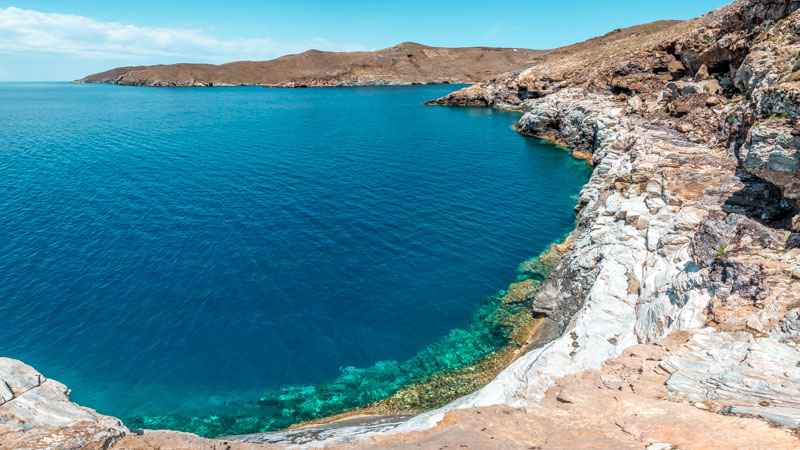
Sturdy footwear and athletic agility are required to explore the former mine. A small path leads down to the sea, where a large grotto is located. When the waves are calm, you can jump into the crystal-clear water from here.
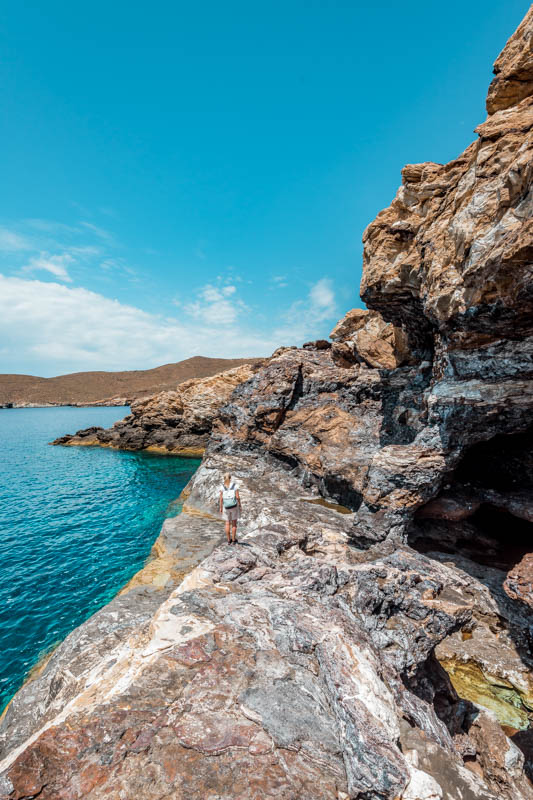

Aspros Kavos is located on the way to Megalo Livadi at the entrance to Koutalas Bay, but it is marked on almost no map and is not signposted. It’s best to ask the locals for the exact location, if they even know it themselves.
#7 Mining Village of Megalo Livadi
The further west you drive, the more barren the landscape becomes; no trees grow here anymore, just a few farmhouses and white little churches add splashes of color to the wasteland. Behind Malliadiko Beach, the road climbs up a ridge; at the turnoff into the mountains, follow the signs to Megalo Livadi and you’ll reach the sea through a long valley.
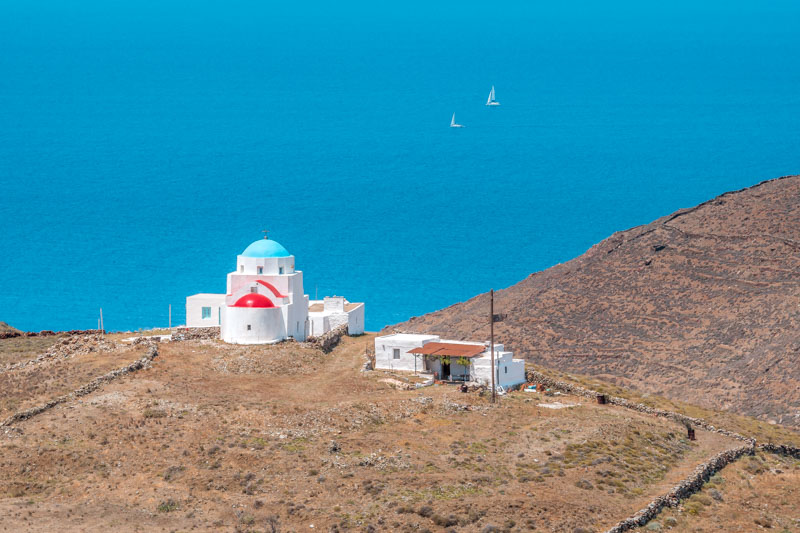
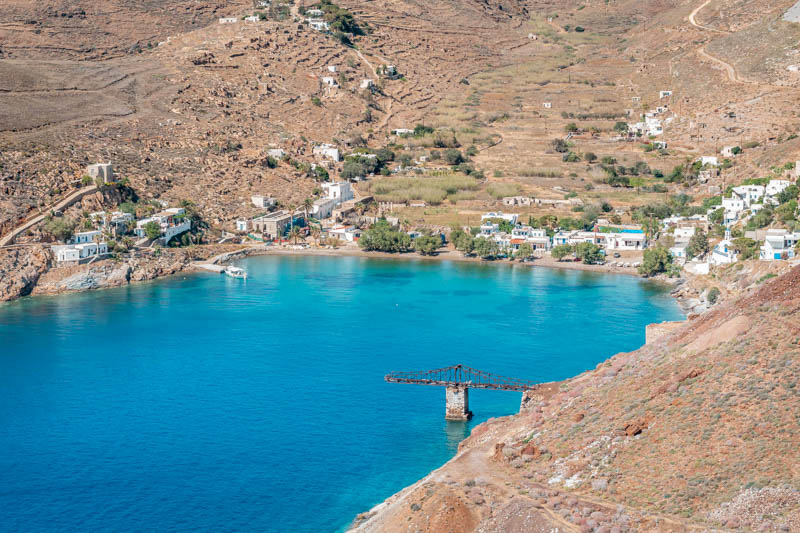
The valley once housed 700 inhabitants, stretching from the port of Megalo Livadi to the upper village of Megalo Chorio. Starting in 1861, iron ore was mined here for 100 years, and many people from other islands came to Serifos to work. The island’s population doubled by 1910 to over 4,000 people, half of whom were employed in mining.
The main operator was initially a Greek company, later the French company Serifos-Spilialeza under the management of the German Grohmann family. In 1916, the miners successfully rebelled against the miserable working conditions and fought a bloody battle to secure the 40-hour workweek and higher wages.
In Megalo Livadi, a monument now commemorates the miners’ struggle against oppression. After the closure of the copper and iron ore mines in the 1950s and 1960s, many residents left the village due to a lack of job opportunities; quite a few even turned their backs on Serifos. There are numerous tunnels throughout the area, but we advise against exploring them due to the risk of collapse.
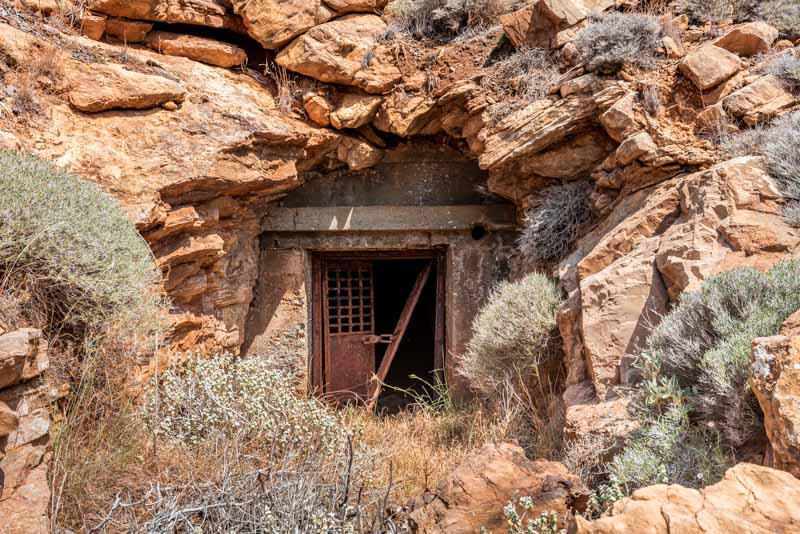
The large cave above Megalo Livadi is not worth visiting; it has collapsed. On the other side, there is still a loading crane and rusted mine cars, which make for good photo opportunities. The cave further back, with the old Almiros hot springs on the shore, looked from a distance as if it had collapsed.

Today, the place seems deserted, yet two taverns serve simple meals to day-trippers at rather high prices. At the end of the beach—which, unfortunately, didn’t invite us to swim—stand the remains of the mining company’s administrative building, which was being diligently renovated during our visit. Plans are in place to establish a mining museum, similar to the one on Milos.
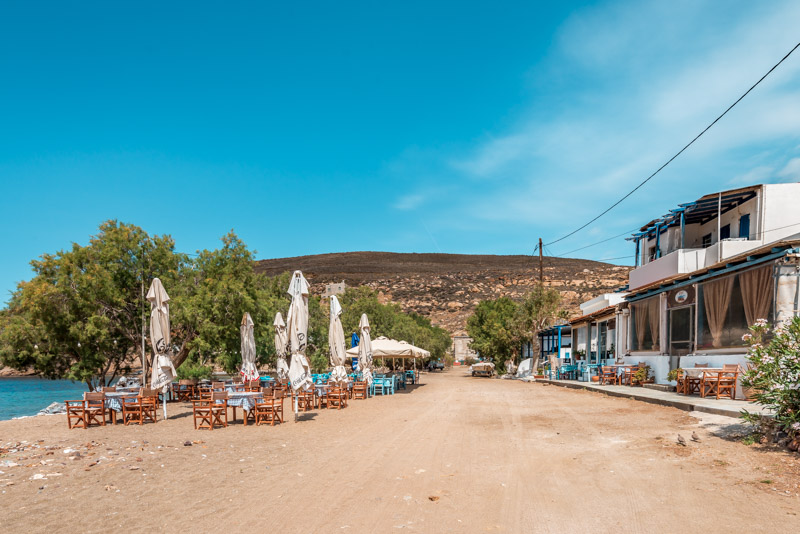
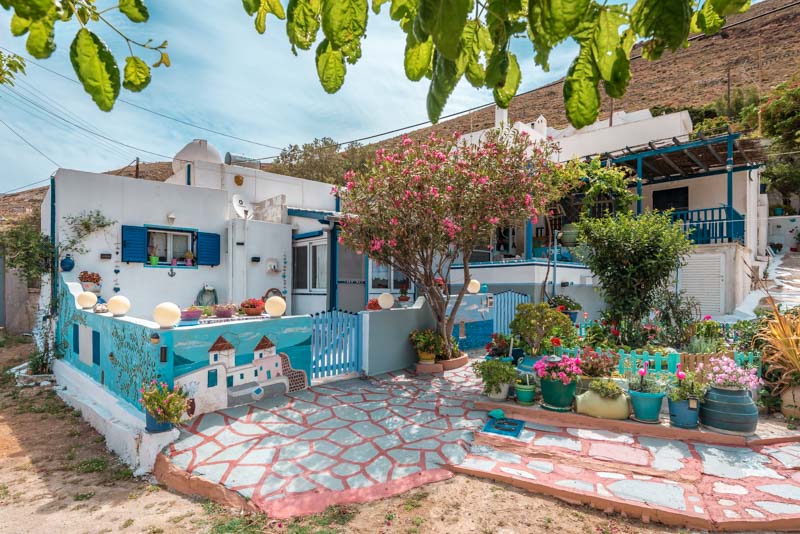
There isn’t much else to see in Megalo Livadi; above it lies the Moni Evaggelistrias convent (20th century), though it doesn’t look very inviting from the outside. Children love the new, oversized playground behind the taverns; next to it stands a lovingly designed colorful little house, a real highlight for young and old alike.
Panoramic view from Aspros Pyrgos
On the way back through the atmospheric mountain landscape, you can make a detour to the White Tower of Serifos (Aspros Pyrgos). It sits on a hill above Megalo Livadi. As on other Greek islands, Serifos also had a sophisticated system of signal towers in ancient times that warned of enemy attacks.


Originally built in the 4th century BC, the tower has been partially restored and gives a good impression of its original size. Curiously, all the blocks that didn’t fit into the puzzle lie in front of it like giant Tetris blocks. An information board provides details about Aspros Pyrgos and its surroundings.

From here, you can enjoy a magnificent view of the Aegean Sea and part of the Western Cyclades. The atmosphere here is especially beautiful at sunset. Another ancient tower is located near the nunnery above Megalo Livadi. The Throne of Cyclops is accessible only on foot and is also a great spot for watching the sunset.

#8 Serifos Lighthouse
Just 5 km south of Livadi lies one of the most beautiful and unspoiled spots on Serifos, which is especially worth a visit at sunrise or sunset. Gleaming white, adorned with natural stone elements, and crowned by a green dome, the Serifos Lighthouse stands at the end of a very dilapidated gravel road.
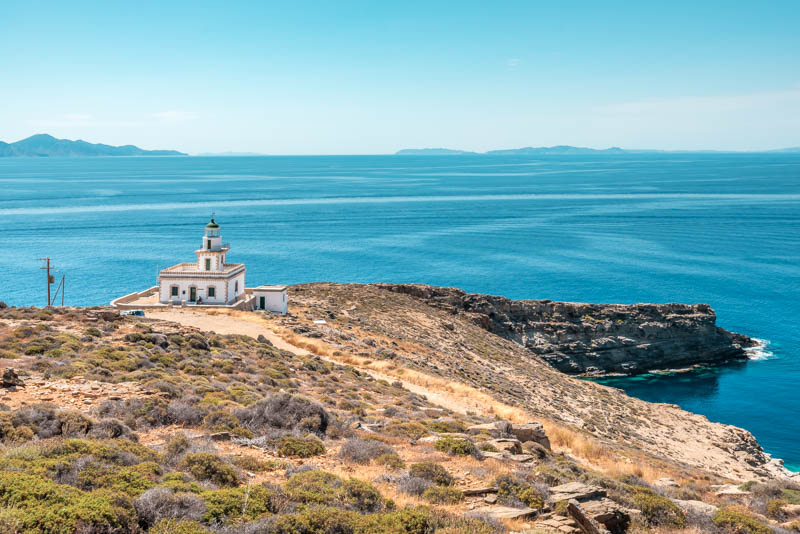
It was built in 1901 on a 65-meter-high rocky cliff at Cape Spathi and has since served as a guide for ships entering the harbor. The small area in front of the lighthouse is perfect for a picnic. On a clear day, you can let your gaze wander over the sea in complete seclusion and admire the islands of Sifnos, Kimolos, Milos, and others from afar.

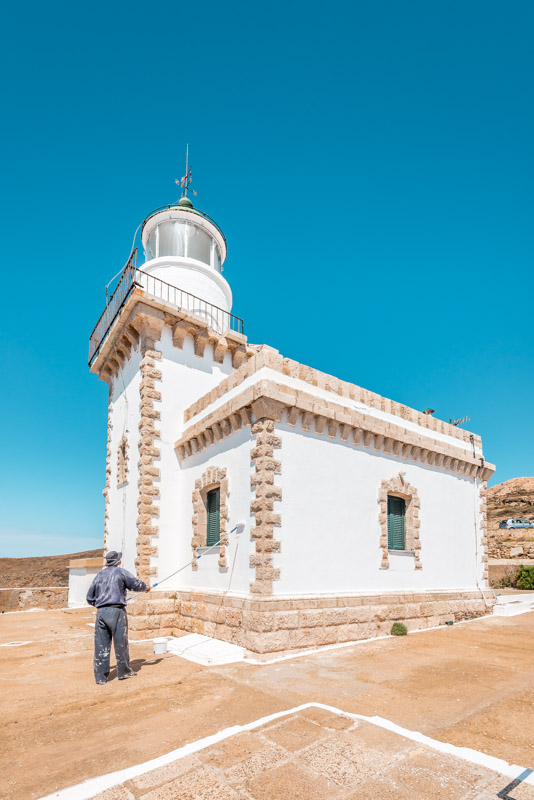
There is a fish farm in the eastern bay; on the way to the lighthouse, we saw dolphins. By the time we reached the bottom, the dolphins were gone, but the lighthouse was just being freshly whitewashed by master painter Leonidas, and we had a friendly chat with him about our favorite Greek islands. Above the western bay is the island’s landfill, the only downside to this beautiful spot.
Hike to Alevrakia Beach
Not far from the lighthouse lies a small but exquisite dream cove with one of the island’s most beautiful beaches. Surrounded by gray rocks, Alevrakia Beach, with its golden sand meeting the turquoise-blue sea, is a true feast for the eyes. Since there is no road leading down to the beach, you have to hike part of the way over rough terrain (about 20 minutes from Ramos).

Unfortunately, we didn’t have time to visit during our stay, but from the road above, we kept gazing longingly at Alevrakia Beach. Maybe you can sink your feet into the secluded sand and take a dip in the cool water for us?
Accommodations on the island of Serifos
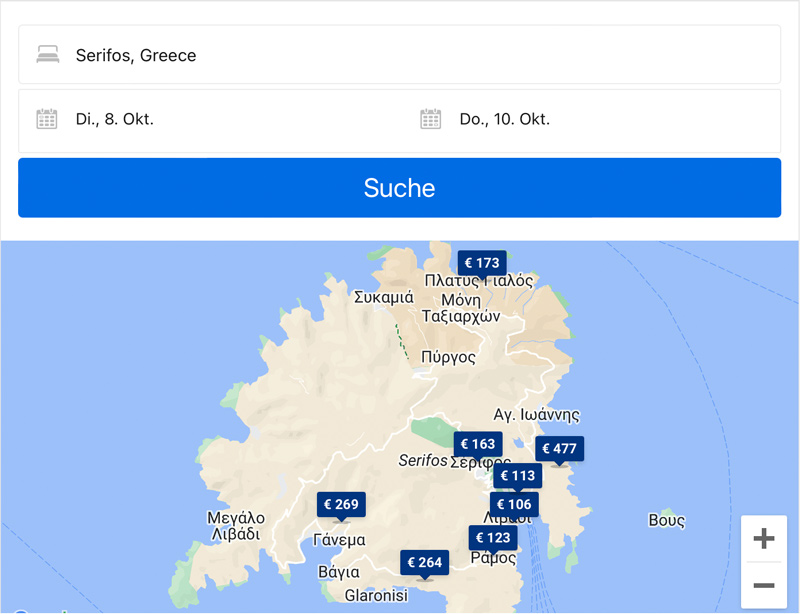
In addition to aparthotels in Livadi and Livadakia, vacation villas are now available all over the island. In Chora, you’ll also find traditional-style studios, and even small luxury retreats (including Coco-Mat) have set up shop on Serifos. However, availability is limited and prices are high. Especially in the summer, many places book up quickly, as Serifos is a popular destination for Greeks.
On Booking.com*, you can compare all available accommodations on a map and check prices:
➲ View accommodations on Booking.com*
Advertisement*
This is where we stayed on Serifos
Galazio Suites, Livadakia
One of our Serifos highlights was definitely our accommodation, where we felt right at home from the very first minute. The friendly host, Stratos, has his heart in the right place and has created a true gem for vacationers.
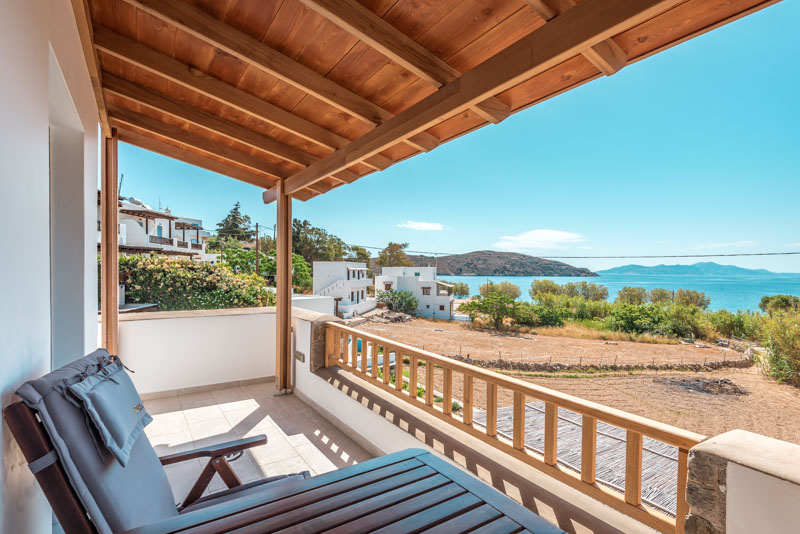
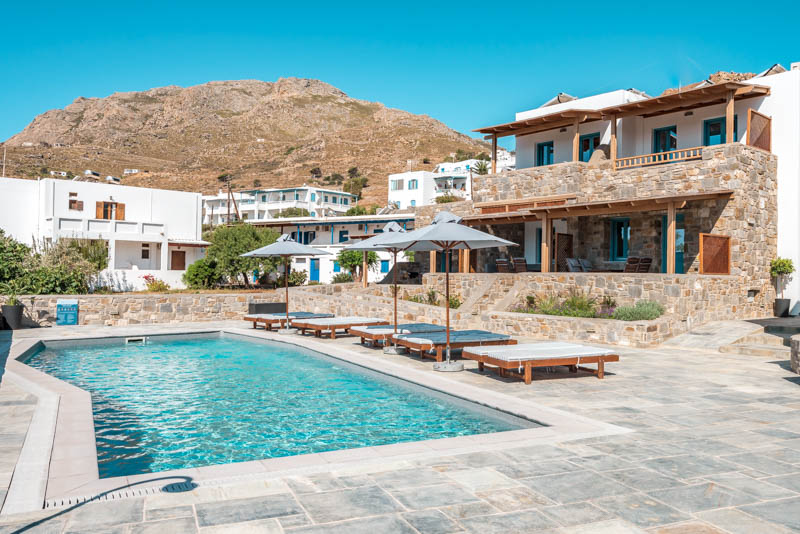
The well-maintained complex with a pool consists of 12 Cycladic-style apartments, each with a kitchenette and a balcony or terrace. A delicious breakfast is served every morning, and afterward, you can jump right into the sea—the beautiful beach of Livadakia is just a 3-minute walk away.
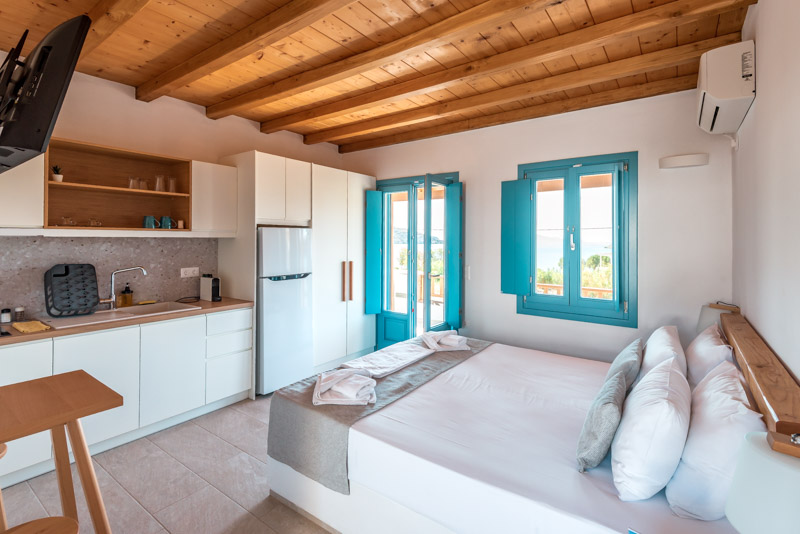
On Booking.com*, you can view our accommodation on Serifos and check prices and availability for your vacation:
Restaurants on Serifos: Our Recommendations
Although Serifos wasn’t a culinary revelation for us, we did enjoy good meals at one or two taverns. A typical dish from Serifos is “Marathokeftedes,” aromatic fennel balls that are perfect for dipping in tzatziki.
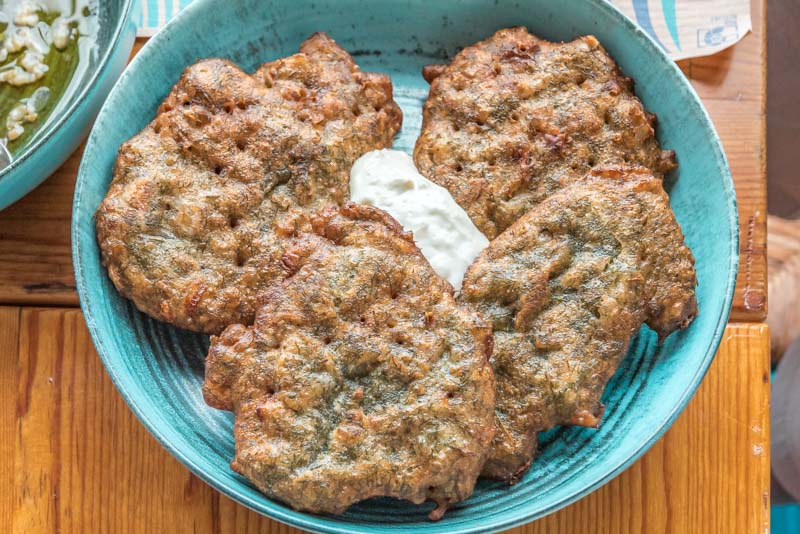
Below you’ll find restaurants and cafés that we tried on Serifos and found to be good:
Sfina Greek Eatery, Livadi – We went here twice; everything was so delicious! Be sure to try the fennel balls. Friendly service and tables right on the beach.
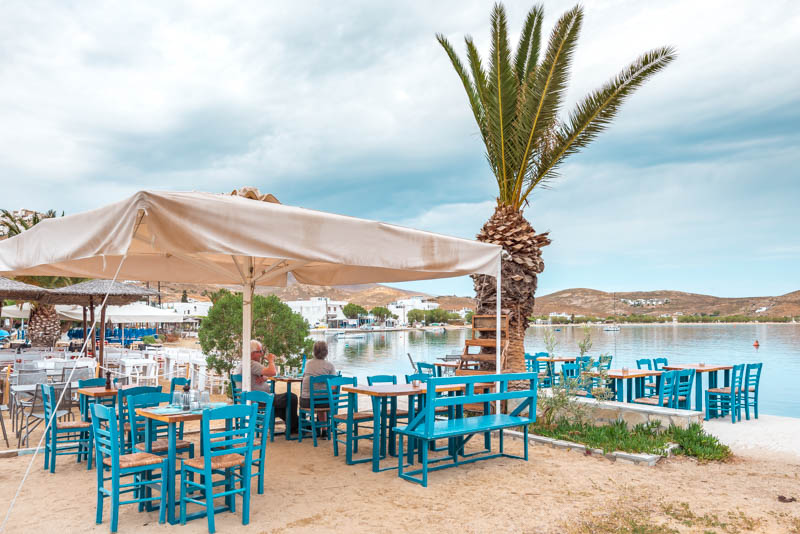
Lepi Lepi, Livadi – Upscale seafood restaurant right on the waterfront promenade. Attentive staff who also serve delicious vegetarian dishes.
Fragkosyko, Livadi – Cozy café-bar above the supermarket. Delicious pinsa and pancakes, good coffee. In the evening, cocktails with a view of the illuminated harbor.
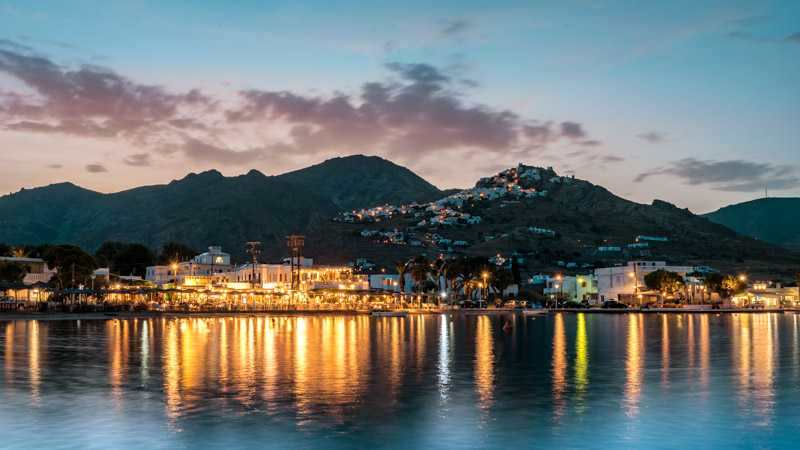
Vassilia Beach Bar, Livadaki – Relaxed beach bar on Livadaki Beach with lounge chair rentals. It’s a nice spot for a drink, but be prepared for the high prices.
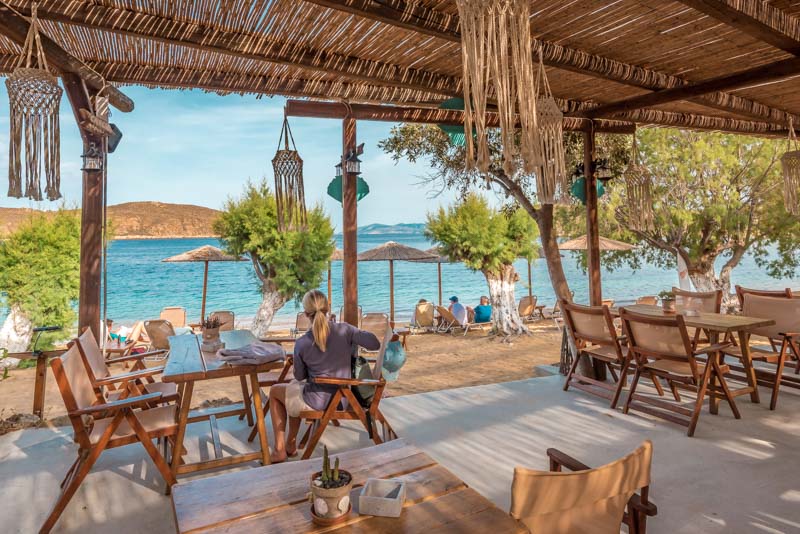
Ta Kambia, Ramos – Family-run tavern in the hamlet of Ramos above Livadakia Beach. One of the few unspoiled spots on the island; the focus is on meat dishes, accompanied by excellent tzatziki and delicious house wine. Open only in the summer and not until 7 p.m.
Stefanakos Tavern, Psili Ammos – Beach tavern with a beautiful sea view. The food is good, but nothing special. The atmosphere above the dream beach is worth a midday snack and a cool drink.
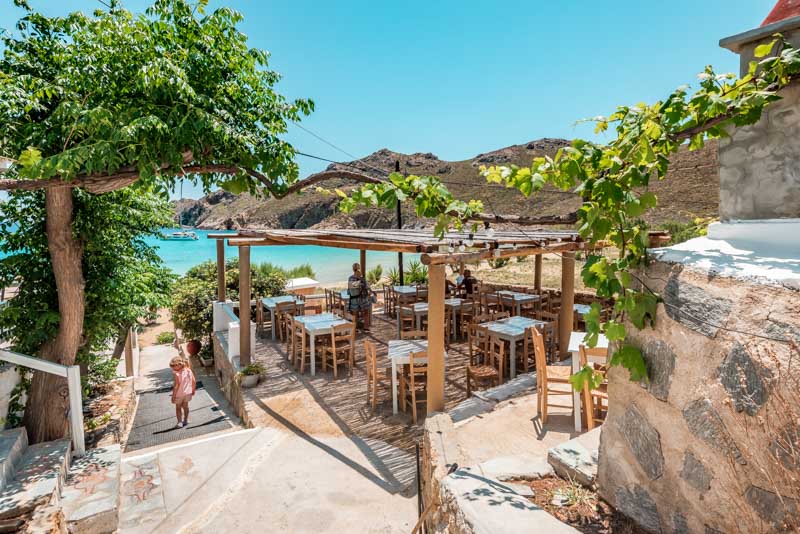
Nikoulias, Platis Gialos – Family-run tavern in the northeast of the island with a large terrace and ocean view. Typical Greek cuisine at fair prices. We found the pastitsio and the imam (stuffed eggplant) particularly delicious. The friendly owner also rents out a vacation home above the tavern.
To Akrogiali tou Vitou, Sikamia – Secluded tavern in the very north of the island, serving homemade dishes attractively presented at slightly higher prices. Idyllic atmosphere and friendly owner family.
Rental Cars for Serifos
Measuring 10 km wide and 13 km long, Serifos is a small Cycladic island that you can circle in a short time. A small car or a scooter is sufficient for a self-guided tour of the island. Buses and taxis are scarce on Serifos and are only recommended for short distances, e.g., from Livadi to Chora.
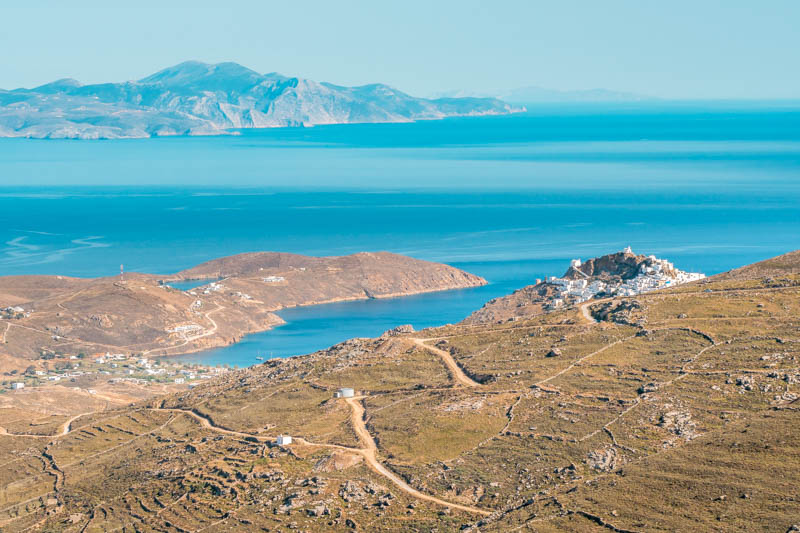
From Livadi, a road runs along the east coast to the north and then through the mountainous interior back to the south. You shouldn’t miss the panoramic road of Serifos, as the hilly landscape of this barren, sparsely vegetated island is truly charming!
In Livadi, there are several local car rental companies, such as Sunset Rentals Grigoriadis. It’s generally a good idea to check the Google reviews of the respective provider before renting a car on Serifos.
Getting Around by Bus and Taxi on Serifos
Public bus service on Serifos does not cover the entire island. Routes are mostly limited to the Livadi–Chora route. In the summer, buses occasionally also serve the surrounding hamlets and beaches.
The bus stop is located in Livadi across from the Condilis supermarket near the marina and in Chora at the turnoff to the large parking lot. More information on bus schedules on Serifos can be found here: Bus Timetables
The number of taxis on Serifos is currently limited to just a few vehicles. Especially during the high season, taxis are often fully booked and must be reserved in advance. The taxi drivers’ phone numbers can be found here: Taxi Drivers

Getting to Serifos
Serifos does not have an airport; the island can only be reached by ferry from Athens. You can find affordable flights to Athens through our partner Skyscanner*:
➲ Search for flights on Skyscanner*
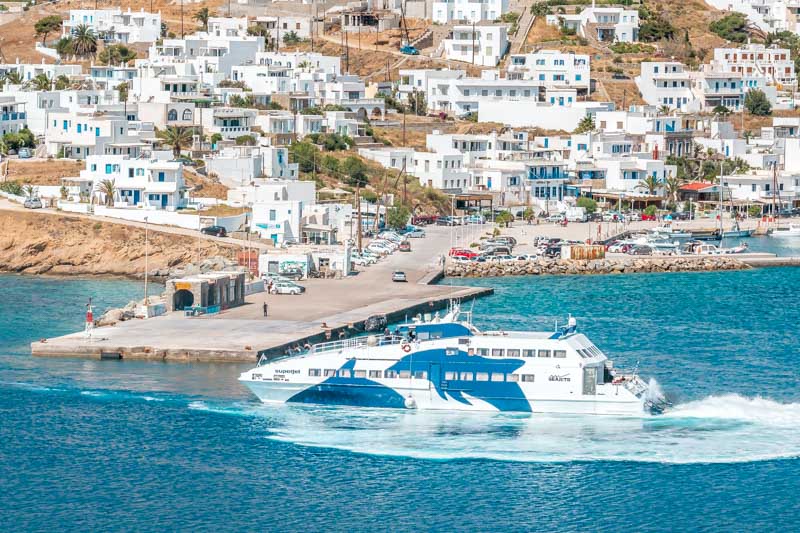
During the season, large car ferries and high-speed boats depart several times a day from the port of Piraeus to Serifos. As early as May, several ferries docked daily at the port of Serifos. From here, you can also reach the southern islands of Sifnos, Kimolos, and Milos. This makes Serifos an ideal stop on an island-hopping tour along the Western Cyclades.
→ This article provides all the necessary information for traveling to Serifos by ferry: Ferries in Greece
→ The following ferry companies serve Serifos from Piraeus (Athens):
- SeaJets (approx. 2 hours)
- Aegean Sea Lines (approx. 4 hours)
- Zante Ferries (approx. 4 hours)
Through our partner Ferryhopper*, you can search for ferry schedules and conveniently book your ferry ticket to Serifos online:
➲ Search for ferries on Ferryhopper*
Alternatively, you can also travel to Serifos via Milos. The island is served by small propeller planes from Athens Airport. From Milos, the crossing by Seajets high-speed catamaran takes just over an hour.

🔍 Our take on Serifos: Serifos, where are you headed? Somehow, we couldn’t shake the impression that every effort is being made here to lure tourists to the island. Even in May, there were so many arriving ferries and so few people disembarking. But it is and remains a modest island. Compared to Milos and Sifnos with their many highlights, there wasn’t much for us to discover on Serifos besides the main town of Chora and a few beautiful beaches. We also didn’t feel like hiking due to the barren yet very hilly landscape. Nevertheless, the island exudes Cycladic charm and is a paradise for those seeking peace and quiet, especially in the off-season. During the high season, people come here for a few days to enjoy the unique nightlife in Chora and the magnificent beaches. Just because of our wonderful accommodation with the lovely host on Serifos, we can imagine coming back.
→ You can find more travel reports and tips on the Cyclades on our overview page: Cyclades Islands
*Support our blog Greece-Moments
This post contains affiliate links marked with an asterisk (*). If you book or purchase something through one of these links, we receive a small commission. The price remains the same for you. This helps us continue to provide high-quality content for free. Did you enjoy this post and want to say thank you? Then simply buy us the next Greek coffee ☕️ To the coffee fund
Save this post on Pinterest!