
When the massive rock of Monemvasia emerges from the sea as if out of nowhere, it leaves you speechless at first sight. Located in the southeastern Peloponnese, this medieval fortress town was one of the absolute highlights of our road trip and, for us, ranks among the most fascinating places in all of Greece.
In Monemvasia, you embark on a journey through time. Rough cobblestones, winding alleys, charming accommodations, quaint taverns, and a very special atmosphere await you. Greece, what more could you want?
Tom & Ella
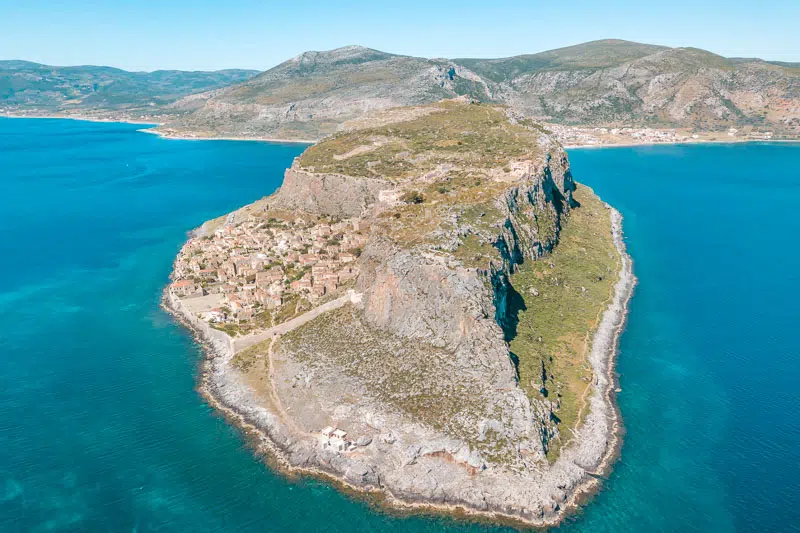
The medieval fortress was built on an offshore island that is now connected to the mainland by a narrow causeway, as the name Monemvasia suggests—which simply means “single access” in Greek. Byzantines, Venetians, and Ottomans fought here for control of one of the most significant fortifications in the entire Mediterranean region and left their mark.
The fortress town is very popular among Greeks due to its eventful history and is a true pilgrimage destination. International tourists, who are always drawn to the Greek islands, on the other hand, have likely never heard of Monemvasia. This is hardly surprising, as the location is very isolated: The nearest airport, Kalamata, is a good 160 km away, and it’s nearly a four-hour drive from Athens.
It’s about time you finally explored this gem on the Peloponnese Peninsula, isn’t it? With our tips for Monemvasia, we’ll tell you everything you need to know for your visit.
🏖️ Dream beaches & hidden bays
🍽️ Restaurants, tavernas & cafés
🏛️ Must-see highlights & ancient sites
🗺️ Worthwhile spots & insider tips
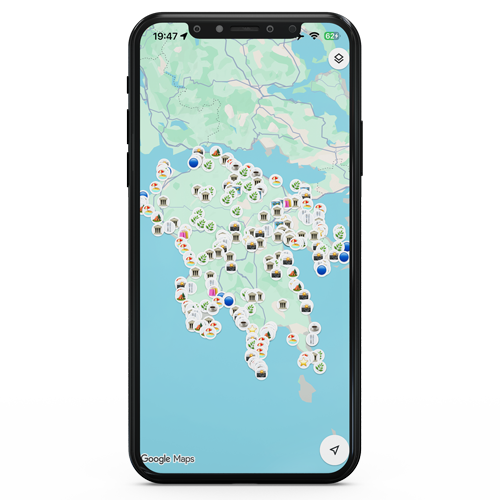
🚘 Practical info like rentals & parking
♾️ Lifetime access & updates
#1 Getting to Monemvasia
Monemvasia is located in the southeast of the Peloponnese, away from the major tourist crowds, and that’s one of the reasons why the place is so special. Depending on your starting point, the journey takes you through a stunningly scenic area with olive groves, ancient villages, and a coastline well worth seeing. To fully explore this region of Greece, a rental car for Monemvasia is practically indispensable, as public transportation here is infrequent and unreliable.
How far is it to Monemvasia?
- Athens to Monemvasia: approx. 322 km, approx. 4 hours’ drive
- Nafplio to Monemvasia: approx. 230 km, approx. 3 hours’ drive
- Sparta to Monemvasia: approx. 89 km, approx. 1.5 hours driving time
- Kalamata to Monemvasia: approx. 186 km, approx. 2.5 hours driving time


By rental car to Monemvasia
The fastest route from Athens to Monemvasia takes you along the A7 highway toward Corinth and Tripoli, then on through Sparta and the picturesque mountainous landscape of the southeastern Peloponnese. The stretch from Sparta is winding but offers stunning scenery. With a rental car, you can also explore the surrounding area with complete flexibility and make spontaneous stops at Kastraki Beach, the hamlet of Limin Ieraka, or the Kastania Cave.

If you have more time, you can opt to drive from Athens via the Peloponnese’s “Forgotten Highway.” This picturesque coastal road, completed just a few years ago, leads from Leonidio via Foukiano and Paralia to the eastern Peloponnese “finger” and, oddly enough, is marked on only a few maps. If you’re coming from Kalamata, it’s also worth taking the Langada-Taygetos Pass instead of Highway 71: it’s extremely winding with many small tunnels, but it really gets you in the road trip spirit!

Parking in Monemvasia
The entire town of Monemvasia is a car-free zone. You can park in the street-side parking spots in front of the city gate or a bit further ahead at the parking lot past the Monemvasia Dam near the Anemi Cafe Bar Restaurant. Parking spots are limited and in high demand during peak season, so you should arrive early.
On our first visit to Monemvasia, we walked nearly ten minutes to the city entrance. Those staying overnight may have an advantage, as some hotels offer a luggage or pickup service, which makes arrival much more relaxed.
You can find an affordable rental car for the Peloponnese through our partner Discover Cars*:
➲ View affordable car rental offers*
By bus to Monemvasia
Buses connect Athens with Monemvasia daily, though there are few connections and the journey takes about five to six hours. The bus stops in Gefira, the coastal town on the mainland across from the rocky island. However, taking the bus in the Peloponnese is only for the patient: schedules change frequently and connections aren’t always reliable. Without a rental car, though, you won’t see the most beautiful spots around Monemvasia.
→ Current departure times and tickets are available on the website of: KTEL Lakonias
#2 Walking Tour of Monemvasia
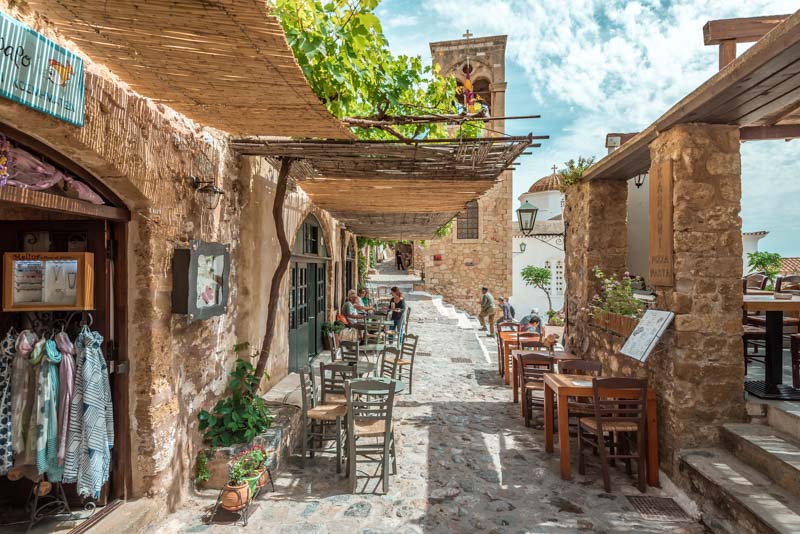
The lower town of Monemvasia has been painstakingly restored over many years, largely in keeping with the original architecture, and the result is impressive. As soon as you step through the medieval city gate, the rhythm of the world changes. Rough cobblestones, narrow winding alleys, and charming arched gateways create an atmosphere that’s hard to put into words and best experienced firsthand. From time to time, small cruise ships dock off Monemvasia. When they do, the main street gets a bit crowded, so it’s best to head into the side streets.

Along Monemvasia’s main street, you’ll find souvenir shops with authentic handicrafts, taverns, bars, and small cafés. The atmosphere is calm and laid-back; time definitely moves at a different pace here. The late evening is particularly atmospheric, when the day-trippers have long since left and the streets are bathed in the warm light of the lanterns; then the entire fortress belongs only to the residents and the guests of the small hotels.


Anyone strolling through the alleys of Monemvasia will inevitably encounter the true rulers of the city fortress: dozens of cats have made the former Kastro their territory and pose on walls, in archways, and in front of church doors, as if they knew exactly what makes a good photo. Once fed, they’ll follow you every step of the way through half the lower town. So if you’re a cat lover, you’ll definitely have a great time in Monemvasia!
→ Find out why there are so many stray animals in Greece and how you can help here: Stray Animals in Greece


In the center of Monemvasia stands the Church of Christos Elkomenos, one of the oldest and most beautiful Byzantine churches in the region. It likely dates back to the 6th or 7th century and has been renovated several times over the centuries. Inside is an impressive icon of the Crucifixion from the Palaiologos era, which returned to Monemvasia after an adventurous odyssey. Surrounding the square are a few old cannons that once served to defend the fortress.

Directly across from the church is the Monemvasia Archaeological Collection, housed in a historic building that has served as a mosque, prison, and coffeehouse over the centuries. The collection includes sculptures, marble architectural fragments, and ceramic finds from the castle town, which were uncovered during restoration work and excavations and date from the early Christian period to the Ottoman era.
The presentation and lighting of the exhibits in this small museum are atmospheric. It is remarkable how the partly ancient marble elements were repeatedly incorporated into new structures and repurposed over the centuries. A compass model in the center of the museum helps visitors navigate through the different eras. Admission costs €5, and the air-conditioned exhibition offers a welcome respite on hot summer days.

If you continue south through the alleys, you’ll reach Chryssafitissa Square, one of the most atmospheric open spaces in Monemvasia. Scattered cannonballs serve as reminders of its turbulent history, while the Panagia Chryssafitissa Church lends the square a heavenly touch. Light a candle inside the beautiful church and escape the daily grind for a moment.
In the courtyard, there is a small fountain with holy water, which tradition credits with healing powers for infertility—naturally, accompanied by a prayer to the Virgin Mary. Behind the church, a passageway through the old city wall leads to the eastern outer area, from where you can reach the lighthouse.

Monemvasia Lighthouse
Hardly anyone knows about it, but the Monemvasia Lighthouse is a real hidden gem. It is located at the eastern tip of the peninsula and can be reached from the eastern city gate of the lower town via a short and pleasant walk along the north side of the rock, about a 15- to 20-minute walk. The complex was built in 1896; the first lighthouse keeper began his service on December 27 of that year, and on January 13, 1897, the beacon was lit for the first time.

During World War II, the lighthouse was severely damaged and remained out of service until 1945, when it was restored and put back into service. In 2015, it was completely renovated with EU funding and remains active to this day. Inside the tower, a marble-clad spiral staircase leads up to the lantern, and in a small museum room (opening hours vary!) in the adjacent building, there is a small exhibition on the history of Greek lighthouses and their significance for seafaring.
💡 Best time to visit Monemvasia: Due to its history, Monemvasia is a year-round destination for Greeks, especially at Easter. When we were there about three weeks after Greek Easter, we had the narrow streets almost to ourselves, along with perfect weather and no crowds. Meanwhile, between May and September, small cruise ships arrive at the coast and bring their guests ashore via tender boats. This can cause the lower town to get crowded for a short time. In midsummer, it gets really hot in the narrow alleys because the cool north wind is blocked by the rocky outcrop. In the fall, however, things quiet down again, and even in winter, a visit to Monemvasia is worthwhile. In fact, some taverns and cafés are still open then, and the alleys are decorated for Christmas. Only the selection of hotels is significantly limited at that time.
Shopping in Monemvasia
Admittedly, you wouldn’t necessarily expect it in this remote corner of Greece, but the shopping scene in Monemvasia is surprisingly good. Along the main street, boutiques, jewelers, artists’ studios, and craft shops line up, all aiming to offer visitors something truly special. It’s a real pleasure to stroll through the alleys, get inspired, or simply make a purchase. Here are our recommendations for worthwhile shops in Monemvasia:
Chrisolithos – A shop full of original handicrafts where you’ll find everything a collector’s heart desires, from handmade amulets and komboloi to small paintings and ornate wall hangings. Every piece has character and tells its own story, so be sure to stop by!
Kastania Eleni – Handmade Souvenirs Shop – A souvenir shop that stands out from the crowd because everything here is truly handmade and unique. From necklaces and earrings to hand-painted icons, everything is crafted with great care and love. The owner is warm and takes time for every guest; browsing here is simply a pleasure.
Monemvasia Deli – Edodimopolio – An innovative deli run by a friendly couple who have been offering high-quality olive oil and cosmetic products for years. Testing and sampling are expressly encouraged, and the cosmetic products from Monemvasia Cosmetics are made in-house. They also offer local honey, homemade jams, and other regional specialties, all of the highest quality.
Niove Greek Designers Boutique – A small, exclusive destination for anyone seeking fashion with soul. Handcrafted, one-of-a-kind pieces by Greek designers, timelessly elegant fabrics, and owner Eleni, who assists with great charm and empathy in making your selection. Here, you’re not just buying a piece of clothing, but a piece of Greece to take home.

Pietra Boutique Monemvasia – A tiny but lovely boutique featuring colorful modern dresses and unique Greek designer fashion. Dresses, tops, scarves, and kimonos hang side by side, along with pretty summer bags and jewelry. For every age, in all styles and sizes—you’re guaranteed to find something here.
Swimming in Monemvasia
You can even swim in the sea in Monemvasia if you’re willing to make a few compromises. The town is surrounded by a rocky coastline; there is no traditional beach. Southwest of Chryssafitissa Square, steps lead down from the old city wall to the sea. The so-called Portello Beach (also known as the Monemvasia Swimming Area) is frequently used by locals. Entry ladders provide access to the water, past black rocks. Alternatively, you can also sunbathe on the terraced areas.
#3 Acropolis of Monemvasia
From the entrance to the lower town, you can reach the Acropolis and its fortress on foot in about 10 to 15 minutes. The climb to the upper town via a steep path is somewhat strenuous, but is rewarded with one of the most spectacular views in the entire Peloponnese.

Unfortunately, not much remains of the once-imposing upper castle complex; time and the centuries have taken their toll. But the view of the lower town and the Aegean Sea is all the more magnificent, and the silence up there has an almost surreal quality. Information boards are scattered throughout the grounds, providing details about the individual buildings and their history. There are even boards about the flora and fauna. During our walk, we even spotted a tortoise. The loop trail around the castle hill takes about 45 minutes (not including photo stops).


Agia Sofia Church
The Byzantine Church of Agia Sofia, which sits spectacularly perched on the edge of the Acropolis, is absolutely worth seeing. The church dates from the mid-12th century, likely around 1150, and, according to recent research, was built in connection with the successful defense against the Norman invasion of 1147. It was originally dedicated to Panagia Hodegetria and only received the name Agia Sofia after Greek independence in 1821, because it was seen as a replica of the Hagia Sophia in Constantinople.

The location of the Agia Sofia Church in Monemvasia is unique, as the cliff behind it drops straight and steeply into the sea. The view beyond the church walls is not for the faint of heart. Over the centuries, the church served as an Orthodox cathedral, a Venetian Catholic church, and an Ottoman mosque, a history still visible today in its various architectural layers. By the way, admission to the Upper Town of Monemvasia and to Hagia Sophia is free.


When we were in Monemvasia for the first time in 2019, we dragged ourselves out of bed at six in the morning to climb up to the Acropolis and watch the sunrise from up there. It took some effort, especially after a long evening in the alleys, but it was one of the best decisions of the entire trip. Not a soul was to be seen far and wide, just the silence, the rising sun over the Myrtoan Sea, and the quiet awakening of the city far below—a magical moment on our Peloponnese trip!

💡 Why Monemvasia is so special to Greeks: For Greeks, Monemvasia is far more than just a pretty fortress town. After the fall of Constantinople in 1453, this rock was the last remnant of the Byzantine Empire and the last vestige of Greek sovereignty before Venice took over its defense. During the War of Independence in 1821, Monemvasia was the first fortress to be liberated from the Ottomans. It is no coincidence that the church on the Acropolis was renamed Agia Sofia after the liberation. The great Hagia Sophia in Constantinople had been in Ottoman hands for centuries and was a symbol of loss for the Greeks. The renaming symbolically reclaimed a piece of that history. Furthermore, Monemvasia is the birthplace of the national poet Giannis Ritsos, who sang of his native rock as a “stone ship.” For Greek visitors, a weekend trip here is therefore also a kind of patriotic pilgrimage, and many affluent Athenians have set up second homes in the restored stone houses.
#4 Restaurants & Cafés in Monemvasia
Monemvasia really surprised us in terms of food. In such a touristy fortress town, you might expect quality to suffer, but fortunately that’s not the case here. Here are some of our recommendations for restaurants in Monemvasia, researched and reviewed:
Voltes – Undisputed number one on TripAdvisor, and deservedly so. Right at the entrance gate, creative mezedes made with local products, excellent stews, and vegan options as well.
Oinomelo Castle – Traditional Greek cuisine on a romantic terrace with a sea view, a cozy atmosphere, and friendly service.

Mirtaki – A small spot for a quick bite on the main street, not far from Elkomenos Christos. They serve simple dishes like homemade pitas, pitakia, and burgers, as well as other snacks prepared by the warm-hearted hosts.
Peinakotheke – A dessert crêperie and waffle paradise with delicious ice cream. The sweetest spot in Kastro, perfect for wrapping up a long tour. If you visit Monemvasia in winter, you’ll find the crêperie festively decorated.
Emvasis Cafe – A cocktail bar with a stunning rooftop garden right at the entrance gate, perfect for your first coffee in the morning as well as for a sundowner with a view of the sea.
#5 Hotels in Monemvasia
Monemvasia offers a range of charming accommodations, most of them in lovingly restored stone houses within the fortress walls. We can’t stress this enough: You should plan to stay at least one night here to experience the very special evening atmosphere. Click on the Booking* links to view details about the hotels in Monemvasia:
Ardamis Traditional Guest Houses
The most historically significant building in the entire Kastro, once a Venetian governor’s house and an Ottoman residence, featuring truly stylish rooms and a 100-square-meter terrace with ocean views. The hostess warmly attends to her guests’ needs.
House in the Castle
Four lovingly renovated apartments with fireplaces, high-quality amenities, and a terrace with a sea view. The hostess, Chrysoula, welcomes you personally at the city gate and is available to assist with any request.
Monolithos Inn
Three rooms at the highest point of the lower town, right where the famous Voltes Stairs to the Acropolis begin, with unobstructed panoramic views of the entire Kastro and the sea.
Ritsos Guesthouse
The very first organized guesthouse in Kastro, 200 meters from the city gate, featuring handmade furniture and breakfast under the old fig tree. We’ve personally tested this accommodation and found it to be excellent.

#6 History of the Fortified City
The history of Monemvasia begins in 583 AD, when residents of the Laconic coast fled the onslaught of Slavic and Avar tribes to the seemingly impregnable rocky outcrop off the coast and founded the first settlement there under the rule of the Byzantine Emperor Maurikios.

What began as a place of refuge evolved over the centuries into one of the most important trading centers in the entire eastern Mediterranean. The city’s name derives directly from Greek; “mone emvasi” means “single access” and aptly describes the narrow connection between the rock and the mainland. It is no coincidence that Monemvasia bore the nickname “Gibraltar of the East” for centuries.
In the Byzantine Empire, Monemvasia grew from the 10th century onward into a thriving commercial metropolis that secured the sea route between Constantinople and Venice. Its most prized export was a sweet wine that the Venetians and Genoese sold throughout Europe under the name Malvasia, known in German as “Malvasier.” For five centuries, this wine was one of the most sought-after in Europe, from England to Constantinople.


In 1147, the fortress withstood a Norman invasion and cemented its reputation as impregnable. A century later, around 1248, the Frankish prince William II of Villehardouin succeeded in forcing Monemvasia to surrender only after a three-year siege. But as early as 1262, the Franks had to return the city to the Byzantine Empire as part of the ransom for William, who had been captured at the Battle of Pelagonia.
After the fall of Constantinople in 1453, Monemvasia held out as one of the last territories of the Byzantine Empire and defied the threats of Sultan Mehmed II until 1460. When the last Despot of the Morea could no longer defend the city, he initially sold it to the Pope, but in 1464 the inhabitants chose instead to submit to the militarily stronger Venice. The Venetians massively expanded the fortress and integrated it into their trade network, but were forced to cede the city to the Ottoman Empire in 1540 following a new conflict.
Under Ottoman rule, the city bore the Turkish name Menekşe (Eng. “Violet”) and served as a provincial center. After a brief Venetian reconquest in 1690, during which the population grew to around 8,000, Monemvasia fell to the Ottomans again in 1715. The vineyards fell into disrepair, trade came to a standstill, and the once-vibrant city steadily lost its importance.
On July 23, 1821, Ottoman rule ended after a four-month siege by Greek insurgents. Maniot fighters led by Tzannetakis Grigorakis, Tsakonian forces under Georgios Michalakis, and other local leaders forced the Ottoman inhabitants to surrender. Monemvasia was thus one of the first fortified cities to be liberated during the Greek War of Independence.
At the height of its power, the city had between 10,000 and 25,000 inhabitants. But liberation did not bring prosperity; internal power struggles and the shifting of trade routes caused Monemvasia to sink into obscurity. By 1971, only 32 people remained in the fortress. It was not until the early 1980s that Monemvasia began to revive; today, around 50 to 60 people live permanently within the walls, and tourism has breathed new life into the town.
When the Ottomans captured the city, the vineyards were destroyed and production came to a standstill. It wasn’t until 2010 that Malvasia wine was reintroduced with its own protected designation of origin. Today, you can taste it at the Monemvasia Winery, which has been carrying on the city’s great winemaking tradition since 1997. The winery is located about ten kilometers west of Gefira and is easily combined with an excursion into the surrounding countryside. More information is available at monemvasiawinery.gr.
Monemvasia is today considered one of the longest continuously inhabited fortified towns in Europe. Since its founding in 583, it has never been completely abandoned, not even during the darkest years of crisis. The Greek government has awarded the Byzantine site the European Heritage Label, and the famous Greek poet Giannis Ritsos, who was born in Monemvasia in 1909, called his birthplace a “stone ship ready to set sail.”
→ Find out what there is to discover on a Peloponnese tour in this article: Peloponnese Road Trip
#7 Things to See in the Area
Monemvasia is not only a fascinating place in its own right but also a great starting point for exploring the wild and little-visited southeastern corner of the Peloponnese. The area has some real hidden gems to offer. Numerous archaeological sites from prehistoric and Mycenaean times, featuring massive Cyclopean walls, are scattered around Monemvasia; you can recognize them by the signs reading “Archeologikos Choros.” If you want to explore everything in the region, you should plan on spending at least two to three days.
✓ Full coverage & unlimited mileage included
✓ Free cancellation until 24h before pickup
✓ Best price guarantee via Discover Cars
Coastal town of Gefira
Gefira is the small town on the mainland located directly across from the rocky island, and it’s usually the first stop after arrival. Here you’ll find shops for daily necessities, supermarkets, bakeries, and simple taverns. If the parking lots at the dam are full, you can also park your car in Gefira. Gefira isn’t a major tourist attraction, but it’s quite charming. From the waterfront promenade, you have a great view of the fortress hill. Plus, there’s really affordable accommodation here—check out Booking.com*.

Kastraki Beach
Swimming isn’t that easy in Monemvasia, and Gefira Beach has little charm. About 10 kilometers north of Monemvasia lies Kastraki Beach, one of the most beautiful and wildest beaches on this coast. The long pebble beach is completely untouched and is occasionally visited by wild campers. Above the coast, adventurers can explore the remains of the prehistoric settlement of Epidavros Limira. There are no taverns on the beach, but a little inland you can enjoy excellent regional cuisine at To Patrikó.

Limin Ieraka
Don’t miss the small hamlet of Limin Ieraka, situated on a sheltered, fjord-like bay and seeming to belong to another era: old stone houses, a few fishing boats bobbing in the sea, and plenty of peace and quiet. At Remetzo, you can enjoy fresh fish and seafood right by the sea, and the Botzi Bar is the perfect spot for a sundowner. Above the village lie the sparse remains of the ancient city of Zaraka. The strenuous climb is rewarded with a magnificent panoramic view.

Kastania Cave
About 40 kilometers south of Monemvasia, in the mountain village of Kastania, lies one of the most beautiful and least-visited stalactite caves in the Peloponnese. The Kastania Cave was only discovered by chance in 1958 and captivates visitors with an underground lake as well as impressive stalactites and stalagmites. Guided tours are available, and opening hours vary by season. An absolute hidden gem that pairs perfectly with a drive through the mountainous landscape of Laconia.
Elafonisos Island
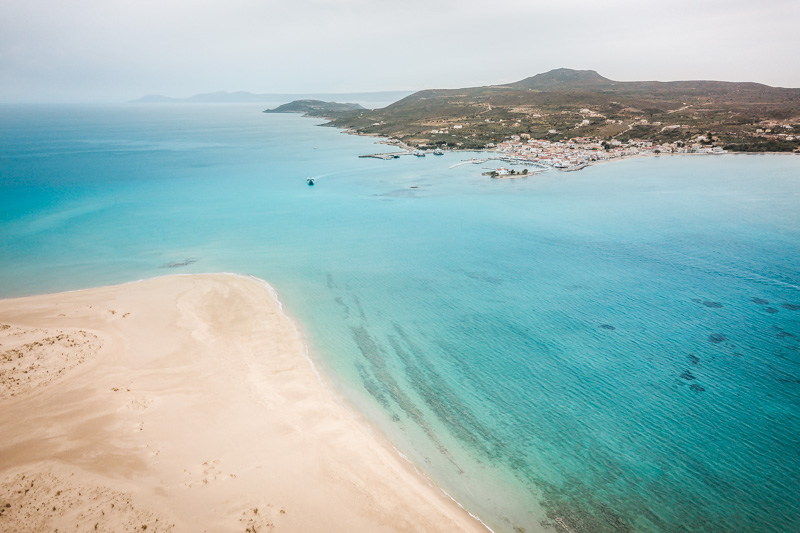
If you’re looking to take a day trip from Monemvasia, the small island of Elafonisos comes highly recommended. The port of Pounta near Neapoli is about 35 kilometers away, and from there a short 10-minute ferry ride takes you to the island, where time moves at a different pace. The absolute highlight is Simos Beach, a double beach with white sand and turquoise-blue water that exudes Caribbean flair. In the charming port town, cozy taverns and cafés await you right by the sea.
→ If you’d like to plan additional stops on your road trip, we have more tips for the Peloponnese here:

FAQ about Monemvasia
How do I get to Monemvasia?
The most flexible option is to rent a car. From Athens, it’s about 322 km and roughly 4 hours via well-maintained highways to Tripoli and then on through Sparta. There are also KTEL buses from Athens, though with only a few daily departures. Without a rental car, you won’t be able to reach the most beautiful spots in the area.
Can you drive into the fortress?
No, Monemvasia is completely car-free. You park outside the city gate and walk in. Roadside parking is limited, and during peak season, it’s best to arrive early.
How many days should you plan for Monemvasia?
Three to four hours are sufficient for a tour of the Lower Town and Upper Town (Acropolis). However, we recommend staying at least one night to experience the special evening atmosphere and the early morning, when the day-trippers haven’t arrived yet. An additional day is ideal for exploring the surrounding area, including Kastraki Beach, Limin Ieraka, and Kastania Cave.
Is Monemvasia suitable for families with children?
To a certain extent. The narrow streets and stairs are uneven and sometimes steep, making them difficult to navigate with a stroller. With older children who are good walkers, it’s a real adventure, and the medieval setting delights curious little explorers. Kastraki Beach, with its calm waters, is also ideal for families.
When is the best time to visit Monemvasia?
In spring (April/May) and fall (September/October), it’s pleasantly warm, quieter, and the colors of the landscape are beautiful. In midsummer, the narrow streets can get very hot and crowded. In winter, Monemvasia has its own unique, almost melancholic charm, though most restaurants and hotels are closed then.
Is there a beach in Monemvasia?
Directly below the fortress walls is the small swimming spot Portello Beach, accessible via stairs and a ladder; it’s natural, with no sand but crystal-clear water. For a proper day at the beach, we recommend Kastraki Beach, about 10 kilometers away.
What does the name Monemvasia mean?
The name is derived from Greek: “mone emvasi” means “single entrance” and describes the only narrow access to the rocky island. Medieval merchants from the West—primarily Franks and Venetians—named the local wine after its place of origin: thus, Monemvasia became “Malvasia,” known in German as “Malvasier,” one of the most traded wines of the entire Middle Ages.
*Support our blog Greece-Moments
This post contains affiliate links marked with an asterisk (*). If you book or purchase something through one of these links, we receive a small commission. The price remains the same for you. This helps us continue to provide high-quality content for free. Did you enjoy this post and want to say thank you? Then simply treat us to the next Greek coffee ☕️ To the coffee fund
Bookmark this post on Pinterest!