

In the northwest of the Peloponnese Peninsula, in the region of Elis, Ancient Olympia rises like a monument to humanity and its insatiable longing for glory and eternity. Today, travellers can walk in the footsteps of history and experience the majestic aura of this place where the gods were once believed to decide the fate of athletes.
“The Olympic Games, which rose like a phoenix from the ashes after 1,500 years of dormancy, are closely linked to the rediscovery of Ancient Olympia.”

Across the vast grounds, antiquity seems to be carved in stone, while the past rests in the shade of olive trees. In the sacred olive grove of the Altis, the first Olympic flame was lit as early as the 8th century BC to ignite the hearts of athletes with the fire of competition.
The rays of the past still cast their light into the present, because since 1936 the flame for the Olympic Games of the modern era has always been lit here in Olympia. Since 1989, the ancient site of Olympia has also been a UNESCO World Heritage Site. In this article, we reveal all the details and share our best tips for your trip to Olympia:
🏖️ Dream beaches & hidden bays
🍽️ Restaurants, tavernas & cafés
🏛️ Must-see highlights & ancient sites
🗺️ Worthwhile spots & insider tips
🚘 Practical info like rentals & parking
♾️ Lifetime access & updates
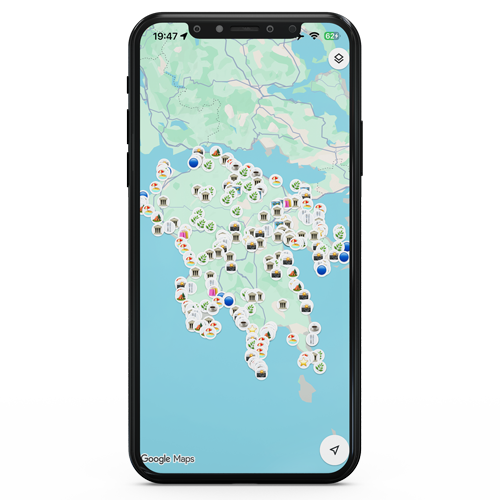
#1 Arrival: How do I get to Olympia?
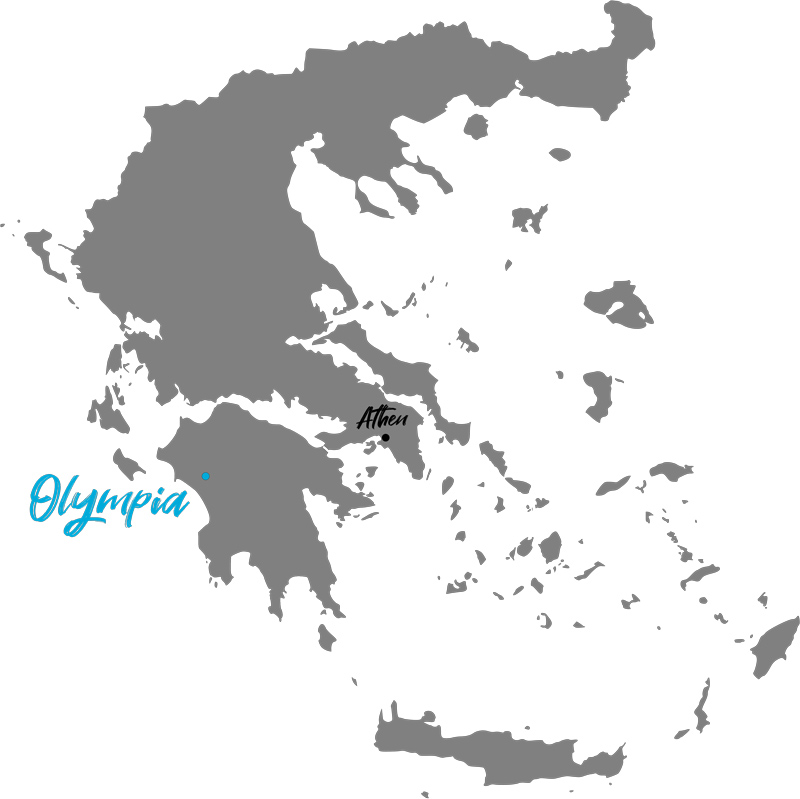
You can reach Ancient Olympia either by car or by bus. From Patras, it is around 115 km along National Road 9 (Patras–Pyrgos) to Ancient Olympia. The historic site lies on the outskirts of Archea Olympia, a modern village that is perfectly geared towards tourism, with numerous hotels, tavernas and souvenir shops.
How far is Ancient Olympia?
Athens to Olympia: approx. 300 km, approx. 3.5 hours by car
Kalamata to Olympia: approx. 110 km, approx. 1.5 hours by car
Corinth to Olympia: approx. 200 km, approx. 2.5 hours by car
Patras to Olympia: approx. 115 km, approx. 1.5 hours by car
Thessaloniki to Olympia: approx. 600 km, approx. 7 hours by car
Is it worth renting a car for Olympia?
For anyone already travelling independently around the Peloponnese Peninsula, it is definitely worth driving to Olympia by rental car. National Road 9 from Patras is well developed and has recently been renewed in sections. If you are driving from Athens to Olympia, take the A8 motorway to Corinth and then the A7 towards Tripoli. Around Corinth, a little patience is needed during rush hour.
You can book your rental car online before travelling to Olympia. You can find affordable offers through our partner Discover Cars*:
➲ Find cheap rental car deals*
Road trip in the Peloponnese: The Peloponnese is ideal for exploring by rental car. You can find out what there is to discover in our travel report: Peloponnese Road Trip
What is parking like on site?
There are several car parks in the village of Archea Olympia, most of them free of charge. If you arrive early enough (see info box on visiting hours), you should still be able to find a free space even in high season. On the southeastern edge of Archea Olympia, you will find the largest one, called the Olimpia car park. From here, it is about a 10-minute walk past the Olympic Museum to the ancient excavation site.
💡 Best time to visit Olympia: The first bus groups from Athens and many cruise passengers usually arrive in Olympia at around 10:30 am, and that is when things can get a little hectic in the village of Archea Olympia. If you arrive early, you will get much more out of your visit. Olympia is open all year round, and in summer the site opens at 8 am, giving you plenty of time before the big crowds arrive. You can also book your ticket online in advance through our partner GetYourGuide*: Online ticket here*
Is there a bus to Ancient Olympia?
The archaeological site of Olympia can be reached by bus from Athens and other Greek cities. From the capital Athens, an intercity bus (KTEL Ileias) runs to Olympia once a day and takes just under 4 hours.
From Patras, KTEL Achaias runs via Pyrgos to Olympia in around 1.5 hours. The fare is about €10 per person. More information and bus timetables are available from the bus companies KTEL Ileias (website of Ktelileias) and KTEL Achaias (website of ktelachaias).
Alternatively, you can also take a look at a guided day tour to Olympia. These bus tours can be booked through our partner GetYourGuide*:
➲ Explore organised bus tours*
Arriving by Olympic Train from Katakolo
A more relaxed way to travel to Olympia is by taking the Olympic Train from the port town of Katakolo in the western Peloponnese. The railway line from Katakolo to Olympia has been revived in recent years for tourism and is mainly used by cruise passengers whose ships dock in Katakolo.
The train journey to Olympia takes around 50 minutes, with the earliest departure from Katakolo at about 8:30 am. The Olympia train station is located a little north of the town centre and is a neoclassical building that is a real gem in the village of Archea Olympia. It was built in the 19th century by the German architect Ernst Ziller and has been extensively restored in recent years.
→ All details about the Katakolo–Olympia train connection, including departure times, can be found here: HellenicTrain
💡 Help with your Greece holiday planning: Not sure where to start or how to plan your trip to Olympia? No problem — benefit from our many years of travel experience in Greece and let us help you. We can advise you on all your questions and concerns, even via video chat. You can book your consultation here: Travel Advice Greece
#2 Opening Hours of Ancient Olympia
Ancient Olympia is open 359 days a year, with separate summer and winter opening hours. From April to October, the site is open from 8:00 am to 8:00 pm, and from November to March from 8:30 am to 3:30 pm. At Olympia, you’ll find toilets (including in the museum), wheelchair and pushchair access, a café, and souvenir shops.
Ticket prices for Olympia:
- Adults: €20
- Reduced ticket: €10
- Children, teenagers and students up to 25 years of age: free admission for EU citizens
In the low season (1 November to 31 March), the Olympia ticket price is reduced by 50% for all visitors.
Days with free admission to Olympia:
- 6 March (in memory of Melina Mercouri)
- 18 April (International Heritage Day)
- 18 May (International Museum Day)
- Last weekend in September (European Heritage Days)
- 28 October (National Holiday – Ochi Day)
- Every first Sunday from 1 November to 31 March
Closing days of Ancient Olympia: 1 January, 25 March, Greek Easter (Good Friday: reduced opening hours from 12:00 pm to 5:00 pm, Holy Saturday: reduced opening hours from 8:00 am to 3:00 pm, Easter Sunday: closed), 1 May, 25 December, 26 December
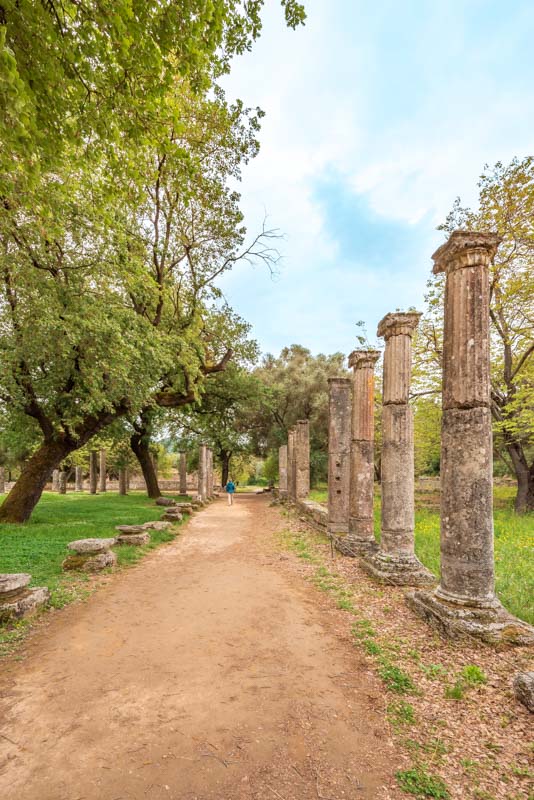
With its extensive grounds, Olympia has been one of the most popular sights in Greece for decades. While in the past only bus tours came from Athens, today cruise passengers also arrive from the port town of Katakolo, 30 km away. In the summer months, you should expect waiting times at the ticket offices. Spring is the most relaxed time to visit.
Via the official ticket website (tickets.hh.gr) or through GetYourGuide*, you can buy an online ticket and avoid the wait at the entrance:
➲ Skip-the-line online ticket*
#3 Walking tour of Ancient Olympia
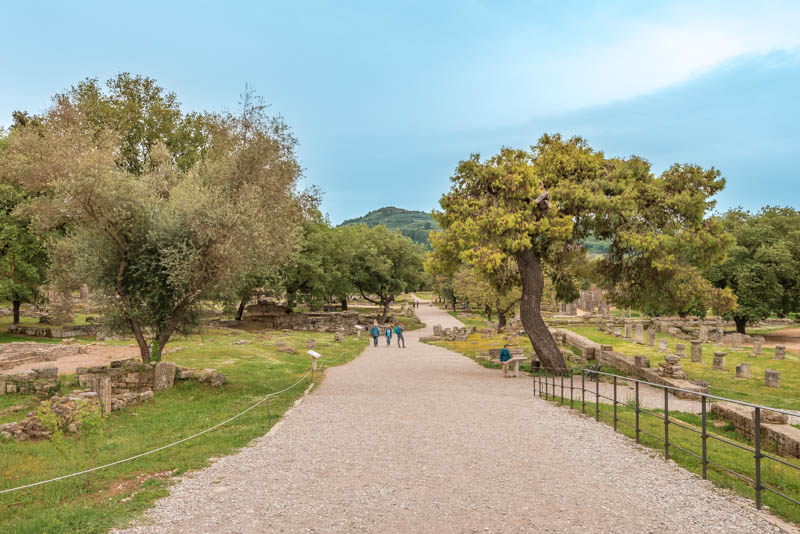
For a relaxed tour of Olympia, you should allow at least two hours. Walking along the paths feels like travelling through time, and information boards (including in German) explain many of the historical connections. You could easily spend several more hours in the Archaeological Museum of Olympia, surrounded by fascinating finds and extensive information.
History lovers should definitely join a guided tour, either as a group or private tour, which can be booked online via GetYourGuide*:
We usually start our tour either from the car park near Restaurant Ambrosia or, a little further south, from the car park by the Museum of the History of the Ancient Olympic Games. We follow the signs (including those for Ancient Olympia) and cross the Kladeos River, which in ancient times was believed to have divine qualities, but today is usually completely dried up in summer.
After a few minutes, we reach a botanical park, the Olympic Botanical Garden, next to the Archaeological Museum of Olympia, which marks the entrance to the site. The museum is one of the best of its kind in Greece and can be visited either before or after your tour of the Olympic complex, depending on how busy it is.
Selected buildings of Olympia
Ancient Gymnasium
In the northern part lies the ancient Gymnasium of Olympia, where boys of the upper classes received intellectual, physical, and character training. The handling of weapons was also practised here from an early age. Only sparse remains of the rooms survive today, with column stumps scattered throughout the sacred olive grove.
Philippeion of Olympia
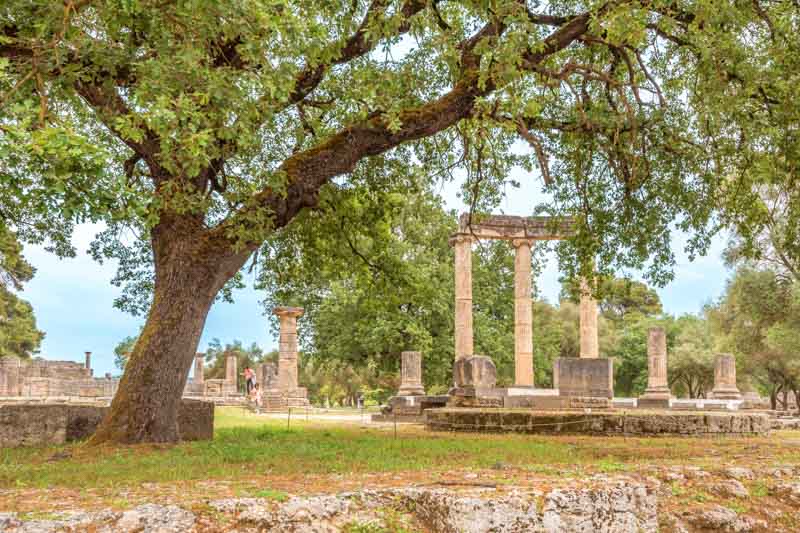
Just a few metres further on, you reach the first monumental structure of the archaeological site, the Philippeion of Olympia. Its name comes from the fact that it was a commemorative building commissioned by the Macedonian king Philip II, the father of Alexander the Great.
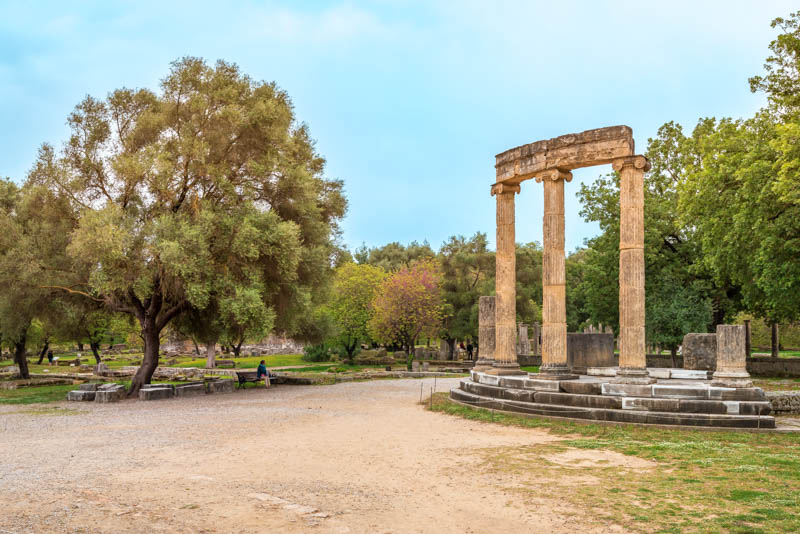
Built in 338 BC, this striking rotunda is a real eye-catcher in Olympia and recalls the Temple of Athena Pronaia in Delphi. Some of the original 18 columns have been reconstructed. The entrance to the round temple faced east, and statues of Alexander the Great’s ruling family once stood inside it.
All information about the ancient site of Delphi can be found in our separate article: Oracle of Delphi
Temple of Hera
The Temple of Hera is probably the oldest temple in Olympia, along with the sanctuary of Zeus. It was built around 600 BC, destroyed by an earthquake in 400 AD, and never rebuilt. Originally, the temple columns were made of wood, but over time individual stone drums replaced them, which is why the columns still look so different from one another today. Since 1936, the Olympic flame has been lit at the Temple of Hera every four years.
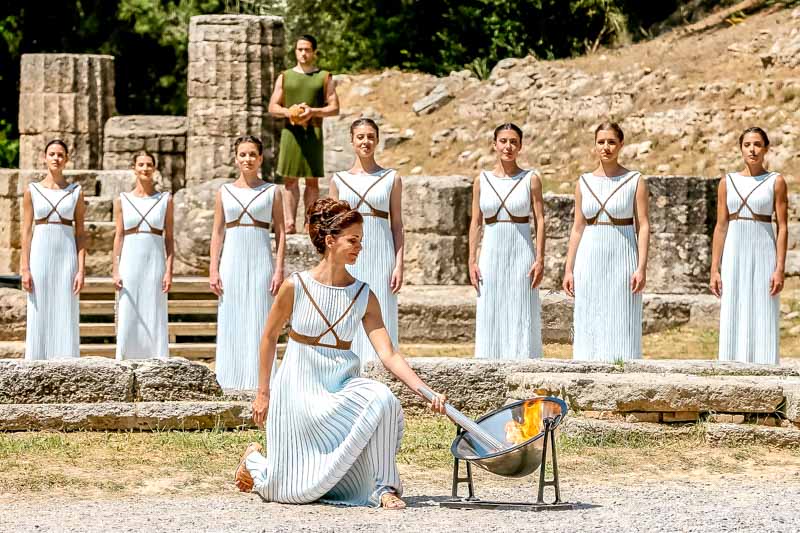
In ancient times, the victors received the Olympic wreaths, the Kotinos. Only after consultation with the Oracle of Delphi were they woven from olive branches, from the 6th Olympic Games onwards. The elongated building measures 50.01 m × 18.76 m and had a surrounding colonnade with 6 by 16 columns. Today, only a few stumps remain, but if you have an Olympia ticket with 3D glasses, you can experience the building in all its former splendour:
➲ Virtual Reality ticket (GetYourGuide)*
Palaestra of Olympia
To the west of the Temple of Hera and the Philippeion lies the Palaestra, which means “wrestling court” in Greek. This square area, originally covered with sand, was used for training wrestlers and boxers. An impressive colonnade, once roofed, surrounds the square.
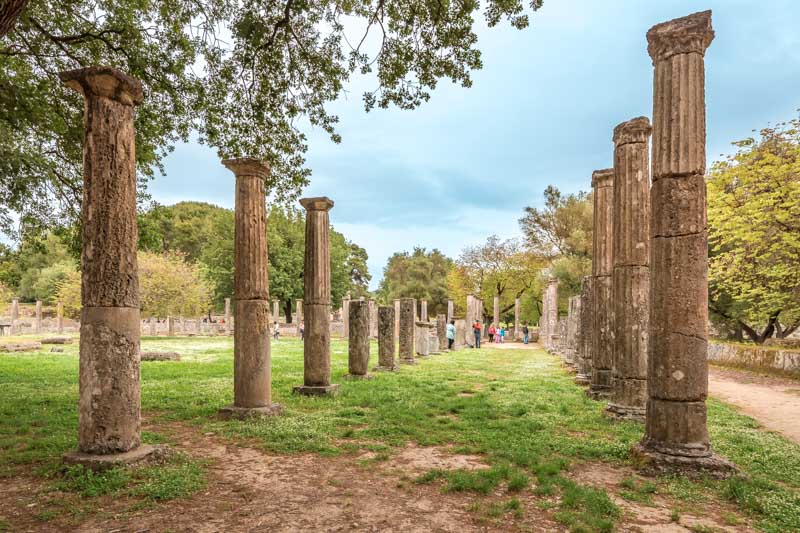
Until the 5th century BC, this area was used purely for sport and partly for military exercises. Later, the Palaestra was connected to the gymnasium, and in addition to athletic training, humanistic education was also taught here. The square complex, with a side length of 66 m, probably received its current form in the 3rd century BC.
Workshop of Phidias
To the south lies a field of ruins which, at first glance, seems rather inconspicuous. Yet here stands a large building known as the Workshop of Phidias. In antiquity, Phidias was regarded as the most important sculptor and architect of his time, and large parts of the decorative programme of the Parthenon on the Acropolis of Athens are attributed to him today.
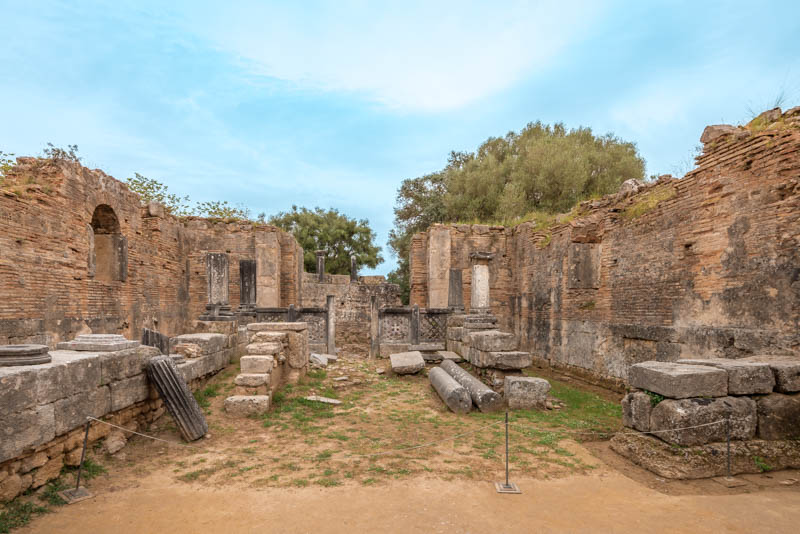
With the 13-metre-high Statue of Zeus by Phidias, this ancient artist created one of the Seven Wonders of the Ancient World. The colossal image of the god, made of gold and ivory, once stood at the altar of Zeus in Olympia. During excavations, however, only the enormous base of the statue was discovered. For centuries, scholars have puzzled over its whereabouts, and stories of its last sighting stretch from Istanbul, once Constantinople, to Rome.
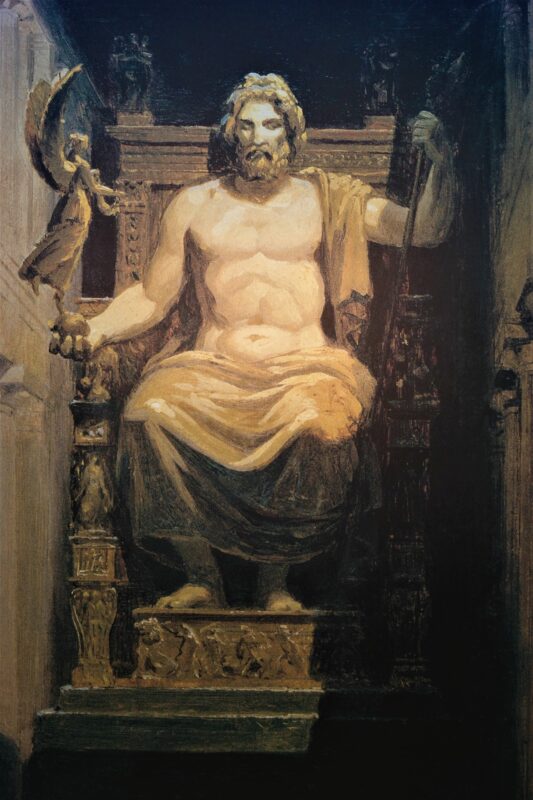
A painting of the statue can be seen in the Museum of Olympia. In 1968, archaeologists found not only remains of gold and ivory, but also a simple clay cup bearing the inscription “I belong to Phidias”. The fact that the former workshop has survived so well is due to the early Christianisation of the sanctuary.
As early as the 5th century, the 32 m by 14.5 m building was converted into a Byzantine church, and the former entrance was given a clearly recognisable apse. To the west of Phidias’ workshop are other buildings, including a bathhouse and Roman-era inns, some of them with interesting floor mosaics.
Leonidaion and Bouleuterion
The Leonidaion lies just a little further south and is now considered the largest building on the site of Ancient Olympia, measuring 74.80 × 81.08 m. Leonidas of Naxos is regarded as the founder and builder of this guesthouse, which was once surrounded by 138 outer columns and 44 columns in the inner courtyard. It is thought that around 150 athletes could be accommodated here.
An earthquake in Roman times destroyed this “ancient sports hotel”, and many parts of the Leonidaion were reused to build a protective wall. Of the neighbouring Bouleuterion, the former council hall of the Olympic committee, only foundations, column stumps and other rubble remain today. In antiquity, athletes were registered here, penalties were imposed, and competition schedules were organised.
Temple of Zeus at Olympia
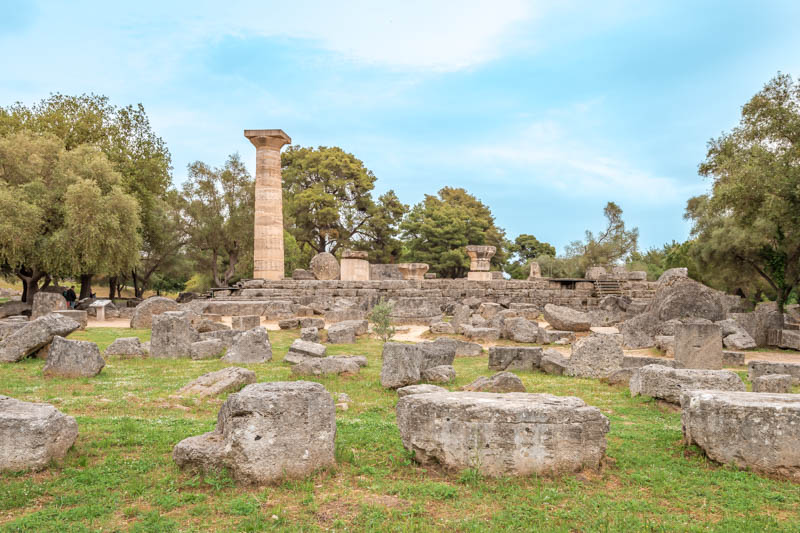
At the heart of the complex are the remains of the Temple of Zeus at Olympia. This peripteral temple, with its former 6 by 13 columns, had a ground plan measuring 64 by 28 metres and is regarded as a masterpiece of ancient architecture. Even though only sparse ruins survive today, it is still easy to imagine the power this building must once have radiated.
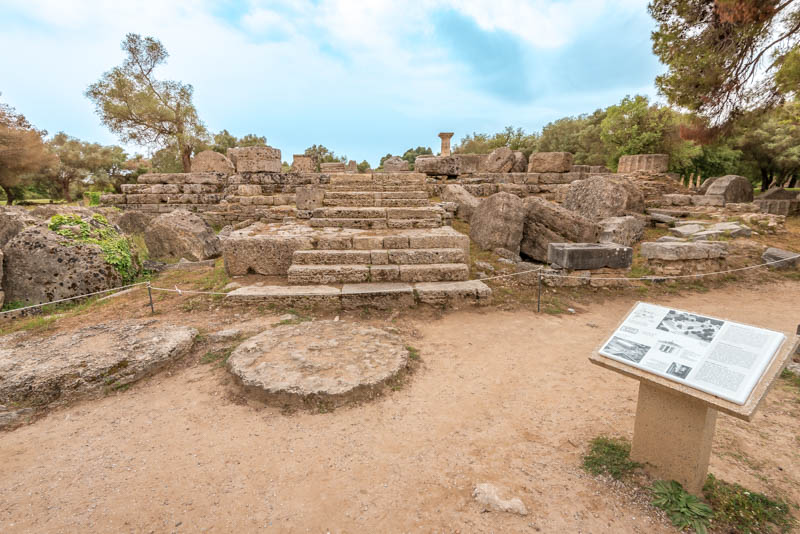
Standing 20 metres tall and built around 457 BC, this temple was considered the largest structure of its kind in ancient Greece. Inside the temple, in the so-called cella, once stood the imposing statue of Zeus. On the fifth day of every ancient Olympic festival, a solemn procession in honour of Zeus took place in and around the building.
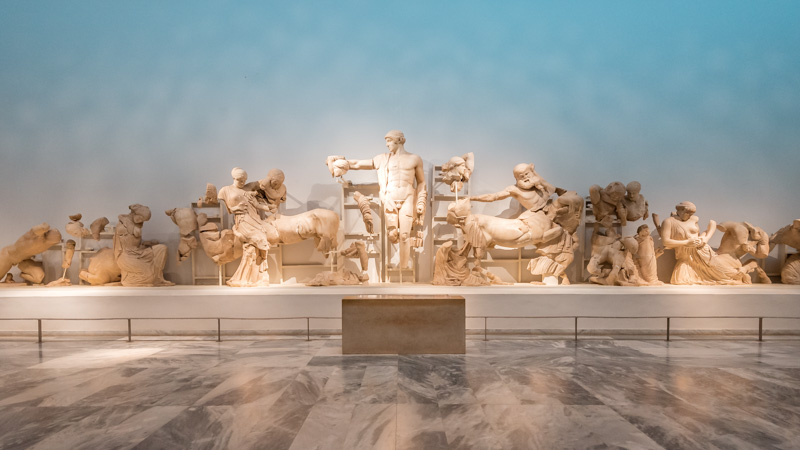
The pediment of the temple was once richly decorated with marble sculptures, some of which are now displayed in the museum, including Zeus with Pelops, the ruler of the Peloponnese. For the 2004 Olympic Games, one column was re-erected at its original height of 10.55 m. The best way to experience the sanctuary is through a virtual reality tour (View on GetYourGuide*).
Treasuries and the Nymphaeum of Herodes Atticus
From the Temple of Zeus, the path continues north. Passing numerous small shrines and altars, you reach the Nymphaeum and the treasury of the Sicyonians. The latter is considered the best-preserved of Olympia’s many treasuries. The nymphaeum was donated in AD 153 by the Roman benefactor Herodes Atticus and once served as the outlet of an aqueduct.
Stadium of Olympia
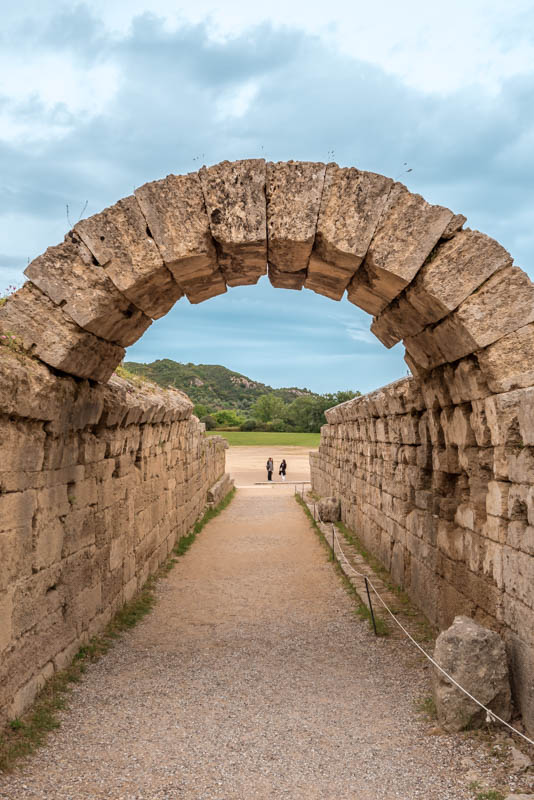
Past countless column stumps, the path widens towards the east and leads through the arched gateway into the Olympic Stadium. For many visitors, the Stadium of Olympia is the absolute highlight of the site, and fans of Greece should definitely add it to their bucket list. During our visit, we also could not resist dashing along the 192.24-metre-long running track ourselves.

Almost every minute, visitors jog across the track, and the Olympic spirit is quickly awakened in young and old alike. Whether you are doing sport yourself or simply strolling through this imposing arena, when the wind blows you can almost hear the murmurs and cheers of the ancient crowd. After all, the Olympic Stadium had a capacity of 45,000 spectators.
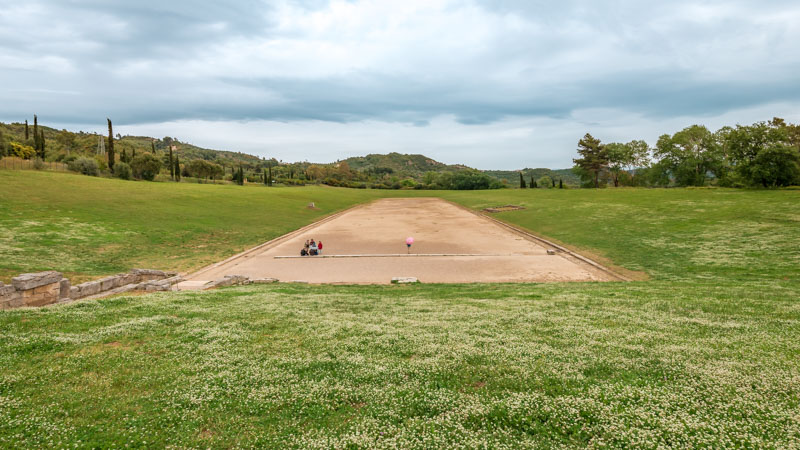
The fact that the stadium lies directly below the striking Kronos Hill, named after the Titans of Greek mythology and the father of the god Zeus, gives this place an even more mystical aura. Incidentally, the 213 m-long stadium was restored in 1961 to reflect the appearance it had during Olympia’s heyday in the 4th century BC.
💡 Peloponnese book tip: The Peloponnese travel guide by Bradt contains plenty of valuable information about Ancient Olympia and is a faithful companion on your road trip. Order it here: View on Amazon*
#4 Guided tours to Olympia
In addition to classic guided tours of Olympia, there is also the option of combining a visit to Olympia with other Peloponnese sights through organised excursions. This is especially useful for anyone not travelling to Olympia by rental car. Some of these tours even depart from Athens. You can find more details about excursions to Olympia on GetYourGuide*:
➲ To the 3-day tour (incl. Epidaurus & Mycenae)*
➲ To the 4-day tour (incl. Delphi & Meteora)*
💡 Weather in Olympia: The weather in the Elis region near Olympia is shaped by the mighty foothills of the Kyllini Mountains in the Peloponnese. In spring and autumn, there can still be rain showers. In summer, on the other hand, it gets very hot, and although the many trees provide shade, we recommend visiting only in the morning or late afternoon in July and August. For more information about the weather in the Peloponnese, have a look at our separate article: Weather in Greece
#5 Archaeological Museum of Olympia
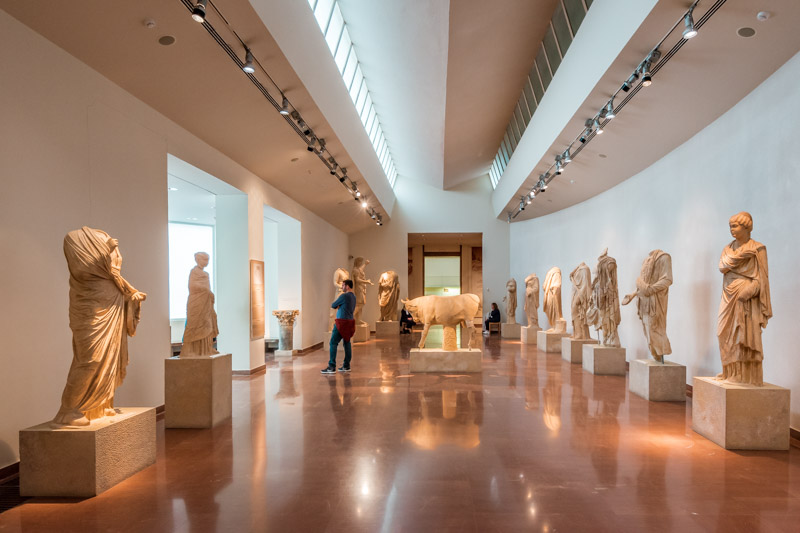
The Archaeological Museum of Olympia is one of the most important museums in Greece. The first discoveries were already put on display in 1885. Until 1975, they were housed in the building that now contains the Museum of the History of the Ancient Olympic Games. The sheer number of finds eventually made a new building necessary. The museum was last renovated in 2003.
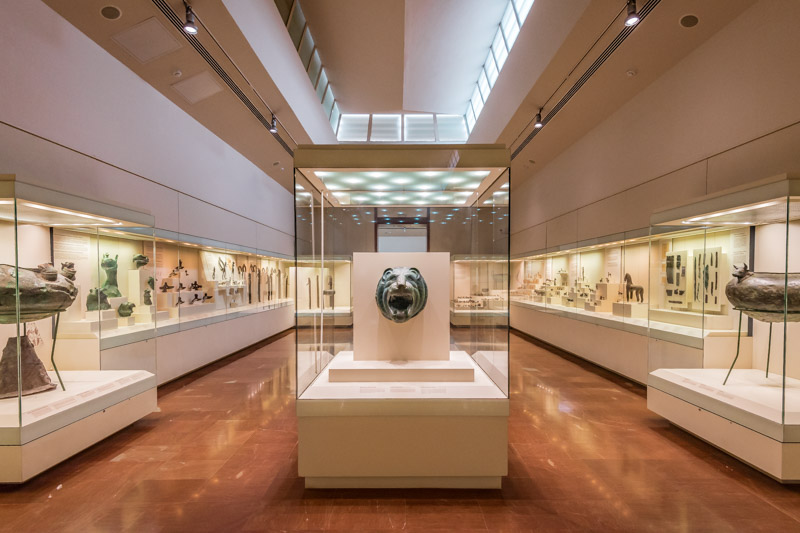
Today, the museum has 12 rooms of varying sizes, presenting important periods, themes, and buildings in sequence along a clockwise route. The first room displays prehistoric finds, the large hall at the heart of the museum (No. 5) is dedicated to the Temple of Zeus, and the final room focuses on modern history.

A visit to the museum is worthwhile for everyone, not just history lovers — especially since admission is included in the Olympia ticket. The complexity of the sanctuary of Olympia only really becomes clear through the many finds, the sculptural models of the individual temples, and the extensive background information the museum provides.
We recommend either joining a guided tour of the museum or exploring it on your own with the Olympia smartphone app or an audio guide, both of which can be booked via GetYourGuide*:
➲ To the museum ticket with audio guide*
Important exhibits in the Olympic Museum
Even in the first halls, visitors are overwhelmed by the abundance of bronze finds, especially bull figurines. Long before the first ancient Olympic Games, offerings of all sizes were brought to the sanctuary of Zeus to honour the god. Among them are numerous small stone “toy figures”, some with movable limbs.
In the fourth room, you can see the Helmet of Miltiades, an important general who won the Battle of Marathon in 490 BC. In the same room, you will also find the drinking cup of Phidias, the gifted sculptor and creator of the legendary statue of Zeus at Olympia.

In the central hall, everything revolves around Zeus, the father of the gods. On display are the magnificent pediment sculptures from the former Temple of Zeus as well as many other marble reliefs telling stories from Greek mythology. The sheer variety of these depictions is enough to make any history lover’s heart beat faster.
In a niche above Hall 4 stands the Nike of Paionios (420 BC), a 3-metre-high marble statue of the goddess of victory, which seems to float down from the sky. The statue originally stood in front of the Temple of Zeus on an 8-metre-high pedestal.
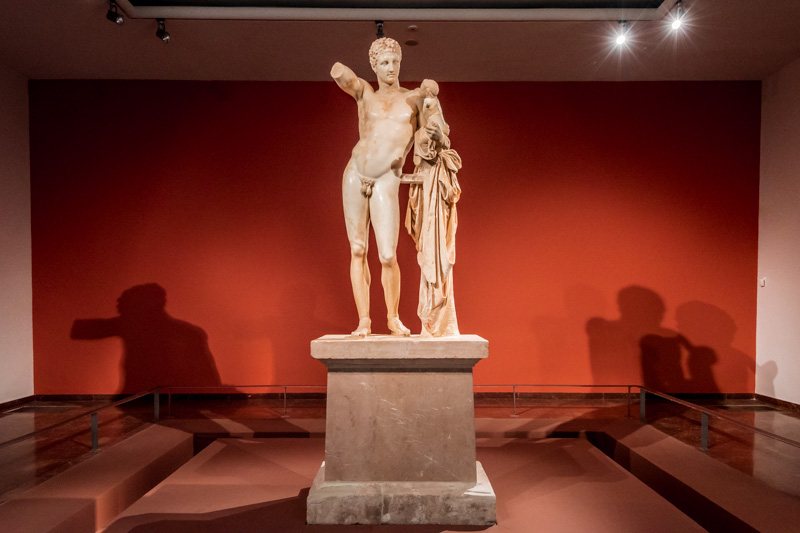
In the seventh room, you can admire the Hermes of Praxiteles, also known as Hermes of Olympia, a marble sculpture honouring the messenger of the gods. In his arms, he carries the infant god Dionysus. This magnificent statue was discovered in 1877 by the German archaeologist Gustav Hirschfeld, and to this day historians still debate whether it is a Greek original or a Roman copy.
Halls 10 and 11 are home to important marble sculptures from the Roman period, including depictions of generals, gods, and mythological figures. The highlight here is the marble bull torso from the Nymphaeum of Herodes Atticus from the 2nd century AD. The sculpture bears a dedication inscription to Zeus by Annia Regilla, the wife of Herodes.
Opening Hours of the Olympia Museum
Like the entire complex, the Olympia Museum is open 359 days a year and closes only on Easter, Christmas, and national holidays. There are toilets and a museum café on the premises. Unfortunately, prices for drinks and small snacks are very high, so we recommend heading to one of the cosy cafés in the village of Olympia after your visit.
- Opening hours of the Olympia Museum: Same as Ancient Olympia
- Website of the Olympia Museum: Ancientolympiamuseum
✓ Full coverage & unlimited mileage included
✓ Free cancellation up to 24 hours before pickup
✓ Best price guarantee via Discover Cars
#6 Interesting Facts about Ancient Olympia
Ancient Olympia lay buried under a thick layer of mud from the Kladeos River for centuries. Until the 18th century, this important sanctuary was considered almost forgotten. Large-scale excavations did not begin until around 1880 and, between 1906 and 1929, were led in part by German archaeologists such as Wilhelm Dörpfeld and Ernst Curtius.
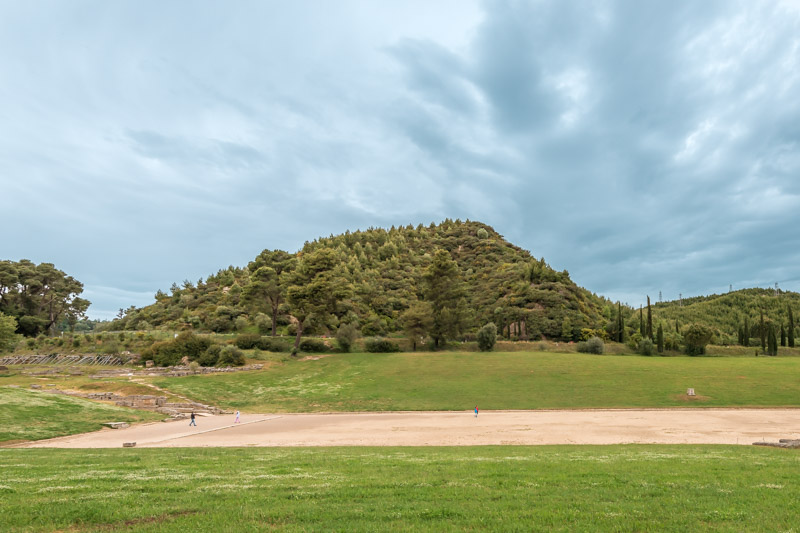
The valley of Olympia, with its striking Kronos Hill, was probably established around 2000 BC as a sanctuary in Elis and was only designated as the venue for the ancient Olympic Games much later. The Olympic Games were not about money, but about the immortal glory of the competitors, which was tantamount to heroic status.
Construction of the sanctuary in the Olympic spirit began in the 10th to 9th centuries BC. Most of the complex had been built by the 4th century BC, while extensions continued well into Roman times (see Olympia map). Over the centuries, unimaginable quantities of votive offerings and valuable treasures accumulated in Olympia.

According to the Greek historian Pausanias (2nd century AD), there are said to have been around 70 temples and sanctuaries in total. Incidentally, the largest part of the Olympia complex was not the stadium, but the hippodrome, a horse-racing track on the neighbouring Alfios River, which has still not been fully excavated to this day.
Olympic Games in Antiquity
The first Olympic Games of antiquity, also known as the Elean Olympics, are believed to have taken place in 776 BC. Although regional competitions are said to have existed before that, mostly with a military rather than athletic background, they were hardly tied to a formal event and did not take place at regular intervals. In the 6th century BC, the games gained wider importance beyond the region.
During the ancient games, the Olympic Truce (Ekecheiria) was in force, and all participants were required to observe it. In any case, no one was ever allowed to enter Olympia as a sanctuary bearing weapons. Through the homage paid to the gods, including offerings and elaborate ceremonies, the Olympic Games always had a peaceful, deeply spiritual, and partly religious character.
It was agreed early on that August would be the month of the Games and that they would take place every four years. The exact origin of the Olympic Games has still not been fully clarified. According to Greek mythology, the hero Heracles or Pelops, king of the Peloponnese, is associated with the founding of the Games.
The Games of Olympia are considered the oldest Panhellenic sporting events. In addition, there were other games such as the Pythian Games in Delphi (in honour of the god Apollo, every 4 years), the Nemean Games at Argos (in honour of Zeus, every 2 years), and the Isthmian Games in Corinth (in honour of the god Poseidon, every 2 years). However, the Olympic Games, which lasted for centuries, held the greatest cultural and political significance.
Interestingly, at that time only men were allowed to participate as athletes and spectators, with the sole exception of the high priestess of the Temple of Hera. After the devastating Persian Wars in the 6th and 5th centuries BC, and the hard-won victory and freedom that followed, the often quarrelling Greek kingdoms came to see the Olympic Games as a symbol of peace and unity.
In AD 393, they were officially held for the last time, because a year later Roman Emperor Theodosius I outlawed them as a pagan cult. As is still often the case today in Greece, people didn’t think much of being told what to do back then either. Scientific studies suggest that the Olympic Games probably continued on a smaller scale until the 6th century AD.
Constant incursions by Slavs and Goths, as well as severe earthquakes (see article: Greece Earthquake), destroyed the site. With its annual flooding, the Kladeos River buried the sanctuary for centuries under a layer of mud up to 4 m thick. The Englishman Richard Chandler was the first scholar to visit Olympia in 1766, where he discovered the remains of the Temple of Zeus.
In Greece, which was still under Ottoman rule at the time, it took years before the first excavations could be carried out. It was only after the founding of the modern Greek state in 1830, and under the direction of the German Archaeological Institute, that the excavations gained real momentum. In 1896, the first flame of the Olympic Games of the modern era was lit.
#7 Hotels near Olympia
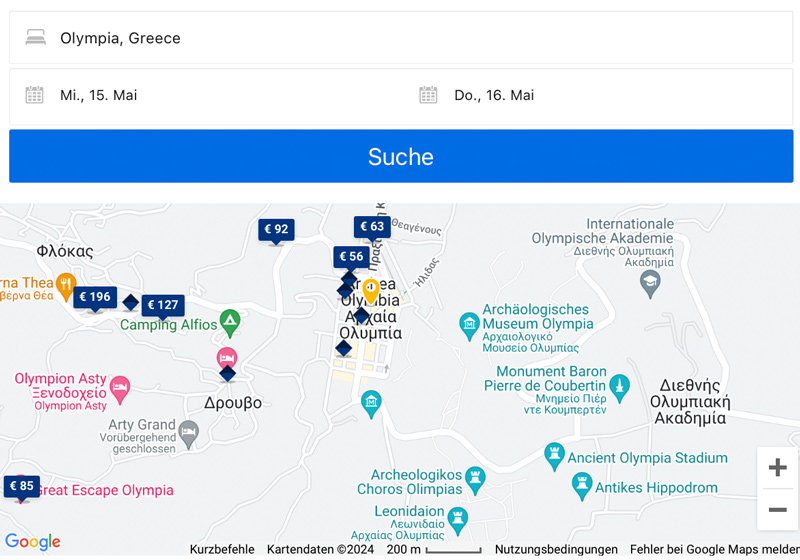
There are some solid hotels in Archea Olympia. In the immediate surroundings, additional accommodation options have been built in recent years. What stands out is the low price level of the accommodation, which in some cases falls below the national average. Since most visitors only come for a day trip, however, the village becomes pleasantly quiet and cosy in the evening.
Still, staying for one or more nights is well worth it, as Olympia is also a great base for exploring the northwestern Peloponnese. By clicking on the links, you can find more information about the hotels through our partner Booking.com*.
Our accommodation tips for Olympia
Great Escape Olympia (Drouvo)
A compact self-catering cottage with stunning views over the valley of the Alfios River. Lovingly furnished with two bedrooms sleeping up to 4 people, in a quiet location about 700 m outside Drouvo. Olympia is just a 6-minute drive away.
Hotel Europa Olympia (Drouvo)
A somewhat dated 4-star hotel about 1 km west of Ancient Olympia. Some rooms and suites have recently been renovated, so it’s best to ask when booking. Very good breakfast and courteous service, plus an inviting pool area in the well-kept garden.
Leonidaion Guesthouse (Archea Olympia)
Beautiful rooms and spacious apartments on the southern edge of the village, not far from Taverna Orestis. The junior suite even has a rooftop terrace with wonderful views of the surrounding area. Good breakfast, friendly staff, and fair prices even in summer.
Prytanio (Archea Olympia)
Small guesthouse at the northern entrance to the village. Modern, somewhat noisy rooms, good breakfast, helpful staff, and very reasonable prices. Just a 7-minute walk from the ancient site.
Stadium Apartments (Archea Olympia)
Friendly owner Costas rents out simple, functional studios in the heart of the village at almost unbelievable value for money. Perfect for anyone wanting to spend a night in Olympia without expecting anything fancy.
Camping at Ancient Olympia
Camping Alfios (Drouvo)
A cosy campsite in Drouvo, the neighbouring village of Archea Olympia. Enjoy a warm welcome and sometimes even personal guidance from the owner. Nature-oriented pitches, also suitable for larger motorhomes, Greek home cooking on site, and a small pool for cooling off.
Camping Diana (Archea Olympia)
A solid campsite on the western outskirts of the village. Small pool, clean sanitary facilities, though a little dated. Perfectly adequate for a stopover in Olympia. Due to its proximity to the village, it can get a little noisy in summer. Information and prices at: Campingdiana

Restaurant Recommendations for Archea Olympia
Anesis: Modern diner-style barbecue tavern. In addition to tourist gyros plates, they serve the best souvlaki in Olympia here, along with good mezedes (appetisers) at fair prices. Family atmosphere and relaxed staff.
Dimitra Restaurant & Wine (ΔΗΜΗΤΡΑ): Very good restaurant right by the main car park in Olympia. Lovely ambience and very tasty, original dishes. The high quality matches the slightly higher prices.
Roda Cafe: From coffee and ice cream to fresh juices, crêpes, wine, and pizza, you’ll find everything here from small snacks to larger meals. Despite its location right by the entrance to Ancient Olympia, prices are still fair. Also highly recommended for breakfast!
Taverna Orestis: Typical Greek tavern with good home-style cooking at fair prices. Friendly welcome and helpful staff, traditional décor, and open all year round.
Zeus: Modern resto-bar on the main promenade, popular with locals too. Delicious coffee, good cocktails, and decent food.
#8 Places of interest in the area
In addition to the ancient site and the Olympia Museum, Archea Olympia has other highlights that are especially interesting for history lovers. If you’re staying longer in the village or have enough time, a visit to Alexandros at the Smili art workshop on the northwestern edge of the village is well worth it. Here, you can gain fascinating insights into pottery and marble craftsmanship.
Archimedes Museum in Archea Olympia
The Archimedes Museum is located in the southern part of the Praxiteli Kondyli promenade and showcases technical inventions and craftsmanship achievements from antiquity. On display are an ancient organ, various military devices such as catapults and battering rams, as well as a wide variety of models, including replicas of Greek ships.
The museum is dedicated to the engineer Archimedes of Syracuse, who is regarded as the greatest mathematician of antiquity. Most of the replicas have been recreated using the materials of the time, and a large part of the exhibits can even be seen in action. The exhibition is impressive for visitors of all ages and is also free of charge; donations and purchases in the adjoining shop are welcome.
→ Further information and opening hours of the Archimedes Museum can be found at: archimedesmuseum.gr
Museum of the History of the Ancient Olympic Games
The Museum of the History of the Olympic Games is located west of the excavation site and, as the name suggests, is dedicated to the historical development of the games, from their beginnings in antiquity to their revival in modern times. Numerous exhibits and displays illustrate the significance of the Olympics for humanity.
A visit to this museum truly completes a trip to Olympia. All explanations are provided in Greek, English, French, and German. Admission to the Museum of the History of the Ancient Olympic Games is already included in the Ancient Olympia ticket. Here too, you should allow at least 1–2 hours for your visit.
→ Further information and opening hours of the Olympic History Museum can be found at: ancientolympicsmuseum.com
Temple of Apollo near Bassae
The Temple of Apollo at Bassae lies about 60 km south of Olympia and is one of the most important sanctuaries in the Peloponnese. Since 1986, this imposing temple near the village of Skliros has been a UNESCO World Heritage Site. Dedicated to Apollo Epikourios, it was built between 450 and 400 BC at an altitude of 1,131 m.
Even the journey there has something unusual about it: the temple is hidden beneath a huge tent. On UNESCO’s recommendation, it has been covered with a weatherproof tarpaulin since 1987, though it is expected to be uncovered again once the excavations are completed. Inside the tent, you can admire the astonishingly well-preserved temple in all its glory.
English archaeologists began extensive excavations at the beginning of the 19th century. Important finds from the Temple of Apollo are therefore now housed in the British Museum in London, including the impressive Bassae Frieze, a marble high-relief sculpture made up of 23 panels with a total length of 31 metres.
- Bassae Temple opening hours: Open all year round, summer opening hours 1 April – 31 October from 08:00 to 20:00, admission €10, closing days same as Ancient Olympia
Oak forest of Foloi
The Foloi Forest (Το Δάσος Φολόη) may sound rather unspectacular to Central Europeans, but it is a unique ecosystem in the Balkans. Nature lovers should definitely make a detour to this enchanted place. Covering almost 42,000 hectares, this oak forest is one of the largest and oldest in southern Europe.
At an altitude of 600 metres, the forest is home to numerous animal and plant species. Short-toed eagles and golden eagles, Eleonora’s falcons, eagle owls, and little owls can be spotted here. Mammals such as wild boar, roe deer and red deer, foxes, and jackals also live here, along with Greek tortoises and various snakes such as vipers, adders, and the Balkan whip snake.
According to Greek mythology, the forest owes its name to the centaur Pholos, who lived here and hosted the hero Heracles during his search for the Erymanthian boar. The Foloi Forest lies about 30 km northeast of Olympia and offers a pleasant coolness during the summer months. In autumn, the changing colours of the leaves are a real highlight in Greece.
→ Here you can find more articles about the region and lots of tips about the Peloponnese peninsula:
FAQ about Ancient Olympia
What’s the best way to get to Olympia?
From Patras it’s about 115 km, from Athens around 300 km, and a rental car gives you the most flexibility. Buses also run from Athens and Patras, and cruise passengers can reach Olympia by train from Katakolo in about 50 minutes.
What are the opening hours and admission prices?
From April to October, Olympia is open daily from 8am to 8pm, and from November to March from 8:30am to 3:30pm. Admission costs 20 euros, 10 euros at the reduced rate, and drops to half price in the low season.
How much time should you plan for a visit of Olympia?
Plan at least two hours for the archaeological site itself. Add another 1 to 2 hours for the archaeological museum.
What are the highlights of Olympia?
The key buildings include the Temple of Zeus at the heart of the complex and the Temple of Hera, where the Olympic flame has been lit since 1936. At the stadium, which once held 45,000 spectators, you can run the 192-meter track yourself.
What can you see at the Archaeological Museum of Olympia?
Spread across 12 rooms, the museum houses major finds like the Hermes of Praxiteles and the Nike of Paionios. Admission is already included in the Olympia ticket.
What’s worth seeing around Olympia?
About 60 km south sits the UNESCO-listed Temple of Apollo at Bassae, hidden beneath a large protective tent. Nature lovers head to the Foloi oak forest 30 km away, one of the largest and oldest woodlands in southern Europe.
*Support our blog Greece-Moments
In this post, you will find affiliate links marked with an asterisk (*). If you book or buy something through one of these links, we receive a small commission. The price stays exactly the same for you. This helps us continue to provide high-quality content for free. Did you enjoy this post and would like to say thank you? Then simply buy us our next Greek coffee ☕️ To the coffee fund
Bookmark this post on Pinterest!