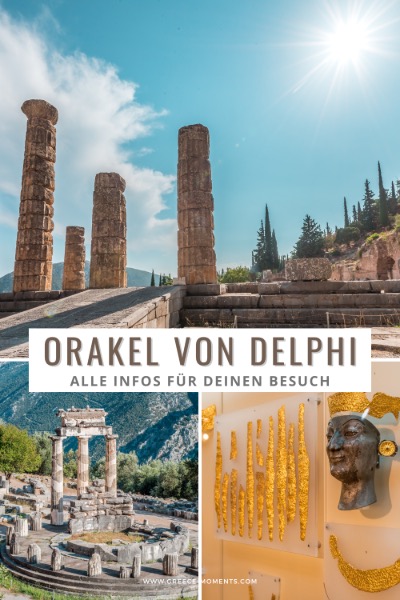

In the ruins of the ancient site of Delphi, where the shadows of the gods still seem to dance between temple foundations and marble columns, lies a secret as old as humanity itself: Know thyself!
The truth that once spoke from the depths of the earth at Delphi already existed in the hearts of those who sought it.
In ancient times, travelers and rulers sought out the Oracle of Delphi to have their futures predicted. For over 1,000 years, it was the mouthpiece of the gods, and Delphi was thus considered the center of the world.
Centuries have passed since then, the oracle has long since fallen silent, but the sanctuary is one of Greece’s most important sights. Delphi has been a UNESCO World Heritage Site since 1987, underscoring the high cultural value of the ancient site.
A walk through the ruins gives you an idea of the power that emanated from this mystical place. Here are our 8 tips for your visit to Delphi:
#1 Getting to Delphi
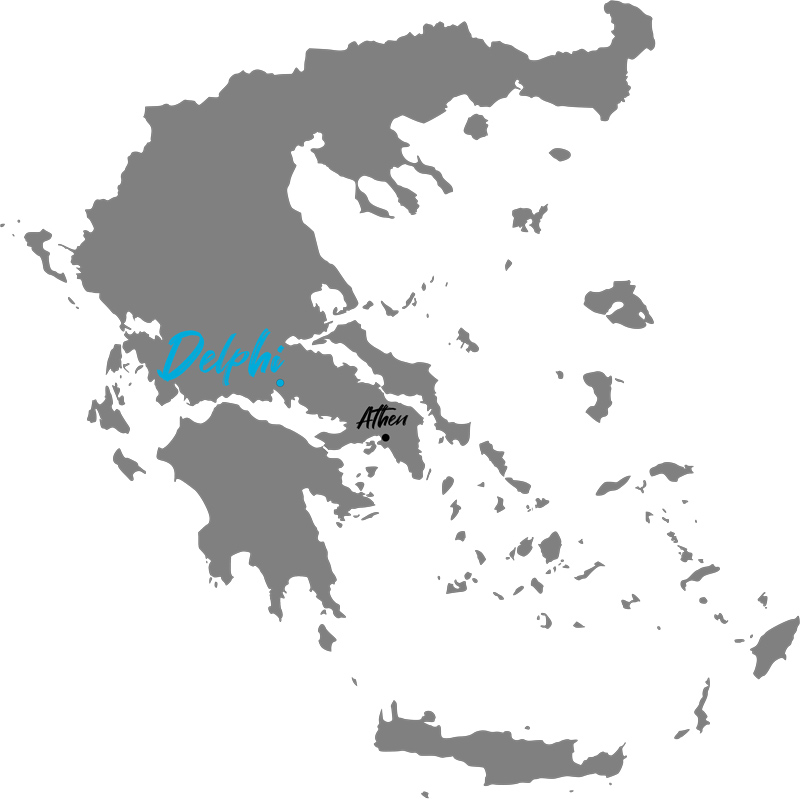
Delphi is located in the region of Central Greece at an altitude of 700 m below the mighty Parnassus Mountains. Today, the name Delphi is used both for the historical site and for the village just a few meters away. From Arachova and Livadia (towards Athens) or from Itea and Galaxidi (towards the Gulf of Corinth), you can reach Delphi via National Road 48.
How far is Delphi from Athens?
The Greek capital Athens is about 160 km from Delphi. Depending on traffic, the journey by car takes at least two hours, either via the A1/E75 motorway or via National Road 3 (20 minutes longer). Please note that tolls apply on the A1 motorway. From Livadia, follow National Road 48 towards Delphi.
Distance to the Oracle of Delphi:
- Athens to Delphi: approximately 160 km, approx. 2 hours’ drive
- Igoumenitsa to Delphi: approx. 335 km, approx. 4 hours’ drive
- Meteora to Delphi: approx. 235 km, approx. 3 hours’ drive
- Patras to Delphi: approx. 125 km, approx. 2 hours’ drive
- Thessaloniki to Delphi: approx. 375 km, approx. 4.5 hours’ drive
Is it worth renting a car for Delphi?
For those who like to travel independently, it is worth renting a car to get to Delphi. This allows you to plan your Delphi trip on your own terms. If you are not already traveling in Greece, it is a good idea to pick up your rental car at Athens Airport. You can compare offers and check prices via our partner Discover Cars*:
Road trip in Greece: Delphi can be easily integrated into a round trip through Greece by rental car. You can find out which other places in the area are interesting in the article: Greece regions
What is the parking situation like?
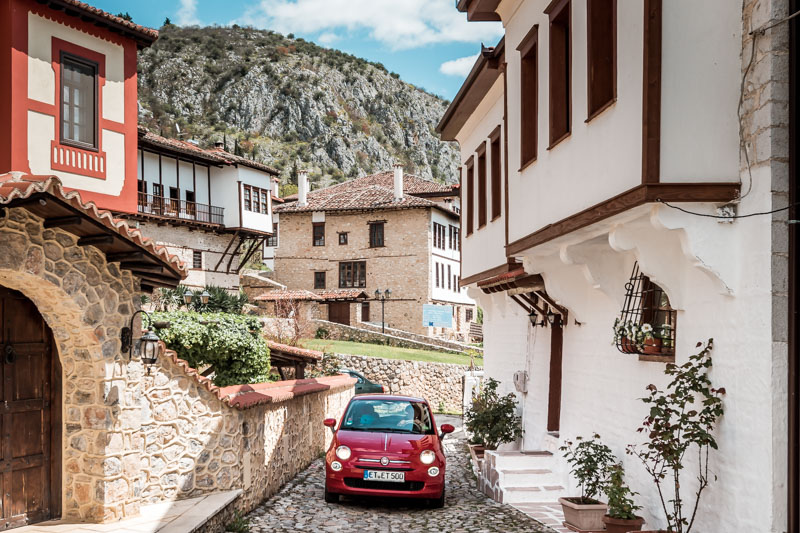
Unfortunately, the parking situation in Delphi is rather poor. Directly below the archaeological site, there are free parking spaces along the national road (yellow lines indicate no parking!). When we visited in August, there were still spaces available at around 9:30 a.m. By noon, however, almost all spaces were occupied.
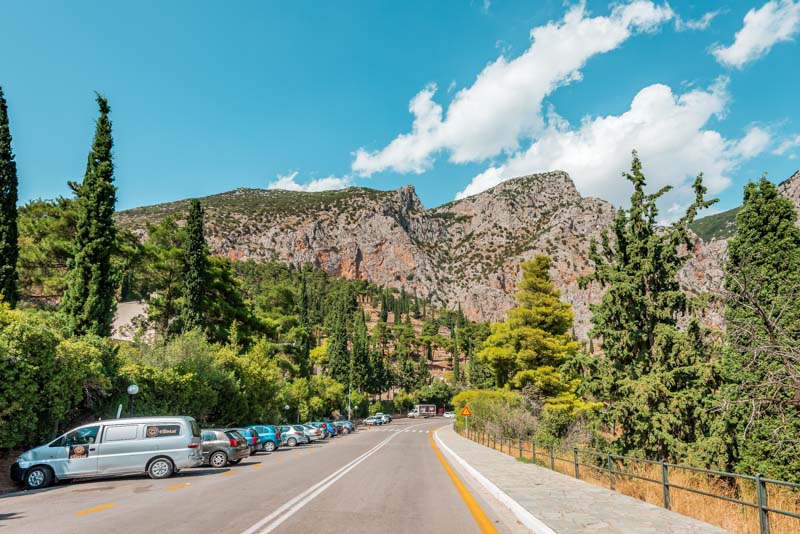
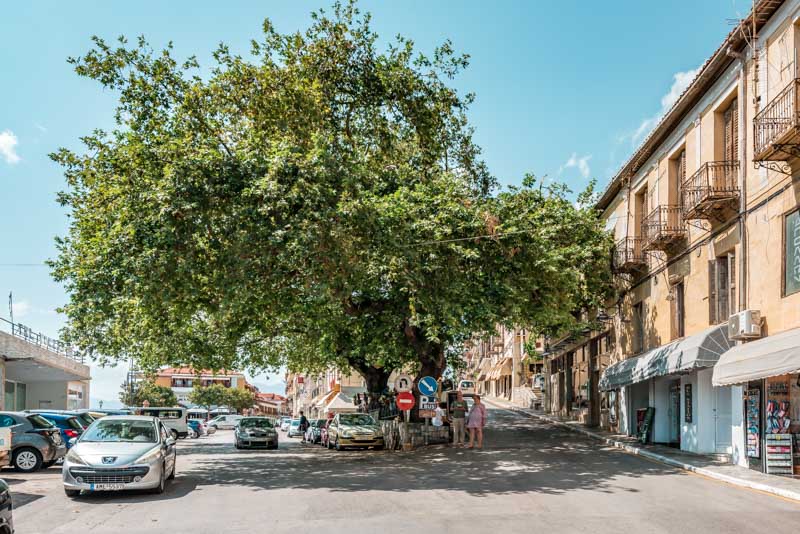
At the Temple of Athena further east, there are only about ten parking spaces available. During the high season, finding a parking space along the road quickly becomes an ordeal. Alternatively, you can park in the village of Delphi itself (e.g., Delphi Parking) and then walk the approximately 400 m (7 min) to the site via the wide footpath. The short walk is rewarded with magnificent views.
💡 Best time to visit Delphi: The first bus groups from Athens arrive in Delphi around 10:30 a.m., after which the ancient site and the village become somewhat chaotic. If you arrive early, you will get more out of your tour and quickly find a free parking space. Delphi is open all year round, in summer from 8 a.m., giving you plenty of time before the crowds arrive. You can book your ticket online via our partner GetYourGuide*: To the online ticket*
Bus connections to the Oracle of Delphi
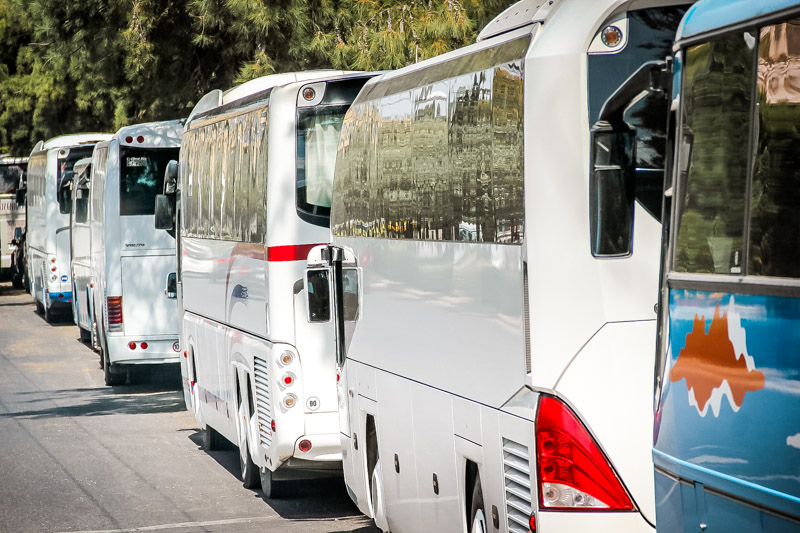
Delphi can also be reached by bus. The bus stop (Delfoi bus station) is located on the eastern edge of the village. The KTEL Fokidas bus company connects Delphi with Athens and other places such as Kalambaka (Meteora monasteries) or Nafpaktos (Gulf of Corinth). The bus ride from Athens takes about three hours. Departure is from Liosion station (Bus Terminal B).
→ Information on bus connections to Delphi can be found here: KTEL Fokidas
If you don’t want to or can’t rent a car and don’t want to use the intercity bus service, you can alternatively join an organized bus tour from Athens to Delphi, which also gives you the opportunity to learn all about one of Greece’s most important archaeological sites. Information and booking via our partner GetYourGuide*:
Taxis in Delphi
For taxi rides in and around Delphi, including the greater Corinth Gulf area, you can use the services of Giannis from TAXI DELPHI. No meter, but fair fixed prices, tel. +306932977953.
💡 Help with planning your holiday in Greece: Not sure where to start or how to plan your trip to Delphi? No problem, take advantage of our years of experience with trips to Greece and let us help you. We can advise you on all your questions and concerns, even via video chat. You can book your consultation here: Travel advice for Greece
#2 Delphi opening hours
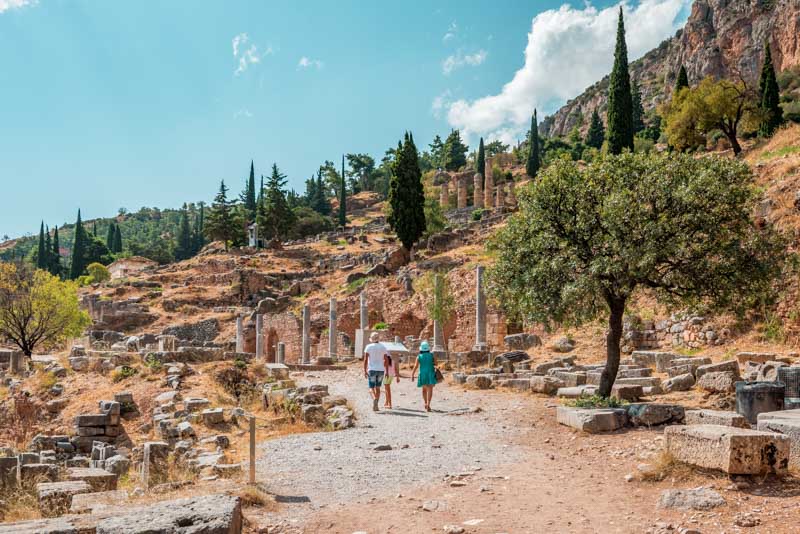
Delphi is open almost all year round, except on Greek national holidays when the site is closed. From April to October, Delphi is open from 8:00 a.m. to 8:00 p.m. (last admission at 7:40 p.m.), and from November to March from 8:30 a.m. to 3:30 p.m. There are restrooms and a small café with a souvenir shop in the entrance area.
Ticket prices for Delphi:
- Adult: €20
- Reduced ticket: €10
- Children, teenagers, and students up to 25 years of age: free admission for EU citizens
As Delphi is open to visitors all year round, it is also worth a visit in late autumn or winter for individual travelers, tour groups, or camping enthusiasts. Incidentally, the impressive Tholos is open to the public all year round for free.

Days with free admission to Delphi:
- March 6 (in memory of Melina Mercouri)
- April 18 (International Monument Day)
- May 18 (International Museum Day)
- Last weekend in September (European Heritage Days)
- October 28 (National Holiday – Ochi Day)
- Every first Sunday from November 1 to March 31
Delphi closing days: January 1, March 25, Greek Easter (Good Friday: reduced opening hours from 12:00-17:00, Holy Saturday: reduced opening hours from 8:00-15:00, Easter Sunday: closed), May 1, December 25, December 26
Visiting the Delphi archaeological site is possible for people with limited mobility using a special vehicle. You should register at least 7 days in advance by email (efafok@culture.gr) or by phone to use this service.
You can purchase your Delphi ticket online via the official ticket website (hhticket) or GetYourGuide* and avoid waiting times at the entrance:
➲ Go to the online ticket without queuing*

#3 Tour of the ancient site
The ancient site of Delphi covers more than 50 hectares and is even divided into two parts by the national highway. The tour starts either at the main entrance or about 300 m further west at the Delphi Archaeological Museum. From there, a paved path lined with cypress and pine trees leads to the ruins.
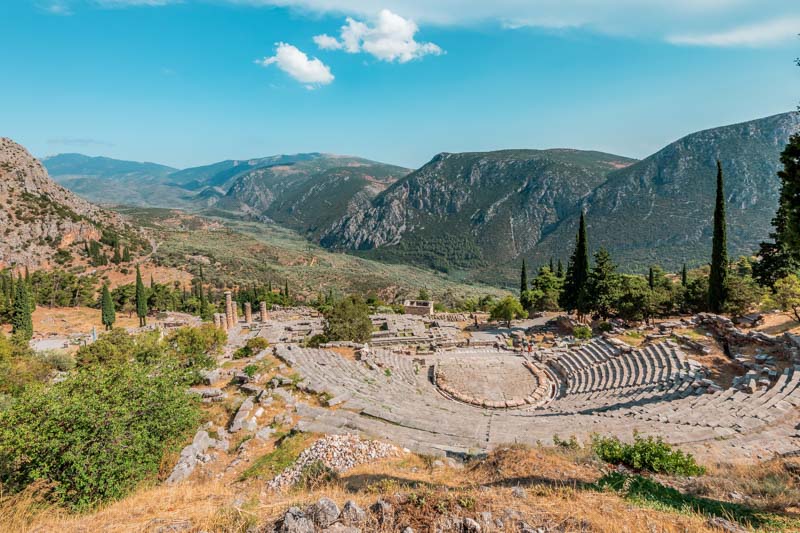
The south-facing location with its fascinating view of the Pleistos River valley and the surrounding mountains is impressive. However, the difference in altitude over which the temple ruins extend should not be underestimated. From the entrance at an altitude of 535 m to the highest point at the ancient stadium, there is a difference in altitude of approx. 130 m and a walk of 850 m.
💡 Delphi Travel Guide: The Bradt Travel Guide for the Peloponnese contains a detailed chapter on the ancient site of Delphi and its surroundings. During our tour of the ruins, the travel guide provided valuable additional information: View on Amazon*
Sacred Road of Delphi
Right after the entrance, you will find yourself in front of the remains of the Roman Agora of Delphi. Like every other ancient Greek city, Delphi also had a central square, the Agora (Greek for “market hall”), where most of public life took place in the shops and stalls. Visitors and pilgrims could probably also purchase sacrificial and votive offerings here.
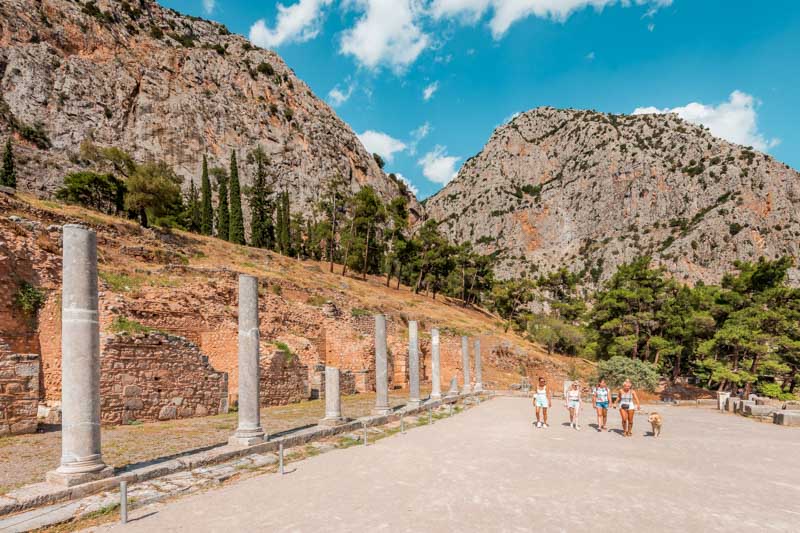
The agora was redesigned in Roman times. It marks the beginning of the so-called Sacred Way, the pilgrimage route of Delphi. The wide path leads directly to the Temple of Apollo via many steps, past numerous treasuries, statues, and stone votive offerings that have accumulated over the centuries.
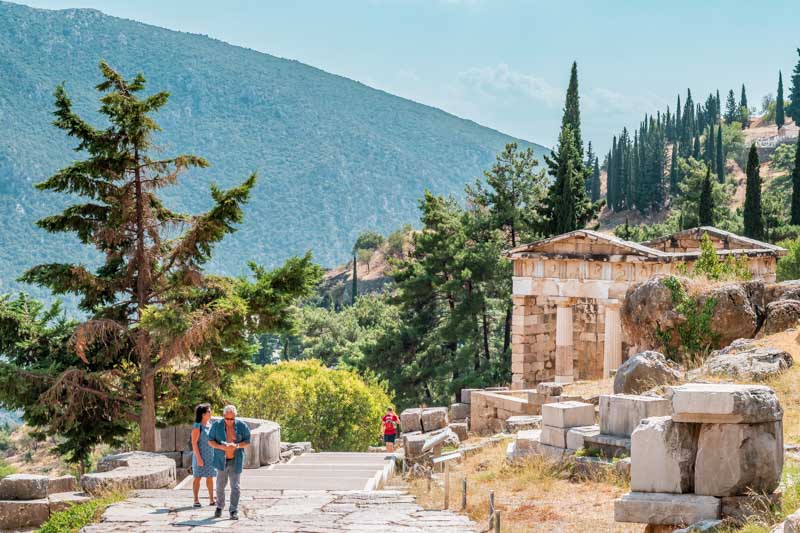
Archaeologists have been able to identify a total of 13 of the treasuries that have been handed down from antiquity. However, there are twice as many buildings grouped around the sanctuary of Apollo. Each treasury has a different architecture with different materials and architectural ornaments. Unfortunately, many of the treasuries along the Sacred Way are now only preserved as ruins, foundations, and masonry.
Navel of the world
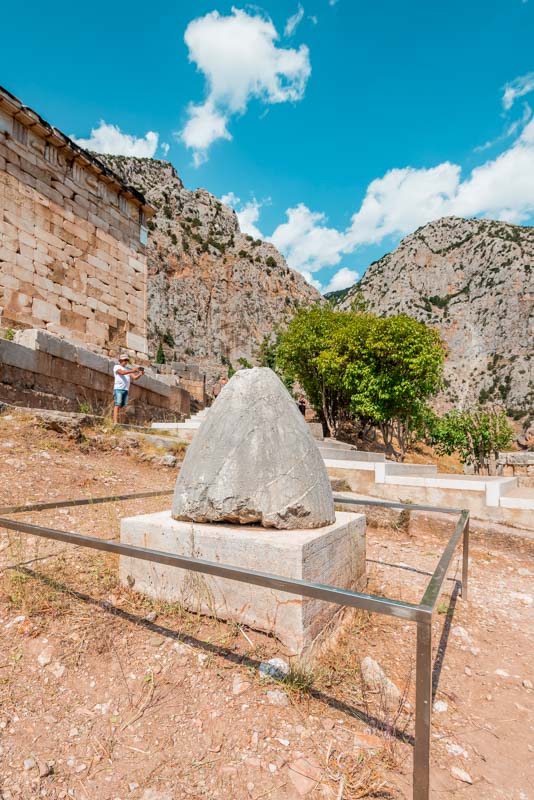
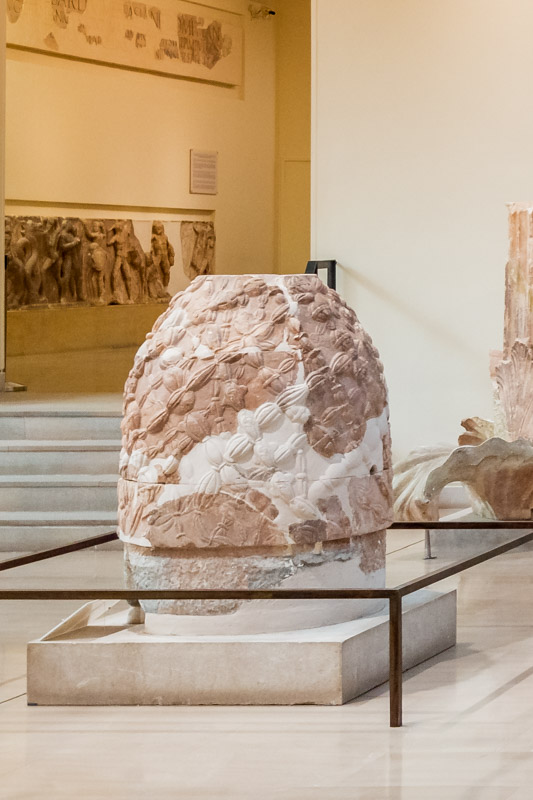
On the way to the Temple of Apollo, you will pass a rather inconspicuous monument in the first bend that resembles a stone egg cut in half – the Omphalos. This was the center of the ancient world. According to legend, this is where the two eagles sent by Zeus met (see point #6). The original stone, which looks like a beehive, is in the Archaeological Museum.
Treasury of the Sikyonians
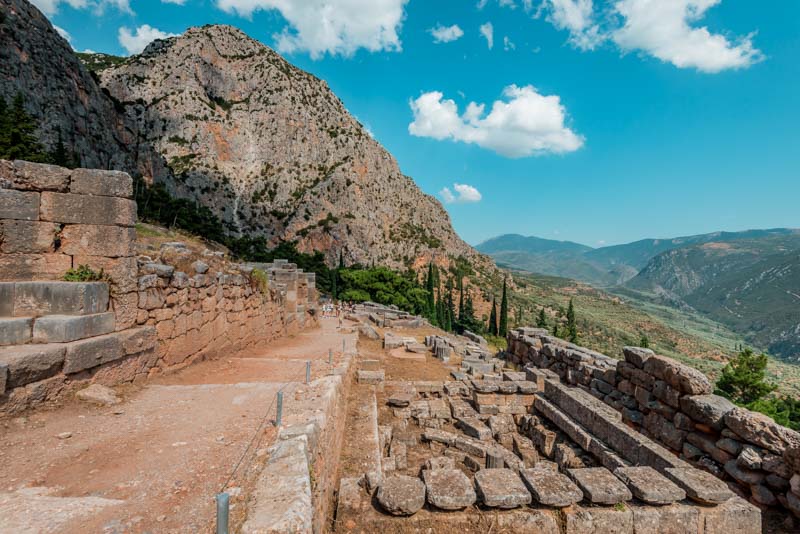
In ancient times, the Treasury of the Sicyonians was the first treasury visitors encountered in Delphi. It was built in the 5th century BC in the form of a temple (6.34 × 8.48 meters in size). Archaeologists discovered fragments of an older temple in the foundations. These finds prove that the buildings in Delphi were altered over time and were therefore never set in stone forever.
Treasury of the Athenians
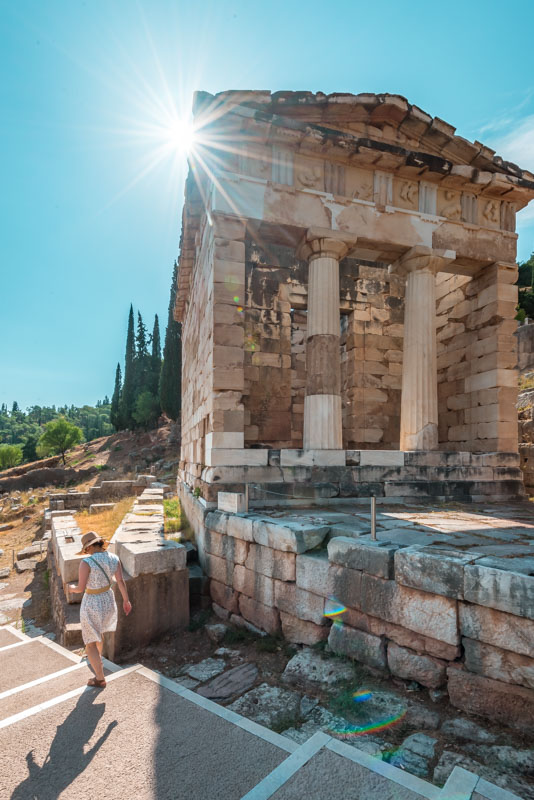
The treasury of Athens is located not far from the navel of the world. In 1893, archaeologists led by the Frenchman Théophile Homolles excavated large parts of the original Athenian treasury. The temple-like building was restored between 1903 and 1906 and now has the form it originally had between 510 and 490 BC.
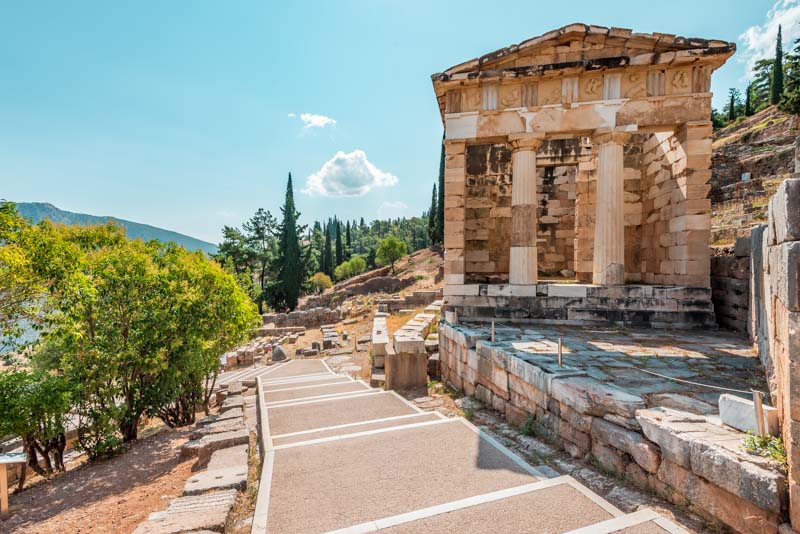
The treasure temple in Delphi was probably inaugurated in gratitude for the victory over the Persians. The Archaeological Museum houses precious finds such as pediments and metopes, similar to those found in other treasure chambers in Delphi. Although the temple has no roof, it is still one of the most beautiful buildings in Delphi.

Treasury of the Corinthians
Just before the Temple of Apollo, on the right-hand side, are the sparse remains of the Corinthian Treasury near the ritual dance floor. The Corinthian Treasury is now considered the oldest treasury in Delphi and once housed votive offerings of silver and gold weighing 800 kg.
If you would like to admire this and many other impressive temples in all their glory, you can book a Delphi Virtual Reality Tour via GetYourGuide*:
Temple of Apollo at Delphi
The Temple of Apollo at Delphi is the centerpiece of the entire ancient site. It is dedicated to Apollo, the god of light, whose name means “herald” or “protector against evil.” It is no wonder that so many rulers sought out the oracle, asking for answers about the outcome of an upcoming campaign, the possibility of having children, succession to the throne, and much more.
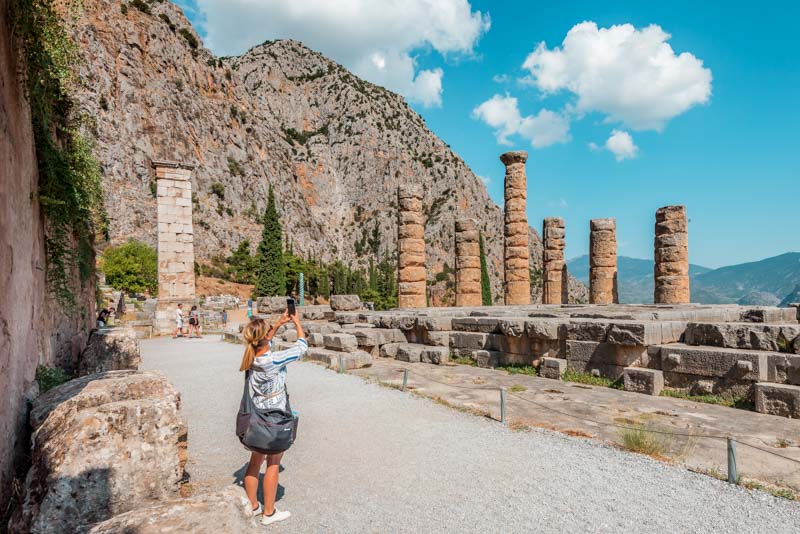
Over the centuries, at least five temples are said to have been built here. The first three temples were built long before the cult of the oracle. According to mythology, they were initially made of branches, then beeswax and feathers, and finally bronze, but were gradually destroyed by earthquakes and rebuilt again and again.
A fourth temple, this time made of stone, was built in 548 BC but destroyed by a devastating fire. A fifth temple was built between 525 and 505 BC at great expense and in an even more solid construction style. This too was destroyed by a rockslide in 373 BC.
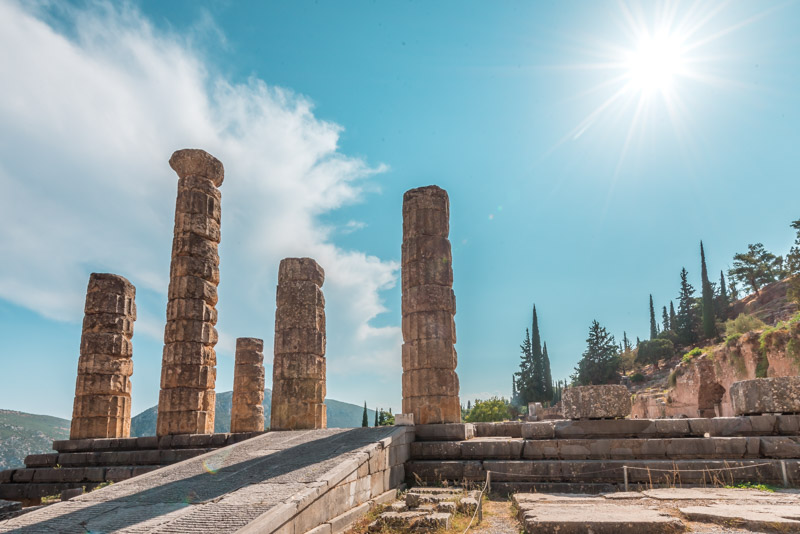
Between 346 and 320 BC, the last temple was built on the countless foundations and ruins of the ancient structures. It was a monumental building (21.70 × 58.20 m) with 6 by 15 columns, the ruins of which can still be seen today. Six original Doric columns have been re-erected, giving an impression of the dimensions of the ancient Oracle of Delphi.
Serpent Column of Delphi
The so-called Serpent Column of Delphi (also known as the Tripod of Plataea) is a votive offering from the Athenian city-states dating from the 4th century BC. The twisted bronze column was originally 12 m high and had three serpent heads at the top. Today, only 5.34 m of it remains, and the original stands in Hippodrome Square in Istanbul.
A replica of the column can now be found at the entrance to the Temple of Apollo, where it stood in ancient times. The column was probably brought to Istanbul (formerly Constantinople) by Constantine the Great around 331 AD. The three snake heads were deliberately cut off in the 18th century. One head is now in the Archaeological Museum of Istanbul.
Ancient Theater of Delphi
Just a few meters northwest of the Temple of Apollo is the well-restored and therefore quite impressive ancient theater of Delphi, which can seat around 5,000 spectators. It was probably built in the 4th or 3rd century and served as a meeting place and for the musical accompaniment of the so-called Pythian Games.
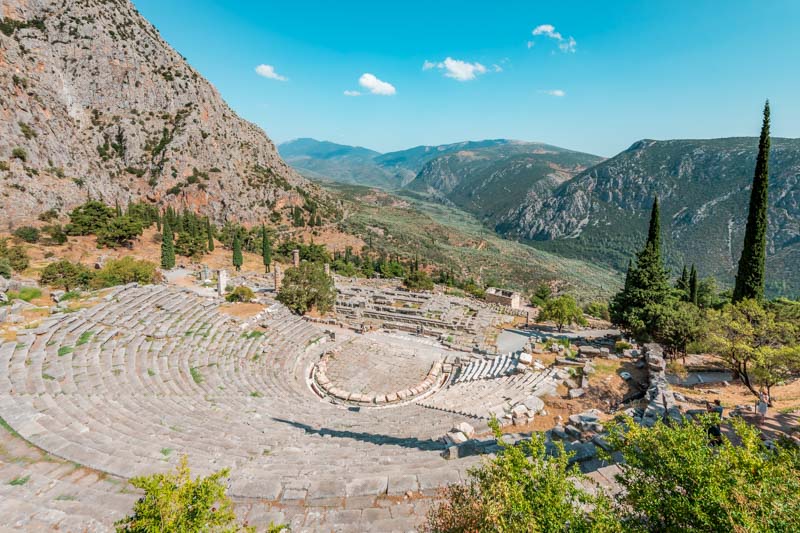
Stadium of Delphi
From the theater, a zigzag path leads about 300 m up to the upper part of the complex. Almost hidden at an altitude of 700 m, surrounded by a pine forest, lies the spacious stadium of Delphi. It was built in the 4th century BC and has a total length of 178 meters. Around 6,500 spectators could watch the competitions from the natural stands.

In 582 BC, the first Pythian Games took place, which at that time had a similar significance to the competitions in Ancient Olympia. Original remains such as the marble starting blocks are still in place. The climb, which is particularly strenuous at midday, is well worth the effort because of the idyllic setting and the magnificent view over the entire excavation site.
Temple of Athena Pronaia (Tholos)
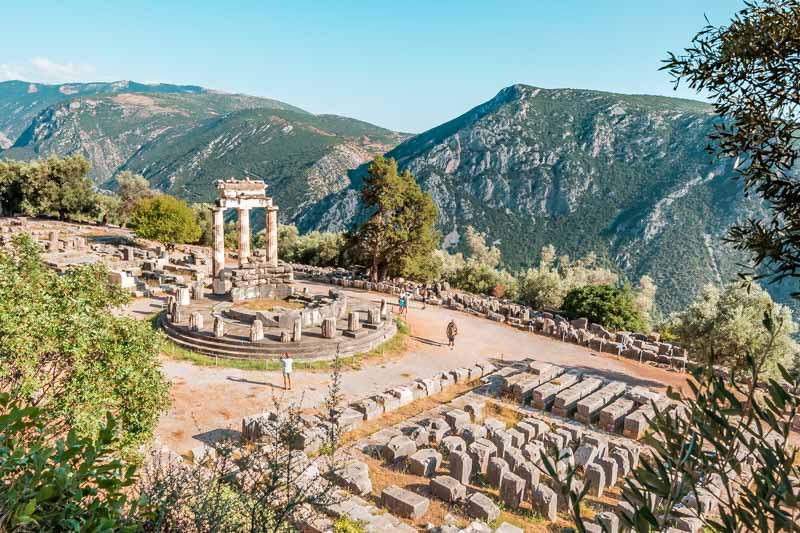
Culture-loving fans of Greece will notice the absence of an important building on the main site: the Tholos of Athena Pronaia. Since the main road cuts through the Delphi sanctuary, the Tholos and the associated temple of the goddess Athena are located about a 10-minute walk to the east. The site is also called Marmaria.

This extraordinary circular building was constructed around 380 BC and, alongside the Temple of Apollo on the main site, is probably the most famous building in Delphi. Numerous brochures and postcards illustrate the image of the Tholos. The striking building, made of marble and dark sandstone, has an outer diameter of 13.50 m and an inner diameter of 8.60 m in the main room (cella).
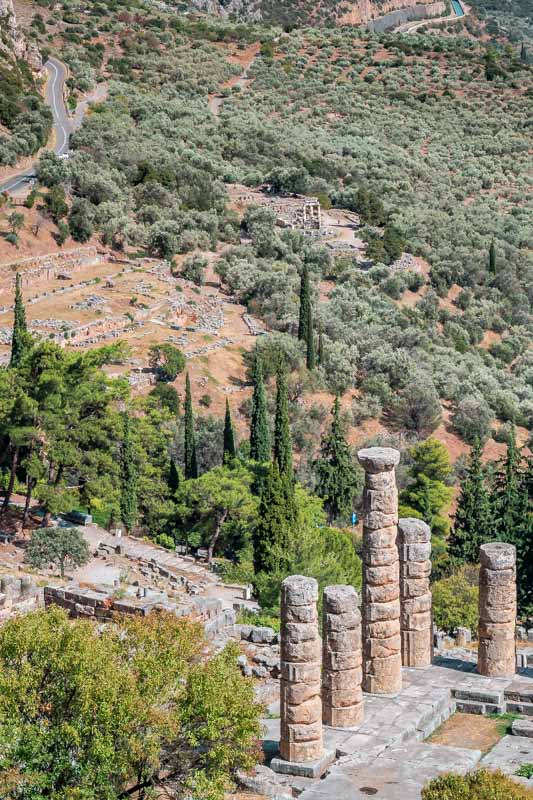
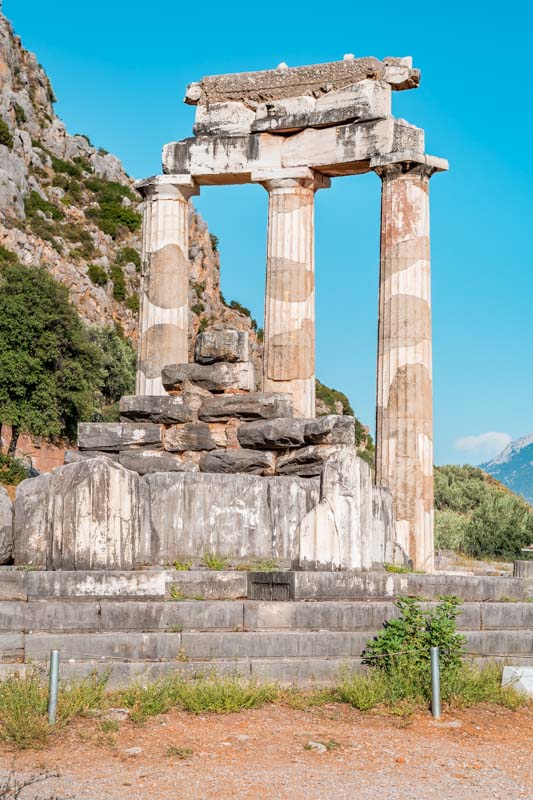
Originally, 20 columns supported the sacred rotunda, whose function remains unclear to this day. In 1938, three of the 6-meter-high columns were erected. On top of them is part of the once magnificently designed frieze, which featured depictions of mythological creatures such as centaurs and Amazons. Admission to the Temple of Athena is free of charge.
Gymnasium of Delphi
The ancient gymnasium, the former training ground for athletes of the Pythian Games, is located directly below the road on the same site as the Athena Pronaia Tholos. Similar to Olympia, the gymnasium was used for the military training of young men and later also for humanistic and cultural education. The area, which is unspectacular except for its exposed location, is visible but currently inaccessible.
✓ Full coverage & unlimited mileage included
✓ Free cancellation until 24h before pickup
✓ Best price guarantee via Discover Cars
#4 Archaeological Museum of Delphi
In 1892, archaeologists led by the French Archaeological Institute began systematic excavations in the Delphi area. The number of finds exceeded the archaeologists’ expectations and required the construction of a first museum in 1903, which was expanded several times (including in 1936 and 1968), most recently in 1999.
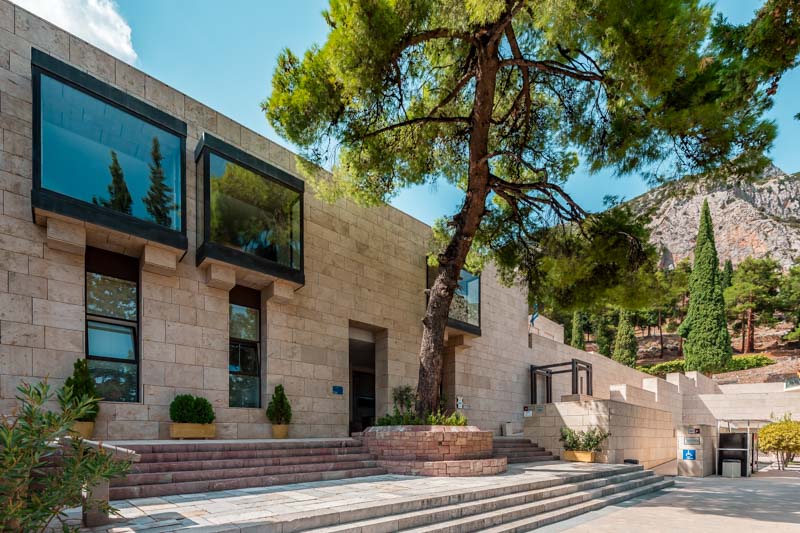
With 14 exhibition rooms and thousands of exhibits, it is one of the most important museums in Greece. The exhibits range from the Bronze Age to Antiquity. The oldest finds date from around 2000 BC and were found in the rubble beneath the Temple of Athena. In addition, numerous golden votive offerings from the treasuries are on display.
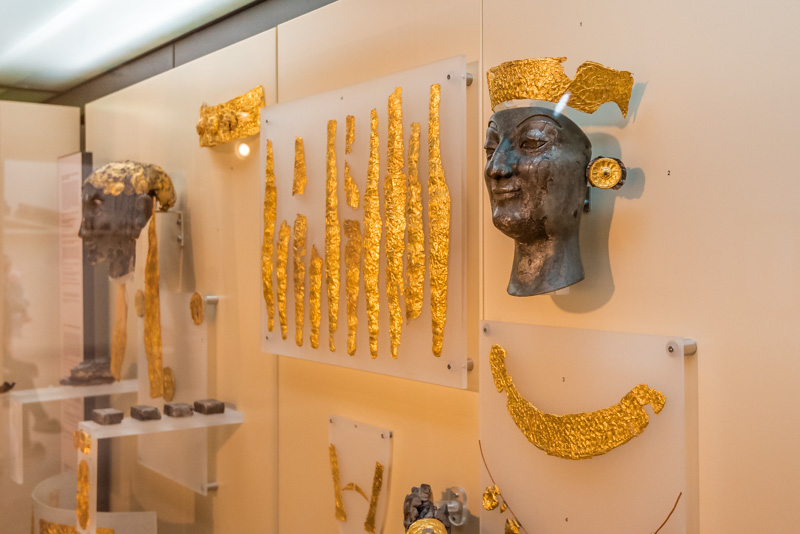
The Archaeological Museum of Delphi is located directly below the ancient site and you should plan 1-2 hours for your visit. There are restrooms in the museum and you can buy souvenirs in the Delphi Museum Shop. For a coffee break, it is advisable to visit a café in the town of Delphi, as prices on site are very high (e.g., €4 for 1 liter of water).
Sphinx of the Naxians
The fusion of ancient Greece with other parts of the Levant, including the Egyptian Empire, becomes clear when you look at the Sphinx of the Naxians (560 BC). The marble statue, half lion, half human with wings, is 2.22 m high and once stood on an 11 m high column. Thanks to this valuable votive offering, the Naxians received preferential treatment when consulting the oracle, as an inscription attests.
Statues of Cleobis and Biton
The statues of Cleobis and Biton are also inscribed as votive offerings to Delphi. The pair of brothers was found at the beginning of the excavations around 1893/94 and donated by the rulers of the city of Argos (Peloponnese). Although identical at first glance, they are not the same size (2.16 and 2.18 m) and have subtle, but barely visible differences.
According to mythology, the priestess Kydippe, the mother of the young men, implored the goddess Hera to give them the best that a human being could receive. As a result, they fell asleep as young and beautiful men and never woke up again, true to the motto: “The gods love those who die young.”
Omphalos
The strange cult stone of Delphi, which marks the center of the world, can be admired in the Archaeological Museum. However, scientists disagree as to whether the sacrificial stone is a Hellenistic or Roman copy. According to Greek mythology, the original Omphalos fell to earth as a meteorite.
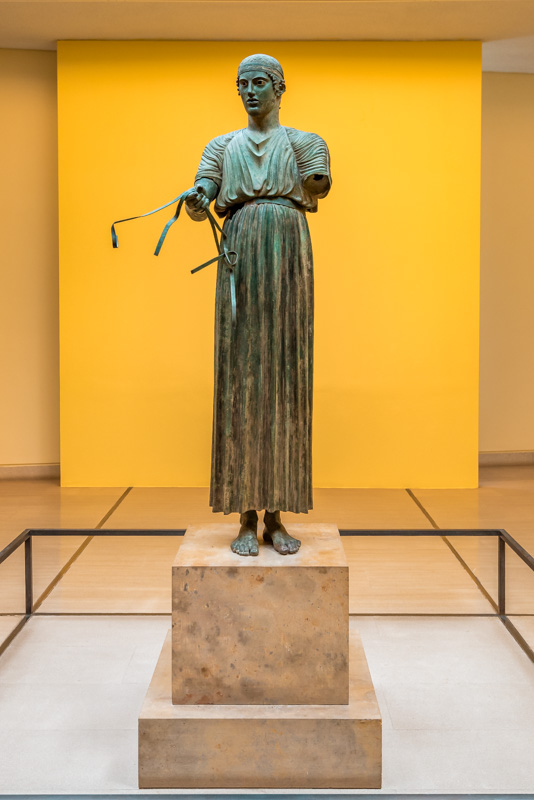
Charioteer of Delphi
The Charioteer of Delphi is one of the best-preserved bronze figures from Greek antiquity. In his honor, a separate hall with other bronze statues was even set up in the Archaeological Museum of Delphi a few decades ago. The life-size statue (1.80 m) was created between 478 and 474 BC and was also found at the beginning of the excavations.
The left hand is broken off, but in his right hand the young charioteer still holds the remains of the reins of a team of horses. The team originally consisted of four horses, but was largely destroyed in a landslide in the 4th century AD. The charioteer’s dress inspired French designer Henriette Negrin to create her Delphos dress made of silk.
Museum opening hours
The opening hours correspond to those of the excavation site. Last admission is 20 minutes before the museum closes, and admission is included in the Delphi ticket. The museum’s website provides detailed information on the most important exhibits and offers a virtual tour, which is ideal for those with limited time or mobility.
- Delphi Museum opening hours: in summer, Mon 8:30 a.m.-3 p.m. and Tue-Sun 8 a.m.-8 p.m., among others
- Delphi Museum website: Delphi Culture
#5 Guided tours to Delphi
If you want to explore Delphi on your own, you should plan at least half a day. It is also possible to join a guided tour of Delphi from Athens. The tours start at €40 per person, last 10 hours, and include stops in Arachova and Livadia in addition to visiting Delphi. Further information on GetYourGuide*:
For individual travelers who arrive by rental car but don’t want to spend the whole time walking around the archaeological site with a guidebook in their hands, we recommend a guided tour of Delphi (also available in German). Bookable directly on site or online via GetYourGuide*:
💡 Weather in Delphi: The weather in the region is influenced by the Parnassus mountain range with its 2,455 m high Liakoura peak. There are still a few rainy days in spring and fall. From July to September, however, it is dry and very hot. Delphi is almost completely devoid of shade, as there are hardly any trees. Due to its southeastern location, the sun beats down relentlessly on the ancient site. In summer, it is advisable to visit only in the early morning hours or late afternoon. For more information about the weather in the region, see our separate article: Weather in Greece
#6 Interesting facts about Delphi
Greece is rich in historical sites: ruins in honor of the gods can be found throughout the country, from the Temple of Apollo to the Sanctuary of Zeus. However, the importance of Delphi as a political power center in ancient times should not be underestimated. For the ancient Greeks, this was the Omphalos, the navel of the world.
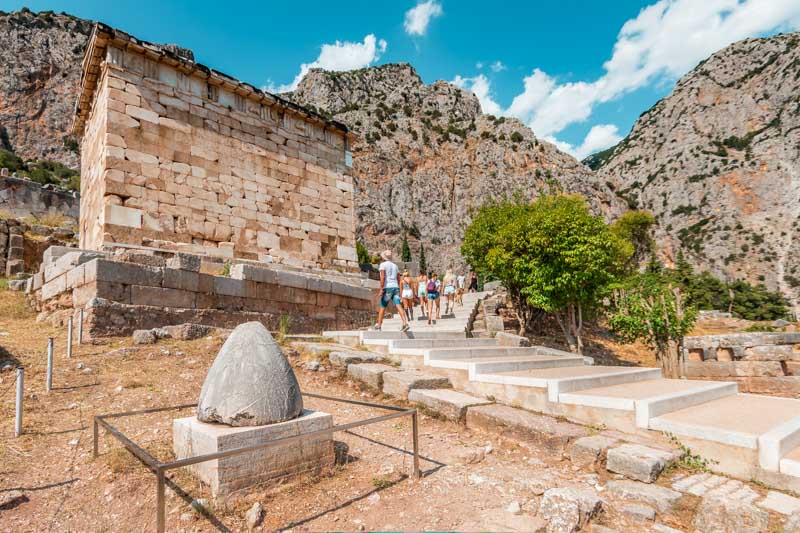
According to Greek mythology, Zeus, the father of the gods, sent two giant eagles to fly to both ends of the world. The place where the eagles met was Delphi, which is why it was declared the center of the world at that time. The name itself is derived from the ancient Greek word for womb (delphys), an allusion to a possible early Delphi sanctuary in honor of the earth mother Gaia.
Records show that from the 8th century BC onwards, a cult of the god Apollo was established in Delphi and a temple was built in his honor. Apollo was considered the god of light, the arts, and prophecy, and as the son of Zeus, he knew the answer to every question. According to legend, he killed the giant serpent Python, which lived in a deep crevice in the earth, in Delphi.
Oracle of Delphi
The city founded here was originally called Pytho, which was replaced by Delphi in the 6th century BC. However, the name of the serpent survived the passage of time, and so the seer at the Oracle of Delphi was also called Pythia, popularly known as the serpent priestess. Only she was able to prophesy the future to those seeking advice at that time.

Historians still argue about the exact circumstances of this prophecy. According to Greek scholars, divine vapors (pneuma) rose from the crevice in the earth where the serpent Python lived, granting clairvoyant abilities for a short time. Apollo entrusted the snake priestess with the task of proclaiming the future to those who asked in his name—the birth of the oracle.

In fact, scientists have detected gas emissions such as methane, ethane, and carbon dioxide in crevices above the Temple of Apollo. It is believed that inhaling these oxygen-depleted gases led to a trance-like state, which caused the Pythia to give vague and ambiguous answers. These oracle sayings were conveyed more or less faithfully by another priest.
The priests and fortune tellers wielded enormous power, and people who consulted the oracle had to pay a high price depending on their request. In a short time, numerous treasuries were built in Delphi to store the riches. Control of the sanctuary of Apollo was of great importance, not least because of these treasures.
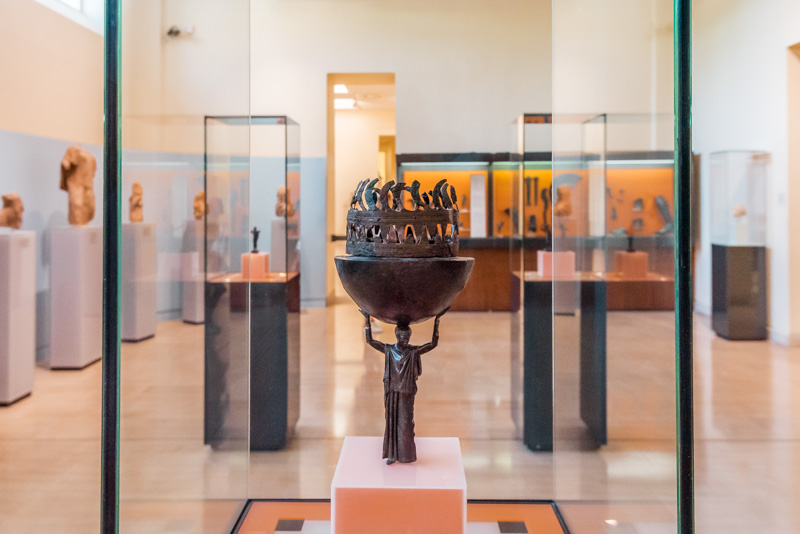
The oracle was consulted before wars, noble weddings, expansions, or state restructuring. This made it an important political instrument, and over the centuries, the Greek states all fought for power in Delphi.
In Roman times (from the 2nd century AD), more houses and baths were built, but the sanctuary increasingly lost its importance as a place of oracle. In 392 AD, the Roman emperor Theodosius I banned the Delphi ceremonies as a pagan cult. With increasing Christianization, the Oracle of Delphi fell silent forever after more than 1,000 years of existence.
Why is Delphi a sacred place?
Long before the founding of the Oracle of Delphi, the region was considered sacred. The mighty Mount Parnassus above Delphi is dedicated to the god Apollo and is also considered the home of the nine Muses, the patron goddesses of the arts. With the construction of the Temple of Apollo and the founding of the Oracle, Delphi developed into a veritable place of pilgrimage.
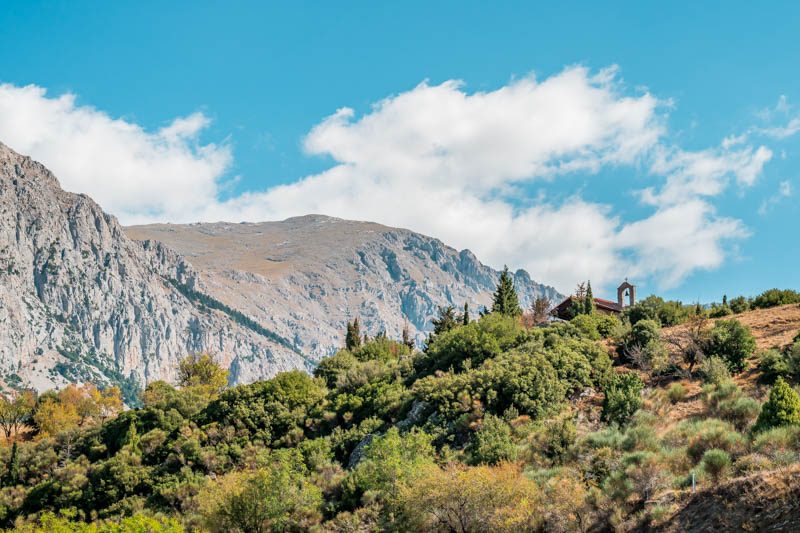
Every traveler and thirsty scholar was confronted with their own ego as soon as they entered the Temple of Apollo. On the columns at the entrance were important instructions and aphorisms, the so-called three Delphic maxims, including meden agan – “nothing in excess” and the most famous:
“Gnothi seauton – Know thyself.”
The inscriptions were clearly visible to everyone at the sanctuary as early as the 6th century, and the god Apollo himself is considered the originator of these calls to action for greater self-knowledge. Many Greek philosophers carried the message into the ancient world, with Heraclitus (520–460 BC) proclaiming: “It is the lot of all men to know themselves and to think wisely.”
From ancient poetry to modern film (e.g., The Matrix), the famous oracle’s saying has moved people and is now attributed to one of the seven sages. Originally, the exhortation “Know thyself” was probably intended to distinguish humans from the gods, according to the motto “Stay within the limits set for you—you are not a god.”
Delphi is not just a historical site like many others. It is a place of remembrance of man’s eternal search for the meaning of his existence and thus also a guidepost for the uncertainties of our modern life. A visit to Delphi is a source of inspiration and inner enlightenment for all who embark on a journey to themselves.
→ Recommended books that we have read to find ourselves and our place in life are (links to Amazon*):
- The Cafe on the Edge of the World: A Story About the Meaning of Life (John Strelecky)
- The Alchemist (Paulo Coelho)
- The Monk who sold his Ferrari (Robin Sharma)
“If you want to move the world, you must first move yourself.” (Socrates)
#7 Hotel tips for Delphi
The modern town of Delphi, with its approximately 850 inhabitants (the number fluctuates greatly), is a typical Greek village that has adapted perfectly to tourism. Several small hotels and apartments have been built in recent years. The town captivates visitors with its dreamlike location at an altitude of approximately 600 m, guaranteeing panoramic views.
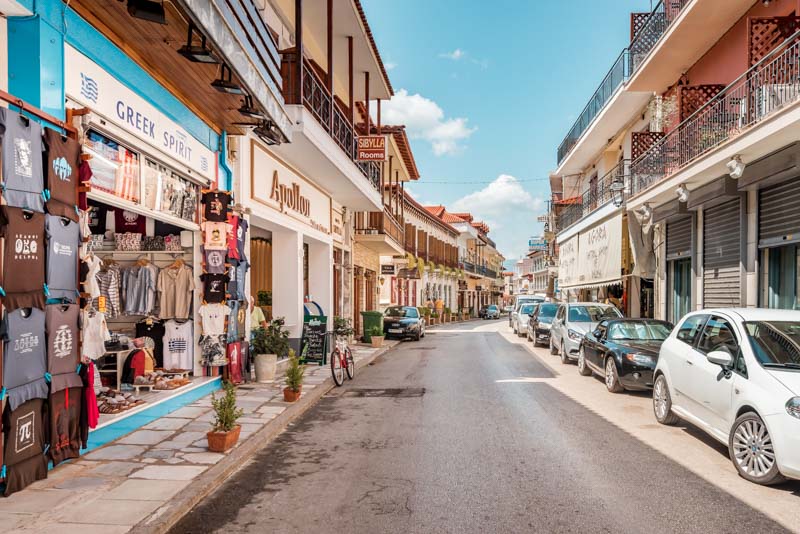
It is advisable to look for accommodation in Delphi away from the busy main streets of Delphi, Apollonos, and Friderikis. Alternatively, we recommend staying overnight in Arachova (see point #8) or in the village of Chrisso, about 10 km away. Due to its altitude, temperatures in Delphi can drop below 5 degrees Celsius at night in spring and autumn.
Delphic Horizons
The lovely Sini and her parents rent out a large apartment with several bedrooms in a quiet location. Traditionally furnished, very clean and with a well-equipped kitchen, ideal for self-caterers. The view from the terrace over the Delphi valley is enchanting. More information about the accommodation is available on Booking.com*:
Komody Hotel
Chic boutique-style aparthotel on the lower edge of the village, about two minutes from the free municipal parking lot. Modern rooms and apartments with a traditional touch, some with balconies. Unfortunately, breakfast is not yet available, but the highly recommended Phileo Cafe Bar is only 60 m north. More information about the accommodation is available on Booking.com*:
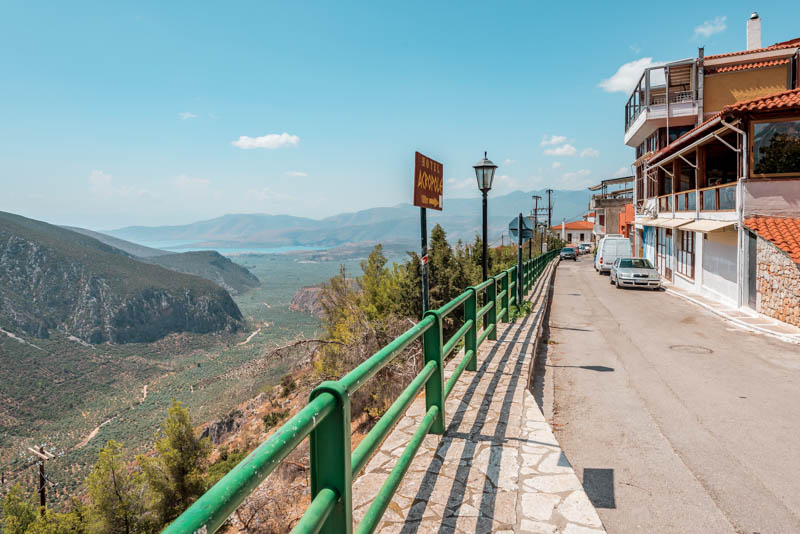
Pitho Hotel
Solid 3-star hotel in the center of Delphi. A little outdated, but clean, friendly staff, and good breakfast. Very fair prices even in summer, but finding parking can be difficult. More information about the accommodation is available on Booking.com*:
Camping near Delphi
Delphi Camping
Idyllically located campsite above the village of Chrisso, only 7 minutes from Delphi and 10 minutes from the ancient site. Friendly staff, well-maintained green areas, clean sanitary facilities, and beautiful views from the restaurant terrace. One of the best places for Camping in Greece.
→ All information about the campsite near Delphi: Delphi Camping

Restaurant recommendations for Delphi
Phileo Cafe Bar: You can linger for hours on the beautiful roof terrace. Coffee and Greek sweet snacks, hearty snack platters with cheese and sausage, as well as bagels, waffles, and crêpes are served. Local products can be purchased in the integrated shop. Our favorite café in Delphi!
Phivos Restaurant (ΦΟΙΒΟΣ): Stylish tavern with delicious Greek dishes at fair prices. At the back, there is a covered terrace with a view over the valley to the Gulf of Corinth. During our visit, the friendly staff even took care of our little daughter so we could enjoy a glass of wine in peace. 😉
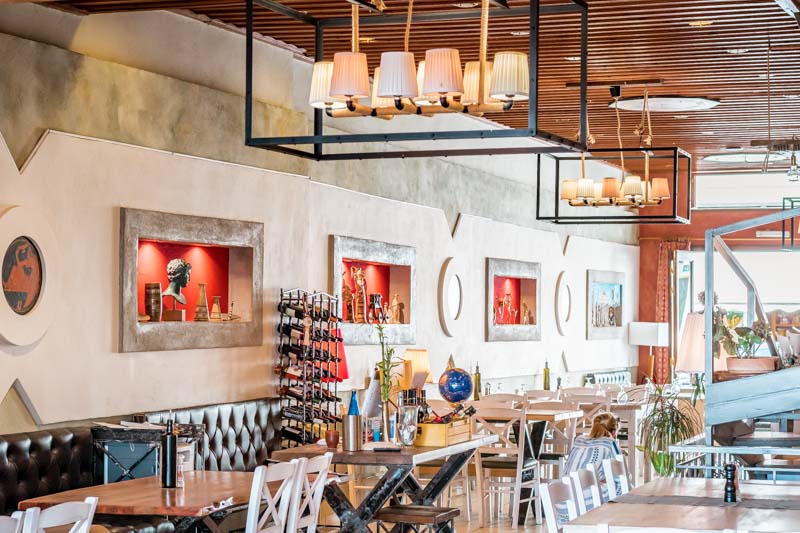
Tavern Dion: Rustic, popular tavern in the town center. Serves classic Greek home cooking with changing daily specials. When the weather is nice, tables and chairs are set up on the steps of the picturesque neighboring alley. Reasonable prices and generous portions.
Telescope: Recommended café-bar with a beautiful terrace. In addition to coffee and cake, there are cocktails and small snacks as well as a good selection of international and Greek beers.
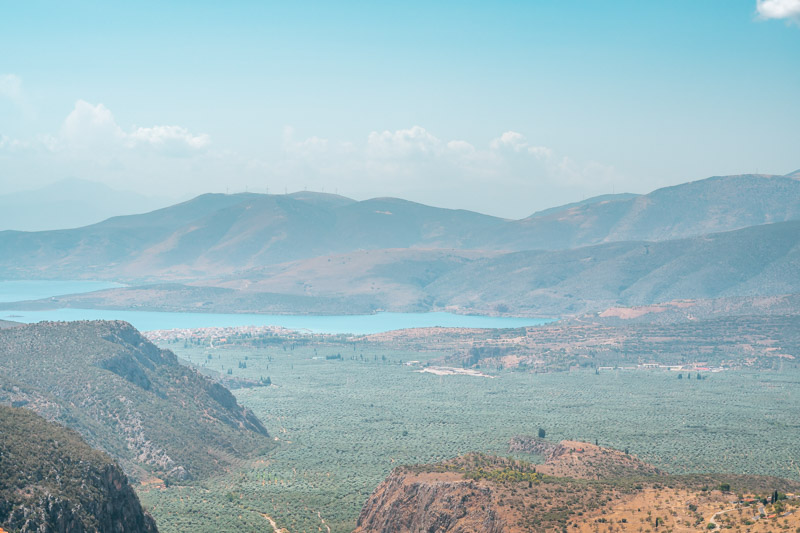
To Patriko Mas: One of the coziest restaurants in Delphi with an inviting dining room, a beautiful little courtyard that is atmospherically lit in the evening, and a magnificent view from the restaurant’s terrace. The prices for the delicious food are slightly higher than at other restaurants.
#8 Places of interest in the surrounding area
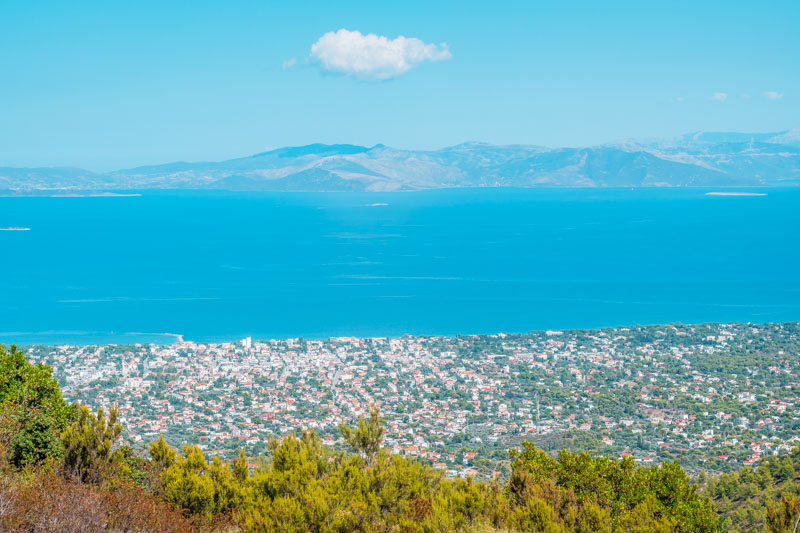
The mountainous region of Delphi, with its valleys and plains dominated by olive trees, is one of the most scenic corners of Greece. Numerous quaint villages invite you to take a stroll, hikers can enjoy extensive trails, and the sea in the form of the Gulf of Corinth is only a stone’s throw away.
Castalian Spring
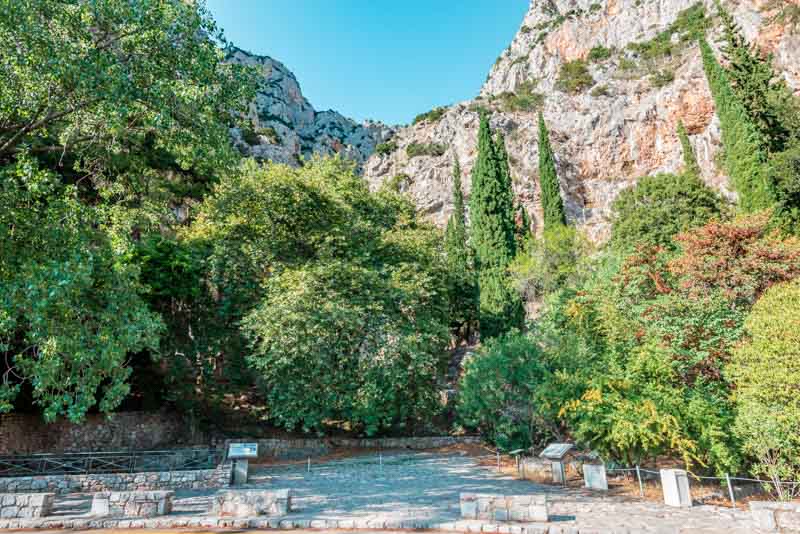
The legendary Castalian Spring is located in the curve between Marmaria (Tholos area) and the main grounds. According to mythology, it owes its name to the nymph Kastalia, who threw herself into the depths to escape Apollo’s advances. The spring is still used today to supply Delphi with water. This enchanted place with its mighty plane trees and hermitages is well worth a photo stop.
Arachova below Mount Parnassus
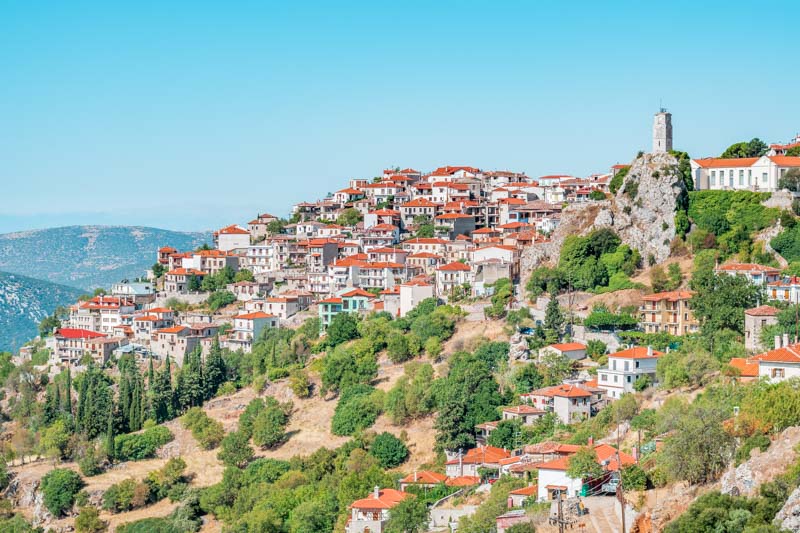
Arachova is located at an altitude of 968 m, about 10 km east of Delphi. The place is hardly known to international tourists, but is very popular with Greeks, as the village with its 2,700 inhabitants is a popular winter destination.
Above Arachova lies the Parnassus mountain range, home to the Greek ski resort Parnassos Ski Center. Visitors to Delphi should take a detour to pretty Arachova at any time of year. The narrow streets are perfect for strolling, and countless cozy taverns and cafés invite you to linger.
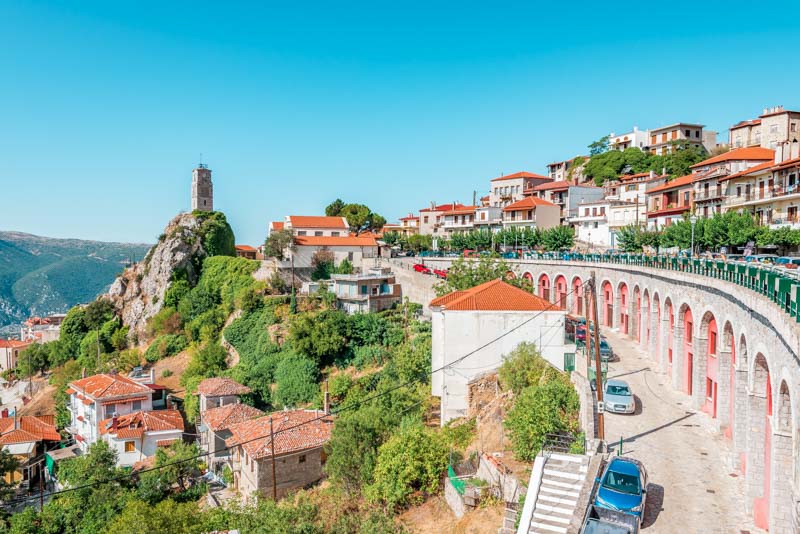
The highlight of Arachova is the historic clock tower (Roloi Arachovas), which sits enthroned on a rock needle in the middle of the village. Another eye-catcher is the bridge of Arachova (Gefira Arachovas), which winds its way through the center in an arc. Due to its proximity to Delphi, Arachova is also an ideal place to stay overnight. More information about Arachova will be available shortly in a separate article.
➲ Hotels in Arachova (Booking.com)*
Galaxidi on the Gulf of Corinth
When it gets unbearably hot on windless days in the historic site of Delphi in summer, it is worth taking a trip to Galaxidi on the Gulf of Corinth. Galaxidi is a picture-perfect Greek village with colorful houses, a small fishing port, and winding alleys that invite you to stroll around.
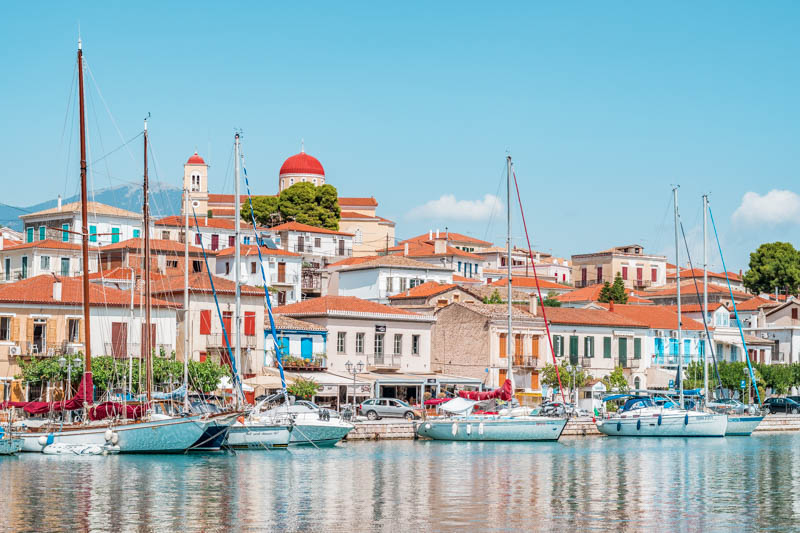
For us personally, Galaxidi turned out to be a real insider tip in Greece, hardly known to international tourists but (especially on weekends) well frequented by Greeks from all over the country.
There are some very good restaurants along the picturesque waterfront promenade of Galaxidi or in the village itself (tip: O Bebelis). From Delphi, it takes about 35 minutes (35 km) to get to Galaxidi. You can take a refreshing dip in the sea at the town beach, Paralia Vistrithra (colorful pebbles).

Kyra Park: Livadia Waterfalls
Even though the small town of Livadia, with its largely modern architecture, may not seem particularly inviting at first glance, it holds a special secret. The Krya springs above the town feed the Erkyna River, which rushes through the town in several cascades.

Old water mills and huge plane trees line the river. Numerous cafés (tip: Pantheon) along the river invite you to take a break. The Kyra Park and its waterfalls in the old town of Livadia are like an oasis in the middle of a concrete desert.


In ancient times, Livadia even had an oracle (Trophonia) and in the Middle Ages a fortress, the remains of which can still be seen above the town. For independent travelers, Livadia, located not far from National Road 48, is well worth a visit. The journey time from Delphi is approximately 45 minutes.
→ You can find more articles and numerous travel tips for mainland Greece here: Mainland Greece
*Support our blog Greece-Moments
This post contains affiliate links, which are marked with an asterisk (*). If you book or purchase something through one of these links, we receive a small commission. The price remains the same for you. This helps us to continue providing high-quality content free of charge. Did you enjoy this post and want to say thank you? Then simply buy us our next Greek coffee ☕️ To the coffee fund
Save this post on Pinterest!