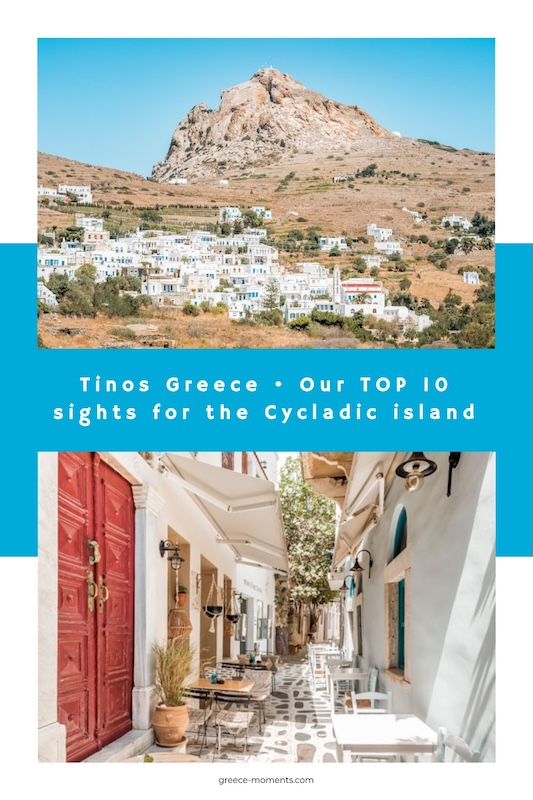

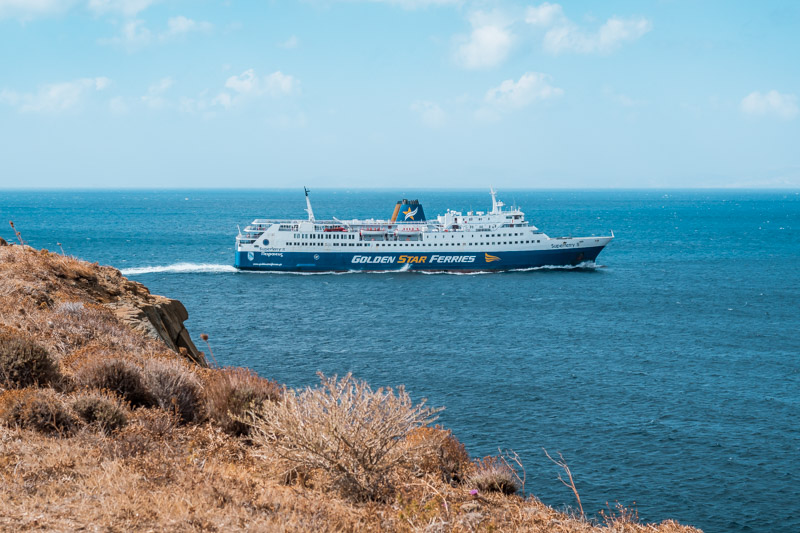
According to Greek mythology, Tinos is the island of the wind god Aiolos. On hardly any other island does the summer wind Meltemi rage as fiercely as on Tinos. The third largest Cycladic island with its 8,600 inhabitants lives up to its name, as even during the ferry crossing a violent storm of six Beaufort blows towards you.
“The windswept island of Tinos is considered the sacred island of the Aegean Sea along with Patmos”
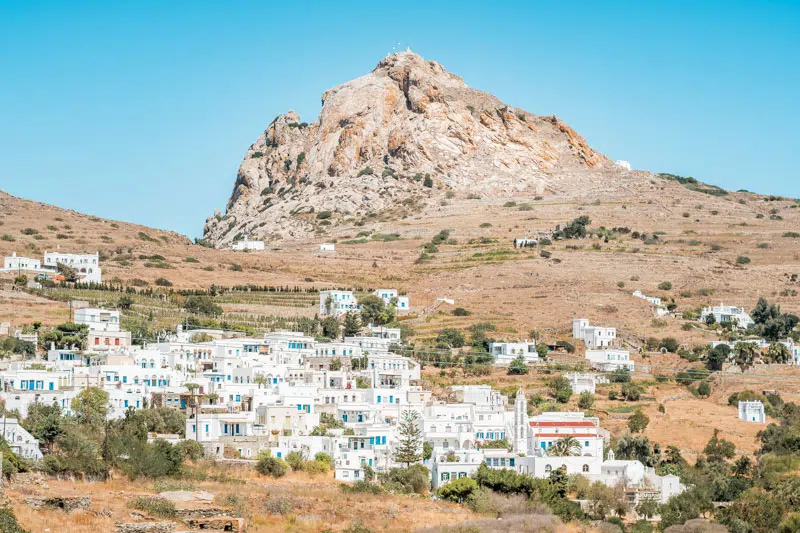
Tinos with its many snow-white villages is hardly known to international tourists, yet almost every Orthodox Greek has set foot on the island at some point. The magnificent church of Panagia Evangelistria in the capital is the most important Marian sanctuary in Greece and has given Tinos the status of a Holy Island.
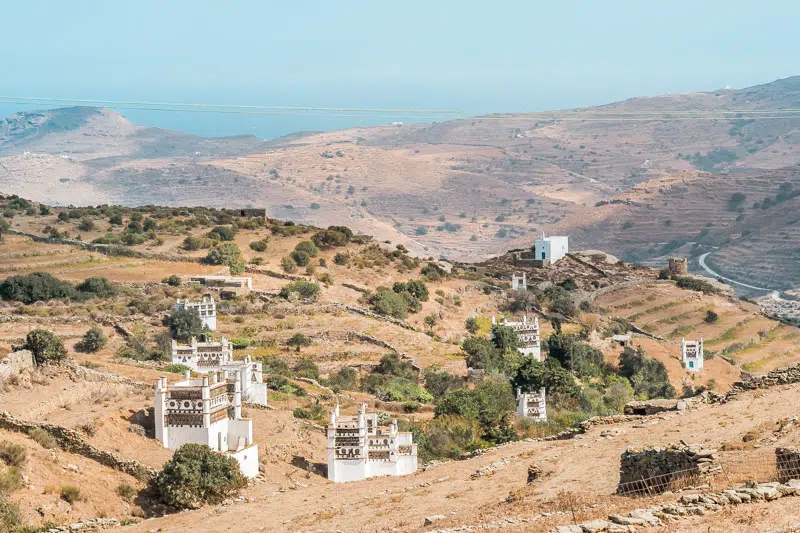
Tinos is an island for individualists and spiritual vacationers. In addition to the almost 1,000 churches and chapels, lovers of Greece will also enjoy the enchanting Cycladic architecture and the unique dovecotes, relics from the Venetian occupation.
The island also knows how to impress on the culinary front. The wealth of outstanding restaurants and tavernas serving creative Greek cuisine is second to none. Here we present our top 10 highlights of Tinos:
- #1 In the alleys of Tinos town
- #2 Panagia Evangelistria: Landmark of the Holy Island
- #3 Tinos’ white villages
- #4 The pigeon towers of Tinos
- #5 Exobourgo: Kastro of Tinos
- #6 Beautiful beaches in Tinos
- #7 The Granite Forest around Volax
- #8 Walk through Kardiani
- #9 Pyrgos: The Marble Treasure of the Island
- #10 Culinary highlights on Tinos
- More Tinos tips for your holiday
#1 In the alleys of Tinos town
If you ask Greeks from other parts of the country about Tinos, you will often hear them rave about the beautiful marble villages there. There are said to be 50 “white villages” on this Cycladic island. They look like bright splashes of colour in summer, set against an extremely barren landscape shaped by long periods of drought.
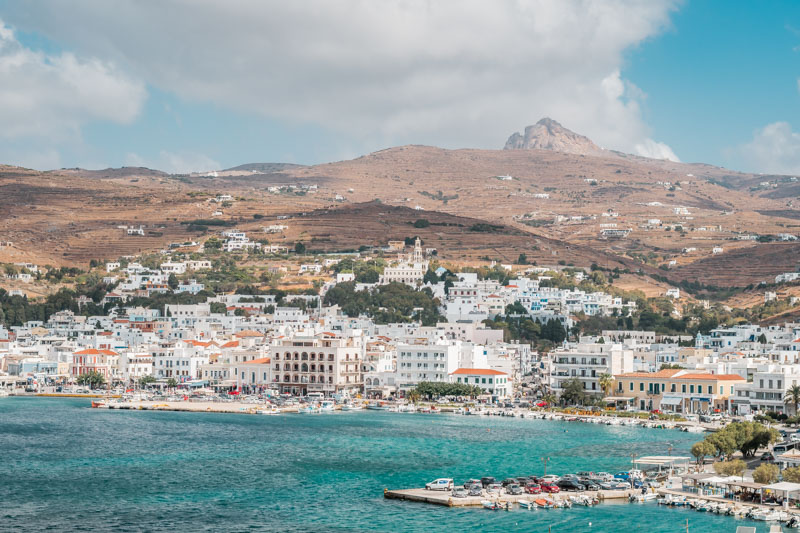
The capital of Tinos, also called Chora, does not seem very inviting at first glance. Behind the bustling harbour rise unadorned concrete buildings — typical Cycladic island architecture is nowhere to be found here. Only the magnificent pilgrimage church shines sublimely on a hill above the town.
For a great view of Tinos town and the hinterland, head to the mini peninsula (Akrotiri) near the city beach Agali. Follow Kazanova Street up the hill to a monument, and above the football stadium a magnificent panorama of the town awaits you.
It takes some time to explore the beautiful corners of Tinos town on a walking tour. In the harbour area, you can park your vehicle in one of the parking areas, usually free of charge. From here, head along the dead-straight pilgrimage route »Megalocharis« and first explore the hidden side streets of the harbour district.
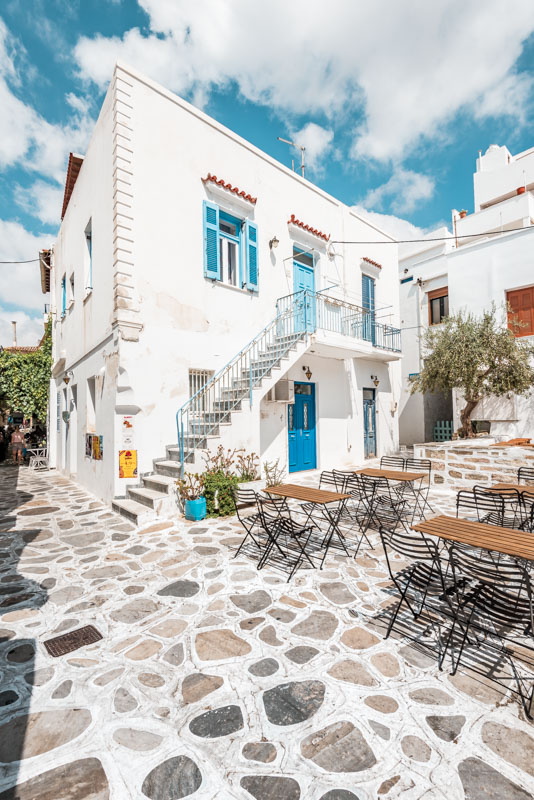

On the left, after about 200 m, is »Paximadi« street, where numerous pubs, hip bars and cafés await you. It’s especially worth a visit in the evening, when the atmosphere in this district is lively and exuberant.
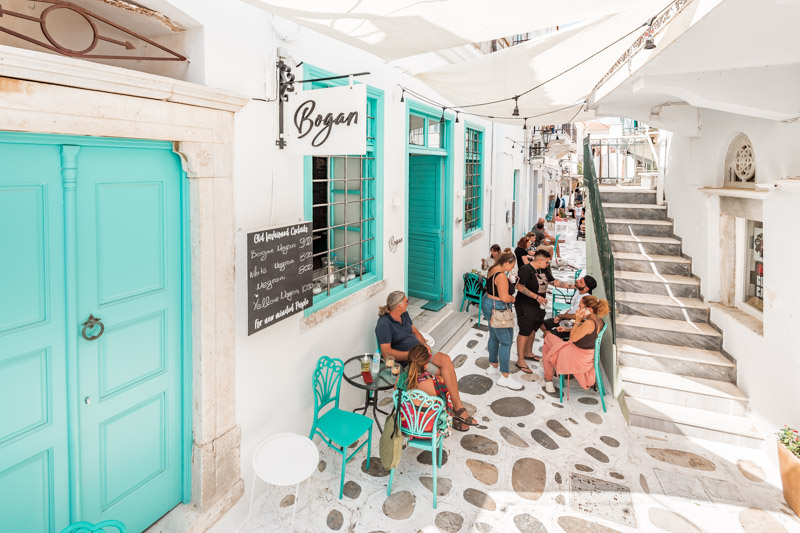
On the right-hand side of the pilgrimage road you will find the “Gizi” alley, which leads you to a pretty square with a marble fountain. From here you can explore the hustle and bustle of the cobbled bazaar alley »Evaggelistrias« or take a short coffee break a few metres away at the cool Bogan Bar.
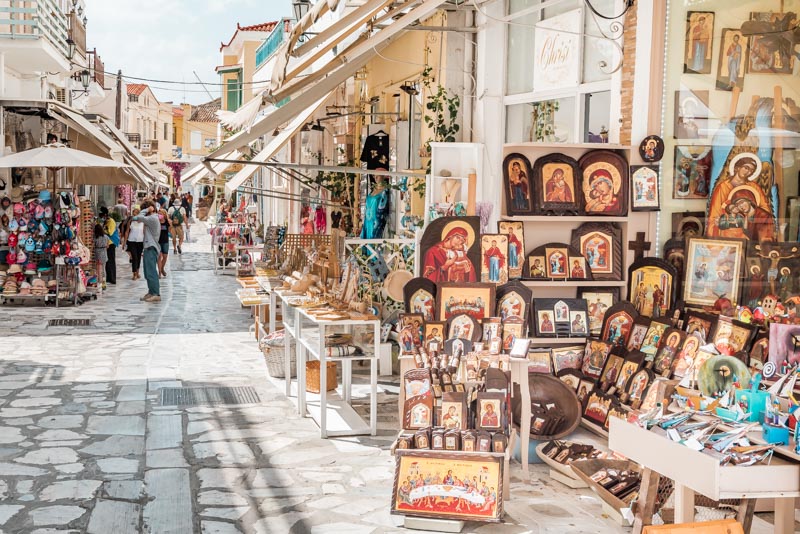
On the long souvenir mile of Evaggelistria, you’ll find religious souvenirs such as icons and votive tablets, as well as numerous tourist souvenirs. In between, there are tasteful little shops and boutiques. If you are looking for a culinary souvenir from Tinos, you should stop by the shop »Karpos Tinian Traditional Products«.
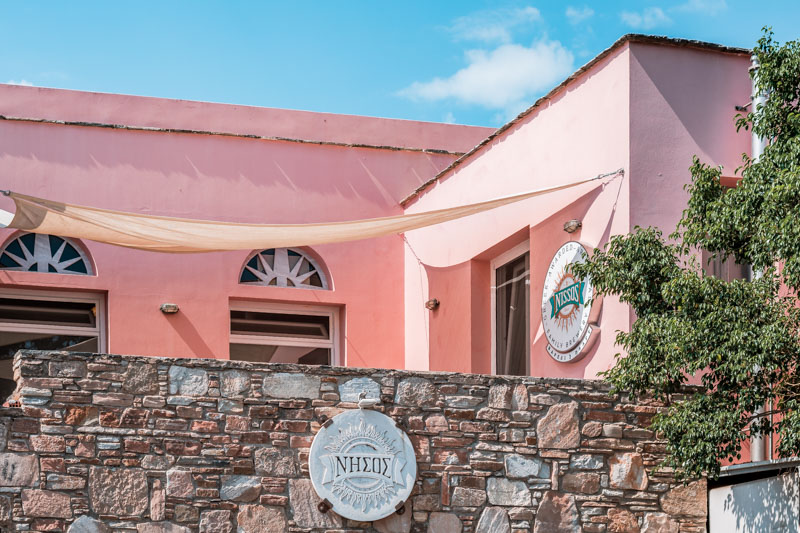
A visit to the Nissos Brewery
In the east of Tinos town, craft beer lovers will be in their element. Nissos Beer was founded in 2012 as the first brewery in the Cyclades on the island of Tinos and is now considered the largest microbrewery in Greece. The beer is not only sold in Greece, but worldwide, from America to Australia.
The first beer brewed and still the most popular variety is the Greek Island Pilsner, with a hoppy, bold taste. In addition, there are a handful of other varieties, including an organic lager (our favorite!). The friendly Nena gives an informative tour of the brewery in 40 minutes, followed by an extensive tasting.
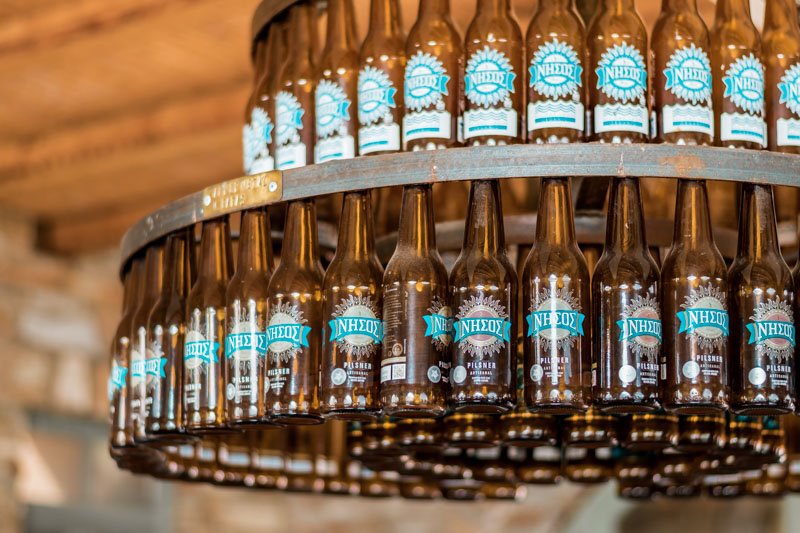
Tours should be booked 2–3 days in advance. The brewery does not have a factory outlet, but right next door there is a well-stocked bottle shop that carries all Nissos beers. Prices in stores: from about €2 per bottle; prices in restaurants: from €4 per bottle. More information and tour bookings at: Nissos Beer
🗺️ 8 Islands with route maps
🏖️ Beautiful beaches & swimming spots
🏛️ All top sights
🔍 Valuable planning tips
🍽️ Accommodation, tavernas & cafés

#2 Panagia Evangelistria: Landmark of the Holy Island
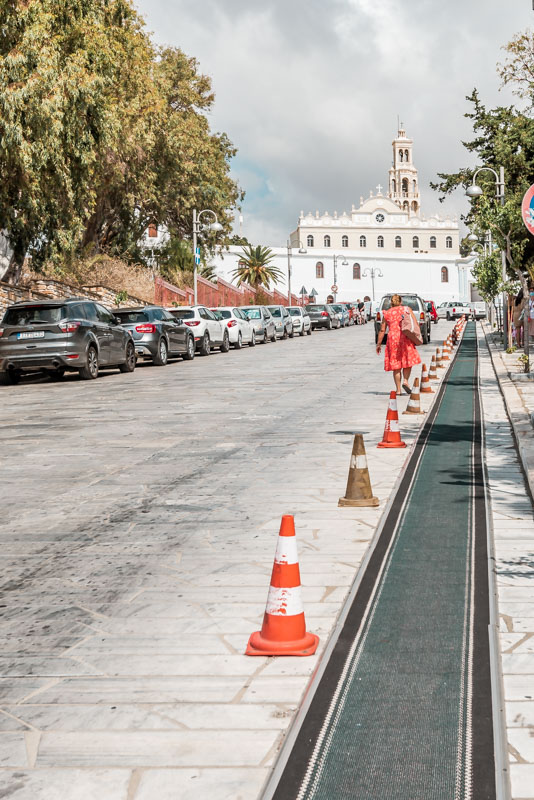
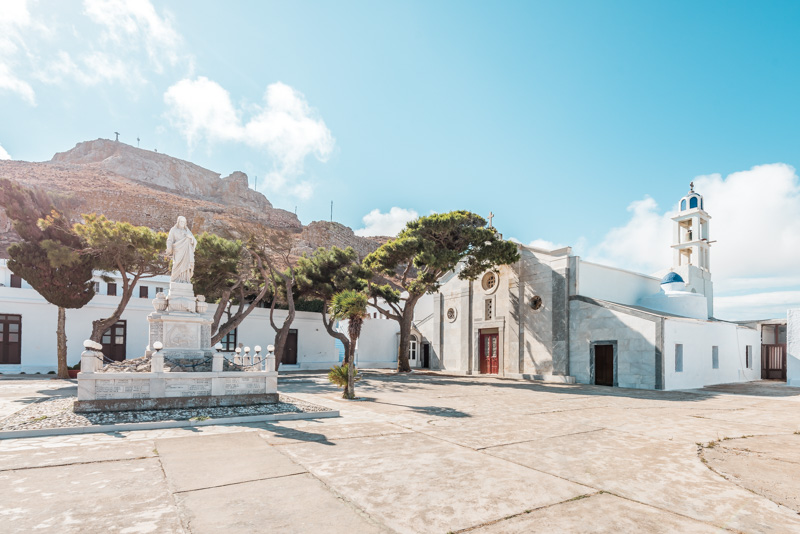
The dead-straight pilgrimage road Megalochari leads you up to the landmark of Tinos, the pilgrimage church of Panagia Evangelistria. It is the most important Orthodox Marian pilgrimage site in Greece.
Throughout the year, numerous Orthodox believers from all over the world are drawn to the »Lourdes of the Aegean« to receive the blessing of the Mother of God. Out of reverence, they make their way up the road from the harbor to the church on their knees. To ensure that their trousers or knees are not completely worn through by the end, a kind of carpet has been laid on the right-hand side of the curb.
The flow of pilgrims reaches its peak every year on Assumption Day on August 15 and on March 25 for the Annunciation of Mary. The ferries are packed to capacity and almost every accommodation on Tinos is fully booked. Prices for accommodation are many times higher than usual at this time.
If you don’t necessarily want to visit the island during these events, we recommend planning your holidays on Tinos at least two weeks before or after August 15 or March 25.
The pilgrimage site of the Cyclades
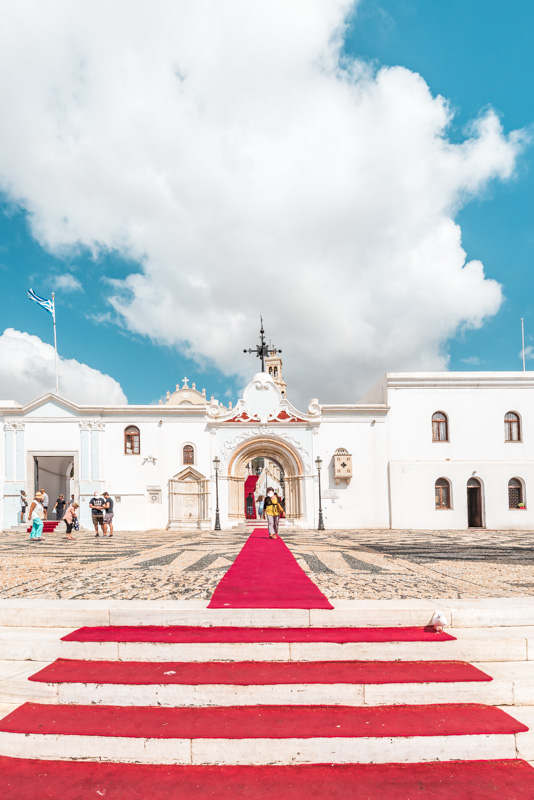
Once at the top of the hill, you stand on a square made of sea pebble mosaics and enter the courtyard of the large complex through the monastery gate, which offers a view of the monumental marble church building. A red carpet accompanies the visitor to the entrance.
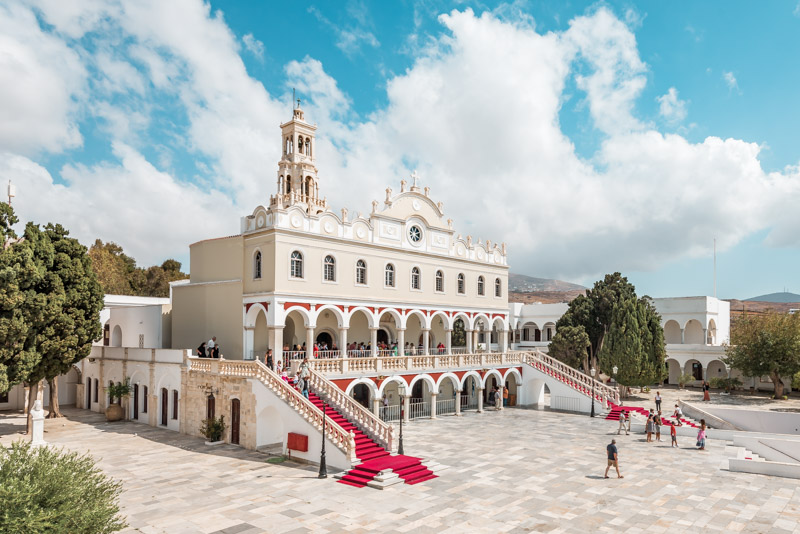
In the dark interior, the scent of incense drifts towards you. Under a canopy of marble stands the miraculous Marian icon Megalocharis (Blessed Mother of Great Grace), which is barely recognizable beneath the numerous offerings made of precious metals.
After making a monetary donation, you can light a candle and take in the magnificent iconostasis with its images of saints. Particularly striking are the numerous votive tablets — small metal pendants with various symbols (e.g. a child, heart, or arm) — which are hung on the respective icons in gratitude for a fulfilled wish.
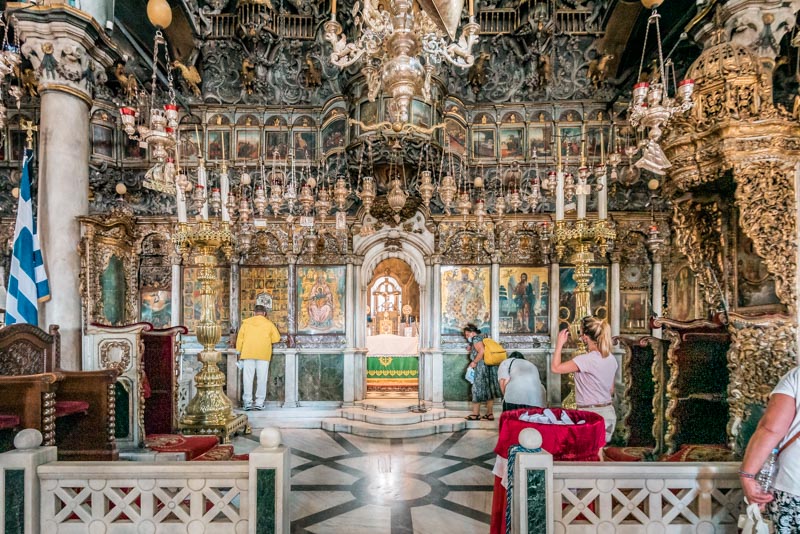
The catacombs below the church tell the story of the monumental building, which dates back to the 19th century. In 1823, the miraculous icon of Mary was revealed to the Nun Pelagia after a vision on this very hill.
Construction of a small chapel then began, upon which the large monastery complex was later built. Even today, an altar can be found in the vaults below the church, along with a baptismal font and the Sacred Spring of Tinos, where believers fill small bottles with water.

💡 A dark day in Tinos: Below the church there is also a prayer room dedicated to the victims of the Greek warship Elli. The ship was torpedoed by an Italian submarine on the feast of the Blessed Virgin Mary on August 15, 1940, while anchored in the port of Tinos. Several crew members died in the attack. The remains of the torpedo are still on display in the premises today.
#3 Tinos’ white villages
While thousands of holidaymakers flock to Mykonos every day during the season, despite it being less than 15 km away, only a few die-hard Hellas fans and mainland Greeks make their way to Tinos.
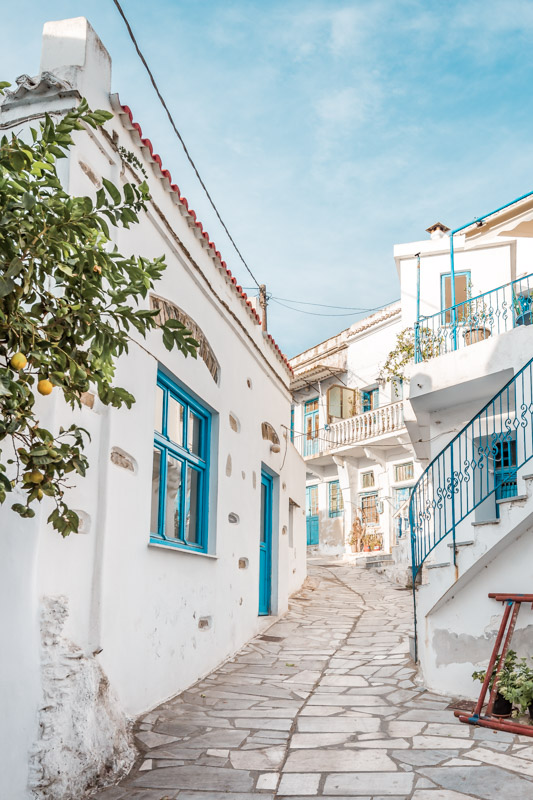
That said, the charming villages of Tinos have no reason to hide in Mykonos Chora’s shadow. On the contrary, all the villages on the island feature the typical white Cycladic architecture that makes the hearts of Greece lovers beat faster. They look like oases in the barren landscape of Tinos.

The 47 villages vary in size, from a handful of houses to partly urban settlements such as Pyrgos. In almost all villages you’ll find a platia (village square) with usually a taverna or a coffee house, as well as a pretty snow-white village church.
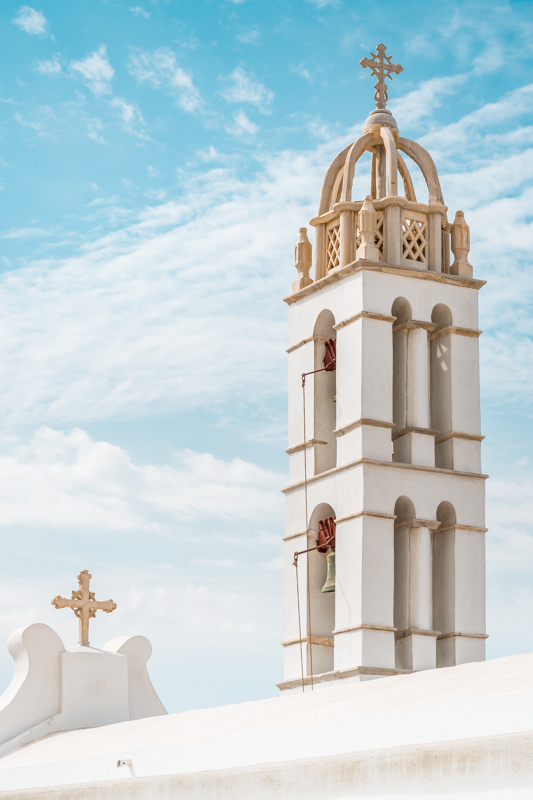

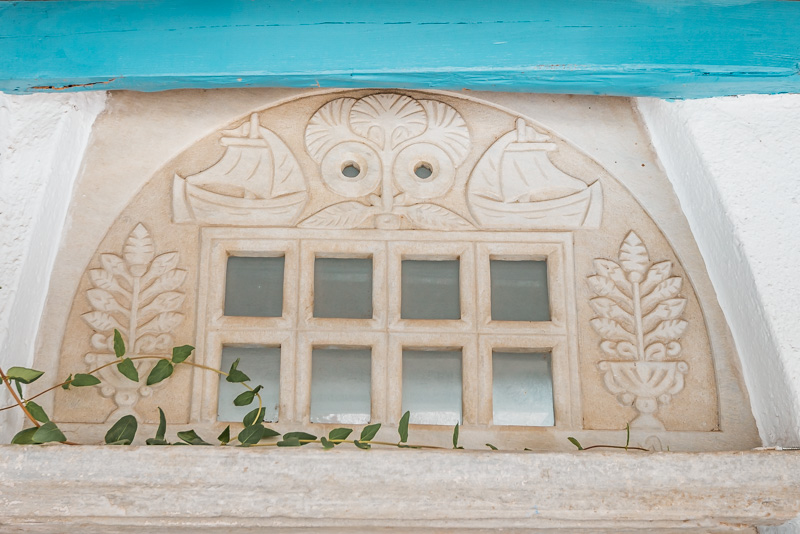
In the winding, partly marble-paved alleys, great photo opportunities await you, with colourful bougainvillea often climbing up house facades. You can admire the charming details, such as slate ornaments and marble transom windows. Some villages were even partly built from Tinian marble (see: #8 Walk through Kardiani).
Most of the villages are clustered in the heart of the island, around the striking peak of Exomvourgo, and were founded during the Middle Ages. Of course, a single stay is not enough to visit all the villages of Tinos.
Dyo Choria
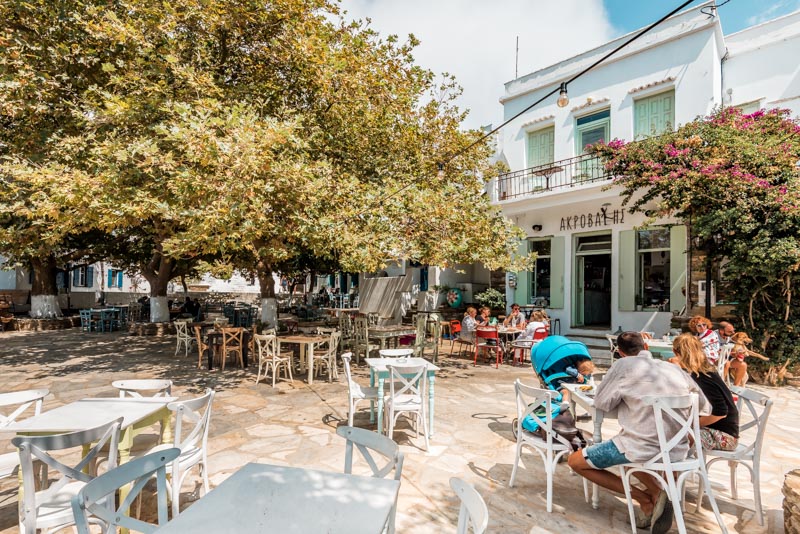
Dyo Choria means something like “two places” and is undoubtedly one of the most beautiful settlements on Tinos. The village has a strong medieval character, with winding streets, arcades and a main square worth seeing, with taverns and cafes under plane trees. A walk through the white village is well worth it!
→ Recommended tavern: Akrovatis
Falatados
Falatados is the second largest village on Tinos after Pyrgos and has a long history. In September, a raki festival (rakizio) takes place. The main square Megalochari is dominated by the imposing Cathedral Ag. Triada. Two kilometres north you’ll find the »Falatados Rock Site«, a cluster of large granite boulders.
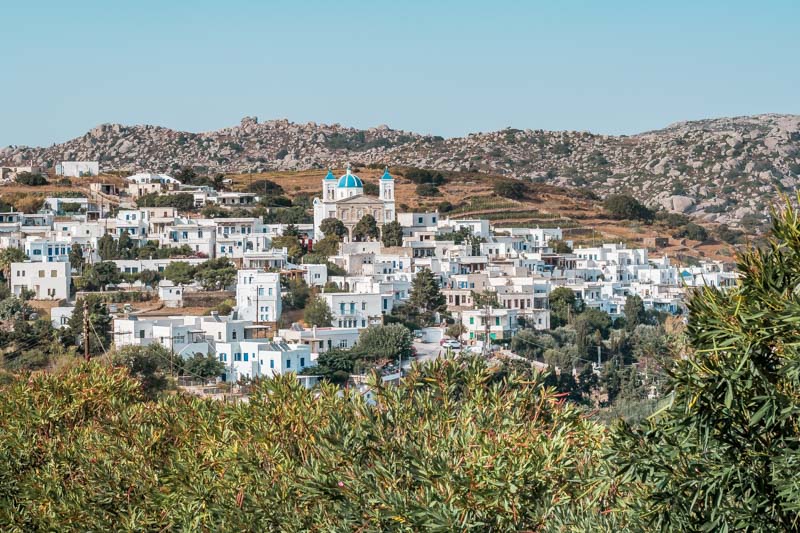
Kampos
Kampos was the home of the nun Pelagia, who found the holy icon of Mary in 1823. The village has remained unspoilt and exudes a special tranquility. Kampos has two notable churches, Ag. Triada (Catholic) and Αg. Aikaterini (Orthodox). At the entrance to the village, it is well worth visiting the museum of the artist Kostas Tsoklis.
→ Recommended taverna: Choreftra
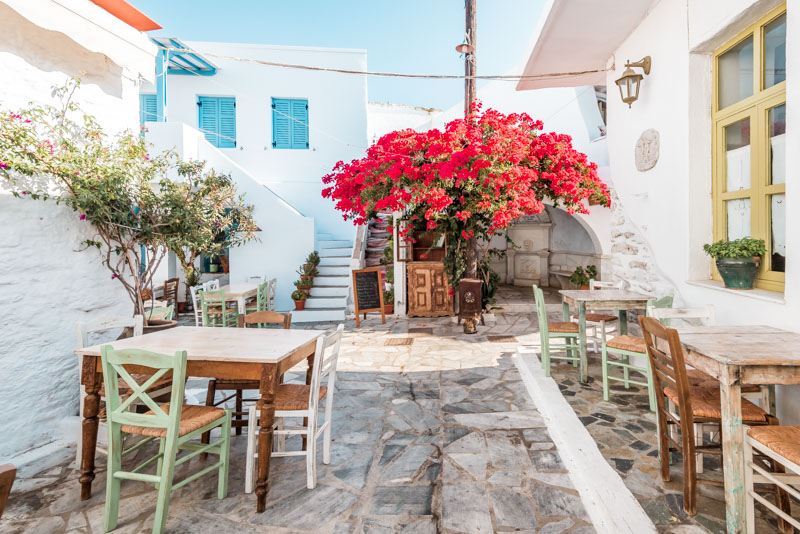
Komi
Komi is located in the valley of Livadi, the most fertile plain on Tinos. The settlement dates back to ancient times, and a detour to Komi is well worth it! The pretty Platia next to the large Ag. Ioanni’s church invites you to linger for hours. At the old village fountain, you’ll find a picture gallery of pigeon towers from the surrounding region.
→ Recommended taverna: Komissa
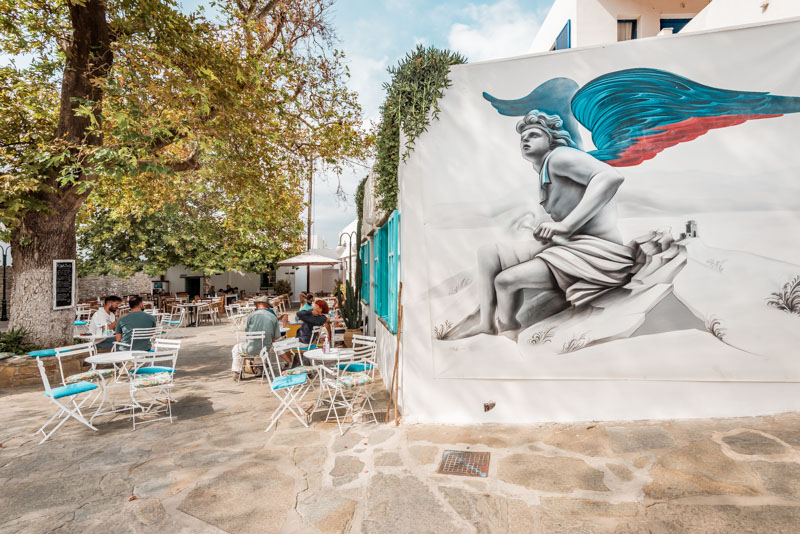
Triantaros
For many, Triantaros is one of the most beautiful villages on Tinos. The village nestles picturesquely on the terraced hillside, like a balcony overlooking the landscape. A walk through the pretty alleyways with their arcades offers countless photo opportunities. Be prepared for a fair bit of climbing, though, as there are quite a few steps along the way.
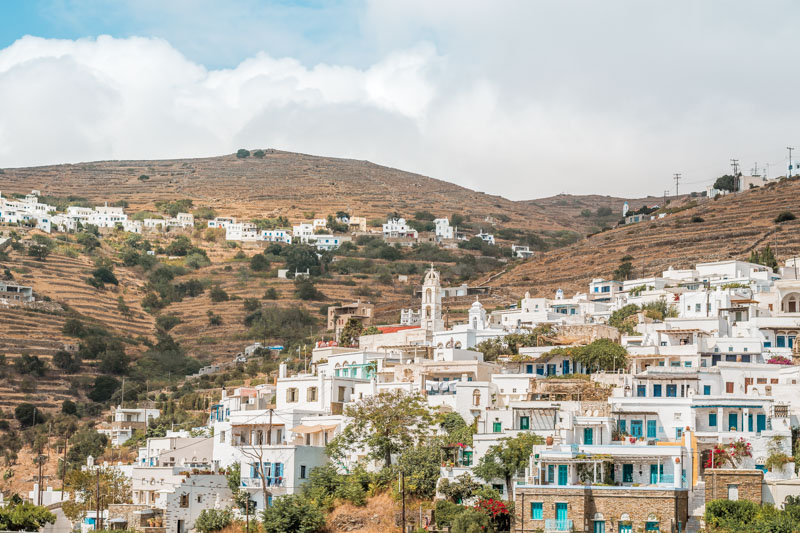
Steni
Steni is located at the foot of the highest mountain on Tinos, Tsiknias at 727 m. The striking Cycladic architecture and the many stone arches in the village are sure to catch your eye. Rustic taverns invite you to linger. In the area you will find the Tinos wineries Vaptistis, T-OINOS and De Kalathas (visits by telephone arrangement).
→ Recommended tavern: Amiséli

Volakas (also Volax)
Volakas is one of the most interesting places on the island. You can find out more about this village, set in the middle of a bizarre rocky landscape, at: #7 The granite forest of Volax
💡 Book tip for Tinos: The Greek Islands travel guide from Lonely Planet contains an informative chapter about the island of Tinos with extensive travel tips: View on Amazon*
#4 The pigeon towers of Tinos
Like most other Greek islands, Tinos was also under Venetian rule for a long time. From 1207 to 1715, the flag of the Lion Republic flew almost continuously over Tinos, making it the island with the longest period of Venetian rule among all the Mediterranean islands.
Even after the Ottoman conquest in 1715, Tinos retained many special rights due to its ties with the Catholic Church. Even today, almost half of the Tiniotes profess the Roman Catholic faith — quite a rarity in Orthodox Greece.
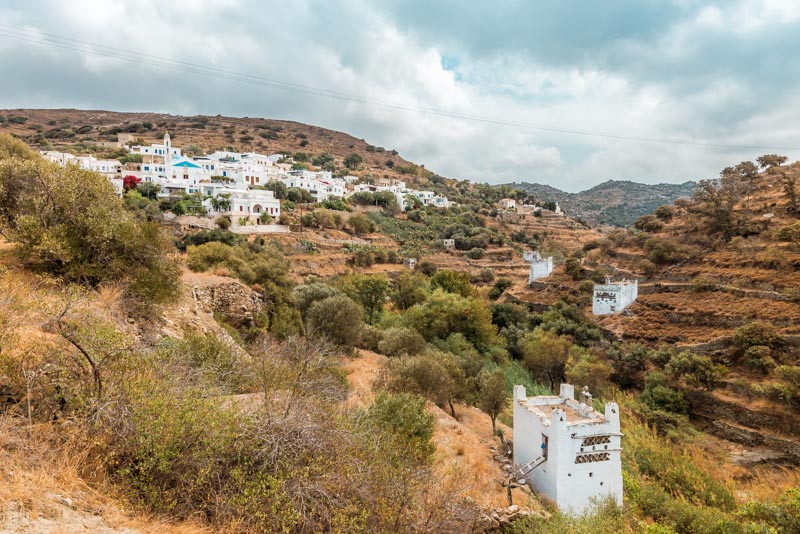
Dating back to Venetian times, the island’s distinctive pigeon towers »Peristeriónas« are architecturally remarkable structures featuring geometric and often imaginative patterns made from slate slabs, which served as nesting sites. The pigeons lived in the upper section, while the lower area was used as a storage room.
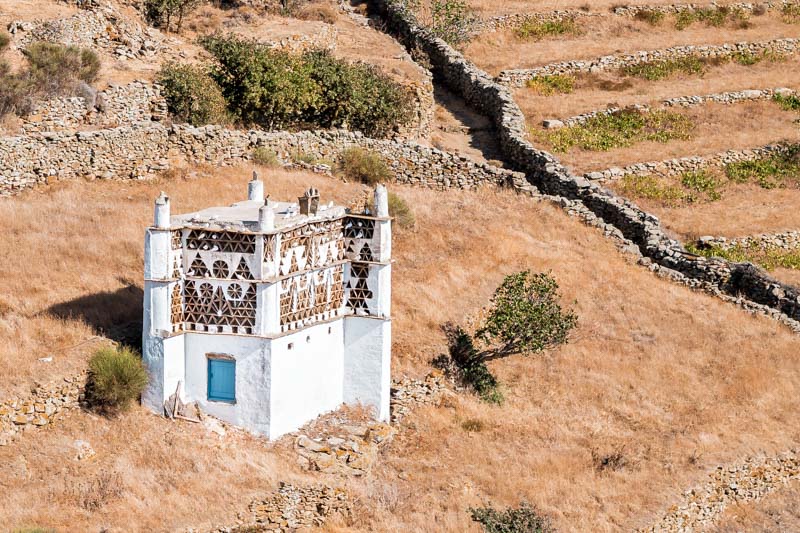
Carrier pigeons were widespread during Venetian times, and Tinos was considered an ideal location thanks to its central position. Pigeon droppings were used as a nutrient-rich fertilizer in the fields. Between 600 and 800 pigeon towers are scattered across Tinos, ranging from inconspicuous ruins to fully renovated holiday homes.
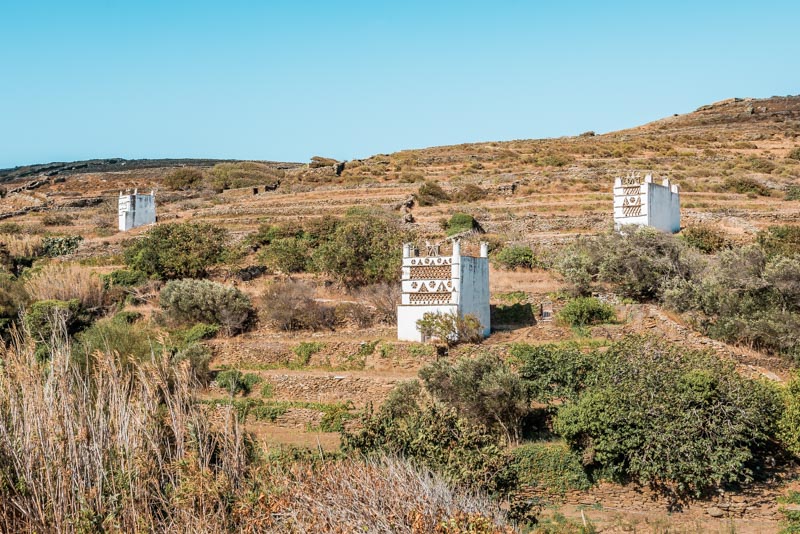
There are a particularly large number of well-preserved pigeon houses on the outskirts of Tarambados. You can enjoy a great view of the white pigeon towers from an unpaved parking lot above the village. The hidden hamlet of Agapi in the northern highlands also offers some pigeon towers. They are located below the village and stretch photogenically through a green valley.
#5 Exobourgo: Kastro of Tinos
The Exomvourgo, also known as the Exobourgo, is the most striking mountain of Tinos. It is located about 12 km north of Tinos town. The rough and massive rocky summit of the 640 m high mountain catches your eye from afar.
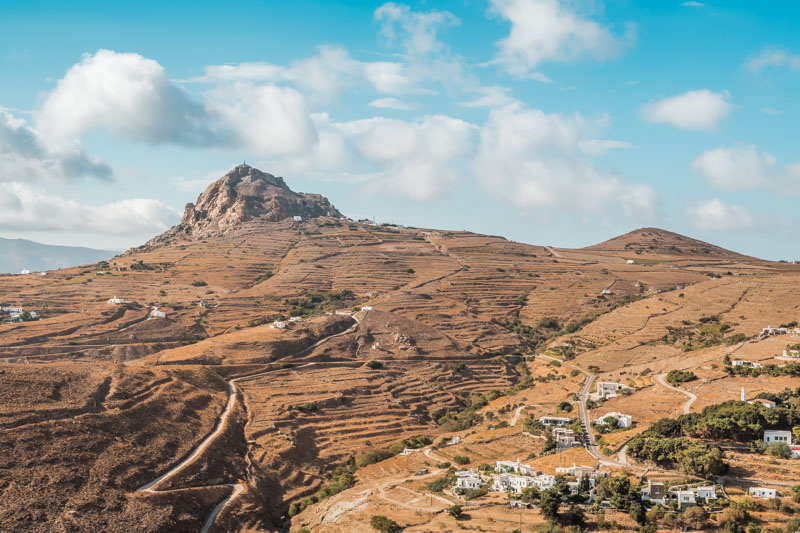
People have always been drawn to the Exomvourgo. The first traces of settlement date back to the Copper Age. A Demeter Temple is said to have stood on the summit in ancient times. Old wall remains from the Ionic period can still be found today.
In Byzantine times, a Kastro was built on the Exobourgo. The Venetians reinforced this Castle of Tinos in the 13th and 14th centuries to defend the island from the Ottomans, and at the same time moved the capital here. In the Middle Ages, about 1,000 people lived around the mountain.
The strategic location of the fortress allowed the Venetians to rule Tinos for almost 500 years. Only in 1537 did the pirate Barbarossa briefly seize Tinos for the Ottomans. It was not until 1715 that Tinos finally fell to the Ottoman Empire after a siege by 25,000 soldiers.
Ascent to the summit
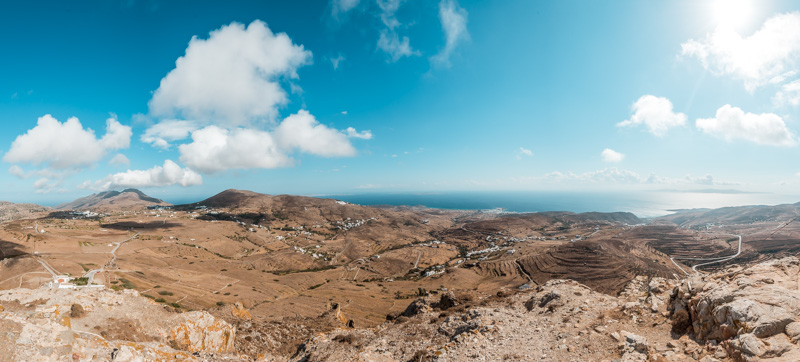
Today, unfortunately, only the remains of the former fortress can be seen. You can drive up by car as far as the Monastery »Iera Kardia Iisou«, just below the Kastro. From here, a short but steep climb begins, taking you to the summit in about 15 minutes.
The view from Tinos towards Mykonos and Delos, as well as Syros, is unique. At the top there is a summit cross and a few ruins to explore. On a clear and windless day, a few ruined windows at the top of Exobourgo make for great photo opportunities — otherwise it can be very stormy up there.
Below the Exobourgo lies Loutra, a village of 35 souls where time seems to have stood still. Loutra is one of the oldest settlements on Tinos and has drawn many believers over the centuries. In the garden of the former Ursuline convent, the Café Serviam has been established, serving coffee and light snacks in an extremely idyllic atmosphere.
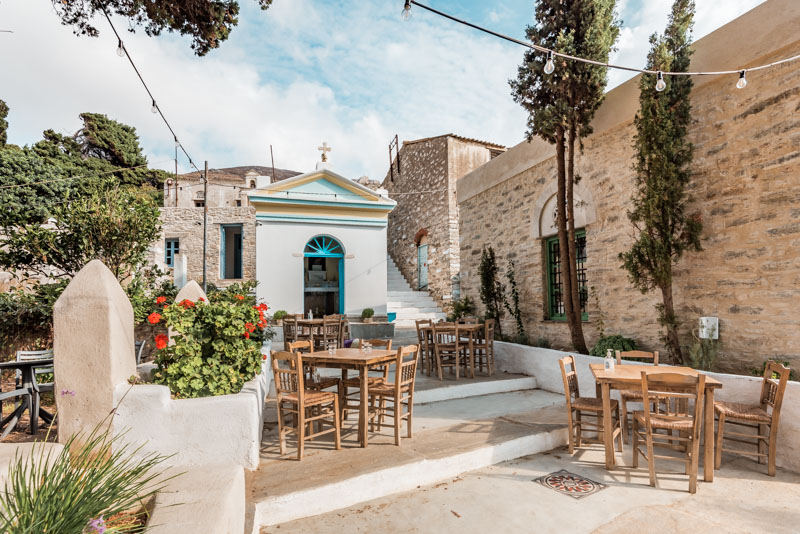
#6 Beautiful beaches in Tinos
The island of Tinos is not necessarily considered a Greek beach paradise, and for a pure beach holiday you would probably prefer to visit other Cycladic islands such as Naxos.
That said, you can of course also take a dip in the Aegean Sea on Tinos, provided you catch a windless day. Especially on the beaches in the north and east, high waves and a fresh breeze are not uncommon in midsummer.

The island is rugged and so are most of its beaches. Many coves of Tinos consist of grey-brown sand or gravel. When the sea is calm, you can still bathe in crystal clear waters.

Agios Fokas Beach
Agios Fokas beach starts about one kilometre east of Tinos town. Despite its proximity to the capital, you will find many quiet and partly unspoilt spots along the elongated bay with its grey sandy beach. On a prominent hilltop at the eastern end of the beach once stood the Venetian Fortress »Vriokastro«.
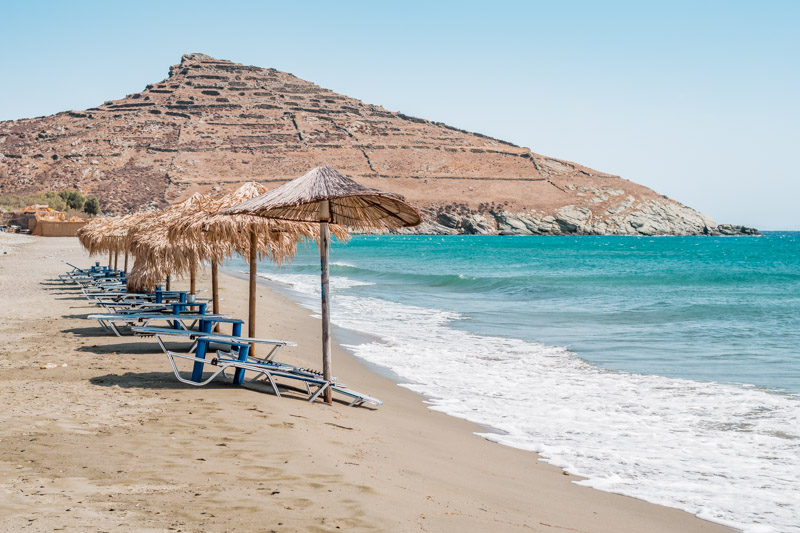
On Agios Fokas Beach you will find the cosy Sundara Bar. In a very relaxed atmosphere, the friendly staff serve delicious snacks and drinks. The cosy ambience radiates a real holiday feeling on Tinos. Perfect for a Freddo with an ocean view.
Coves near Kionia
West of Kionia Beach, which is dominated by a large hotel complex, you will find a few quiet little bays below the road. The natural sandy beaches slope quite gently into the clear sea and are wonderful for an undisturbed beach day.
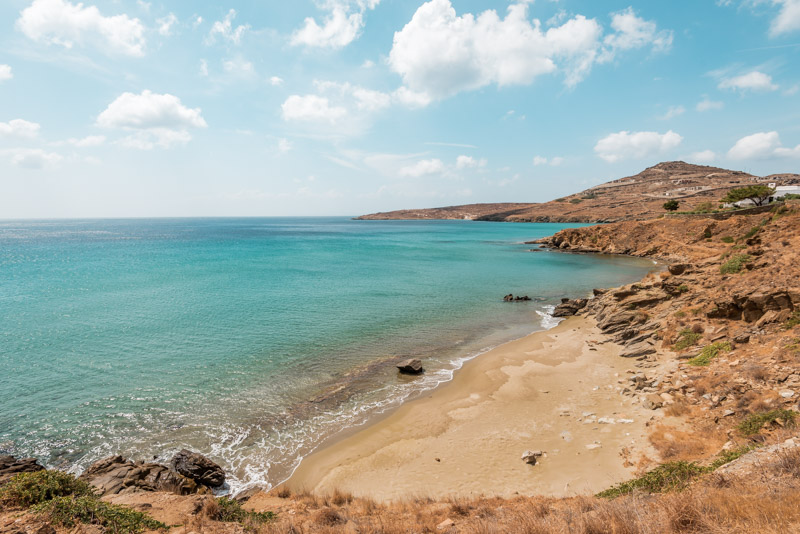
Kolimbithra Beach
In the north of Tinos, at the mouth of the reed-covered Livadi valley, lies the wide bay of Kolimbithra, also known as Megali Ammos.
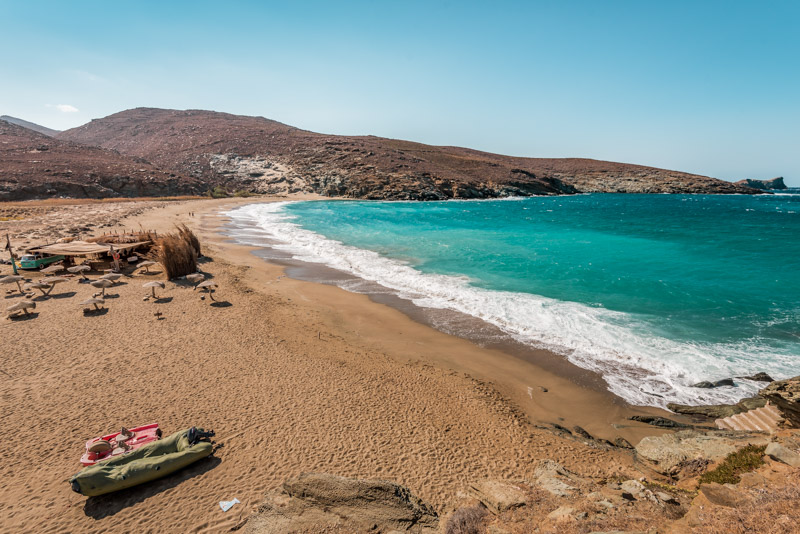
The coarse sandy beach, with its dunes that reach into the hinterland, is one of the most beautiful beaches on Tinos and drops quite steeply into the sea. When the wind blows from the north, there are metre-high waves here, which are popular with the local Tinos Surf School.
The beach bar with a Volkswagen Bulli provides cool drinks as well as creative parasols and a few sandbags as sunbathing spots. One bay further is the small Kolimbithra beach (also known as Mikri Ammos), and at the very end of the road is Apothikes Beach.
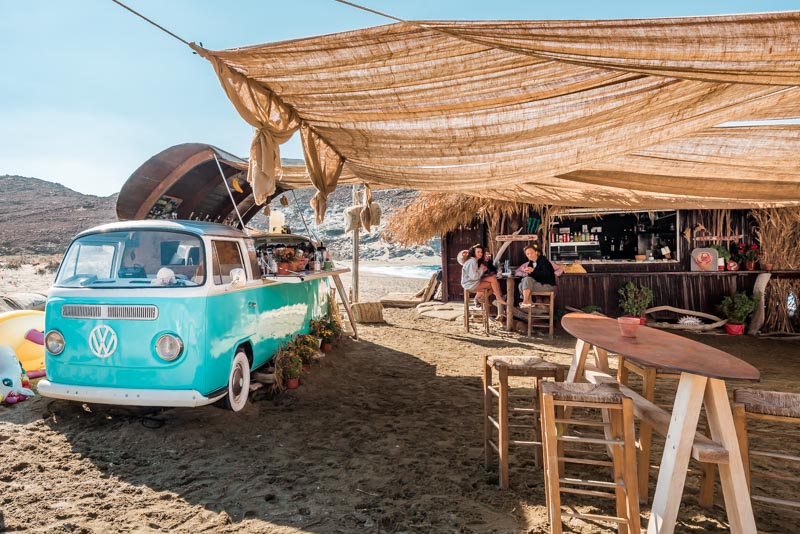
Livada Beach
A natural pebble beach in the northeast of Tinos, framed by dramatic rocks. To the left of the bay, a small river flows into the sea where turtles often frolic, and on the shore you’ll find ducks and geese.
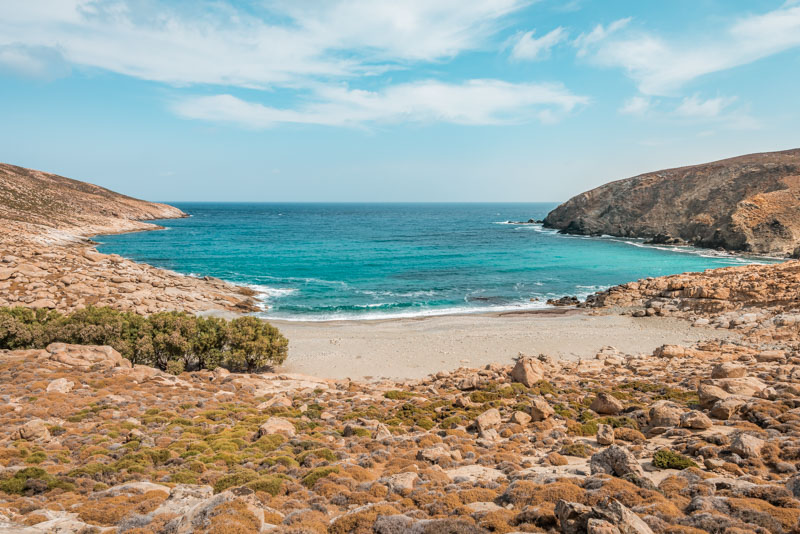
Especially on windless days, a visit to Livada Beach is worthwhile, as the clear water is ideal for swimming. The approach is via a gravel road, which was easily manageable for our small car.

Pachia Ammos Beach
A dune-lined bay in the southeast of Tinos. A trail leads you down to the natural sandy beach, which has a fairly shallow entrance into the sea. Since there is no operator and no shady trees, you should bring your own parasol. Above the beach, there is a country club serving refreshing drinks.
Rochari Beach
In the northwest, not far from the coastal town of Panormos, lies the grey sandy beach of Rochari, which is lined with a few tamarisk trees. When the north wind is not blowing, the sea here is pleasantly calm.
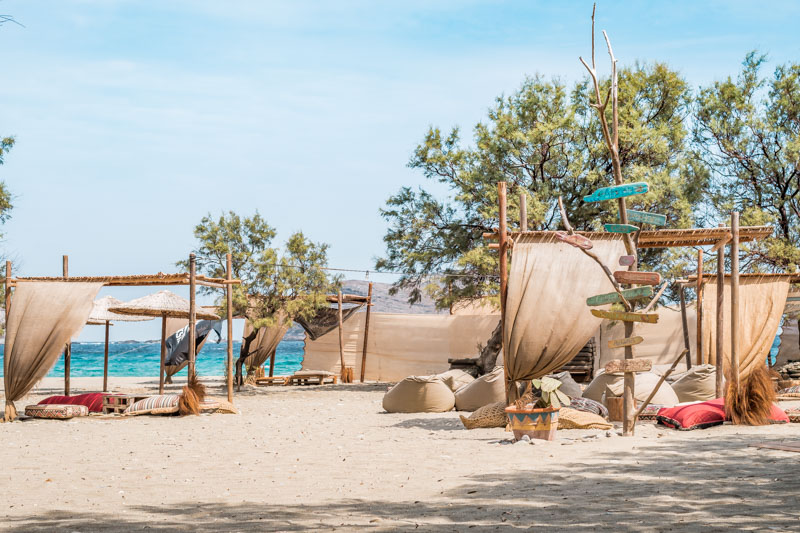
The beach slopes quite gently into the water, making it suitable for families with children. The cosy beach bar on site offers parasols and seat cushions or beanbags for hire.
Santa Margarita Beach
A pretty bay with a sandy beach in the east of the island. Outside of high season, this unorganised beach is very peaceful. There are some tamarisk trees along the shore, and the sea is clean and quite shallow.

The beach is accessed via a steep and narrow concrete track. Above the bay lies the Catholic Monastery of Panagia ton Aggelon, from which you can enjoy a beautiful view of the east coast.
#7 The Granite Forest around Volax
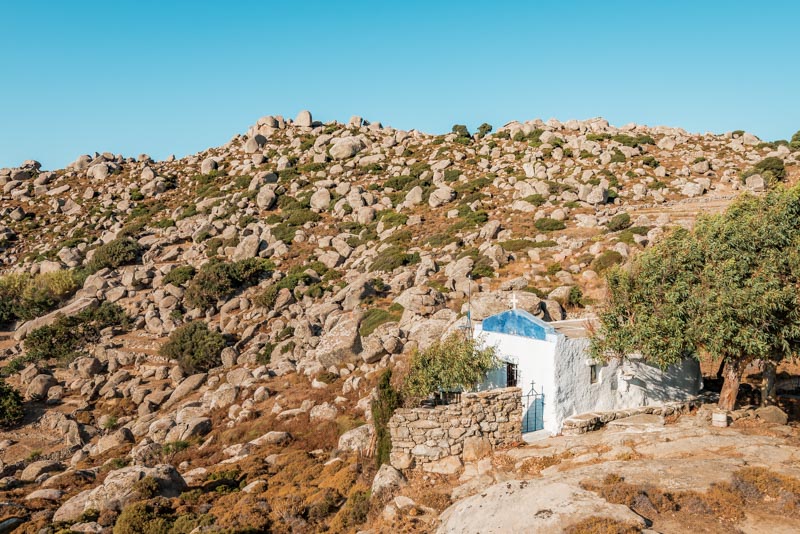
In the northeast of Tinos, you’ll find an extraordinarily bizarre landscape of huge, rounded granite boulders. It looks as though the Greek gods once played a game of bowls here.

At the heart of this curious moonscape rises the village of Volax (also Volakas), which is a popular starting point for bouldering, especially among outdoor sports enthusiasts. A walk through the photogenic village with its white cube houses and colourful flower pots is entertaining and well worth it.
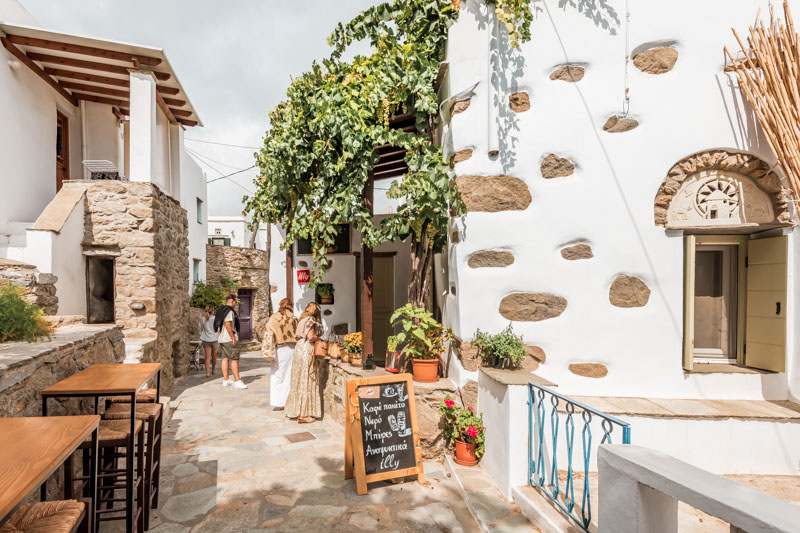
Among other things, there is a photogenic main street with small shops and the cosy Café Kafe-nai. The many houses built directly on the rocks are particularly striking. At the entrance to the village, beautiful wickerwork is sold — basket making has its roots in Volax on Tinos.
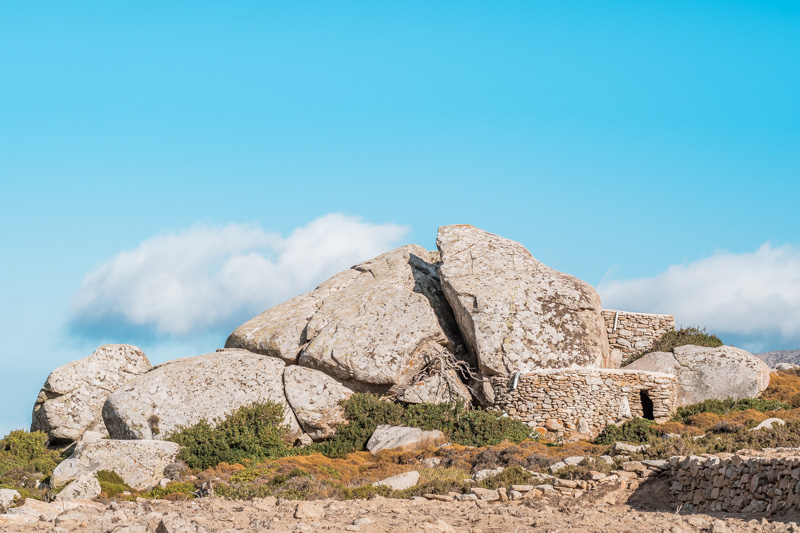
On the northern edge of the village you will come across a washhouse with a spring and village well. Further towards the end of the village is a field with interesting rock formations where you can take great photos. East of the village you will find a small amphitheatre, which offers a beautiful view of Volax from the top row.
💡 Vineyards near Volax: Especially in the evening, it is worth driving from Volax a little further towards Volacus Winery. The warm evening sun then bathes the entire granite landscape in a golden light, and you feel a bit like you’re on another planet. A tour of the winery, which is well worth seeing, is possible on Monday, Wednesday and Friday from 5 p.m.

#8 Walk through Kardiani
Tucked below the connecting road from Tinos town to Pyrgos hides this beautiful marble village. After Pyrgos, Kardiani on Tinos enchanted us the most. The white village is picturesquely situated on a hillside and, embedded in lush vegetation, offers fantastic views of the coastal plain.

At the entrance to the village there are a few parking spaces where you can leave your car. On foot, you then head into the narrow maze of alleys of the traditional village.
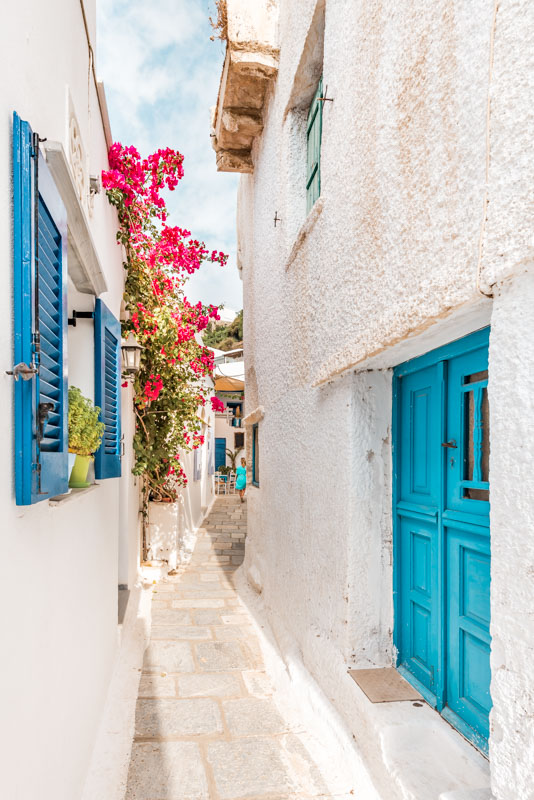

Between white houses, sometimes connected by round arches, you’ll discover numerous photo opportunities. In the centre of Kardiani lies the quaint Kafenion Dimitra. Behind it you reach the historic washhouse with a spring and the church of Agia Triada, from which you have a wonderful view of the village.
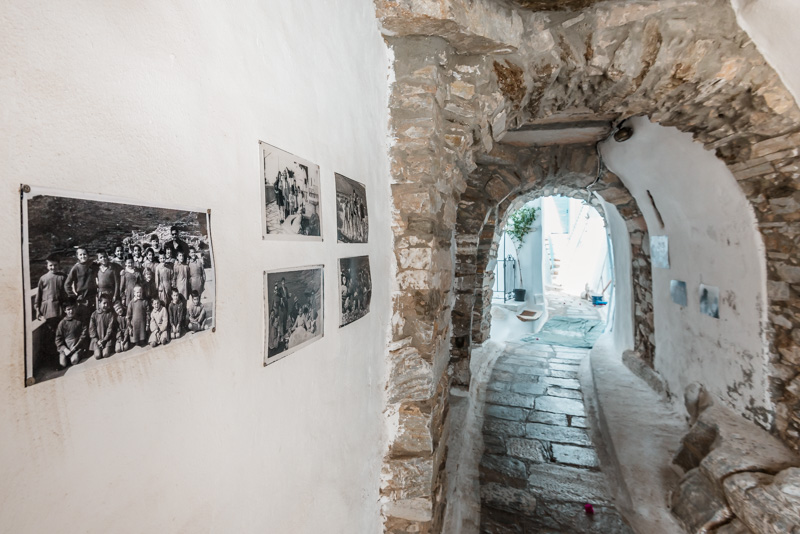
Throughout our tour of Kardiani, we were accompanied by beautiful photographs displayed on the walls of houses, documenting village life from times long past and showing the place from a very personal and authentic perspective.
Below the marble village lies the fishing hamlet of the same name, Ormos Kardiani, with its Giannaki Beach. The coastal town is known for its Tavern O Ntinos, which serves excellent Tinian cuisine. An asphalt road leads to the tavern, after which you continue on a gravel road to Giannaki Beach (a sand and gravel mix).
#9 Pyrgos: The Marble Treasure of the Island
Whenever the Greeks mention the name Tinos, an enthusiastic rave about the village of Pyrgos inevitably follows. Nestled in the far northwest, Pyrgos — also known as Panormos — is the largest village on the island and a true gem.
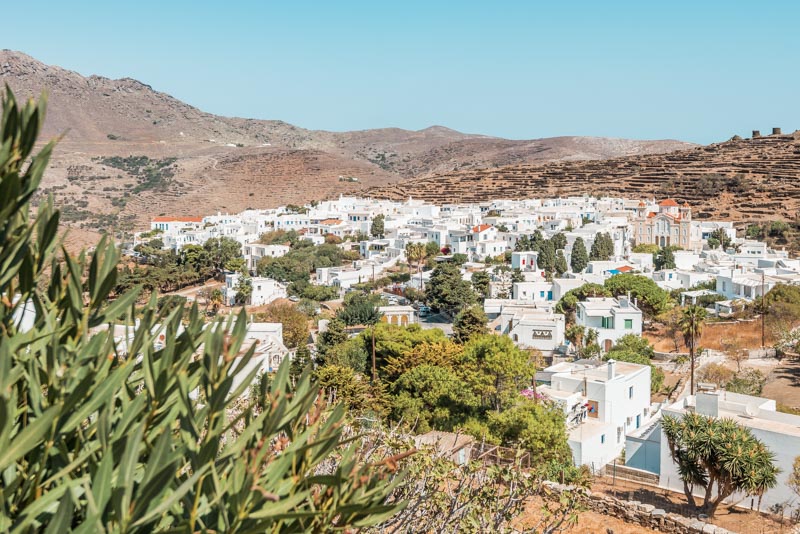
After a winding drive through a barren mountain landscape, the view opens up to a white sea of houses with magnificent church buildings. On the western outskirts of the village there is a large free car park, and directly opposite you can enter the enchanting alleys of the marble village. Pay attention to the numerous small details on the walls of the houses — much of it was made from marble.
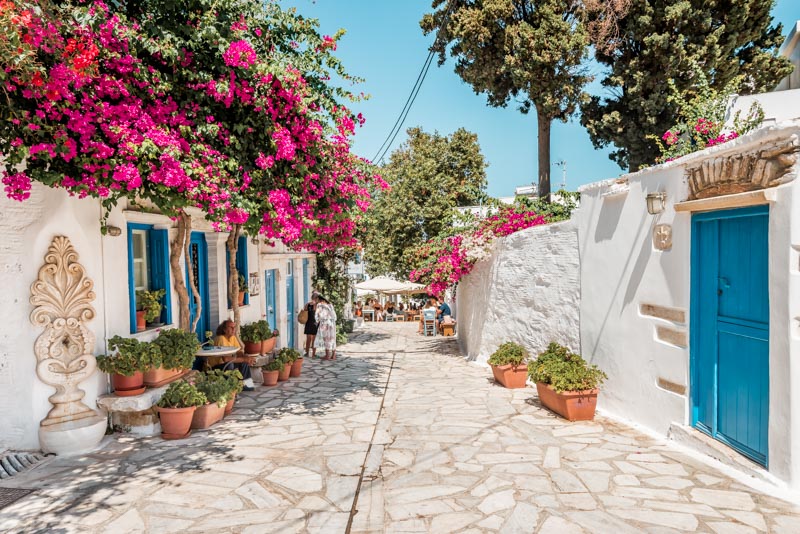
Marble quarrying and the processing of this precious stone have a very long tradition in this region, dating back to antiquity. Many artists and sculptors come from Pyrgos, and some still run workshops and studios in the village today.
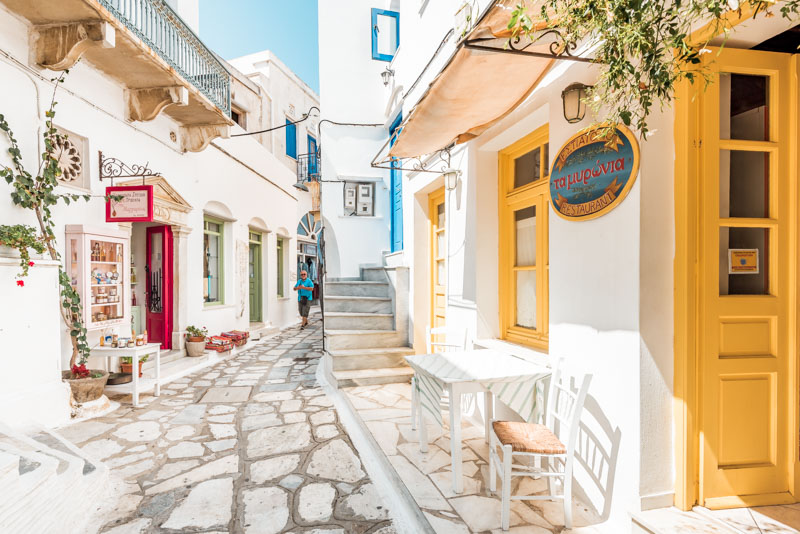
The prestigious Sculpture School is located at the highest point of the village, near the Marble Museum. Along the picturesque alleys of Pyrgos you will find numerous charming boutiques and studios, which are sometimes closed for the siesta (2–6 pm).

The most beautiful viewpoint in Pyrgos is the platia with its large plane tree and the marble fountain house. The village square with its numerous cafés was packed even during our visit in September. We had a particularly lovely seat and, as is so often the case on Tinos, also excellent food, at the Athmar Café on the Platia.
💡 Museum of Marble Crafts: The modern Museum of Marble Processing is located above Pyrgos and vividly illustrates the extraction and processing of marble on Tinos. At the heart of the exhibition are numerous historical marble works of art from all over Greece (Wed.–Mon. 10 a.m.–6 p.m., 4 €).
Lunch break in Ormos Panormou
If Pyrgos is too busy for you, stop by Ormos Panormou, just 3 km away. The tranquil coastal town was once a busy commercial port of Tinos. In the old days, marble was shipped out through tunnels that had been excavated in the area.
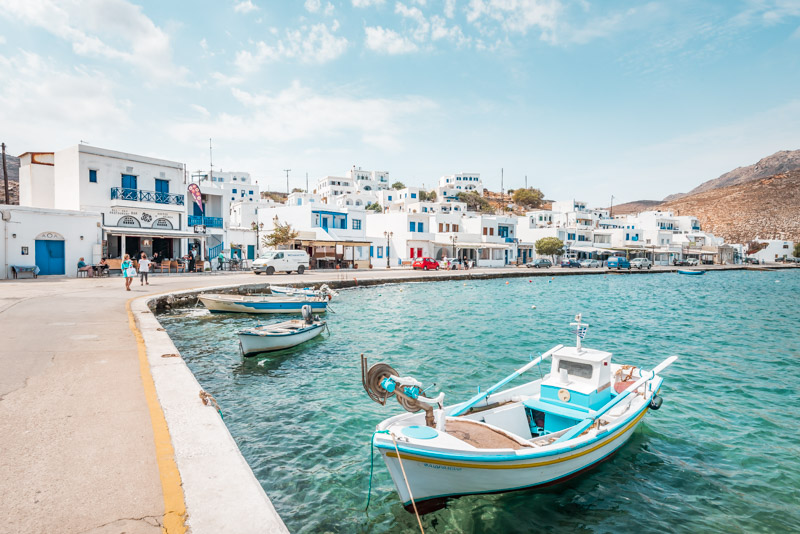
Around the bulbous harbour pier in the fishing village, cafés and tavernas invite you to take a lunch break or a coffee stop. We had a particularly delicious meal at Maru, right on the waterfront.
The tamarisk-lined stretch of Stafida Beach is perfect for a quick refreshment. From here you also have a great view of the rocky island of Planitis with its lighthouse.
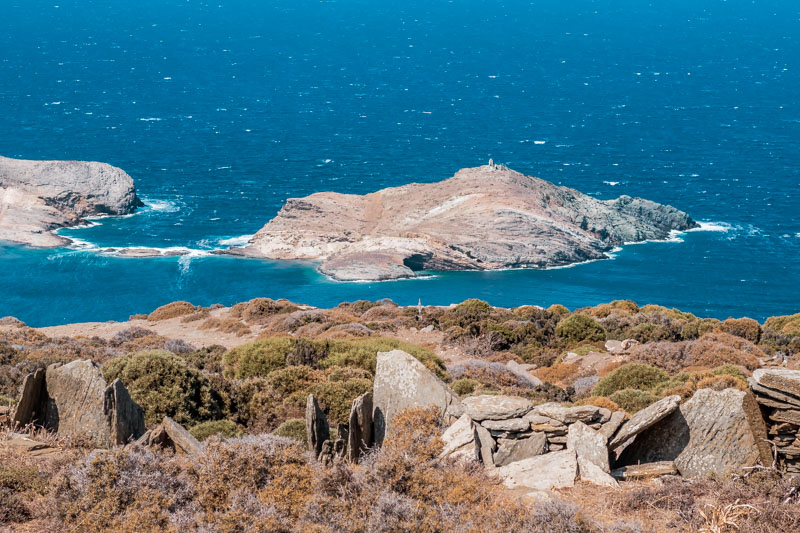
If you’re a good walker, a real Tinos insider tip awaits you at Kavalourko Beach at the northern end of the bay. Here, an artist has carved a relief of the wind god Aiolos into the rock.
By the way: if the fishing village of Ormos Panormou looks familiar to you, you may have already seen the German feature film »Highway to Hellas« (View on Amazon*), large parts of which were filmed right here.
Koumelas and Malli
With an off-road vehicle, you can take a detour to the coastal towns of Malli and Koumelas in the far northwest. The wild landscape is truly inspiring and the scenery resembles a pirate’s nest. Green marble was once mined here, and the old tunnels are located directly on the sea. In recent years, some “illegal summer houses and huts” have been built in both villages.
#10 Culinary highlights on Tinos
The culinary offerings alone would make us visit Tinos again. What is served here in many places is creative Greek cuisine — sometimes at a gourmet level — which is well above the average of other Greek islands.

Almost every village is home to at least one, and often several, taverns or restaurants serving visually appealing and extremely tasty Greek cuisine with international influences. And all of this usually at a very fair price-to-quality ratio.
Where on other islands you might search long and hard for a good tavern, on Tinos you are truly spoilt for choice. We have put together a small selection of our personal favorites. But the list can certainly be extended on the next visit:
Tinos restaurants: Our recommendations
Athmar Café, Pyrgos
A nice café overlooking the Platia of Pyrgos. Very friendly staff and fair prices. We found the quinoa salad, the stuffed pita bread and the zucchini balls particularly delicious.
Akrovatis, Dyo Choria
A cozy restaurant in a beautiful location on the village square of Dyo Choria. The tomato salad, Skordalia (garlic dip) with chickpeas and the keftedes (meatballs) were particularly tasty.
Komissa, Komi
A superb restaurant with gourmet-level food in the heart of Komi. Whether on the Platia or in the cozy courtyard, you can dine wonderfully. The three owners Konstantinos, Markos and Laertis run Komissa with great passion and take Greek cuisine to a whole new level! Every dish was delicious, from the lamb to the Tinos salad.
Krok Monsieur, Krokos
The best breakfast spot on Tinos! Here you’ll find everything you need for a hearty breakfast or a snack in between — from delicious avocado toast and fluffy omelettes to heavenly pancakes. The charming ambience and friendly staff make it a place you’ll never want to leave.
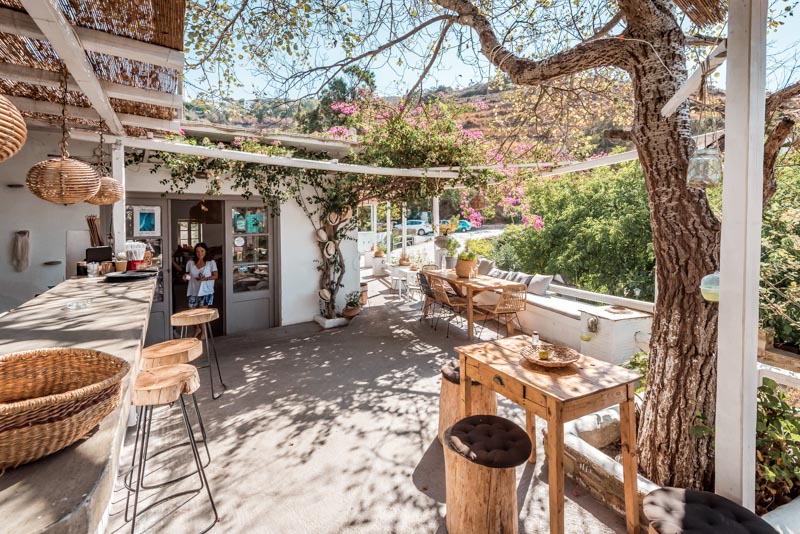
Maru, Ormos Panormou
Just thinking about Maru still makes our mouths water. The crab balls, the Maru salad and the oven-baked anchovies — a true flavour explosion! The modern restaurant sits somewhat inconspicuously among the traditional tavernas right on the waterfront. Despite the upscale cuisine, we found the value for money very fair!
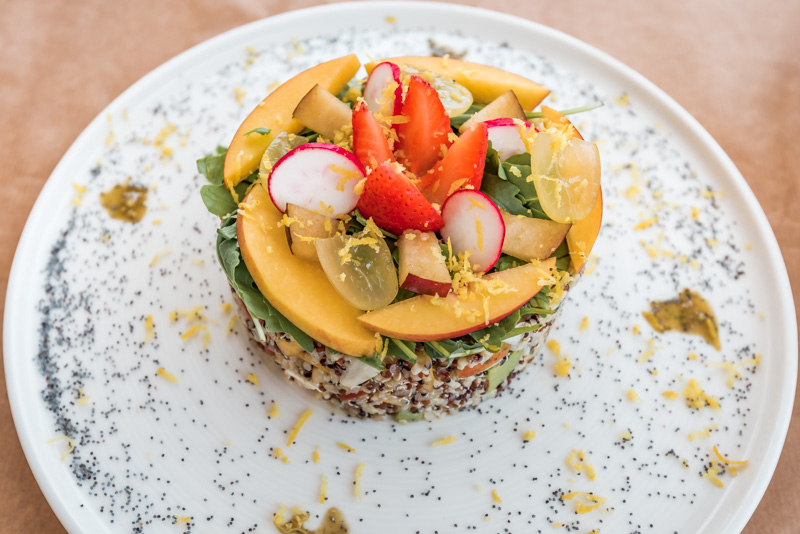
Sta Fys Aera, Aetofolia
A quaint taverna in the small hamlet of Aetofolia, serving homemade Greek cuisine. The staff were a little reserved, but the delicious mezedes and cozy atmosphere alone make it well worth a visit.
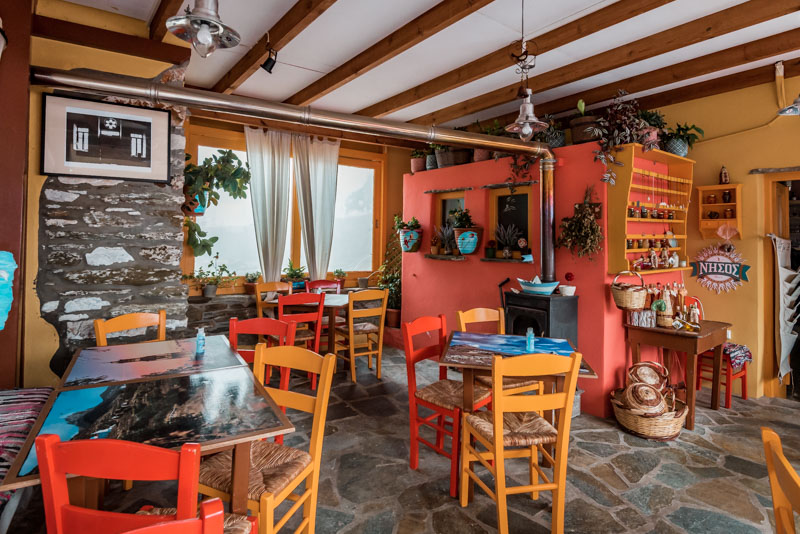
Choreftra, Kampos
A tavern in the heart of Kampos. The friendly owner family serves delicious Greek cuisine and island-typical specialties. We particularly remember the aubergine dip (Melitzanosalata), the Tiniotic pasta and the meat dishes with homemade mashed potatoes!
More Tinos tips for your holiday
Guided tours and activities in Tinos
The best way to explore the island of Tinos is by renting a car on your own. As a tour operator, Tinos Unveiled offers numerous activities, from island tours to city tours and everything in between. There is also the opportunity to take part in a cooking course in Tiniotic cuisine.
→ You can find out more about it here: Tinos Unveiled
Accommodation in Tinos
Similar to the neighboring island Andros, Tinos lives mainly from individual tourism. As a result, you will find numerous family-run hotels, tasteful holiday homes and villas, as well as modern studios and apartments on the island.
→ On Booking.com* you will find many accommodations in Tinos and you can check prices here:
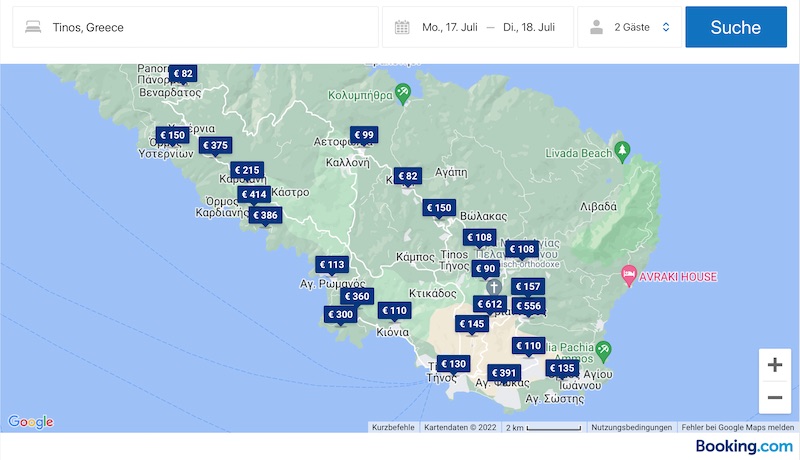
Where we spent the night
Villa Aerino, Kampos
We spent a week in the beautiful Villa Aerino in the central village of Kampos. Host Antonis and his mother Maria were very helpful and made sure we were completely comfortable during our stay on Tinos.
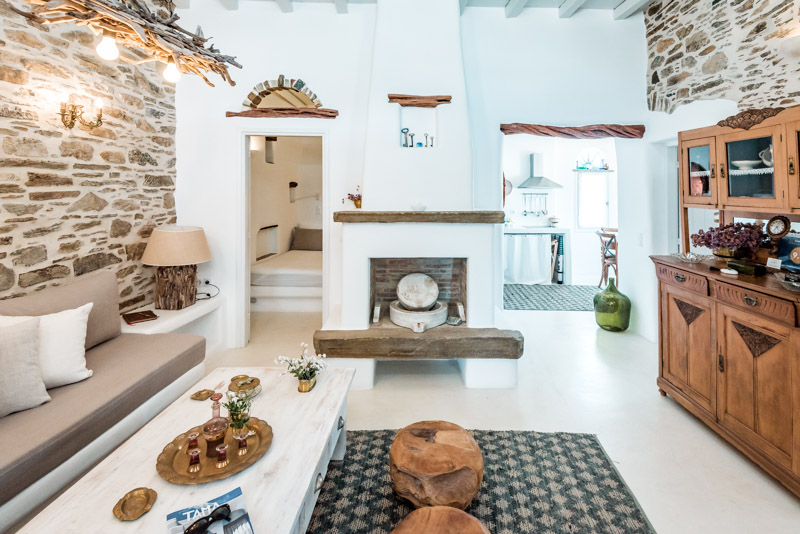
The spacious Tinos villa for 4 people is located right in the center of Kampos and offers a large living room, a well-equipped kitchen, a bathroom, and two bedrooms.
On the cozy outdoor terrace with lounge corner you can relax wonderfully. Villa Aerino is very well equipped for self-catering and has been tastefully decorated in a traditional island style.
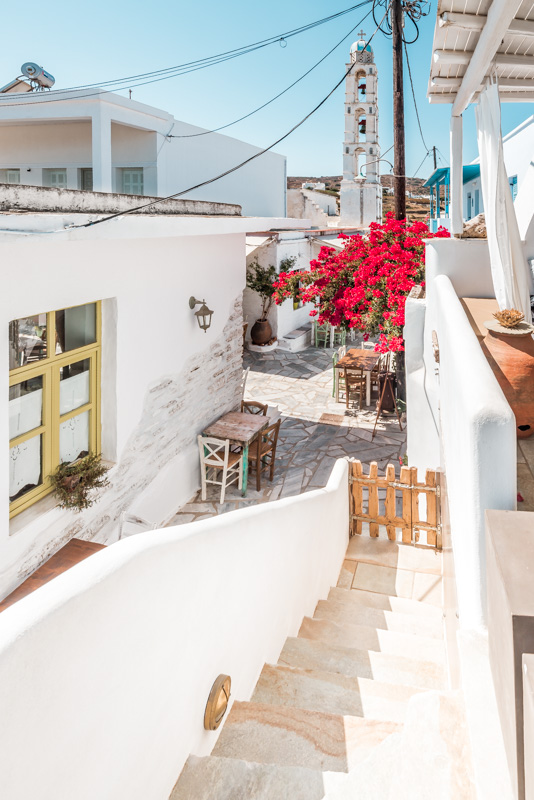

From the bedroom and kitchen you can enjoy a great view of the Exobourgo mountain. Below the villa is the Taverna Choreftra, which serves excellent Tinian food in the evenings. On Booking.com* you can book the accommodation directly if needed:
Getting around Tinos
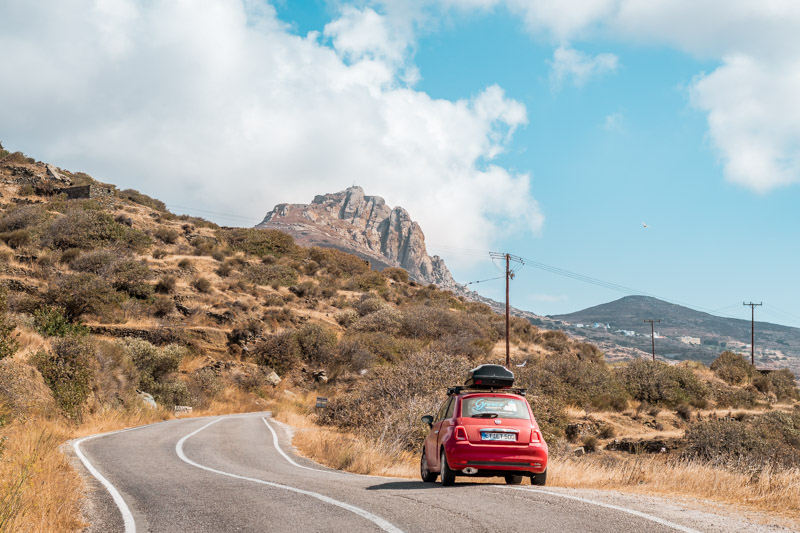
With an east-west extent of about 27 km, the island of Tinos is wonderful to explore by hire car. You can find local rental companies especially around Tinos town. We can recommend the following car rental companies on Tinos:
- Vidalis Tinos Rent a Car & Bike
- Dimitris Rent A Car Tinos Island
- Jason Tinos Rent a Car
The public Tinos buses from the KTEL company connect the main villages in Tinos, from Chora to Pyrgos. However, the timetables are more geared towards the local population, so you’ll have more flexibility with your own vehicle. You can find the current bus schedules at: KTEL Tinos
Getting to the island of Tinos
Since the island does not have an airport, you can reach Tinos only by ferry from Athens. Regular connections are available from both the port of Piraeus and Rafina (Athens East). The large ferries of Blue Star and Golden Star call at Tinos several times a week. On the Ferryhopper* portal you can search for suitable ferry connections and check prices:
➲ To the ferry booking with Ferryhopper*
Take a direct flight from Germany (or AT, CH) to Athens or Mykonos. From Piraeus the ferry takes about 4.5 hours, and from Rafina it is 3 hours 45 minutes. The shortest ferry connection is just 35 minutes from the neighbouring island of Mykonos, making Tinos easy to incorporate into a Greece Island Hopping itinerary.
→ All information and travel reports about the Cyclades archipelago can be found at: Cyclades Islands
*Support our blog Greece-Moments
In this post, you will find affiliate links marked with an asterisk (*). If you book or buy something through one of these links, we receive a small commission. For you, the price remains the same. This way, you help us continue to provide high-quality content for free. Did you enjoy this post and want to say thank you? Then just buy us a Greek coffee ☕️ To the coffee fund
Bookmark this post on Pinterest!