

The myth that Greek cuisine is all about meat still persists. Everyone immediately thinks of gyros, bifteki, souvlaki, and the like when it comes to eating in Greece. We believe this is a misconception, and that’s why it’s high time to dispel this one-sided image.
Authentic Greek cuisine is far more diverse than its reputation suggests, and many a taverna in Greece offers culinary delights of the highest caliber.
Tom & Ella
What is typically served as Greek cuisine actually ranks among the healthiest diets in the world. Scientists refer to this as the so-called Mediterranean diet, which in its original form is also known as the Cretan diet.

Various cultural influences have positively shaped Greek cuisine over the past centuries. As a result, you’ll find interesting influences from Asia Minor, Egypt, the Balkans, and Italy in many traditional Greek dishes.
You’ll be surprised by all the culinary delights hidden behind the sometimes curious dish names. But don’t worry—the friendly tavern owners usually explain their Greek dishes to interested tourists with great patience.
- Traditional Greek cuisine
- Greek Dips: Tzatziki & Co.*
- Mezedes: Greek appetizers
- Greek Side Dishes to Accompany the Main Course
- Popular meat dishes in Greece
- Fish dishes on the menu
- Greek Desserts
- Greek Drinks: From Freddo to Ouzo
- Unique Dishes by Region
- The Parea: How the Greeks Eat
- Cooking Classes in Greece
- Greek Recipes: Vegan, Vegetarian & Meat
- FAQ: Greek Cuisine
Traditional Greek cuisine
Traditional Greek cuisine consists of many vegetable dishes and only a few meat dishes. In fact, many older Greeks eat meat only on special occasions, such as Easter. The main component of Greek cuisine is the many small appetizers, known as mezedes (Μεζέδες). Usually, everything is ordered at once and served as “Greek meze” (Μεζέ).

Vegetables such as eggplant, zucchini, tomatoes, and bell peppers are an important part of Greek dishes. They are seasoned with plenty of olive oil and garlic, as well as the local wild herbs oregano, thyme, and rosemary.
The basic components and individual ingredients of a dish should remain recognizable in terms of flavor. Greek dishes are often served lukewarm, and strong or excessive seasoning is uncommon. This was already the case in ancient times and still holds true in Greek cuisine today.

For meat dishes, in addition to beef, pork, and chicken, goat and lamb are traditionally used. After all, Greece has the largest goat population in the EU, with around 3.5 million animals. Fish is still very popular in taverns, but due to overfishing in the Mediterranean, demand is noticeably declining.
Recommendations for good Greek cookbooks
Of course, Greek food only tastes truly divine in Greece. Some Greek specialties are likely centuries, if not millennia, old. Many family recipes are passed down from generation to generation, and every Greek mom makes her own distinctive “moussaka.”
If you want to be inspired by the delicacies of Greece while cooking and baking at home, check out our Greek cookbook recommendations (on Amazon*). From traditional Greek cuisine to modern Mediterranean fare, there’s something for everyone:
- Yiayia: Time-Perfected Recipes from Greece’s Grandmothers*
- Greece: The Cookbook (Cucina)*
- Greekish: Everyday recipes with Greek roots*
- Eat Like a Greek: 100 Quick, Easy, Delicious Recipes*
Are there vegan or vegetarian Greek dishes?
Yes! Greek cuisine has plenty to offer vegetarians and vegans as well. We’ve marked all vegan dishes with a (V) in our article. Since classic recipes are occasionally adapted, it’s worth asking in advance whether a particular dish is truly prepared vegan. Interestingly, most Greek appetizers (mezedes) are vegetarian, and many are even vegan.

Here, we’ll show you everything that typical Greek cuisine has to offer. With this post, we’d like to encourage you to try something new on your next vacation in Greece. Our little guide to the Greek menu is here to help you do just that.
Greek Dips: Tzatziki & Co.*
*often also referred to as a salad
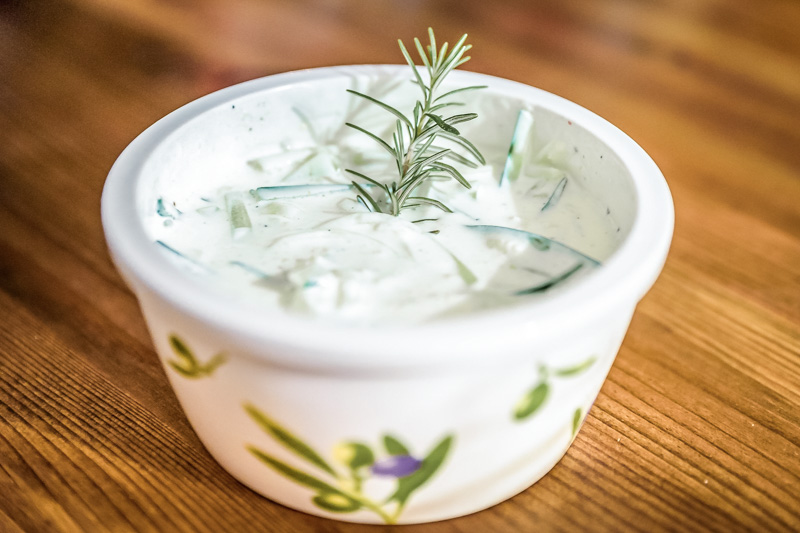
Tzatziki (also Zaziki or Tsatsiki), τζατζίκι
Greek yogurt with cucumber and plenty of garlic, especially delicious with fresh dill. You can find the perfect recipe for your next Greek night or barbecue party on our fellow blogger Malte’s site: Tzatziki recipe
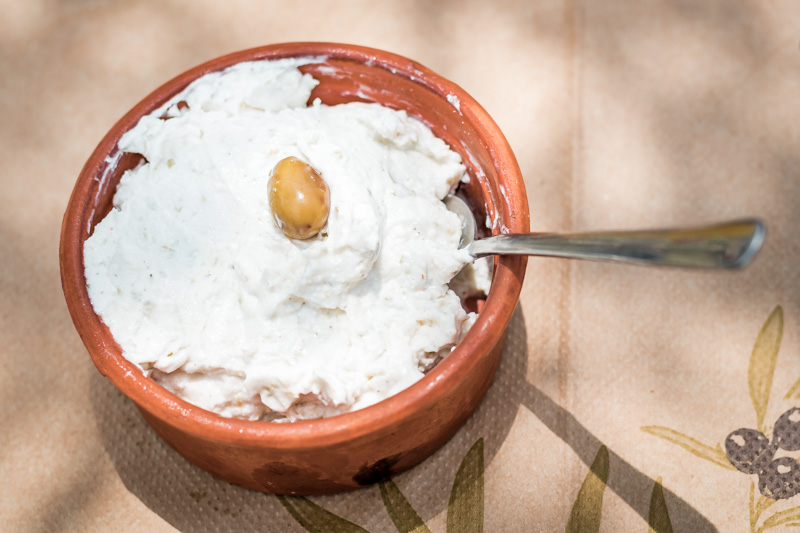
Skordalia, Σκορδαλιά (V)
Delicious potato-garlic cream for garlic lovers. On the island of Nisyros, it’s made with stale bread and grated almonds instead of potatoes.
Fáva, φάβα (V)
Delicious purée made from yellow fava beans, served with olive oil, onions, and lemon juice.
Eggplant salad – Melitzanosalata, μελιτζανοσαλάτα (V)
Creamy eggplant purée with garlic, olive oil, and wine vinegar.
Fish roe salad – Taramosalata, ταραμοσαλάτα
Fish roe cream (Tip: Only order this by the sea; otherwise, it’s usually pre-packaged).
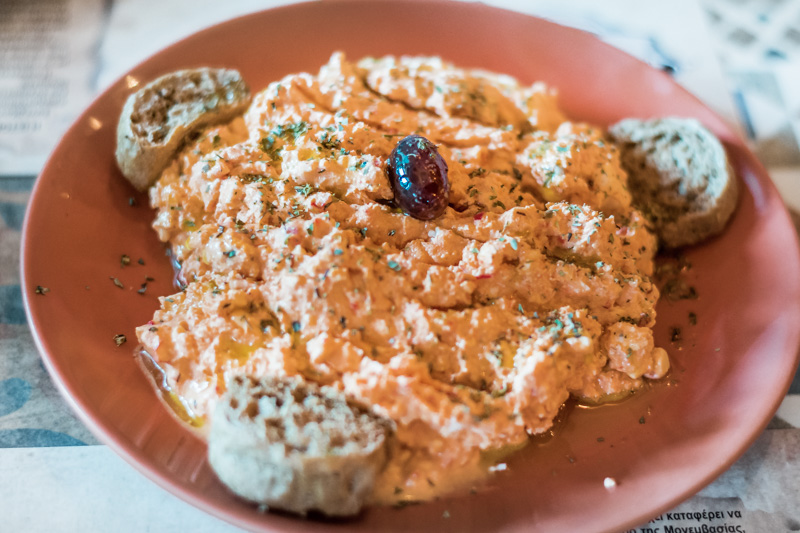
Spicy feta cream – Tirokafteri, τυροκαυτερή
A spicy cheese dip made from yogurt and feta (also known as Cheese Spread or Spicy Feta Dip).
Mezedes: Greek appetizers
Greek farmer’s salad – Choriatiki salata, χωριάτικη σαλάτα ((V) without feta)
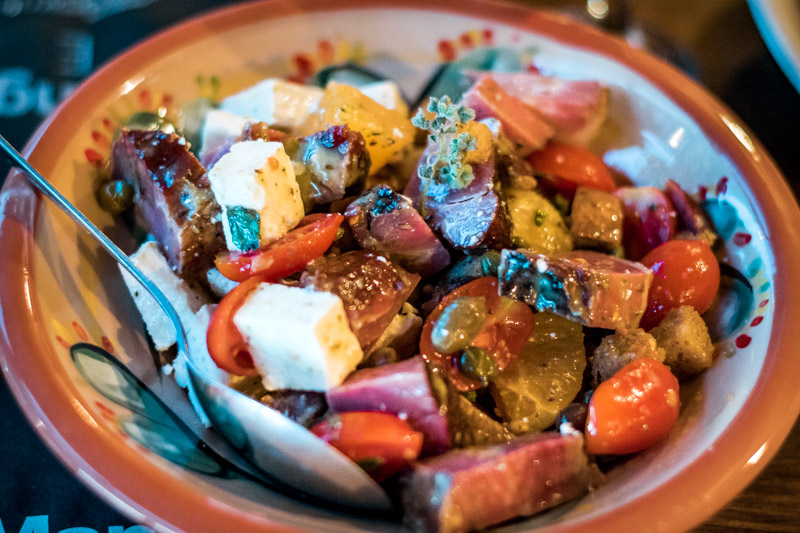
The classic par excellence! Greek salad with cucumbers, tomatoes, green peppers, onions, feta, and olives. Every taverna makes the salad a little differently, sometimes with capers and rusks.

Greek Cabbage Salad – Lachano salata, σαλάτα λάχανο (V)
Hearty coleslaw made with red and white cabbage, carrots, oil, and vinegar.
Fasolada, Φασολάδα (V)
Greek bean soup, the quintessential national dish.
Dolmades or Dolmadakia, ντολμάδες/ ντολμαδάκια (V)
Grape leaves stuffed with rice or ground meat. We had the best dolmades on the island of Kasos.
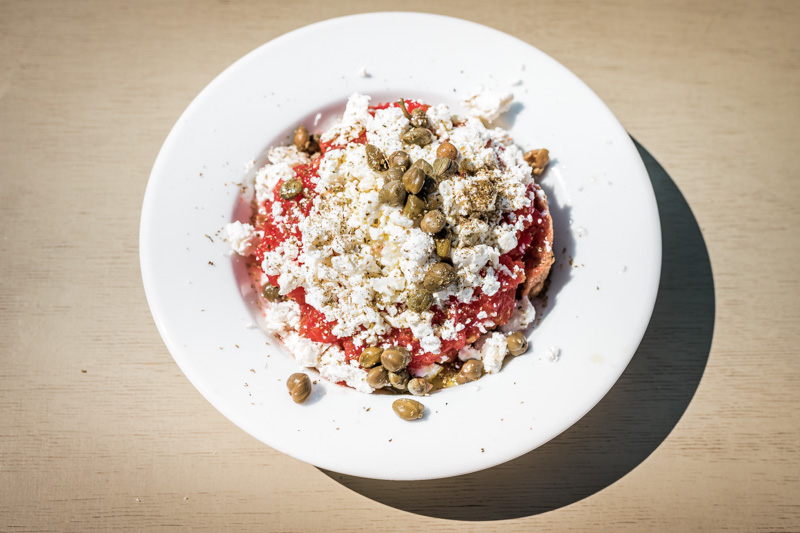
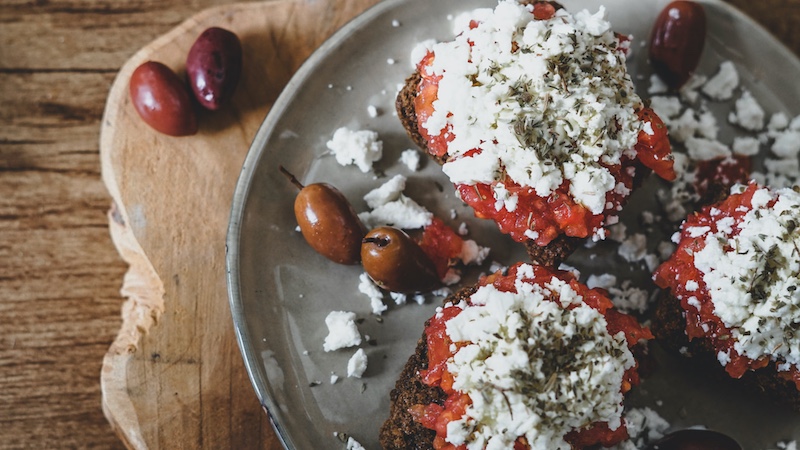
Dakos, ντάκος ((V) without Feta)
Cretan paximadi (sourdough rusks) with feta, tomatoes, and herbs. Often enhanced with capers. A very tasty and filling snack.
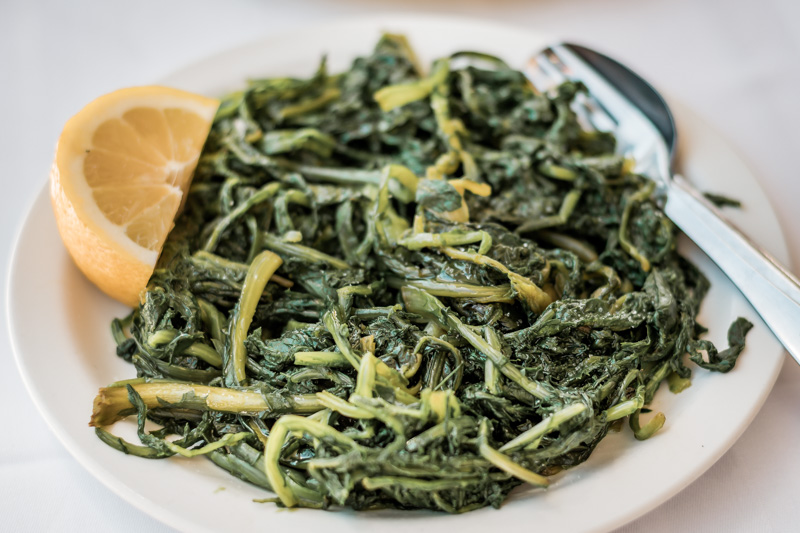
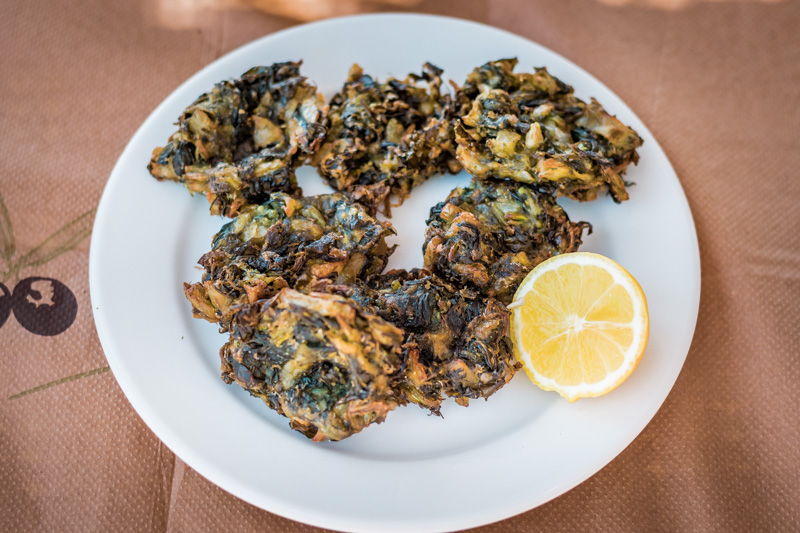
Wild greens – Chorta, χόρτα (V)
Appetizer made from wild greens, such as dandelion or sorrel (spring or fall). For us, a Greek superfood!
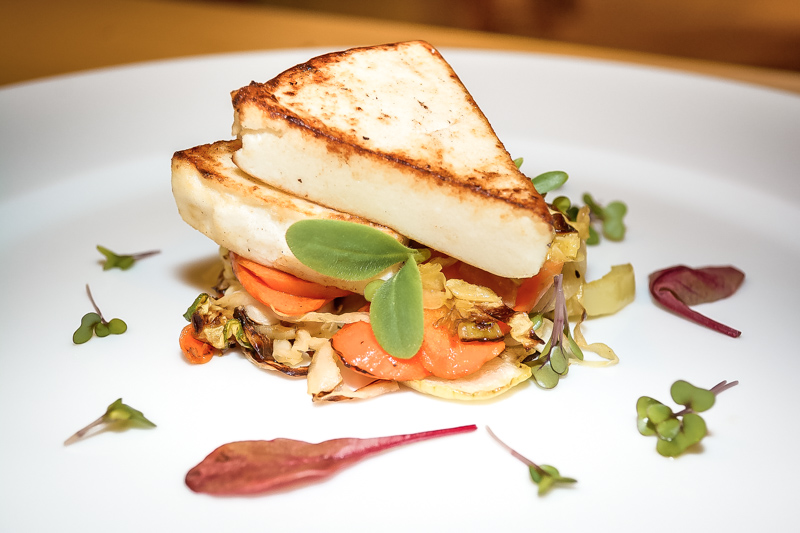
Saganaki, σαγανάκι
Fried or deep-fried sheep’s milk cheese or Kefalotyri (hard cheese), sometimes breaded with sesame seeds.
Gigantes (sto forno), γίγαντες στο φούρνο (V)
Giant beans in tomato sauce. Especially delicious when baked in the oven (forno) with wild herbs.
Okra pods – Bamies Laderes/ Bámia, Μπάμιες λαδερές/ Μπάμια (V)
Okra pods cooked in tomato sauce, also known as vegetable mallow.
Green beans – Fasolakia, Φασολάκια (V)
Braised beans with tomatoes and potatoes or simply beans marinated in oil.
Wild mushrooms – Manitária, Μανιτάρια (V)
Delicious sautéed mushrooms, usually oyster mushrooms.
Zucchini flowers – Louloudia/ Anthous gemista, Λουλούδια/ Ανθους γεμιστά
Zucchini flowers are stuffed with feta or rice, marinated in egg, and pan-fried.
Oven-baked eggplant – Melitzanes Imam, Μελιτζάνες ιμάμ (V)
Eggplant braised in the oven with tomatoes, onions, and plenty of garlic, sometimes topped with cheese or feta.
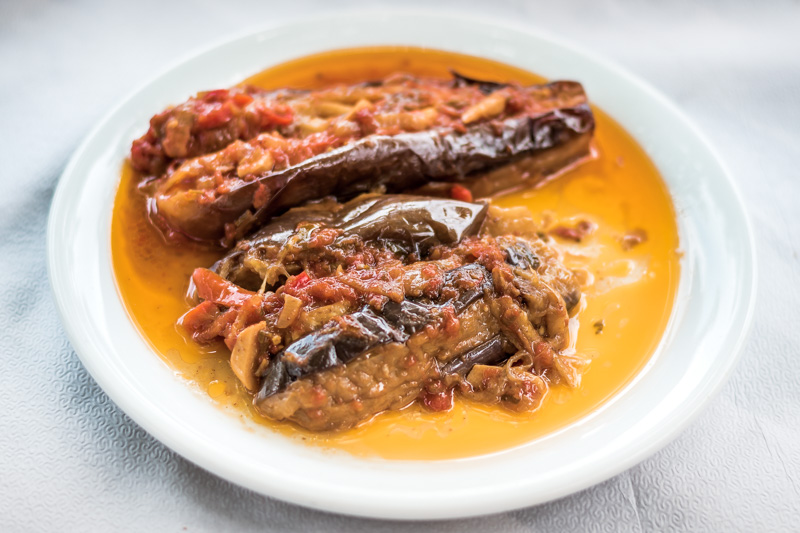
Vegetable Skillet – Briám, Μπριάμ (V)
Vegetable ratatouille made with zucchini, eggplant, potatoes, and tomatoes.
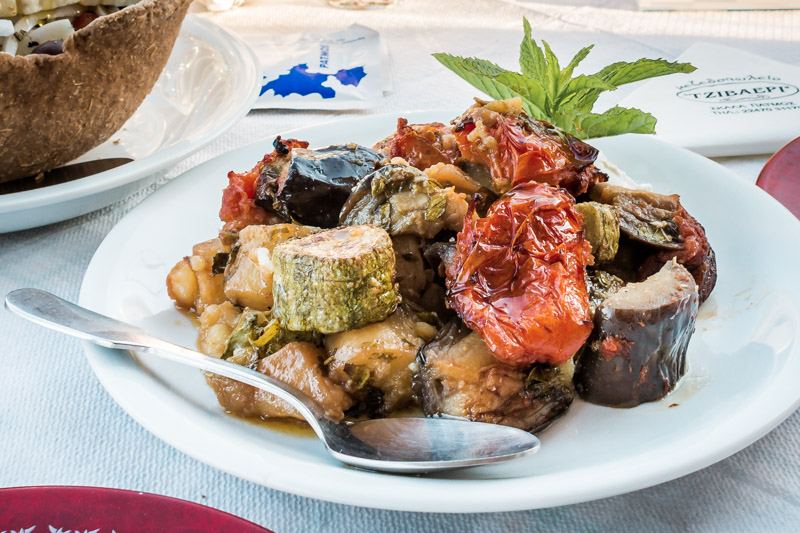
Stuffed Eggplant – Melitzanes papoutsakia, Μελιτζάνες παπουτσάκια
Large eggplant stuffed with tomatoes and feta, sometimes also with ground meat.

Gemista, γεμιστά (V)
Stuffed vegetables, optionally with ground meat, rice, or feta. Bell peppers or tomatoes are usually used. Often prepared vegan with just rice and vegetables.
Chickpea balls – Revithokeftedes, Ρεβυθοκεφτεδες
Patties or balls made from chickpea flour, a kind of “Greek falafel.” Egg is usually used as a binding agent.
Tomato patties – Tomatokeftedes, Ντοματοκεφτέδες
Patties or balls made from tomatoes, usually with egg as a binding agent.
Zucchini patties – Kolokithokeftedes, κολοκυθοκεφτέδες
Patties or balls made from zucchini, usually with egg as a binding agent.
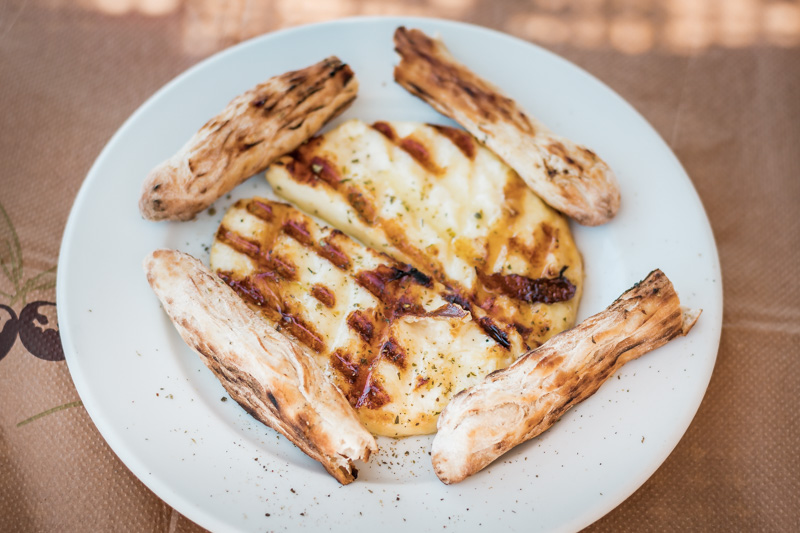
Local cheese, χωριάτικο τυρί
The municipality’s typical Greek sheep’s or goat’s cheese. Unprocessed or grilled. Especially delicious on Chios, Lesvos, and Limnos!
Spinach pita – Spanakopita, σπανακóπιτα
Phyllo pastries filled with spinach and feta.
Cheese pita – Tiropita, Tυρóπιτα
Phyllo pastries filled with cheese or feta.
Tiropitakia and Spanakopitakia, τυρόπιτακια/ σπανακοπιτακια
Basically the same as the two dishes above, but in the form of small pockets. Very tasty!
Greek Side Dishes to Accompany the Main Course
A small selection of side dishes is traditionally ordered with Greek meze. Fried vegetable or potato slices or rice are usually served with the main course. Kritharaki pasta is the classic among Greek side dishes.
Melitzanes tiganites, Μελιτζάνες τηγανητές
((V)
if breaded without egg)
Fried eggplant is very popular as a side dish. Sometimes breaded with eggs and flour.
Kolokithakia tiganita, Κολοκυθάκια τηγανητά
((V)
if breaded without egg)
Fried zucchini slices are also a popular dish. Served with or without a breading made from eggs and flour.
Pita bread – Πίτα ψωμί (V)
Small yeast-leavened bread that can be eaten with any meal.

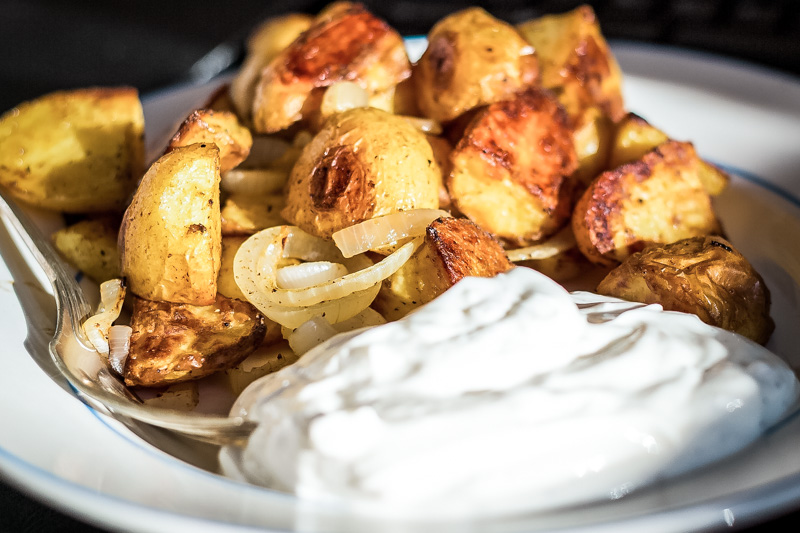
Baked potatoes – Patates ston fourno, Πατάτες στον φούρνο (V)
Potatoes baked in the oven, usually seasoned with rosemary.
Kritharaki, Κριθαρακι (V)
Durum wheat semolina pasta that looks like rice. Often served as a side dish with chicken.
Tomato rice or Djuvec rice – Ntomatorizo, ντοματόρυζο (V)
A traditional side dish throughout the Balkan Peninsula.

Popular meat dishes in Greece
While very little meat was eaten in the past—for example, at Easter or during church festivals—Greeks consume significantly more today. The over 40 million tourists per year also contribute to the rising meat consumption in Greece.
Incidentally, today’s gyros (gíros: Greek for “spinning top”) is not a dish of Greek origin. It was only after 1922 that the meat dish found its way to Greece via refugees from Asia Minor. The horizontal rotisserie of that time had long been known in the Arab world under various names.
In the late 1960s, the Greek vertical rotisserie, as we know it today, became established, primarily through Greek migrant workers in the U.S. and Germany. The take-out version, “Pita Gyros,” is now considered a popular fast food in Greece.

Nevertheless, many traditional meat dishes have survived over the centuries. Smaller taverns in non-touristy regions often still use meat from their own farms, raised in conditions that are largely species-appropriate. It goes without saying that the food here tastes great!
Bifteki, Μπιφτέκι
Classic ground beef or mixed ground meat patty, often called a burger.

Souvlaki, σουβλάκι
Classic pork skewer, sometimes also made with lamb or chicken.
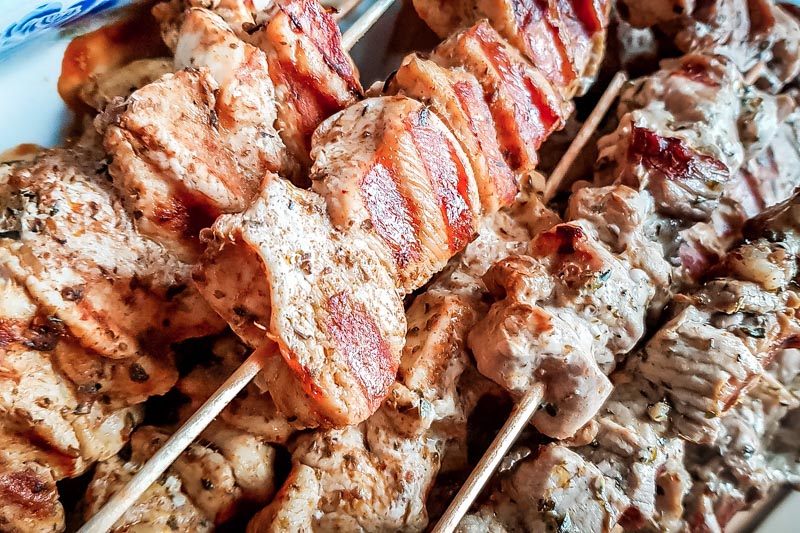
Chicken – Kotopoulo, Κοτόπουλο
Chicken, available as a souvlaki skewer or as a fillet.
Pastitsio, παστίτσιο
Greek pasta and cheese casserole with ground meat. One of our favorite Greek dishes!
Moussaka, μουσακάς
An eggplant and potato casserole prepared with ground beef or mixed ground meat.
Spicy country sausage – Loukanika, Λουκάνικα
Spicy, pan-fried country-style pork or beef sausage.
Meatballs – Keftedakia or Keftedes, Κεφτεδάκια/ Κεφτέδες
Meatballs or meat patties, usually made from mixed ground meat. Often served as an appetizer.
Soutzoukakia, σουτζουκάκια
Ground meat sausages in tomato sauce.
Lamb – Arni (sto fourno), Αρνί στο φούρνο
Lamb braised in the oven, often served with beans.
Goat – Katsiki (sto fourno), Κατσικι στο φούρνο
Goat meat cooked in the oven. Combined with kritharaki pasta, it makes a delicious risotto.
Giouvetsi, Γιουβέτσι
Rice-like pasta baked with cheese and beef or chicken.
Giouvarlakia, Γιουβαρλάκια
Greek soup with beef meatballs.
Kleftiko, Κλέφτικο
Slow-cooked lamb or goat with oven-roasted vegetables.
Greek stuffed cabbage rolls – Lachanodolmades, Λαχανοντολμαδες
Cabbage leaves stuffed with rice and ground pork.
Liver – Sikoti, συκωτι
Grilled or pan-fried liver, usually veal.
Spetzofai, σπετζοφάι
Smoky sausages in a hearty paprika-tomato sauce.
Stew – Stifádo, στιφάδο
Beef goulash with oven-roasted vegetables.
💡 Good to know in Greece! In Greek taverns and restaurants, bread (Greek: psomi) is usually served with your meal and charged for without asking. If you don’t want it, you can let the friendly host know right at the start: “Ochi psomi parakalo” (No bread, please).

Fish dishes on the menu
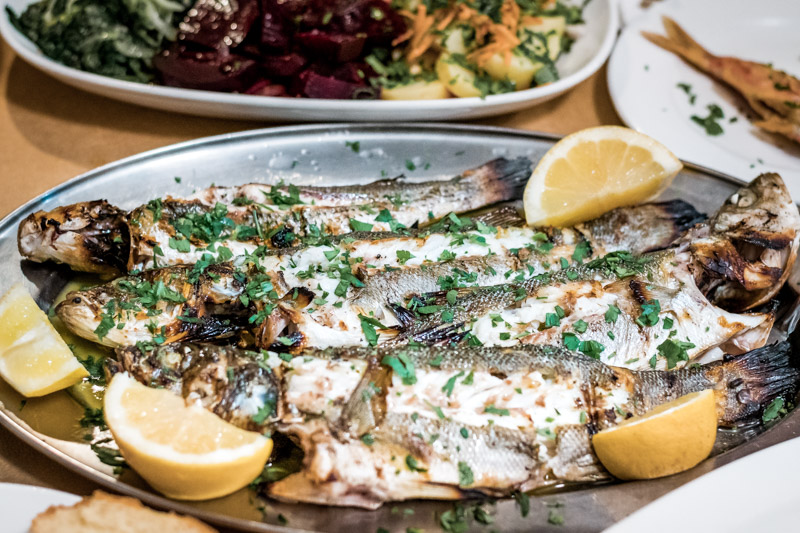
The Mediterranean is severely threatened by overfishing. These days, much of the fish advertised on menus is frozen and sourced from wholesalers. We therefore recommend eating only fresh-caught fish at seaside taverns. Ideally, the tavern owner or family owns their own fishing boat and practices sustainable fishing. The WWF’s guide reveals which fish you can eat in Greece without hesitation: WWF Fish Guide
Fish of the Day, Ψάρια της ημέρας
Freshly caught fish—ask the owner beforehand. Transparent taverns allow a view into the kitchen. It’s best to ask about the fisherman or have them show you the fishing boat!
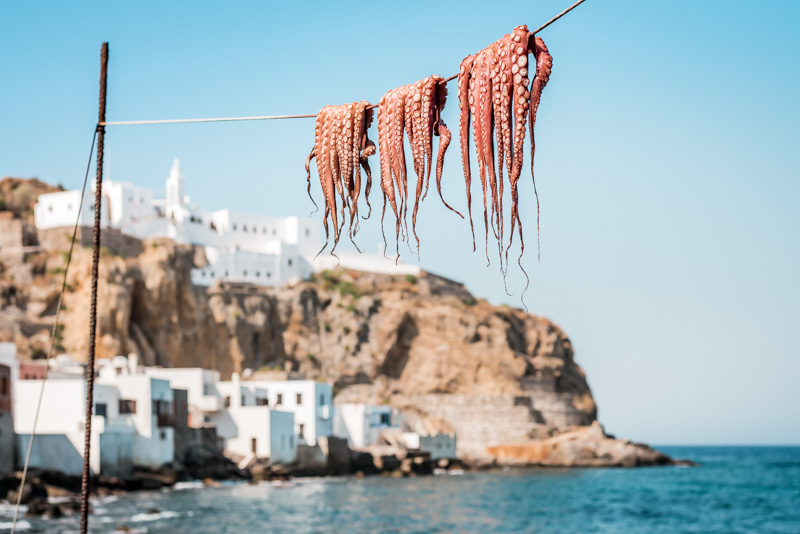
Octopus – Chtapodi, χταπόδι
Octopus in many variations, usually grilled with vinaigrette or braised in red wine.

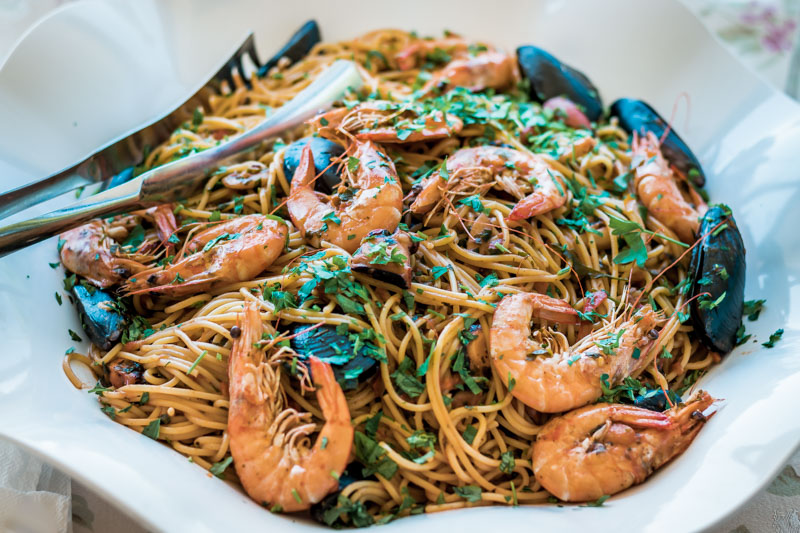
Shrimp with pasta – γαριδες με μακαρονια
Shrimp with spaghetti is very popular in Greece. The shrimp are usually frozen.
Shrimp Saganaki (Γαρίδες σαγανάκι)
Small shrimp cooked in a tomato sauce with plenty of vegetables and feta cheese.
Calamari (Καλαμαρί)
Fried squid rings with lemon juice.
Kakavia (Κακκαβιά)
Traditional fish soup, in which the fish is served on a separate plate.
Small Fish – Marida or Gavros, μαριδα/ γάβρος
Crispy fried anchovies with lemon juice; eaten whole.
Greek Desserts
First things first: Greek desserts are truly delicious, but also very sweet and rich. It’s best to ignore the countless calories in Greek desserts. 😉 In the past, it was customary everywhere to receive a free dessert after the main course. Today, this is mostly only the case in traditional taverns and in remote regions of Greece.
Yogurt with honey, γιαούρτι με μέλι
The simplest dessert of all, it always tastes good. In some places, it’s enhanced with nuts.
Loukoumades, λουκουμάδες
Heavenly yeast dough balls with honey and cinnamon, known worldwide as Greek donuts.

Rawani, ραβανι
Delicious, moist semolina cake with sugar syrup or honey.
Bougatsa, μπουγάτσα
Greek pastries made from phyllo dough, filled with different ingredients depending on the region (such as custard, semolina cream, or soft cheese) and optionally dusted with powdered sugar and cinnamon.
Baklava, Μπακλαβάς
A classic Middle Eastern pastry with nuts and almonds—perfect for those with a sweet tooth.
Spoon Sweets/Spoon Fruits – Glyko Koutaliou, Γλυκό Κουταλιού
Fruit (grapes, figs, and more) or vegetables (tomatoes) preserved in sugar syrup.
Fruit Salad – φρουτοσαλάτα (V)
Simple and healthy! Served with or without Greek yogurt and honey.
Greek Drinks: From Freddo to Ouzo
When you think of Greek drinks, the first thing that comes to mind is the Frappé. But appearances can be deceiving, because the iconic iced coffee is no longer the star of the menu. From Freddo to craft beer to Soumada, the world of Greek beverages has much more to offer than most vacationers realize.
Coffee Culture: More Than Just Frappé
Greeks love their coffee, and they take their time with it. At 35 degrees in the shade, one thing matters above all else: it has to be chilled. The Freddo has now dethroned the Frappé, and not just among the younger generation.
Freddo Espresso, φρέντο εσπρέσσο
Ice-cold espresso, frothed with ice cubes into a creamy crown. Today, it’s Greece’s most popular coffee drink and our favorite for hot days. You can get it glykos (sweet), metrios (medium-sweet), or sketos (no sugar).
Freddo Cappuccino, φρέντο καπουτσίνο
Like the Freddo Espresso, but with whipped, ice-cold milk foam. Creamy, full-bodied, and the perfect drink for a summer breakfast paired with a still-warm bougatsa.
Frappé, φραπέ
The classic made with instant Nescafé, ice-cold water, and ice cubes, vigorously shaken until frothy. Invented by accident in Thessaloniki in 1957, it’s somewhat out of fashion in some places today.


Greek coffee – Ellinikos Kafes, ελληνικός καφές
Strong, black, and prepared in a briki (copper pot). Served in tiny cups with coffee grounds at the bottom, accompanied by a glass of water. It’s best to leave the grounds at the bottom while drinking; do not stir.

Wine: From house wine to Assyrtiko
In every taverna, you can get a carafe of house wine with your meal upon request, often straight from the barrel. In addition, Greece boasts an impressive variety of several hundred indigenous grape varieties that are gaining increasing international attention.
Important white wine grape varieties
Assyrtiko, grown on Santorini, is Greece’s most famous white wine, mineral-driven and elegant. The aromatic Moschofilero and the rose-like Malagousia grow in the Peloponnese, while the noble Robola is found on Kefalonia. The traditional Retsina, with its unmistakable pine resin aroma, is made from the Attic Savatiano grape. Vidiano and Vilana dominate in Crete.
Important red wine grape varieties
In Nemea on the Peloponnese, the deep-colored Agiorgitiko is cultivated, Greece’s most widely planted red grape variety. Xinomavro, often compared to the Italian Barolo, originates from Naoussa in Macedonia. Mandilaria and Kotsifali grow on the South Aegean islands and Crete, and are frequently blended into distinctive island wines. The sweet Mavrodaphne comes from Patras and Kefalonia.
Spirits: Ouzo, Raki, and More
No mezedes evening is complete without a small carafe of high-proof spirits. Greek spirits are sipped in tiny sips and are meant for socializing, not for getting drunk.
Ouzo, ούζο
The quintessential anise liqueur, made from distilled grape pomace and anise seeds. When diluted with water, it turns milky white—the popular “ouzo effect.” Ouzo tastes especially good on Lesbos and Samos.

Tsipouro, τσίπουρο
A pomace brandy made from the leftovers of wine production, clear as water and quite potent at 40 to 45 percent alcohol by volume. On the mainland, especially in Thessaly and Epirus, tsipouro is as much a part of the mezedes tradition as bread is to a meal.
Raki/Tsikoudia, ρακή/τσικουδιά
The Cretan counterpart to Tsipouro, usually called Tsikoudia there. In Crete, at the end of almost every meal, you’ll be served a small bowl of Raki and some sweets for free. It would be rude to refuse.
Mastiha, μαστίχα
A liqueur made from the resin of the mastic tree, which grows exclusively on the island of Chios. It has a distinctive resinous-sweet flavor and is considered beneficial to health. Served ice-cold straight from the freezer, it’s a real treat.
Greek Beer: From Mythos to Nissos
For a long time, Greek beer was synonymous with a few major brands. In the meantime, the craft beer scene has come of age and, according to the Brewers’ Association, accounts for about six percent of the market, with its own microbreweries on many islands.
The Great Classics
Mythos is the best-selling Greek beer brand, a light lager with a subtle honey note. Alpha from the Athenian Brewery has a slightly maltier flavor and is considered a solid all-rounder. Fix Hellas is the oldest Greek brewery of all, founded in Athens in 1864. Vergina from Komotini in northern Greece is smooth and subtly hopped. Mamos from Patras is also very popular throughout Greece.

Craft beer from the islands
Our personal favorite is Nissos from the island of Tinos, which has been unfiltered, unpasteurized, and partially organic since 2012. It won the European Beer Star award shortly after its founding. Other recommended craft beers from Greece include Septem from Evia and Voreia from Serres, as well as Chios Beer from the island of Chios.

Non-alcoholic soft drinks
When the sun is beating down, nothing tastes as good as an ice-cold non-alcoholic drink. Fortunately, Greece has far more to offer than just cola and water.
Freshly squeezed orange juice, φρέσκος χυμός πορτοκάλι (V)
Found on practically every Greek menu, often squeezed right before your eyes from juicy fruits. Our daughter’s favorite—and honestly, ours too.
Homemade lemonade, σπιτική λεμονάδα (V)
Many family-run taverns make their own lemonade, usually from fresh lemons, sugar, and sometimes a bit of mint. On hot days, it’s arguably the best invention in human history. Ask for “spitiki lemonada” if it’s not on the menu.
Soumada, σουμάδα (V)
Our personal favorite drink, discovered on our beloved island of Nisyros. Soumada is a milky-white almond syrup made from bitter almonds, diluted with water and served ice-cold. It tastes wonderfully like marzipan and is considered the “drink of happiness” in Greece.
Kanelada, κανελάδα (V)
The cinnamon-flavored sister of soumada, also a specialty of Nisyros. The dark cinnamon syrup is diluted with water in a 1:4 ratio and served chilled. Surprisingly refreshing and a true rarity in the Dodecanese islands.
Unique Dishes by Region
At the beginning of this article, we mentioned that Greek cuisine is shaped by a wide variety of influences from other countries. In some places, this has led to the creation of entirely new Greek dishes that are typical of a specific region. Here is a small selection of special Greek dishes that you can usually only try locally.
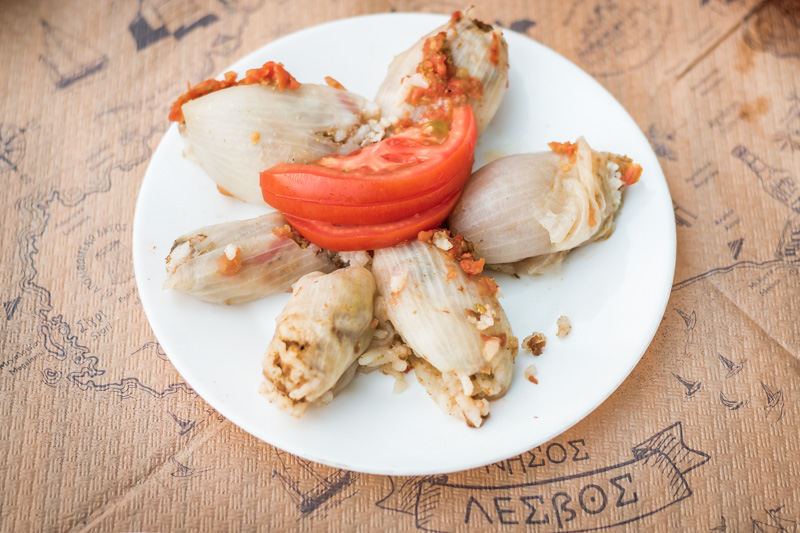
Stuffed onions – Sougania Mytilini, Σουγάνια Μυτιλήνης
On the island of Lesvos (Lesbos), you’ll find stuffed onions filled with rice or ground meat and cumin.
Makarounes, Μακαρούνες
These homemade mini noodles are seasoned with olive oil and caramelized onions. Grated goat cheese is sprinkled on top. A divine Greek dish that tastes best in the mountain village of Olymbos on the island of Karpathos.

Flomari noodles, Φλωμάρι λημνου
A pasta specialty from the island of Limnos. Flomari pasta is made from durum wheat, eggs, and sheep’s milk. It is often served as a side dish with meat dishes.

The Parea: How the Greeks Eat
For Greeks, a meal is not an end in itself. Rather, the Greek meze is an occasion for socializing and a delightful tradition. In Greek dining culture, known as Parea, families and friends often spend hours enjoying a hearty meal, engaging in cheerful conversation, and simply relaxing together.

Greeks usually don’t start dinner before 9 p.m. Sometimes they stay at the tavern until midnight. When dining with family and friends, everyone always orders together. They briefly discuss the menu to decide who wants what, and then place their orders. The diversity of Greek cuisine is highly valued here.
They keep ordering until the table is overflowing!
Greeks love having as many different dishes on the table as possible at once. So the dishes are usually all served at the same time. Everyone gets to try a little of everything and takes whatever they like. In addition to mostly vegetarian appetizers, meat and fish dishes are also ordered.
Various dips, such as the classic tzatziki, are also brought to the table. Of course, the obligatory Greek farmer’s salad is a must. Care is taken to ensure an ample supply of water, table wine, and the occasional sip of raki (grape marc schnapps) or ouzo (anise liqueur).
💡 Fancy some really good ouzo for home? Then check out the Kurambakos online shop. Here you’ll find hand-selected Greek spirits, fine wines, and top-quality olive oil. Learn more at: Kurambakos Shop*

By the way, clearing everything off the table is considered a shame, because that apparently means you didn’t order enough for the group. Mutual respect is a top priority for Greeks. Usually, one person or a family pays the tab for everyone. At the next meal, someone else will treat.
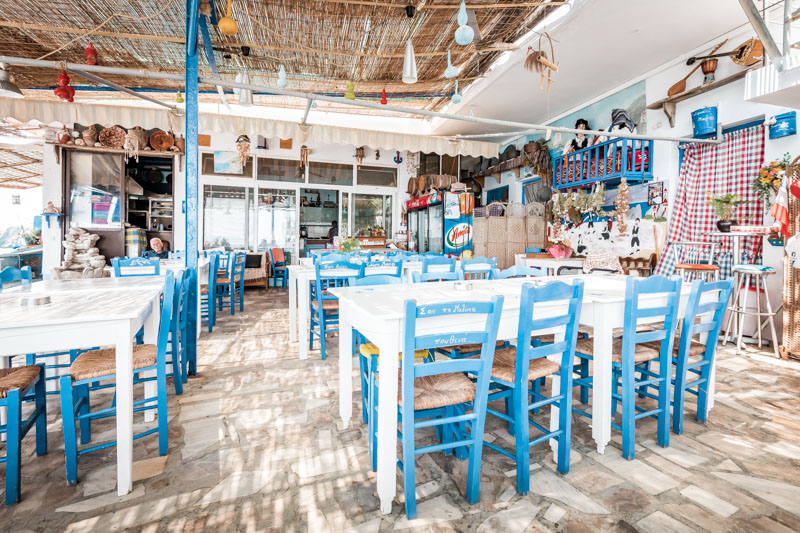
By the way, a good rule of thumb is: In taverns where Greeks eat, the food usually tastes good and you’ll be served homemade traditional dishes at fair prices. In some places, you can even go straight into the kitchen and choose your own dishes. This makes sense especially when it comes to fish.
Cooking Classes in Greece
Where better to get to know Greek cuisine than right on the spot in beautiful Hellas? In Athens and on numerous islands, so-called Greek cooking classes are now offered, where you can immerse yourself in Greek cuisine and get your hands dirty in the kitchen. Find more inspiration on GetYourGuide*:
➲ Greek cooking class in Athens*
➲ Greek cooking class in Crete*
➲ Greek cooking class in Naxos*
➲ Greek cooking class in Mykonos*

Greek Recipes: Vegan, Vegetarian & Meat
Did you fall in love with the diverse Greek cuisine during your vacation in Greece? Then you feel the same way we do! We also love recreating Greek dishes at home.
Our dear fellow bloggers at HEYCRETE aren’t just huge Greece fans—they’re also passionate about cooking and baking. On their Crete travel blog, they share valuable travel tips about Greece’s largest island as well as super delicious Greek recipes to try at home.
All the dishes are beautifully described and photographed to a very high standard, making your mouth water just by looking at them. In addition to many classics of Greek cuisine, you’ll also find numerous vegetarian and even vegan Greek recipes. Have fun cooking them!
→ Click here for the recipes: HEYCRETE Greek Recipes
Cook Greek like a celebrity chef
If you’re looking for more recipe ideas, we have another tip for you! Greek celebrity chef Akis Petretzikis learned to cook at a young age in his family’s tavern. He’s known throughout Greece thanks to many TV shows and knows how to impress with his sophisticated Greek recipes.
Akis has already written several cookbooks on Greek cuisine. The best part: he offers the right recipes for every taste and dietary preference! Whether you’re looking for vegetarian and vegan Greek dishes or classic Greek meat and fish dishes, there’s something for everyone here.
And what can we say—vegan carrot-soy moussaka or vegetarian chickpea soutzoukakia sound temptingly good, don’t they? Find more recipe ideas here: Akis Petretzikis
→ Want to learn even more about Greece? Click here for our most popular posts:
- Greek Islands Overview
- Island Hopping in Greece
- Which Greek island is right for me?
- Greece Regions and Destinations
FAQ: Greek Cuisine
What is typical Greek food?
Greek cuisine is much more than just gyros and souvlaki. Typical are the many small appetizers, called mezedes, which are served together: tzatziki, dakos, stuffed grape leaves, or grilled feta cheese. These are accompanied by plenty of fresh vegetables with olive oil, wild herbs, and garlic. Lamb, goat, and fresh fish round out the repertoire. In Greece, eating is just as much about enjoyment as it is about sharing.
What is the difference between gyros and souvlaki?
With gyros, seasoned meat is layered on a vertical rotating spit and sliced paper-thin. Souvlaki, on the other hand, are small meat skewers grilled directly over charcoal. Both are traditionally made with pork, though sometimes chicken or lamb is used as well. In Greece, you can get both varieties either on a plate with sides or as a convenient pita sandwich to go.
When do Greeks eat dinner?
Late! In Greece, dinner rarely starts before 9 p.m., and in the height of summer, often not until around 10 p.m. It’s simply too hot during the day, and the siesta between 2 and 5 p.m. is still a tradition. If you’re sitting in a taverna at 7 p.m., you’ll be alone with the other tourists at first. Our tip: Go with the flow—it’s part of the vacation vibe.
How much does a meal cost in a Greek tavern?
In a simple village tavern, you’ll get by just fine with about 15 to 25 euros per person for an appetizer, a main course, and a drink. In tourist hotspots like Mykonos or Santorini, on beach promenades, and in fancier restaurants, you’ll pay significantly more. Fresh fish is usually charged by the kilo; be sure to ask beforehand. Bread and a cover charge are often added to the bill at around one euro per person.
How much should you tip in Greece?
Tipping is now also appreciated in Greece. It’s customary to tip about 5 to 10 percent of the bill or at least one euro. The most polite way is to leave the tip in coins on the table or in the bill folder. For a friendly host with good service, feel free to tip a little more—especially in small family-run establishments, it makes a difference.
Why is Greek food often served lukewarm?
This is both a tradition and a matter of climate logic. Many Greek dishes are braised in the oven and then left to rest, allowing the flavors to fully develop. In the summer heat, lukewarm food is also much easier to digest than piping hot food. What may seem strange to us Central Europeans at first is actually quite sophisticated. Just give it a try—you’ll probably never want to eat moussaka piping hot again.
Is Greek cuisine healthy?
Very much so! The traditional Cretan diet is considered the mother of the Mediterranean diet and is classified by scientists worldwide as one of the healthiest diets. Plenty of fresh vegetables, high-quality olive oil, legumes, fish, wild herbs, and very little meat are the secret. Anyone in Greece who mainly chooses mezedes, salads, and fish instead of daily gyros with fries is practically automatically eating very healthily.
Which Greek dish do I absolutely have to try?
That’s a tough question, because so many things taste divine! But if we have to narrow it down: dakos in Crete, homemade pastitsio, zucchini fritters, fava as a dip with bread, vegetarians should try chorta, loukoumades for dessert, and bougatsa as a snack between meals. And don’t forget: a glass of raki or ouzo to toast with. The rest will fall into place as soon as you’re sitting in a small village tavern.
*Support our blog Greece-Moments
This post contains affiliate links marked with an asterisk (*). If you book or buy something through one of these links, we receive a small commission. The price remains the same for you. This helps us continue to provide high-quality content for free. Did you enjoy this post and want to say thank you? Then simply buy us the next Greek coffee ☕️ Go to the coffee fund
Save this post on Pinterest too!