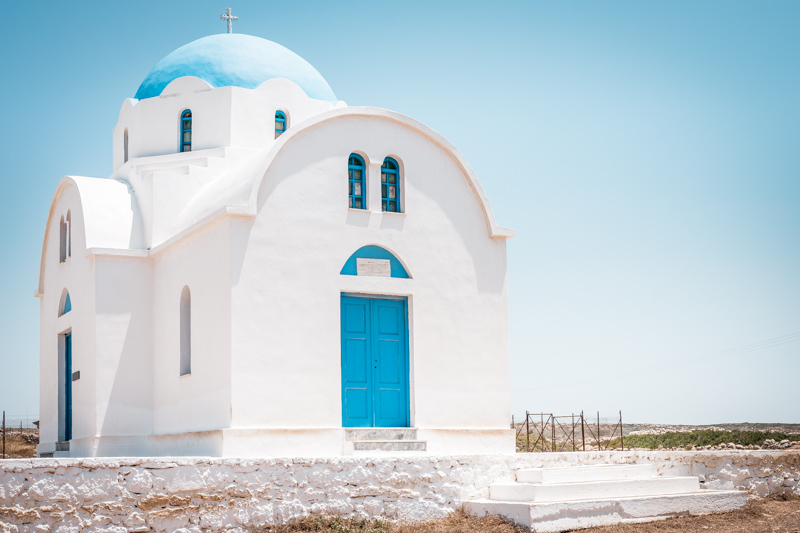

When people ask us when is the best time to experience Greece in the most intense and authentic way, our answer is almost always: not in July or August, when the islands are bursting at the seams, but in the spring, when the Greeks celebrate their most important festival of the year. Experience Easter in Greece!
Páscha, as Easter is called in Greek, is more than a religious festival; it is the emotional heart of Greek culture, a celebration of life, family, community, and faith that deeply moves every visitor, whether religious or not.
Tom & Ella
We’ve experienced Greek Easter four times now: in the mountains of Zagori, in Athens, and on the islands of Nisyros and Kimolos. Each time was different and always unforgettable. If you embrace the customs, the still-unpredictable April weather, and the laid-back Greek preseason, you’ll experience the Greek islands and mainland from a completely different perspective.
We’ll take you through Holy Week, from the quiet moments on Good Friday to the sizzling skewers on Sunday morning, and tell you where to best experience Easter in Greece:
#1 When is Easter in Greece in 2027?
Easter in Greece falls on 2 May 2027, five weeks after Western Easter Sunday on 28 March 2027. The reason for this lies in the calendar, as the Greek Orthodox Church calculates the date of Easter according to the older Julian calendar, which was introduced by Julius Caesar as early as 45 BC. Western churches, on the other hand, have been using the Gregorian calendar since 1582.


The difference between the two calendars is now 13 days, which is why the relevant spring full moon falls on a different date. Added to this is an old church rule that Orthodox Easter must always follow the Jewish Passover, which can further influence the discrepancy. It can also happen that both Easter celebrations coincide, as was most recently the case in 2025. Sometimes, however, Western and Orthodox Easter are several weeks apart.
The most important dates for Easter in Greece in 2027 at a glance:
- Good Friday (Megáli Paraskeví): 30 April 2027
- Holy Saturday (Megálo Sávvato): 1 May 2027
- Easter Sunday (Kyriakí tou Páscha): 2 May 2027
- Easter Monday (Deftéra tou Páscha): 3 May 2027
Orthodox Easter Dates for the Coming Years
In Greece, Easter usually marks the start of the new season on the tourist islands. In fact, local hotel chains on Rhodes, Crete, and other islands base their schedules on the country’s Easter celebrations, and airlines also begin bringing the first tourists to the islands and the mainland. To help you plan your next trip to Greece for Easter, we’ve listed the Orthodox Easter Sunday dates for the coming years and the difference from Western Easter Sunday. By the way, Orthodox Easter always falls between April 4 and May 8.
- 2026: Orthodox Easter on April 12, Western Easter on April 5 (1 week)
- 2027: Orthodox Easter on May 2, Western Easter on March 28 (5 weeks)
- 2028: Orthodox Easter on April 16, Western Easter also on April 16 (same)
- 2029: Orthodox Easter on April 8, Western Easter on April 1 (1 week)
- 2030: Orthodox Easter on April 28, Western Easter on April 21 (1 week)
💡 Orthodoxy for Beginners: The Greek Orthodox Church is one of the oldest denominations in the world. In 1054, the Orthodox and Roman Catholic Churches split during the Great Schism. Their 1,000 years of separate religious history have left their mark. There is no pope, no purgatory, and no organ in the church; instead, there is Byzantine chant, incense, and icons, which are not merely decorative but sacred. And there is one more distinctive feature: in Greece, name days hold greater significance than birthdays.
For Greeks, Pascha is the most important festival of the year, far more significant than Christmas. The name Pascha (Greek: Πάσχα, pronounced roughly “Pás-ha” with a soft, rolling H) is derived from the Hebrew “Pesach” and the Aramaic “pas’a” and originally refers to the Jewish Passover. In the Christian context, it stands for resurrection, new life, and salvation and is the central concept of Orthodox Easter, which celebrates Jesus’ transition from death to life.

#2 How Easter is Celebrated in Greece
Greek Easter is not just a single day or a long weekend when people have time off, but an entire week full of rituals stretching from Palm Sunday to Easter Monday. To truly understand the Orthodox Easter celebration, one must experience Holy Week, for Easter Sunday itself is merely the radiant culmination of a long, moving ritual. And even after Easter, there are further highlights, such as May 1st, which in many places takes on the character of a folk festival.
We can still vividly recall our first Easter in Greece. With very little prior knowledge, we were fascinated anew each day by the devotion with which the Greeks celebrate this holiday. In fact, there are many common customs in Greece at Easter, but surprisingly, there are still regional differences in how certain traditions are observed. Especially on the Greek islands, interesting local customs have developed over centuries of isolation.
Lent and Carnival in Greece
Before Pascha arrives, the Greeks prepare with a long period of fasting (Greek: Sarakosti) that is quite demanding. The Orthodox Lenten season lasts about seven weeks and begins on Clean Monday, known as Katharí Deftéra, right after Carnival. Those who fast strictly abstain from meat, dairy products, eggs, and even oil during this time, and many Greeks, especially the older generation, take this very seriously to this day. Among young Greeks, there is a lot of tolerance when it comes to fasting.
During Lent, taverns introduce special fasting menus, with seafood, legumes, and vegetable dishes taking center stage. Before the fast comes Carnival, known as Apokries, three exuberant weeks during which life is turned up to the max one last time before the quiet sets in. The country’s biggest Carnival celebration takes place in Patras, where for weeks on end parades, costumes, and music transform the city into a single frenzy, drawing hundreds of thousands of people from all over Greece.

This last day before Lent is Tsiknopempti, “Smoky Thursday,” and it ranks among the most bizarre experiences Greece had in store for us. Everyone, absolutely everyone, grills meat on this day—on balconies, in gardens, on sidewalks—because the next day marks the start of strict Orthodox Lent, during which meat, dairy products, and even oil are avoided. It’s a final collective feast, announced in advance.
Our first Tsiknopempti was on Syros, right in the middle of Ermoupoli, and at first we had no idea what was going on. Smoke billowed from every alley, and the whole town smelled of grilling. As we walked, the locals practically pressed souvlaki into our hands right there on the sidewalk. So spontaneous, so warm, and so unpretentiously Greek. Since then, Tsiknopempti has been a fixture on our calendar, and even when we’re in Germany, we think of Smoky Thursday. 🙂
Holy Week in Greece (Megali Evdomada)
After the weeks of Lent, Holy Week (Megali Evdomada) begins, marking the emotional climax of the entire Easter celebration. Here’s how it unfolds, explained simply for you:
Palm Sunday (Kyriakí ton Vaïon) is a quiet but beautiful start to Holy Week. The churches have already been elaborately decorated with palm branches and laurel in the preceding weeks, and children bring small, woven crosses home. In many families, preparations are now in full swing, as the first family members are arriving from the mainland or from overseas to their old homes on the islands. Here and there, you can still see one or another small church being whitewashed just before Easter.
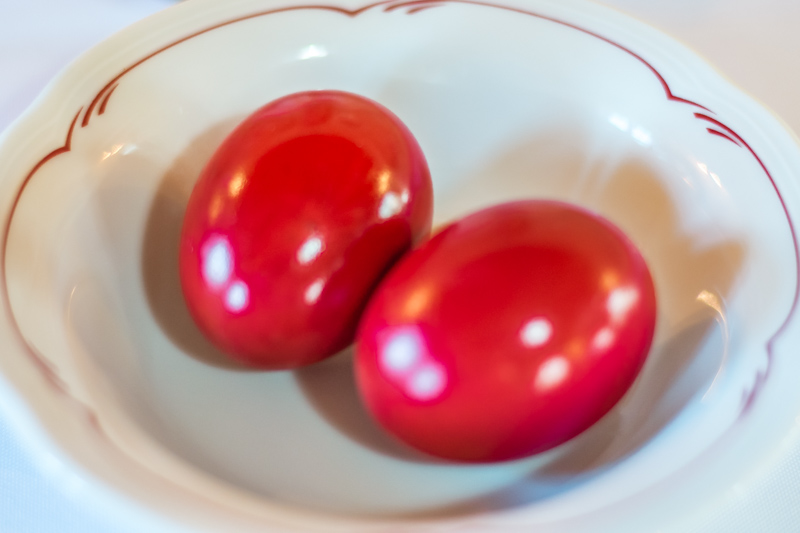
Holy Thursday (Megáli Pempti) is the day when women traditionally dye Easter eggs bright red using onion skins or, nowadays, typically with red Easter egg dye. The red color symbolizes the blood of Christ, while the egg represents the Resurrection. In many households, the sweet yeast bread Tsoureki is freshly baked on this day, and its sweet aroma seems to waft through the entire country. The Greeks now exchange the greetings “Kalo Pascha” (Happy Easter) or “Kali Anastasi” (Happy Resurrection) as good luck charms.
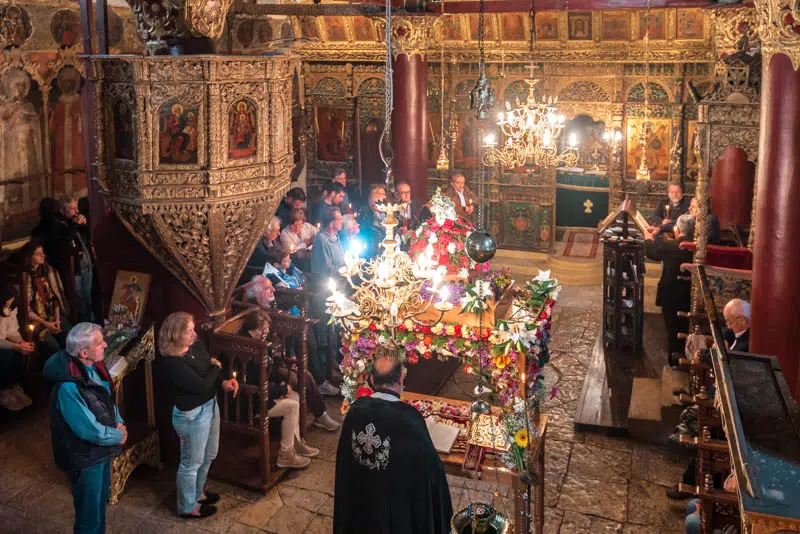
Good Friday (Megáli Paraskeví) is the most solemn day of the year for an Orthodox Greek. In the morning, the Epitafios, which symbolizes Christ’s tomb, is elaborately decorated with flowers. In the evening around 9 p.m., the Epitaphios procession takes place, marking the emotional climax of Holy Week. Depending on the region and local customs, the Epitaphios is carried slowly through the streets and circled around the church several times, accompanied by candles, incense, church hymns, and a silent crowd.
Holy Saturday (Megálo Sávvato) is a day of subdued anticipation, and a peculiar silence prevails, especially in traditional towns. The children are excited, while the older people are quiet and introspective. Everywhere, church bells ring all morning and throughout the day to commemorate Christ’s death, ringing slowly and mournfully; usually, the children of the congregation take turns ringing them. In the taverns, hardly any music is played on this day, and the menu is greatly reduced depending on the region.
On Holy Saturday, something happens in the background that we only truly understood the second time around. As early as the afternoon, the Holy Fire is flown from the Church of the Holy Sepulchre in Jerusalem to Athens, where it is delivered by a delegation and received with great ceremony. From there, the Holy Fire is first taken to the Church of Agioi Anargyroi in the Plaka district of the Old Town and from there distributed by plane or ferry to all parts of the country. Thus, at midnight, the same light burns everywhere.

In the evening, the churches gradually fill up until, at midnight, the lights are turned off and the priest lights the Easter candle: “Christós Anésti!” (“Christ is risen!”) and the candlelight spreads like a wave through the crowd. Thousands of flames light up, and sometimes the solemn procession is accompanied by fireworks and firecrackers. People embrace and kiss each other on the cheeks, calling out: “Alithós Anésti!” (“He is truly risen.”). Anyone who has experienced this moment once will never forget it.
Easter Sunday (Kyriakí tou Páscha) is all about the preciousness of life, family, and celebration. From early morning on, spits are turning all across the country: from Kastoria in the north to Crete in the south, the classic roast lamb and the traditional specialty kokoretsi sizzle over the embers. People also play tsougrisma, in which young and old tap red eggs against each other to determine their luck for the year.

The atmosphere on Easter Sunday in Greece is exuberant and warm; the tables are full, and conversations continue well into the afternoon. Even if you don’t speak Greek, you’ll still be immediately included in the gathering, because Easter in Greece isn’t a family celebration behind closed doors, but one shared by the whole neighborhood, the whole village, the whole island. No matter where you are in Greece on Easter Sunday, it will be unforgettable.
Easter Monday (Deftéra tou Páscha) marks the end of the Easter holidays and is usually the quietest day of all. People get together with family for coffee and cake or simply do nothing—which, after several weeks of church services and traditions, is a welcome respite even for an Orthodox Greek. On the islands, there’s usually a sense of renewal in the air, as many mainland Greeks who have visited their families head back to Athens, Thessaloniki, and other cities.

#3 Beautiful Places for Easter in Greece
In fact, you can experience Easter anywhere in Greece, sometimes a bit more quietly, sometimes a bit more intensely. If you want to experience the Greek Easter celebration in a particularly authentic way, we recommend visiting a small island or a region away from the tourist crowds. Many places in the country have their own distinctive customs that make a visit at this time of year truly special.
In addition to the places where we’ve experienced the Greek Easter celebration ourselves (see point #7), there are several others known for their special customs. The most famous is probably Easter on Corfu. Everyone has likely seen the images of giant clay pots flying out of windows. Here are a few examples of where you can celebrate Easter in Greece:
Easter on Santorini: Sea of Candles in Pyrgos
Our personal insider tip for Easter in Greece is the medieval village of Pyrgos on Santorini. On Good Friday evening, local associations distribute over 20,000 candles as well as small tin cans filled with sawdust and paraffin across the walls and roofs of the old fortress. At dusk, they are all lit simultaneously. Pyrgos then glows in a surreal sea of flames, and three giant crosses shine all the way down to the coast. This spectacle is hard to believe until you see it with your own eyes.
→ Find out everything you need to know for a trip to Santorini in this article: Santorini Holiday

Easter on Chios: The Rocket War of Vrontados
If you want to experience something crazy at Easter, head to the village of Vrontados on the island of Chios. On Easter Eve, two rival church communities fire tens of thousands of homemade rockets at each other, each targeting the bell tower of the other church. The event is known worldwide as “Rocket Wars” (Greek: Rouketopolemos). Even though it’s loud and a bit crazy, the locals swear by it. The next day, both sides count their hits and claim victory. Easter on Chios is not something you’ll forget anytime soon.
Easter on Corfu: Botides Throwing in the Capital
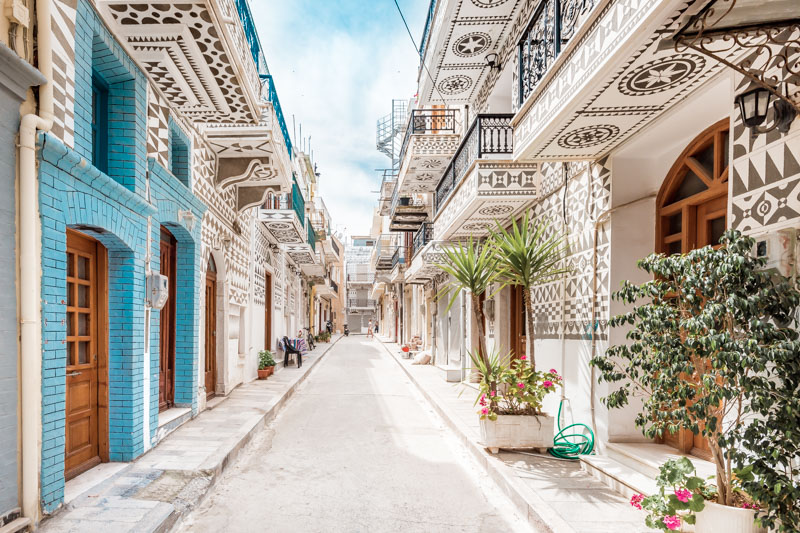
Easter on Corfu is something truly special! Corfu Town celebrates Easter with a blend of Orthodox devotion and Venetian festive culture found nowhere else in Greece. Throughout Holy Week, philharmonic orchestras accompany the processions through the city. On Holy Saturday, residents throw huge clay jugs filled with water from their balconies—the so-called botides. The deafening crash on the cobblestones of the old town symbolizes the victory of life over death and dates back to a Venetian tradition.
→ Find out everything you need to know for a trip to Corfu in this article: Corfu Holiday

Easter in the Peloponnese: Lanterns of Leonidio
In the small town of Leonidio on the Peloponnese Peninsula, after midnight mass, hundreds of handmade hot-air balloons made of tissue paper—some up to two meters tall—rise into the night sky, reaching heights of over 1,000 meters. This custom has existed since around 1910, and you won’t find it anywhere else in Greece. The sight of these glowing balloons against the dark mountains is breathtakingly beautiful and makes Leonidio something truly special at Easter.

Easter on Patmos: The Holy Island
Patmos, the Holy Island where John wrote the Apocalypse, is one of the most significant Orthodox pilgrimage destinations in Greece—if not the world—during Easter. The Monastery of St. John, high above Chora, has maintained the same rituals for centuries; the Good Friday procession through the narrow streets of Chora has a medieval solemnity that leaves a deep impression. Patmos at Easter is not a vacation in the usual sense, but a spiritual experience, even for non-religious visitors.

Easter on Paros: The Burning Judas Boat
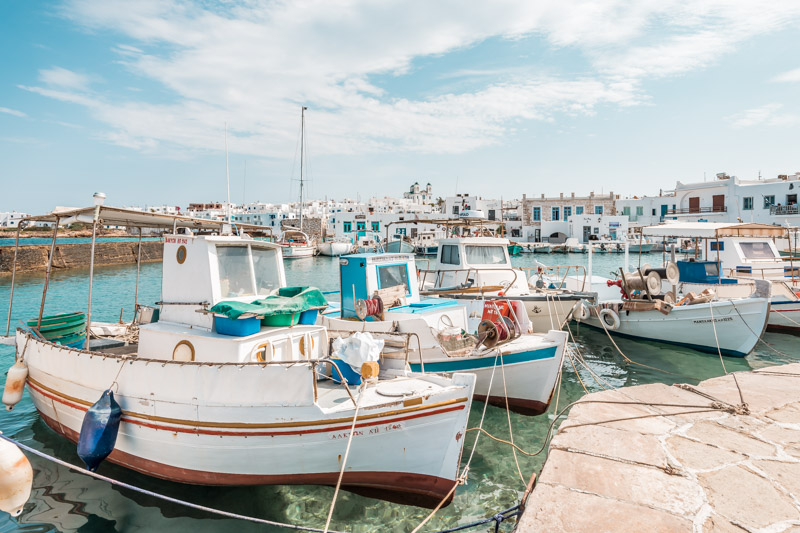
In addition to the traditional Easter ceremonies, Paros is also known for a tradition all its own: Judas dolls are carried through the streets and then set ablaze. In the harbor, a large Judas boat is even launched, which then sails across the sea while burning. This symbolizes the punishment of Judas and the victory of good over evil. To be honest, the whole thing seems a bit strange. In a historical context, this tradition is controversial, but for the locals, it has a purely religious character and is firmly rooted in Orthodox customs.
#4 Greek Easter Customs
Greek Easter is a festival full of rituals, some of which are ancient and others so vibrant that they are constantly evolving. Here is an overview of the most important traditions of the Orthodox Easter celebration in Greece:
Red Eggs (Kokkina Avga): Dyeing eggs on Maundy Thursday is an integral part of Páscha. The red color symbolizes the blood of Christ, while the egg represents the resurrection and new life. Traditionally, the eggs are naturally dyed with onion skins, though today brightly colored dyes from the supermarket are just as common.
Tsougrisma: Tapping red eggs against one another is the playful centerpiece of Easter Sunday. Whose egg remains intact will have good luck in the coming year. Ella still holds the record in our family.
Icon Procession: In many Greek villages and on small islands, the most important icon from the main church is carried from house to house and from community to community at Easter. It is either carried on foot or accompanied by the entire village community in a car. This deeply local ritual leaves strangers in awe and makes the locals beam with joy.

Candlelight at Midnight: On Resurrection Night, the Holy Light—which is flown from Jerusalem to Athens every year—is passed from candle to candle. The faithful try to carry the burning candle home and use the soot to draw a cross above the front door, which is said to bring protection in the coming year.
Lambádes: The festive Easter candles, usually white and decorated with ribbons or flowers, are lit on Resurrection Night. For children, there are elaborately decorated candles with small figures or toys—a true ritual for the little ones.
Vaïa (palm branches): On Palm Sunday, palm branches are woven into small crosses and blessed; they then hang in many Greek homes throughout the year.


#5 Traditional Greek Easter Dishes
Greek Easter is also a culinary event and offers some of the most interesting meals of the year. During Lent, vegetarians get their money’s worth, as many taverns serve traditional Greek dishes without meat, such as chorta (wild greens), beet salad, or beans of all kinds. In some places, meat is even frowned upon during this time. On Easter Sunday, however, everything revolves around lamb.
Magiritsa is the soup eaten after the midnight service to break the long fast. It is made with lamb offal, spring onions, dill, and avgolemono, the traditional Greek egg-and-lemon sauce. Its aroma is unmistakable, and the first spoonful after the long Holy Week tastes like salvation.

Tsoureki is the sweet, light yeast bread that is baked and given as gifts all over Greece at Easter. What makes Greek Tsoureki special is the spice Mahlab (also Mahlep), an extract from cherry pits that gives it its distinctive, slightly bitter aroma. Tsoureki is available year-round, but at Easter, a red egg is often baked into it. Anyone who has ever tasted real Tsoureki from a Greek bakery can hardly take German yeast braids seriously anymore.

Lichnarakia, meaning “little oil lamps,” are sweet cheese tarts that are a must-have in every bakery at Easter. They consist of shortcrust pastry with a creamy mizithra cheese filling, are seasoned with cinnamon, and have characteristic indented edges. These little treats are simply delicious and irresistible.
Koulourakia are traditional butter cookies that are a must-have in Greece at Easter. They have a taste of orange and vanilla, are baked in a braided shape, and are usually served with coffee or given as a gift to guests.
Easter lamb (Arnì) is the culinary centerpiece of Easter Sunday. From early morning, the skewers turn over charcoal, the aroma wafts through the entire villages, and the hours of slow cooking make the meat tender and flavorful. In parts of northern Greece, kid is preferred over lamb.
Kokoretsi is not for the faint of heart, but an absolute must for true meat lovers: lamb offal, especially liver, lung, and heart, is wrapped around a skewer, encased in intestine, and slowly cooked over an open flame. The result is crispy, spicy, and unique. We tried it for the first time during our first Easter in Zagori and found it delicious.
In addition to these classics, it’s worth making a point of trying the meatless dishes in the taverns during Lent. On the islands, you can get freshly caught grilled octopus, creamy fava made from yellow broad beans, and dolmadakia—vine leaves stuffed with rice and fresh herbs instead of ground meat.

Add to that gigantes, the famous giant baked beans, and a vegan version of spanakopita without feta. Anyone who thinks that Greek Lenten fare means you have to give up everything is mistaken. It’s more of a culinary journey of discovery through the plant-based side of Greek cuisine.
#6 Practical Tips for Easter in Greece
If you want to experience Easter in Greece, there are a few things you should know in advance to get the most out of your trip. In fact, Easter is one of the main travel seasons for Greeks, alongside school vacations. So it’s no surprise that in many taverns, you’ll hear more Greek than other languages. Except for the tourist islands like Rhodes, Crete, and Santorini, however, many small islands are still in hibernation: beach bars haven’t opened yet, and most restaurants don’t open until Easter Sunday.
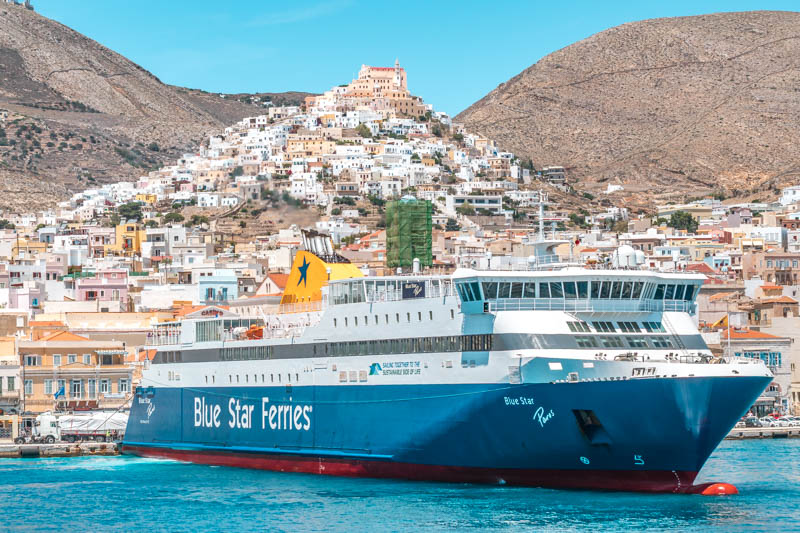
Book your Easter vacation in Greece early: For Greek travelers themselves, Easter is peak season. Ferries, accommodations, and rental cars on the islands are often fully booked weeks in advance. In particular, ferries operated by Blue Star and Hellenic Seaways, which serve the smaller islands, are overcrowded. If you want to travel in April, you should therefore book by January at the latest. Surprisingly, accommodation prices during Easter in Greece are relatively low; they don’t start to rise until mid-May.
→ In this article, you’ll learn what to keep in mind when it comes to Greek ferries: Ferries in Greece
Celebrate Easter twice in Greece: In 2027, Western Easter falls on 28 March, while Orthodox Easter follows much later on 2 May. If you celebrate at home at the end of March and then travel to Greece afterwards, you can actually experience two Easter celebrations in one year. It gets even more exciting when both Easter dates fall at the same time—the next time will be in 2028.
Respect in Greece’s churches: During Holy Week, churches across the country are open almost everywhere, but the usual dress codes apply: shoulders must be covered, shorts are frowned upon, and it’s important to be quiet and respectful. Greeks are warm and open, but Easter is sacred to them. Often, people are still busily decorating and preparing right up until the last minute.
Villages over cities for Easter: Easter in a small village or on a small island is much more authentic and moving than in a tourist hub. Zagori, Nisyros, and Kimolos are the places where we truly experienced the spirit of Easter. Athens was beautiful, but not traditional in the true sense. That doesn’t mean, however, that you can’t experience an authentic celebration on Kos, Rhodes, or Crete. It’s best to head into the countryside.

Weather in Greece at Easter: Even in April, the Greek weather still does as it pleases. While it’s noticeably more stable and five to seven degrees warmer than in Northern Europe, showers are certainly possible. Sometimes a warm southerly wind brings Saharan dust, which clouds the sky. After one or two days, a fresh northerly wind brings cooler temperatures and clear skies. The best thing about Easter in Greece, however, is that even the barrenest islands and regions are in full bloom.
→ In this post, you’ll learn more about the weather in Greece: Weather in Greece
If you greet the locals with the right words, doors will open for you immediately. You should definitely have these phrases ready during Easter in Greece:
- Kaló Páscha! – Happy Easter! (before the holiday)
- Kalí Anástasi! – Happy Resurrection! (before midnight on Saturday)
- Christós Anésti! – Christ is risen! (from midnight and the days following)
- Alithós Anésti! – He is truly risen! (the response)
- Chrónia pollá! – Many happy returns/All the best (standard greeting after Easter, for birthdays, etc.)
#7 Our experiences with Greek Easter
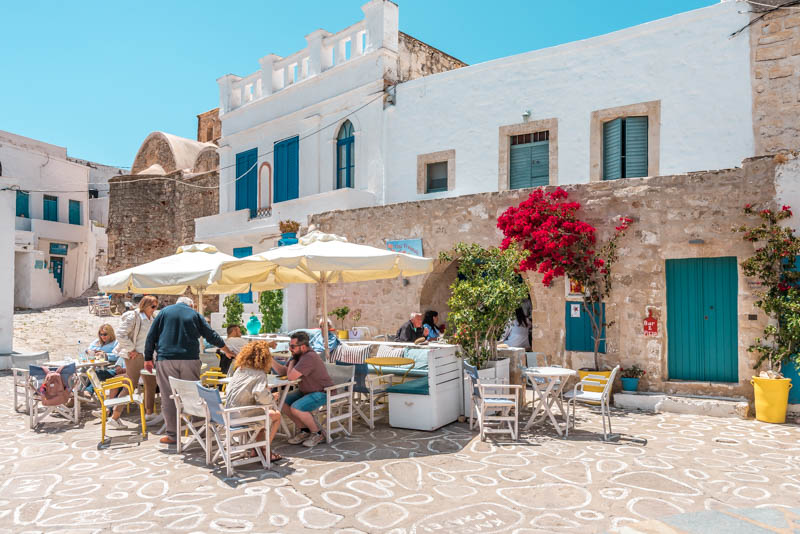
We’ve spent Easter in Greece four times and had completely different experiences each time: once as a couple and three times as a family with our daughter. And every time, the holiday touched us in a way we hadn’t expected, no matter how much we’d read about it beforehand. Below, we describe our experiences; perhaps they’ll inspire you to plan a future trip to Greece during Easter.
Easter in Zagori
We spent our first Orthodox Easter in Epirus, more specifically in Ano Pedina, one of the small stone villages in the Zagori region. From the very first minute, it felt like stepping into another world. We took part in the full program from Holy Thursday through Easter Monday—it doesn’t get much more authentic than that. Our hosts at the time, Kostas and Margarita from the Gioraldi Art Hotel (view on Booking.com*), treated us like family from the very beginning.
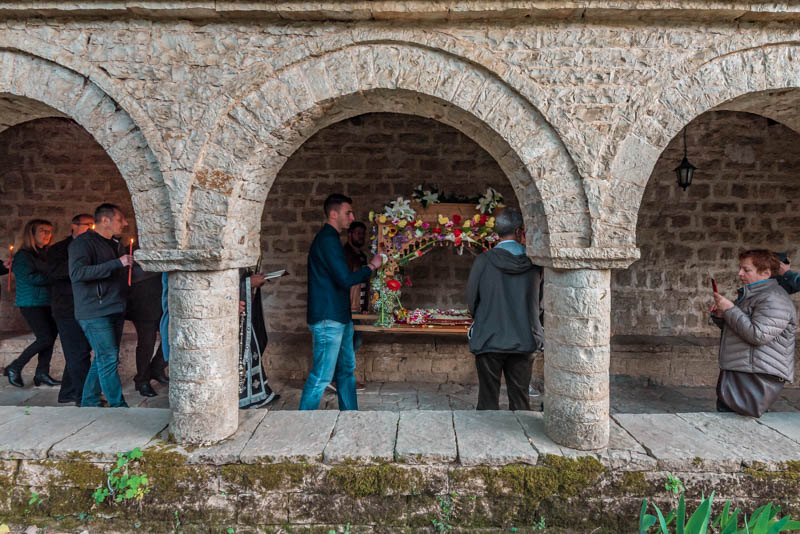
On Good Friday evening, the procession with the richly decorated Epitafios, the symbolic shroud of Christ, made its way through the village and circled the church several times. It was accompanied by a surprisingly large crowd and Byzantine church chanting, which created a very moving atmosphere. On Holy Saturday, there was no music in the taverns; only the monotonous tolling of the death bells could be heard. The menus were limited, meat was not served, and conversations were quiet. One could sense that this festival truly touched the Greeks deeply.

And then, at twelve o’clock sharp, the moment arrived in the large village church. It was pitch black, then suddenly a flame lit up all the other candles, the priest cried out “Christós Anésti,” and the whole village breathed a collective sigh of relief. It was like a miracle that cannot be described. On Easter Sunday, barbecues were held in every one of the small Zagorochoria villages—naturally, kokoretsi for true meat lovers, which is quite delicious. A visit to Zagori at Easter is highly recommended for anyone who wants to experience Greece in a truly authentic way.
→ Find out everything there is to discover in the Zagori region in this post: Zagori
Easter in Athens
A few years later, we spent our first Easter together as a family in Athens, when our daughter was a year and a half old. Experiencing Easter in Athens is definitely different from doing so in a small mountain village, but both have their charm. The city is well-organized; every neighborhood has its own parish and its own small procession on Good Friday evening. Here and there, candles glow through the narrow alleys, and towering above it all is the Acropolis, illuminated by spotlights, while fireworks light up the sky in the background.

At midnight, Tom set off alone for the nearby church in the Thiseo district. Surrounded by locals, candle in hand, he was joyfully greeted with “Christos Anesti” even though no one knew him. On Easter Sunday, nearly all the churches in Athens were open; grills were set up in the alleys of Plaka, tables lined the streets, and people from all over the world sat together at one table. As a tourist in Athens, you get a wonderful glimpse into the country’s Easter traditions.
→ Find out everything there is to discover in Athens in this post: Athens Sights
Easter on Nisyros
We spent three weeks around Easter on our favorite island, Nisyros. The volcanic island, with a population of just under 1,000, immediately captivated us, and the locals included us in many customs and Easter rituals. At Easter, everyone comes together, and relatives from Athens visit their old home for a few days. Even the diaspora from New York makes the trip, and the taverns fill up, while the churches are as packed at Easter as on no other day of the year.

Outside the high season, the villages live in a different way; people come together and aren’t solely focused on profit. So people who are competitors in August suddenly work hand in hand to make the festival of all festivals in their little town something special. For the midnight meal, we sat with our friends Nektaria and Efthimios, ate a wonderful magiritsa, and enjoyed the peaceful atmosphere. After Easter Monday, something began that might seem a bit foreign to us as Northern Europeans.

The island’s most important icon was paraded through all the villages on the island in a bus amid great fanfare. It was accompanied by a convoy of honking cars and mopeds. There were also endless firecrackers and fireworks. This might seem a bit strange at Easter, but that’s the tradition, and once you understand what’s behind it, it’s simply beautiful. In the evening, there was a big fireworks display in Mandraki, just like we’re used to on New Year’s Eve, except this time it took place at Easter.
→ Find out everything there is to discover on Nisyros in this post: Nisyros Island
Easter on Kimolos
After a stay on Milos in April 2024, we moved to the small neighboring island of Kimolos for Easter. In early April, there were hardly any tourists, but the locals were very warm and welcoming. We watched the fireworks and firecrackers on Easter night from our terrace, from a safe distance. The Greeks really go all out with firecrackers, but our daughter was asleep and we were amazed.

What moved us most was the children’s service on Sunday morning: the locals welcomed us as if we were old friends. Our daughter received a candle and a tsoureki from the priest himself, just as a natural gesture of community. Afterward, we sat in the small cafés on the Platia; the sun was shining, the island was in a festive mood, and we felt like a part of it. That is exactly what makes Greece special to us and what turns Easter on a Greek island into an unforgettable experience.
→ Find out everything there is to discover on Kimolos in this post: Kimolos
Helpful links for your trip to Greece at Easter
Would you like to experience Greek Easter for yourself? Then check out the following links from our partners*—you’ll find everything you need for your travel planning there.
🏨 Hotels in Greece
🎟️ Tours & Activities
⛴️ Book ferries
✈️ Cheap flights
🚗 Car rental deals
*Affiliate links
You can find more interesting articles and plenty of travel tips for Greece here:
We wish you an unforgettable Easter in Greece, whether it’s your first time or your tenth: The atmosphere at midnight always has something magical about it. Kaló Páscha!

FAQs about Easter in Greece
When is Greek Easter in 2027?
Orthodox Easter Sunday falls on 2 May 2027. Western Easter takes place much earlier, on 28 March. The difference exists because the Greek Orthodox Church calculates the Easter date according to the Julian calendar.
Why does Greek Easter fall on a different date than ours?
The Orthodox Church uses the Julian calendar, which lags behind the Gregorian calendar by 13 days. Additionally, there is a rule that Orthodox Easter must always follow the Jewish Passover. Sometimes the two dates still coincide, as was most recently the case in 2025.
Where is the best place to celebrate Easter in Greece?
Corfu is famous for its botides throwing, Pyrgos on Santorini for its sea of candles, and Chios for its rocket war. Those who prefer an authentic and peaceful experience should head to a small island or a mountain village like Zagori. There, you’ll experience the festival most intensely because, as a visitor, you immediately become part of the community.
Is there an Easter Bunny in Greece?
No! The Easter Bunny is a Central European invention that simply has no tradition in Greece. The heart of the celebration beats for the red egg, the tsoureki, and the lamb on a spit. While chocolate bunnies can now be found in Greek supermarkets as well, the red egg remains the centerpiece of the Easter ceremony.
What do people eat for Easter in Greece?
After midnight mass, people eat magiritsa, a soup made from lamb offal with avgolemono. On Easter Sunday, everything revolves around spit-roasted lamb and kokoretsi. These are served with tsoureki, the sweet yeast bread with mahlep, and bright red Easter eggs for tsougrisma.
Can tourists participate in the Easter celebrations?
Absolutely! The Greeks are happy to have visitors join in the celebrations. The processions and midnight masses are open to the public, and you’ll be warmly welcomed everywhere. The only important thing is to dress appropriately in churches and observe the rituals with respect.
Are shops and restaurants open over Easter in Greece?
On Good Friday, many shops are closed or close early. In the taverns, the menu is often greatly reduced, and no music is played. Starting on Easter Sunday, there’s a festive mood everywhere, the taverns are open, and the tables are full. On small islands, some restaurants may not open for the season until Easter or after.
*Support our blog Greece-Moments
This post contains affiliate links marked with an asterisk (*). If you book or purchase something through one of these links, we receive a small commission. The price remains the same for you. This helps us continue to provide high-quality content for free. Did you enjoy this post and want to say thank you? Then simply buy us the next Greek coffee ☕️ Go to the coffee fund
Save this post on Pinterest too!