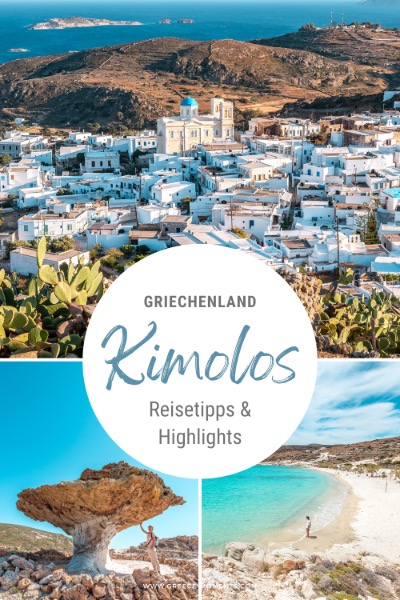

A real Greek insider tip or not? Kimolos is still relatively unknown. Apart from the Greeks who holiday on the island in summer and a few tourists from Milos popping over for a day trip, only a handful of people know about this neighbouring island, which is just a stone’s throw away.
“The Cycladic island of Kimolos offers everything its big sister Milos does, only a little more pristine and quiet.”

Kimolos remains modest and traditional. If you have the chance, you should visit Kimolos today, or tomorrow at the latest – Milos, with its hectic activity, is beginning to rub off on its small satellite. Perhaps in a year’s time, Kimolos will merely be a reflection of its cosmopolitan neighbour.
We explored Kimolos extensively for Greek Easter in May, received a warm welcome from the locals and were absolutely thrilled by this island dwarf. Below, we reveal our 5 highlights of this charming Cycladic island:
#1 Walk through Chorio
Just over 900 people live on the island, which measures a mere 37 km², most of them in the main town of Chorio. Even upon arrival by ferry in Psathi, the port of Kimolos, you can spot some of the white cubic houses perched above.

From the sea to Chorio is about a 900-metre walk. From the harbour, follow the road to the Twins Coffeeshop and turn left into the village behind it. After 180 m, an alleyway leads to the right towards the large main church of Panagia Odigitria.
If you arrive by car, you can leave it in the free car parks on the western outskirts of the village (Municipal Parking) or below the Ipapanti Church. Chorio is largely traffic-calmed, allowing you to stroll through the alleys in peace.
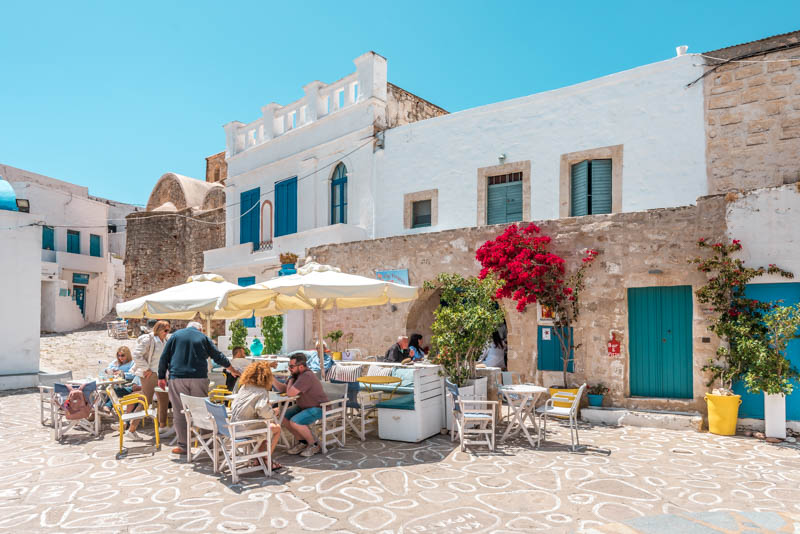
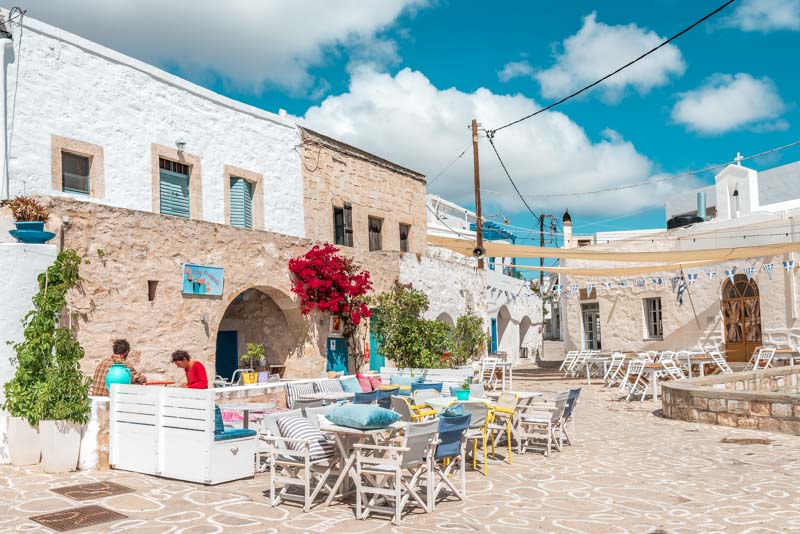
The linchpin of Chorio is the Platia Kambos. Here you will find a number of cafés (tip: Stou Fragouli) and tavernas, a playground and two churches, including the 17th-century Agios Ioannis O Xrysostomos. Photogenic alleyways branch off from the village square in all directions, their paving lovingly painted with traditional patterns.


From the Platia, you can take a short walk through Chorio. Follow the narrow alley uphill behind the church of Agios Spyridon, which will also take you past the charming little shop Kimoltihos.

At the town hall of Chorio, you will reach a second small square, which turns left into the main alleyway Agora and leads to the Cathedral of Panagia Odigitria. A look inside the large village church of Kimolos is well worth it for its rich decorations. With its shops and bars, the Agora alley is probably one of the most photographed motifs on Kimolos.

Kastro of Kimolos
At the grill house Palaia Agora, heading left through archways takes you into the old Kastro district of Chorio. The Venetian castle complex dates back to the 13th century and today survives only as a ruin. For history buffs, it is well worth taking a short walk through the medieval settlement, past ruined houses and chapels. Most of the buildings are dilapidated, though one or two are currently being rebuilt.
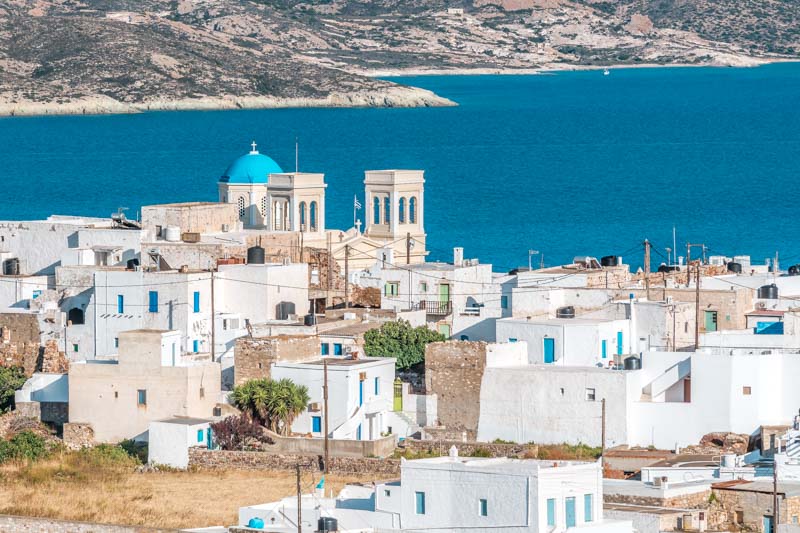
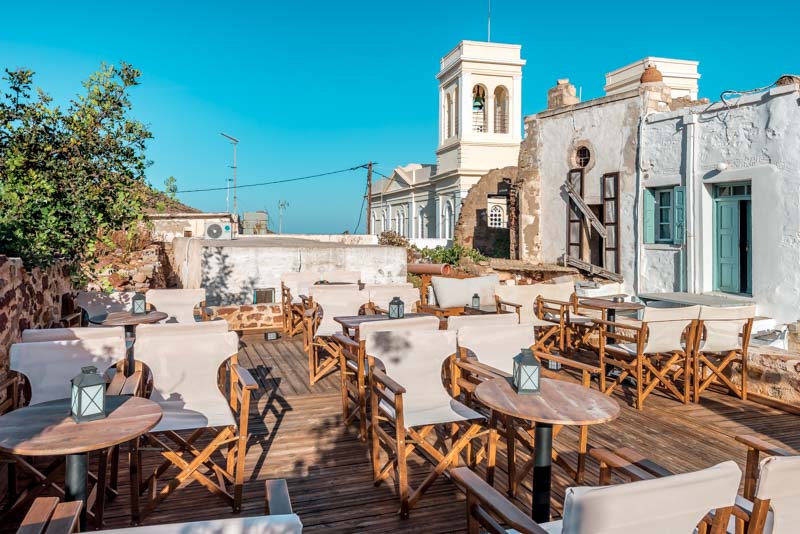
A very special backdrop within the Kastro is offered by the Bar Brachera, whose terrace has been built right in the middle of the ruins. It is the perfect spot to end the day in a relaxed atmosphere on balmy summer evenings.
From the large main church, continue your tour northwards. The alley leads past some souvenir shops to the traditional Bakery Paradosiakos, where you can try “Ladenia”, a type of flatbread topped with tomatoes, onions and olive oil.
After the bakery, turn left back towards the Platia. You will pass the Stavento ice cream parlour, where you can enjoy a cooling freddo alongside delicious homemade ice cream.
Windmills of Kimolos
The windmills of Kimolos on Mount Xaplovouni are the island’s ultimate landmark, just as they are on many other Greek islands. They are located directly above the main town of Chorio and are best reached on foot. In the past, this wind-exposed location was used for milling grain.
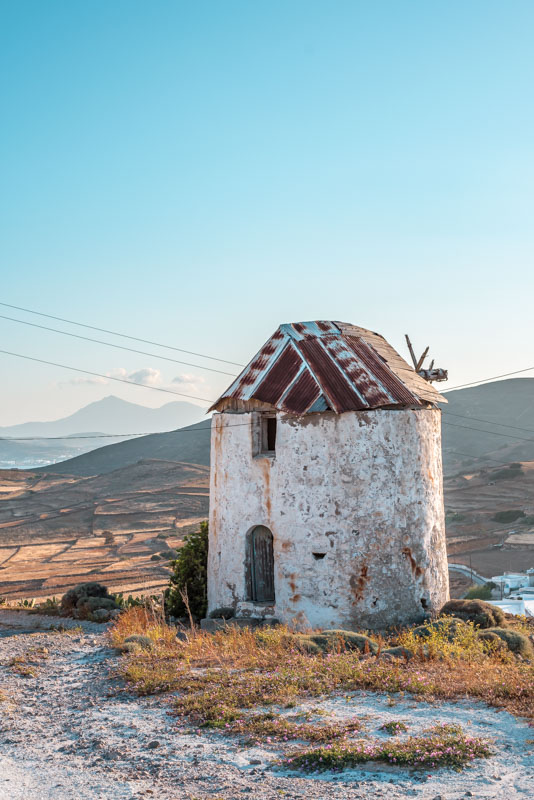
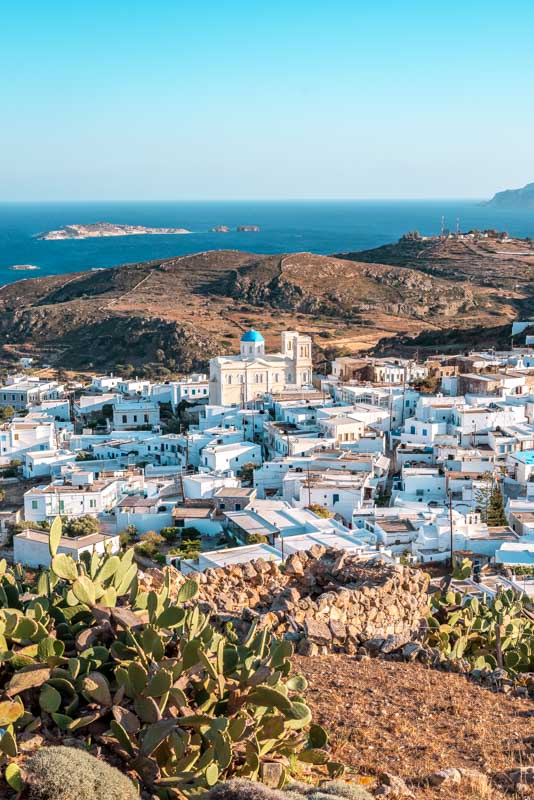
Today, the windmills are largely derelict, but they offer wonderful photo opportunities, especially in the evening light. From the windmill hill you have a fantastic view over to the uninhabited neighbouring island of Polyegos – a highly romantic spot, particularly at sunset!
💡 The donkeys of Kimolos: On no other island have we seen quite so many donkeys as on Kimolos. You will encounter the “Gaidouraki” (Greek for donkey) all over the island. Particularly from the windmill hill, their “ee-aw” could be heard ringing out from all directions.

#2 Kimolos’ Boathouses: Goupa, Karras and Psathi
The harbour village of Psathi is where everyone sets foot on land for the first time. When we entered the small port of Kimolos at the beginning of May, we were greeted by a tranquil scene. In front of a narrow pebble beach stood a few white, cubic houses lined up next to one another. A taverna directly on the shore had already put out its parasols.

Most people leave Psathi on their left immediately after arrival, but it is well worth stopping at the café To Raventi. Here you can let your first impression of the island sink in over a cool freddo before setting off on further discoveries.
Just 1.5 km from Psathi, in the southeast of the island, lies the small fishing village of Goupa. At first glance, this cluster of white houses on the coast might seem unspectacular.

But taking a short walk from Goupa beach along the coast, you will discover boat garages (Syrmata) with distinctively coloured doors, carved into the tuff stone much like the Milos boathouses. The Syrmata of Goupa largely still serve their original purpose, as evidenced by the fishing boats anchored directly in front of them.
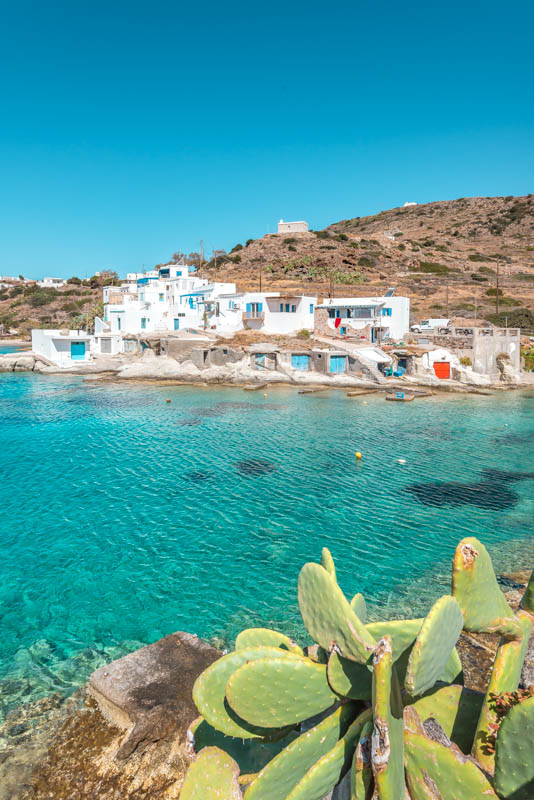

You can enjoy a beautiful view of Goupa bay and its turquoise sea from the “petrified elephant” – a rocky outcrop sitting on the shore. For a quick dip, we recommend Rema Beach west of the village. The beach at Goupa itself was unfortunately looking rather neglected during our stay.

Note: Parking in Goupa is limited. It is best to park on the main road, as stopping just above the beach is strictly reserved for locals.
Just one bay further east lies the coastal village of Karras, with its rugged coastline of white tuff and sandstone. Here the sea shimmers in the most stunning shades of blue and green, practically inviting you in for a swim. Snorkelling is also excellent here when the sea is calm.
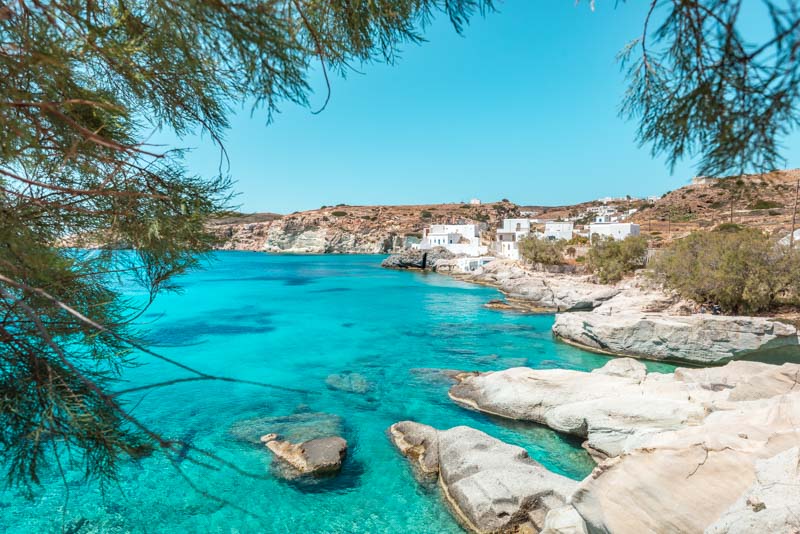
The rocky coast is a wonderful place to linger under the shade of tamarisk trees. There is an unpaved car park at the entrance to the village where you can leave your car and walk down to the shore.
#3 Kimolos’ wild west coast
The west of Kimolos is secluded and largely uninhabited. In May, bales of hay were still blowing through the tiny settlements, and all the tavernas remained closed.
Coming from Chorio, you first pass the inconspicuous hamlet of Aliki with its mostly dried-up salt lake. From there, follow the gravel track directly along the sea.
After a few minutes you will reach the sandy beach of Bonatsa, followed closely by the bay of Kalamitsi Beach. Both beaches slope gently into the crystal-clear water, making them ideal for families with small children.

The asphalt road ends at the bay of Fykiada in the far west, but it is well worth continuing the drive north along the west coast for a while.
The long stretch of Paralia Dekas flows seamlessly into Ellinika Beach. Both beaches are unspoilt and were completely deserted during our visit. Here you can enjoy an undisturbed swim, though only when the wind is calm.

Just off the shore of Ellinika Beach lie bizarre rock formations. Ash deposits from ancient volcanic eruptions have created pointed rock needles and other striking shapes here. The atmosphere is particularly magical at sunset!
From here you have a clear view of the offshore island of Agios Andreas. In ancient times, this island was connected to Kimolos and housed the island’s ancient capital. Gradually, however, the narrow isthmus subsided, separating the landmasses. Even today, divers can explore the ruins of this sunken city.

One of the last beaches on the west coast accessible by car is Mavrospilia Beach. This stretch of brown sand is bordered by a few tamarisk trees, and in summer the beach bar Sunset Paradise opens, offering sun loungers, drinks and snacks at fair prices. A very special highlight here is watching the sunset with a view of the white rock needles of “Aspragremna”.
#4 Hike to Skiadi
A marvel of nature awaits you in the northwest of Kimolos. The Skiadi Rock is one of the geological monuments of the Aegean Sea. Shaped by wind and weather, it has taken on its current, bizarre form of a giant mushroom and is one of the most popular things to do in Kimolos.
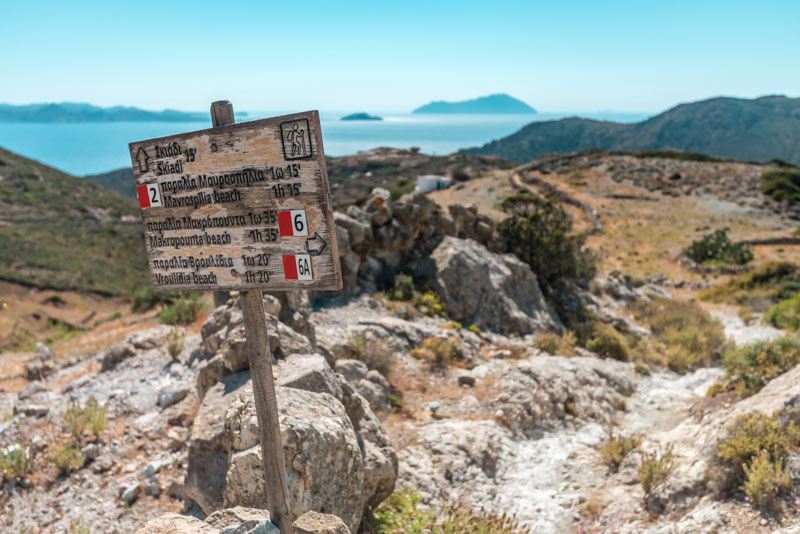
Skiadi on Kimolos can only be reached on foot via an old mule track (approx. 2 km, 35 mins one way from the parking bay). By hire car, you drive roughly 3 km north from the main town of Chorio.
Outside the village, the road turns into an easily navigable gravel track, passing the church of Profitis Ilias before reaching a fork. On the left side there is a parking bay (Google Coordinates, GPS: 36.808684, 24.555011). A signpost to Skiadi is painted in white letters on a rock.
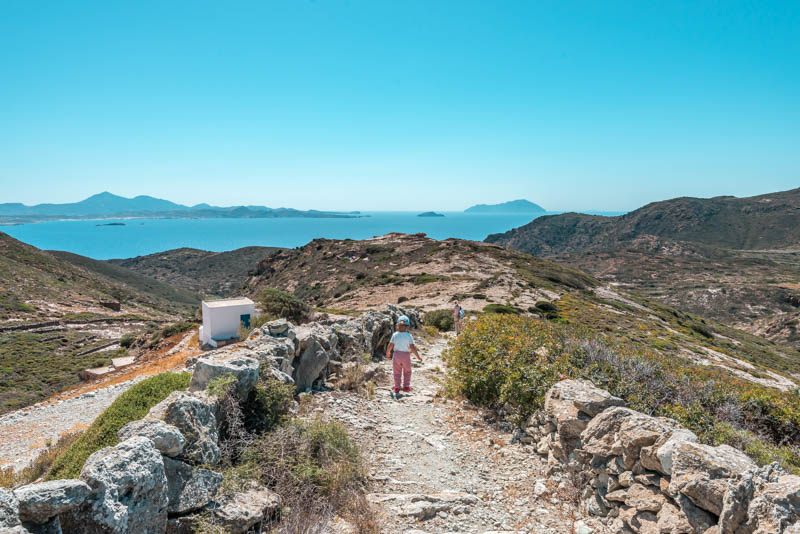
From the car park, an old monopati (path) leads along the terraced slopes of Mount Sklavos. The route is highly scenic; in spring especially, the hinterland of Kimolos bursts into the most beautiful colours. The hiking trail is well marked and easy to walk – even our three-year-old daughter managed the 35-minute walk there all on her own.
Towards the end of the path you reach a junction leading onto a sort of plateau. From here you can already spot the bizarre structure standing out in the landscape from afar.

The closer you get, the more impressive the “Mushroom Stone” becomes, changing its shape depending on your viewing angle. From Skiadi, there is a magnificent view over the deep blue sea towards Milos. Enjoy this unique scenery and take a short picnic break before heading back.
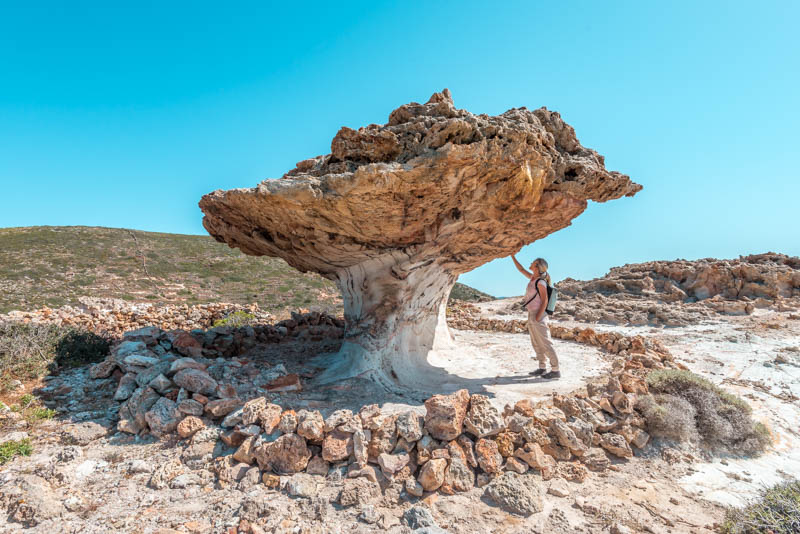
💡 Important hiking tip for Kimolos: Avoid this hike in the height of summer and during the midday heat. There is no shade along the entire route to Skiadi. We therefore highly recommend wearing a hat and sturdy shoes, and taking plenty of water and provisions with you. On hot days, start early to avoid the midday sun.
#5 Prassa Beach and the lonely north
The north of Kimolos is largely uninhabited and can only be fully explored via dirt tracks or on foot. The asphalt road ends at the deeply cut fjord of Agios Minas; beyond that, a dirt road leads to Prassa in the extreme northeast.
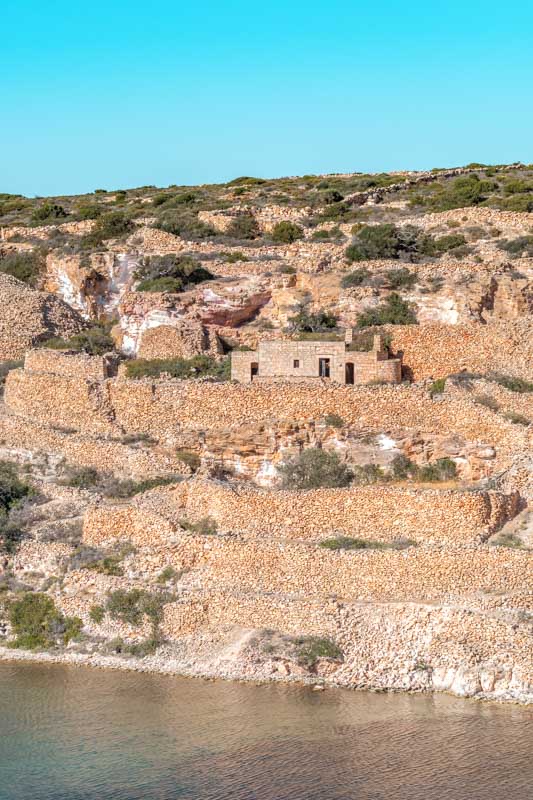

The route from Goupa along the east coast reveals a long history. Past the island’s only petrol station and Klima beach, piles of excavated stone become noticeable everywhere. Countless walls and terraces have been built from the waste rock generated by former mining operations in the region.

After a few kilometres you reach the hamlet of Prassa with the small islet of Prasonisi sitting opposite. Even from a distance, the water of the lagoon shimmers in the most stunning shades of blue, making Prassa arguably the most charming spot on the island. The bright sandy beach shelves very gently into the sea, creating an almost Caribbean setting.
These days, the entire stretch of Prassa Beach (also known as Agios Georgios Beach) is completely natural and unmanaged. You must bring your own parasols, though a few tamarisk trees do provide some shade. There are no beach showers or toilets on site.

The almost white sand originates from the rock that is still mined near Prassa today. Just behind the lagoon lies the bentonite mine of the Kedros Peninsula. Powdery-white bentonite is a clay mineral of volcanic origin, commonly known as healing clay because it can bind toxins and heavy metals and flush them from the body.
Bentonite is used not only as a dietary supplement but also in construction, cosmetics, the food industry, and even as cat litter. The bentonite from Kimolos is loaded onto trucks from open-cast mines and shipped out via the port of Psathi.
For a midday snack after a swim, we highly recommend the Restaurant Prasonisi to the south of the lagoon. Although a bit pricier, it was here we enjoyed the best food on the island – a real culinary treat paired with a fantastic view of the turquoise lagoon.
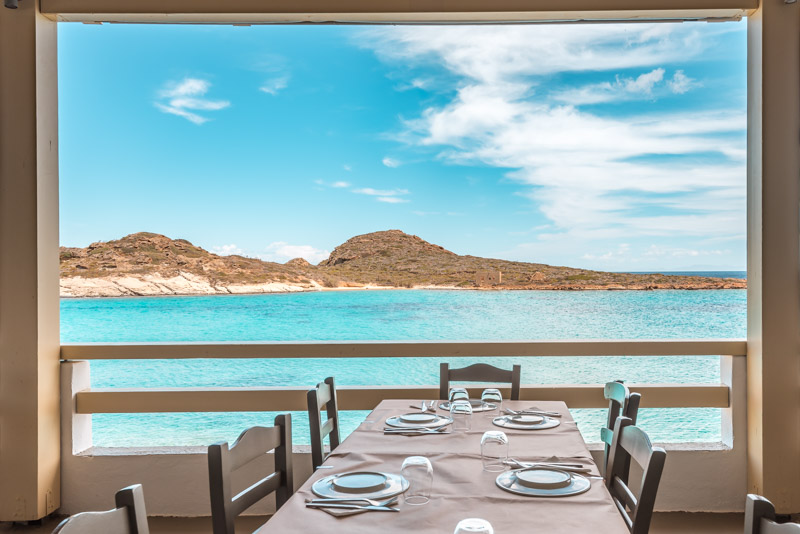
In a rather unassuming building just in front of the restaurant entrance, you will find the thermal springs of Kimolos. These hot springs, also of volcanic origin, reach temperatures of up to 46 degrees and are said to aid all kinds of physical ailments. Unfortunately, the facility and the pools where the thermal water is collected seemed somewhat neglected during our visit.
Sarakiniko of Kimolos
After lunch, it is well worth following the road to Vromolimni on the north coast. The road ends at a farm, and you can park your car in an open space just above the coast.
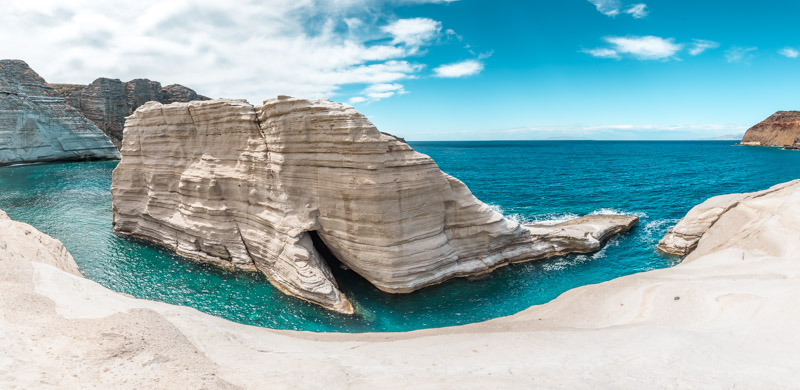
Cross the wild Kioni Beach heading south and climb the rocks on the other side. After just a few metres, the “little Sarakiniko” of Kimolos reveals itself: white-layered volcanic rocks dropping away into the deep blue sea. A deeply photogenic setting that you can still enjoy entirely undisturbed.
💡 The island’s name, Kimolos, is derived from the Greek word “kimolia”, meaning chalk, a reference to the island’s geological wealth. The chalk from Kimolos, a type of clay rock, was used as early as prehistoric times, and as a healing earth it was known as “Kimolia Gee”. Even today, the island’s volcanic origins yield several valuable minerals such as bentonite, pozzolan, perlite, kaolin, barite and zeolite, which are primarily used for a wide variety of industrial purposes.
More Kimolos travel tips for your holiday
How to get to Kimolos
Most holidaymakers travel to Kimolos from the neighbouring island of Milos. The shortest connection is from Pollonia in the north of Milos. Several times a day, the car ferry Osia Methodia, affectionately nicknamed “Pantofles” (Greek for slippers) by the locals, makes the crossing from Milos to Kimolos in just 25 minutes. Timetables can be found directly on the ferry company’s website: Osia Methodia

During the high season, several large car ferries also depart daily from the port of Adamas on Milos to Kimolos, operated by companies including Hellenic Seaways, Zante Ferries and Aegean Sea Lines. This crossing takes about an hour.
→ This article provides all the necessary information for your journey by ferry to Kimolos: Ferries in Greece
For a direct journey from Germany to Kimolos, we recommend either a flight to Milos with a stopover in Athens, or a direct flight to Athens (find cheap flights on Skyscanner*) followed by a ferry from the port of Piraeus to Kimolos.
The ferry operators Zante Ferries and Aegean Sea Lines run the Piraeus–Kimolos route several times a week. The crossing takes just over 6 hours.
→ You can easily search for ferry times and book your ferry ticket to Kimolos via our partner Ferryhopper*:
➲ To the ferry search on Ferryhopper*
Accommodation on Kimolos
Accommodation on Kimolos consists mainly of small, family-run hotels, holiday homes, villas and private studios or apartments. The vast majority are located in and around Chorio. Here you will also find the most important amenities for self-caterers, including a bakery, mini markets and a pharmacy.

You can find many accommodation options on Kimolos on Booking.com* and compare them directly on a map:
➲ To accommodation on Booking.com*
Where we stayed on Kimolos
Villa Argentosa, Chorio
The holiday home belonging to the welcoming host Giorgos sits on a hill just northwest of the main village of Chorio. Villa Argentosa accommodates up to four people across two bedrooms, and features a well-equipped kitchen along with a washing machine.
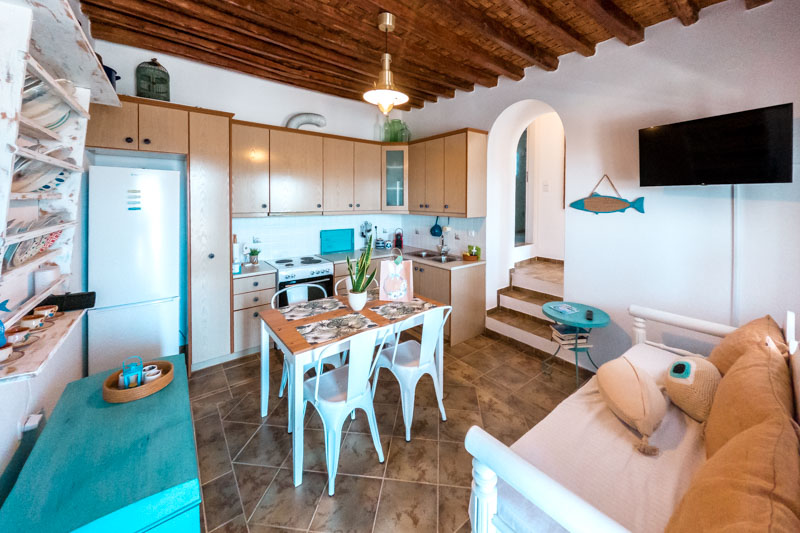
From the terrace you have a wonderful view over the village down to the sea. The village square of Chorio, along with its numerous tavernas and cafés, is just a 10-minute walk away. Parking is available directly in front of the house, though reaching it by hire car is slightly challenging due to the very narrow roads.


You can take a closer look at our beautiful accommodation and book it directly via Booking.com*:
More hotel tips for Kimolos
Our recommendations for great places to stay on the island of Kimolos can also be booked on Booking.com*. Click the links to check prices and availability:
- To Rantevou tis Alykis Rooms & Apartments* (Location: Aliki)
- Monachofolitses Hotel* (Location: Chorio)
- Stella’s House* (Location: Chorio)

Kimolos restaurants: Our recommendations
During our visit for Greek Easter at the beginning of May, not all gastronomic establishments were open yet. Nevertheless, we were able to try out several tavernas and cafés, some of which truly surprised us on a culinary level.
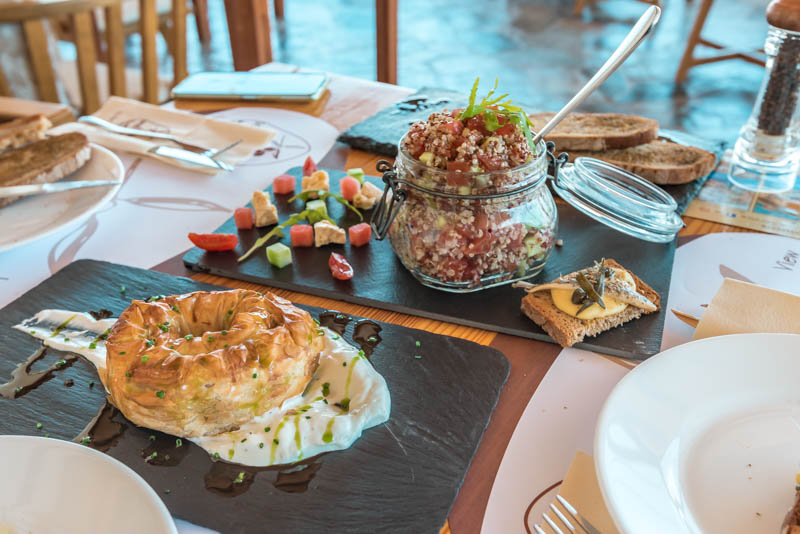
In terms of pricing, Kimolos is no cheaper than its sister island Milos – prices sit above the national average. Here is where we enjoyed a delicious meal or a refreshing freddo:
- Prasonisi Restaurant – our No. 1 on the island, though higher-priced
- Meltemi Restaurant – very tasty Cycladic cuisine, higher-priced
- Stavento – delicious ice cream!
- Sinantisi – a cosy café in a side street of Chorio
- Stou Fragouli – perfect for a freddo on the Platia, relaxed atmosphere
- Café Sweet Mug – a kiosk selling island specialities (honey, etc.)
- To Raventi – a breakfast café right on the harbour in Psathi
💡 Delicacies of Kimolos: Despite its compact size, the island produces some traditional specialities from its own agriculture and livestock farming. These include delicious thyme honey, hard herb cheese and pasta made from ancient wheat – all available at the delicatessen “I Farma tou Samplou” along the main street leading to Platia Kambos.

Getting around Kimolos Island
Most holidaymakers bring their rental car from Milos to Kimolos. The Osia Methodia ferry, which sails from Pollonia on Milos, carries vehicles of all sizes. Whether your car hire contract permits taking the vehicle on a ferry should, however, be checked with the rental company in advance.
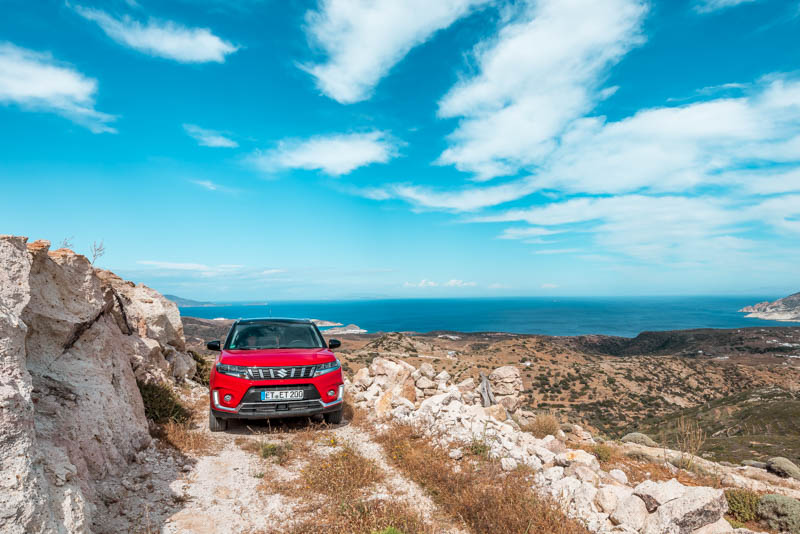
Alternatively, there is a local car hire service on Kimolos. The company Rent a Car Kimolos (RAC) rents out quads, scooters and small cars right in the harbour town of Psathi, and has excellent customer reviews. In high season, it is highly recommended to contact the rental company in advance by phone or email to reserve a vehicle.
→ More travel reports and tips on the neighbouring islands of Kimolos can be found on our overview page: Cyclades Islands
*Support our blog Greece-Moments
In this post, you will find affiliate links marked with an asterisk (*). If you book or buy something through one of these links, we receive a small commission. For you, the price remains exactly the same. In this way, you help us continue to provide high-quality content for free. Did you enjoy this post and would like to say thank you? Then simply buy us a Greek coffee ☕️ To the coffee fund
Bookmark this post on Pinterest!