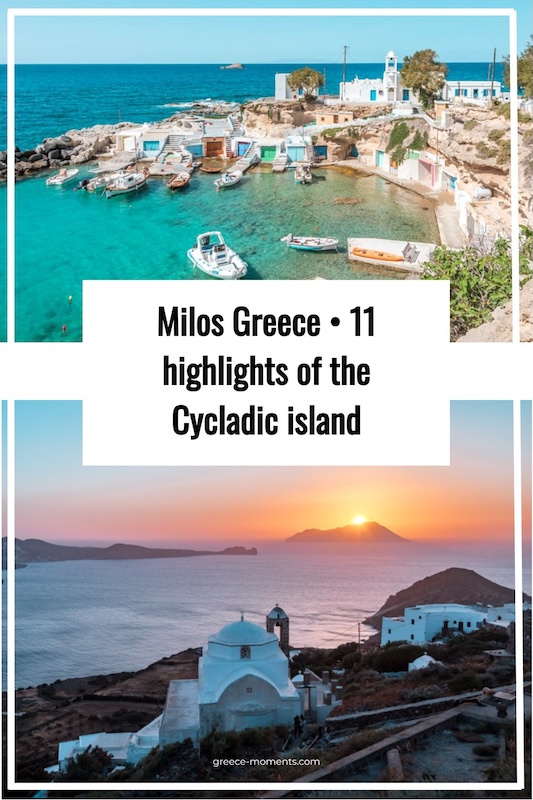

A simple pop music video awakened Milos from its slumber and paved the way for international tourism. Today, with its bizarre lunar landscapes, dazzling dreamy coves, and colorful boathouses, the island of Milos exerts a tremendous pull on visitors from all over the world.
“Milos—the island of colors—can either captivate or deter you, depending on your expectations and the time of year you first set foot on it.”

Hardly any other Greek island has evolved so rapidly from an insider’s secret to a high-flyer over the past 10 years. Yet Milos, of volcanic origin, does not depend on tourists: The island, just 150.6 km² in size, is rich in mineral resources, and exploring it reveals the many open-pit mines and quarries.
We visited Milos in the off-season at the end of April, had many beaches all to ourselves, quickly struck up conversations with locals, and enjoyed an island idyll that, according to them, is hard to find in the summer. By then, the picturesque towns of Plaka and Klima are bustling with visitors, and the landscapes of Sarakiniko and Kleftiko act like magnets for vacationers.


Join us on a journey of discovery around the island. We’ll show you the best sights of Milos and our personal insider tips that we discovered during our stay. You’ll find out at the end of this post whether Milos ultimately enchanted us or left us feeling a bit put off:
- #1 Stroll through Plaka
- #2 Klima: Boathouses of Milos
- #3 Adamas: Milos’s Port Town
- #4 Mandrakia and Firopotamos
- #5 Sarakiniko Beach
- #6 Pollonia: Cycladic charm in the north
- #7 Day Trip to Kimolos
- #8 Thiorichia: Sulfur Mines of Milos
- #9 Kleftiko Boat Trip
- #10 Milos West: From Cape Vani to Profitis Ilias
- #11 Milos Beaches: Our Top 5
- More Milos Travel Tips
🏖️ Dream beaches & hidden bays
🍽️ Restaurants, tavernas & cafés
🏛️ Must-see highlights & ancient sites
🗺️ Worthwhile spots & insider tips
🚘 Practical info like rentals & parking
♾️ Lifetime access & updates
#1 Stroll through Plaka
As you enter the expansive bay of Milos, one of the largest natural harbors in the Aegean, the white houses lining the steep cliffs immediately catch your eye. Plaka, also known as Milos Chora, is the island’s capital, but with just over 800 residents, it has a distinctly village-like character.
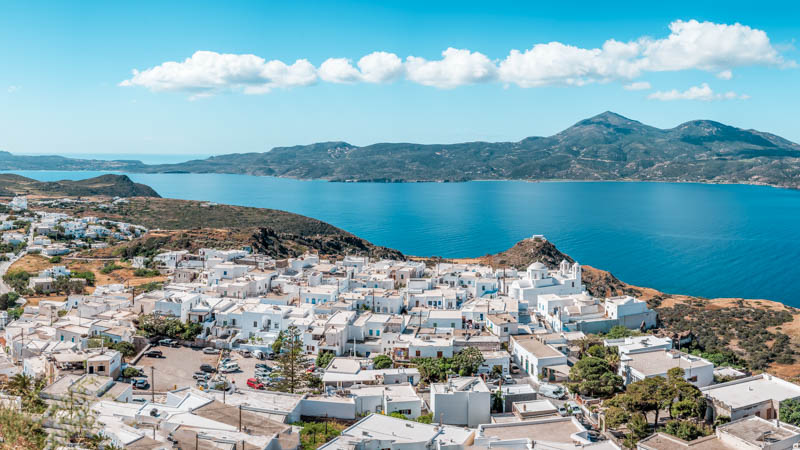
Plaka is a typical Cycladic village with winding alleys, built high above the sea in the Middle Ages as a refuge from impending pirate raids. The village has limited traffic; from the large free parking lot, Free Parking Plaka, at the entrance to the village, you make your way up numerous stairs into the center.


As you make your way through the labyrinth of white-washed alleys, you’ll pass many quintessentially Greek photo opportunities. The houses are adorned with colorful doors and windows, vibrant bougainvilleas climb up the walls, and cats doze in the shade of the midday sun. Shopping enthusiasts will find great boutiques, jewelry, and craft shops in Plaka, including Giteftra and MargaritaCreations.
Archaeological Museum of Milos
History buffs can plan a visit to the Historical Museum of Plaka. The striking building above the parking lot was designed in 1870 by German architect Ernst Ziller and today houses all of the island’s significant archaeological finds. With the exception of the Venus de Milo, the famous statue of Aphrodite, which is now on display at the Louvre in Paris (see #2)
- Milos Museum hours: 8:30 a.m.–3:30 p.m., closed Tues. & Thurs., admission €5.

For culture enthusiasts, art galleries also open their doors in the summer. Don’t miss the unique little Marmara Sand Museum, run by Asteris. As a trained geologist, he exhibits gravel, clay, and other materials from Milos and around the world, even creating fascinating works of art from them that make great island souvenirs.

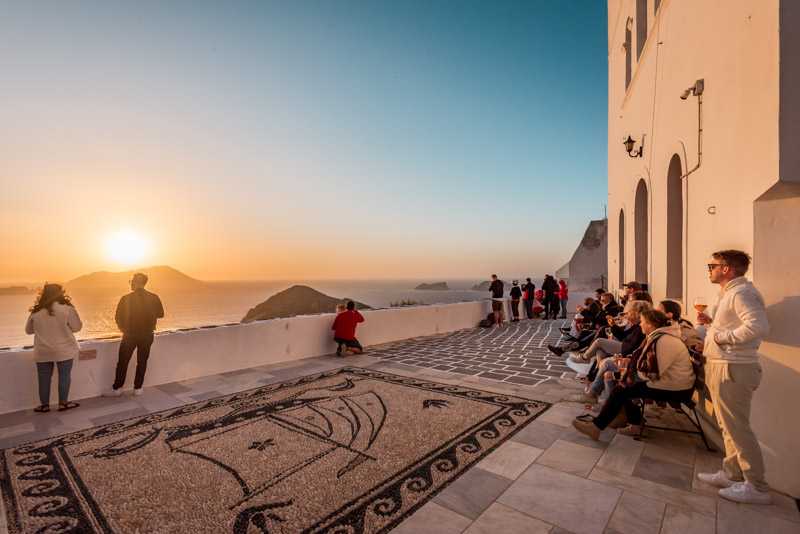
In addition to the many shops, Plaka naturally also has cafés and restaurants where you can linger; you can find our recommendations here: Milos Restaurants. At the western end of the village, another great viewpoint awaits you on the charming forecourt of the Panagia Korfiatissa Church. At sunset, this is a popular meeting spot for locals and tourists alike.
Ascent to Milos Kastro
The fortress above Plaka, also known as Milos Kastro, is one of the most striking landmarks on the entire island. The 280-meter-high rock with its snow-white Marian chapel can be seen from many locations.

The hike to Plaka Kastro takes about 15 to 20 minutes from the parking lot. The trail is well-marked and leads through the traffic-calmed section of Dimokratias Street to Café EN PLO, past jewelry stores, on to ORYHIO The Mine Bar, and then up a few more flights of stairs.
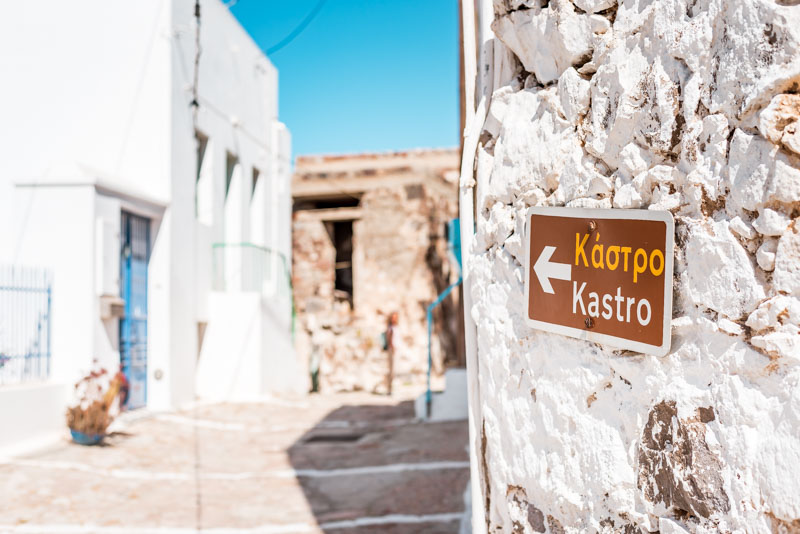
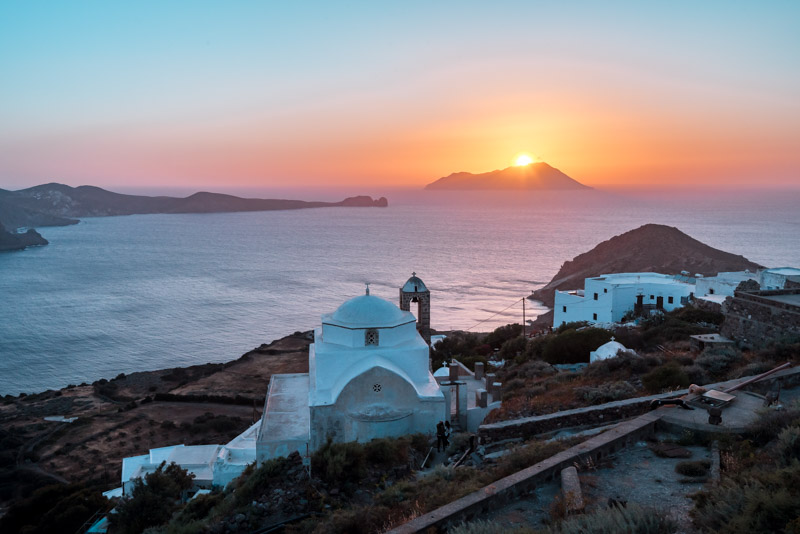
Time and again, magnificent views of Plaka and the surrounding area open up. Just before the summit, you’ll reach the impressive Panagia Thalassitra Church (1839), which is arguably one of the most photographed churches on Milos. At sunset, numerous visitors gather on the church’s terrace to watch the play of colors.
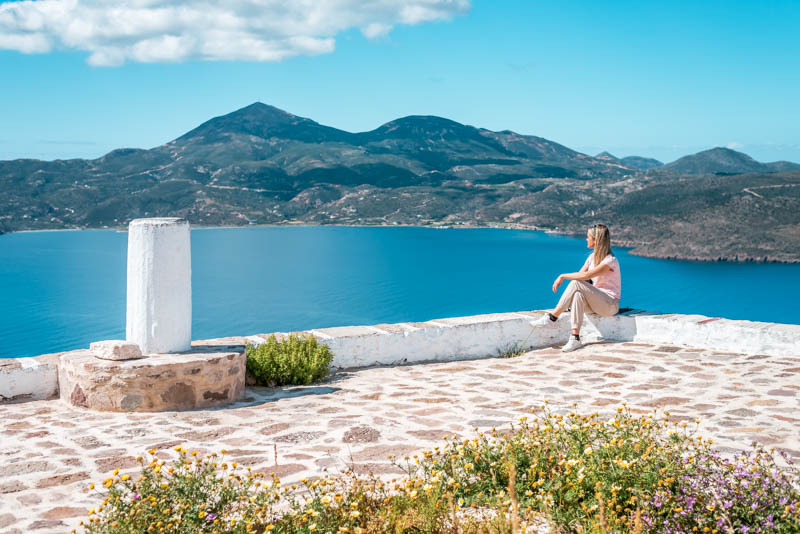
A few meters further up, you reach the summit of the former Venetian fortress (built starting in the 13th century), of which only the remains of the walls are visible today. Light a candle in the Panagia Sikiniotisa chapel and then enjoy the breathtaking 360-degree panoramic view of Milos.
#2 Klima: Boathouses of Milos
Like a string of pearls, the white houses with their red, blue, green, and yellow doors line the coast below Plaka. Klima is one of the most beautiful places in Greece, and the history of the boat houses of Milos (Syrmata) dates back to a time when many Milosians sought their fortune as fishermen on the waves of the Aegean Sea.

After each season, in the fall, the fishermen had to protect their boats from the extreme winter winds and bring them ashore. Here, the volcanic caves and grottos along the Milos coast, with their natural ramps, served as garages. Later, the caves were fitted with wooden sheds painted to match the color of the boats.
Over the centuries, numerous boathouses sprang up, especially along the north coast. When fishing with small boats (kaiki) was no longer profitable, the boathouses fell into disrepair. Tourism breathed new life into the Syrmata of Klima—resourceful Greeks converted the simple boathouses into luxurious vacation rentals.

Today, Klima has fewer than 20 permanent residents; most of the houses are rented out to vacationers. This makes Klima one of the smallest villages on Milos, but also one of the most visited. Anyone wishing to spend the night in a boathouse on Milos (view on Booking.com*) should choose the off-season, as the terraces are bustling with activity in the summer.
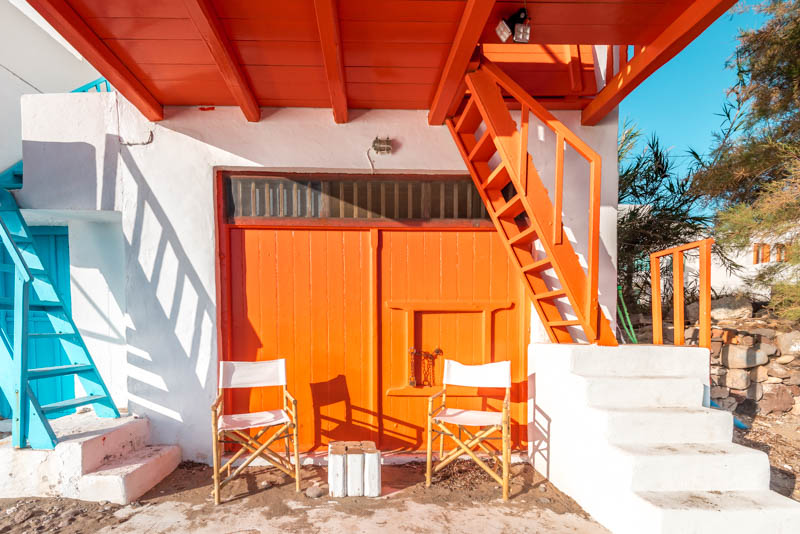
The scenery is truly unique in Greece; photography enthusiasts will find countless subjects here. In addition to Klima, which lies directly below the village of Tripiti, there are other places with these distinctive boat garages. All information about the colorful coastal villages, as well as suitable accommodation tips, can be found in this article: Milos Boathouses
Catacombs of Milos
Above the hill of Klima lies the island’s most significant archaeological site, the Catacombs of Milos. Coming from Plaka, follow the “Catacombs” signs through the village of Tripiti, but be careful—the main road is very narrow. Just before the free parking lot, you’ll pass a marble statue of a woman, the Venus of Milos.
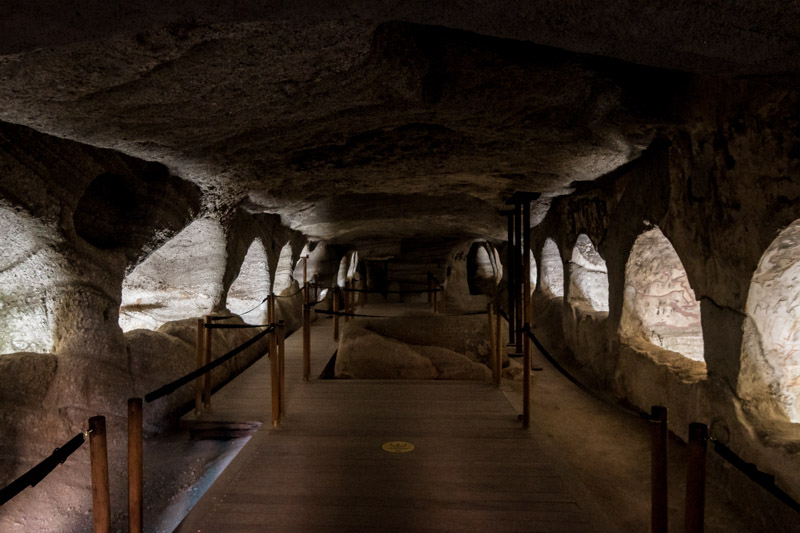
The catacombs were established in the 1st century AD as burial sites for the first Christians and were used for burials until the 5th century; today they are among the most significant early Christian monuments in all of Europe. Over the centuries, approximately 2,000 burials are said to have taken place, though many of the 291 graves were desecrated before their discovery.
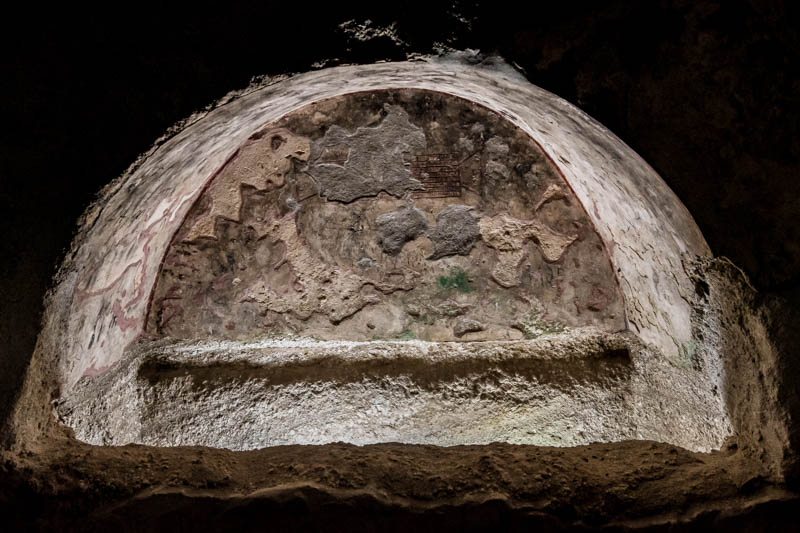
The burial chamber system is 183 m long and divided into three segments. In some of the 1.5- to 2.5-meter-wide burial niches, original inscriptions dating back nearly 2,000 years, as well as the Christ monogram, are still preserved. According to legend, the Apostle Paul is said to have been shipwrecked near Milos while traveling from Crete to Athens and to have preached the Christian faith there.
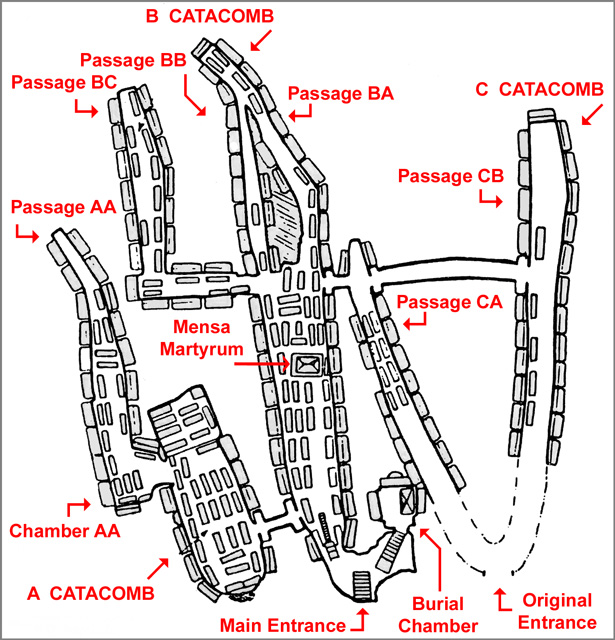
Although the catacombs have long been known to the local population, it was not until the 19th century that Ludwig Ross undertook a comprehensive exploration of them. Currently, only a portion of the burial chambers is accessible. Accompanied by a guide, a tour of the atmospherically lit crypt takes 15 minutes.
- Milos Catacombs opening hours: Wed–Mon 9 a.m.–6:45 p.m., admission: €10 (reduced €5)
💡 Car rental on Milos: To explore Milos thoroughly, it’s definitely worth renting a car. Be careful in the towns of Plaka, Adamas, and Triovasalos—the yellow lines indicate no-parking zones, and illegal parking is subject to a fine of at least €15. To learn more about traffic and car rentals on the Greek islands, check out our separate article: Car Rentals in Greece
Venus of Milos
The Venus of Milos, a two-meter-tall marble sculpture of the goddess Aphrodite, is arguably the island’s most significant work of art. Yet it has not been on Milos for 200 years. The story of its discovery, its disappearance, and the centuries-long dispute over its return to Greece could fill a novel.

In short: In 1820, farmer Georgios Kentrotas stumbled upon the beautiful statue of the goddess while plowing his stubble field. Unaware of the significance of his find, he sold it for a “song” to French art dealers. Today, the Venus stands in the Louvre in Paris, where it is arguably one of the absolute highlights.
The Greek government has been trying in vain for decades to bring the statue home. A replica of the famous statue of the goddess Aphrodite stands by the roadside on the way to the catacombs. The farmer Georgios’s field is said to have been located directly below this spot. The replica is definitely a great photo opportunity!

From here, it takes about 5 minutes to reach the ancient theater of Milos, which was a cultural part of the ancient city of Melos (from 1000 BC). Not much remains of the old island capital, which was located directly above Klima, except for the theater with its marble seating rows and a bastion from Roman times. However, admission is free.
On the prominent hill above stands the Chapel of the Prophet Ilias, which features clearly recognizable ancient marble fragments embedded in its structure. The chapel and the theater are about a 10-minute walk apart and offer a magnificent view of the surrounding area.

#3 Adamas: Milos’s Port Town
You’ll set foot on land for the first time in Adamas (also known as Adamantas). With a population of over 1,200, it is the largest town on the island and was founded by refugees from Crete (Sfakia) in 1824. Along with Crete, Milos was also a site of World War II; both islands were occupied by the German Wehrmacht for the longest period of time.

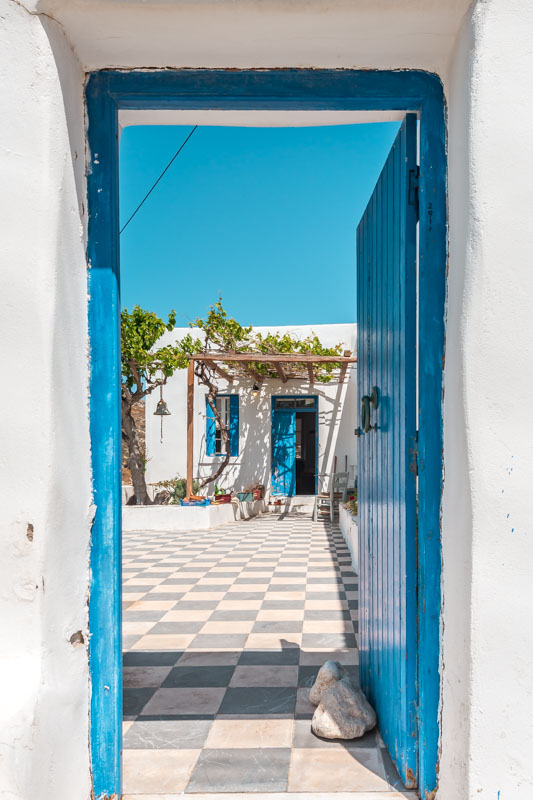
Today, Adamas presents itself with typical white Cycladic houses complete with colorful doors and windows. The only thing missing is tranquility; the coastal town is always bustling, as it serves as the hub of Milos. Here you’ll find the most lodging options and a variety of dining establishments, as well as souvenir shops and stores for daily necessities.
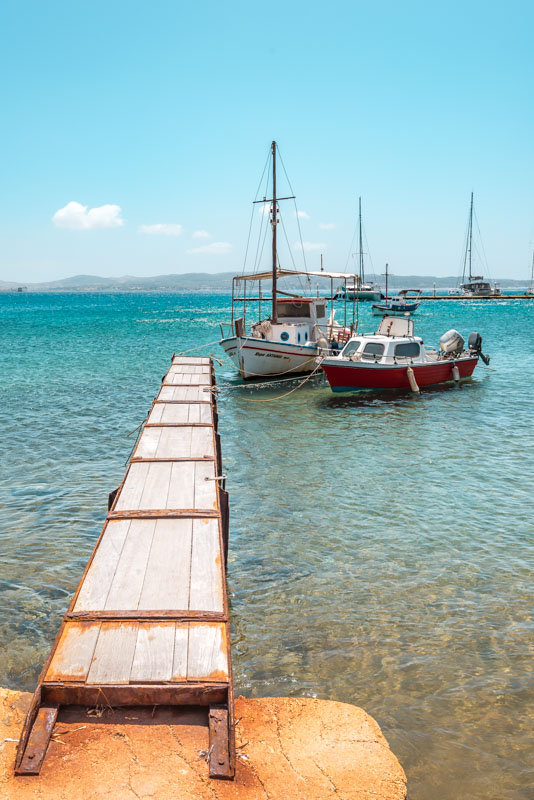
While it’s pleasant to stroll along the promenade from the old fishing harbor to Lagada Beach, it didn’t quite spark our interest. Much of it seemed too touristy to us, and we couldn’t find a quaint tavern. At least in the upper part of town, there are charming alleys and white churches (including Agios Haralambos) that make for lovely photo opportunities.
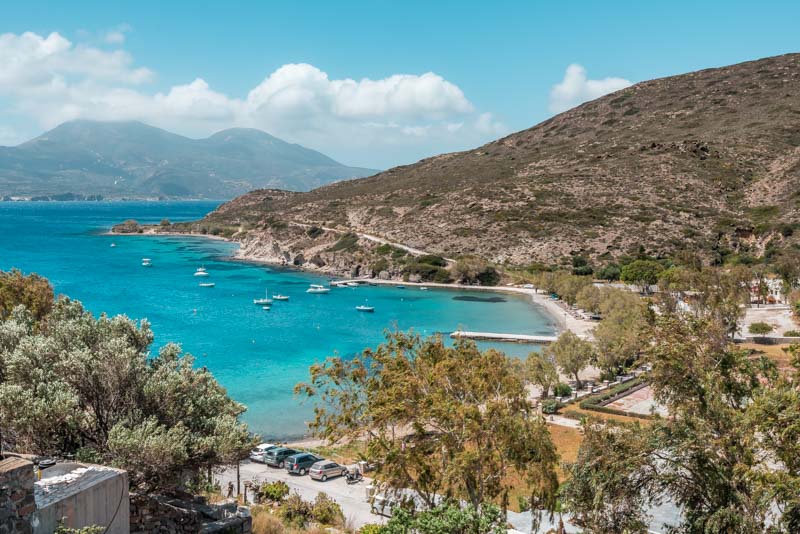
Unfortunately, two significant historical monuments in the town are no longer accessible: the Iamitika Loutra thermal springs located at the harbor (closed since 2020) and the World War II bunkers below Adamas. The latter provided shelter for the German occupiers and the local population during Allied bombing raids and were occasionally used for exhibitions.

Visit to the Milos Mining Museum
Valuable raw materials have been mined on Milos since the Stone Age. As early as 8,000 years ago, the most important export was the jet-black, glass-like rock obsidian (see box), from which tools and weapons were made and fragments of which have been found in many parts of the Mediterranean region.

Over the millennia, other minerals have been mined, so much so that one could say mining is the soul of Milos. The industry is in full swing, with old and modern open-pit mines and spoil heaps scattered across the entire island. Warning signs reading “Trucks passing” (oncoming trucks) should be taken seriously; some mines operate 24 hours a day, 7 days a week.

For those who want to learn more about the island’s volcanic origins and mining on Milos, a visit to the Milos Mining Museum is recommended. The museum was founded by Imerys, the largest mining company on Milos, and is located about one kilometer east of the port of Adamas on the main road heading south.
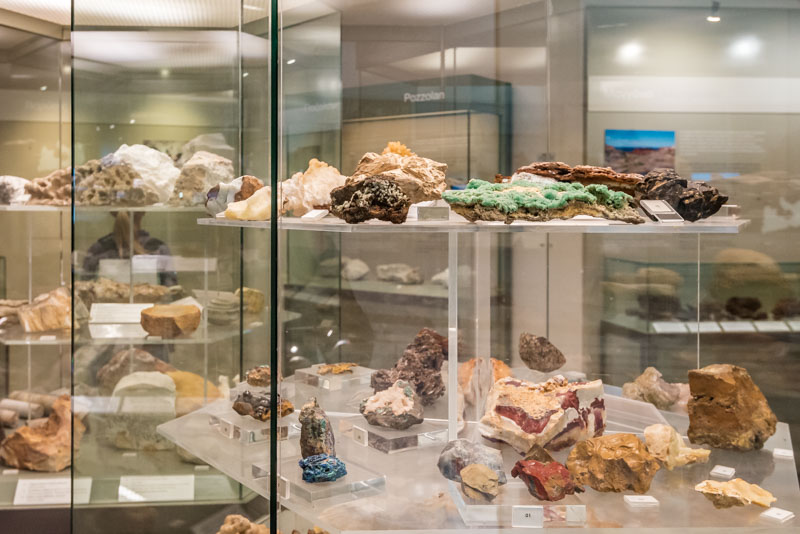
Although quite compact, the museum vividly illustrates the geological features of the island of Milos and the various minerals (see #8 Thiorichia) that are mined, along with their practical applications, across three levels. In the basement, a film (with English subtitles) offers insight into the lives of the old miners of Milos.
- Milos Mining Museum Hours: Tue–Sun 10 a.m.–2 p.m., Admission: €7, students and seniors €4, and children under 6 free
💡 Obsidian from Milos: Obsidian was likely mined on Milos as early as the 7th millennium BC. In addition to jewelry and talismans, tools and weapons were primarily crafted from this sharp rock, which is also known as volcanic glass. By law, obsidian is considered archaeological material and may not be removed. Incidentally, a large obsidian vein is located west of Adamas near the lighthouse at the harbor entrance.
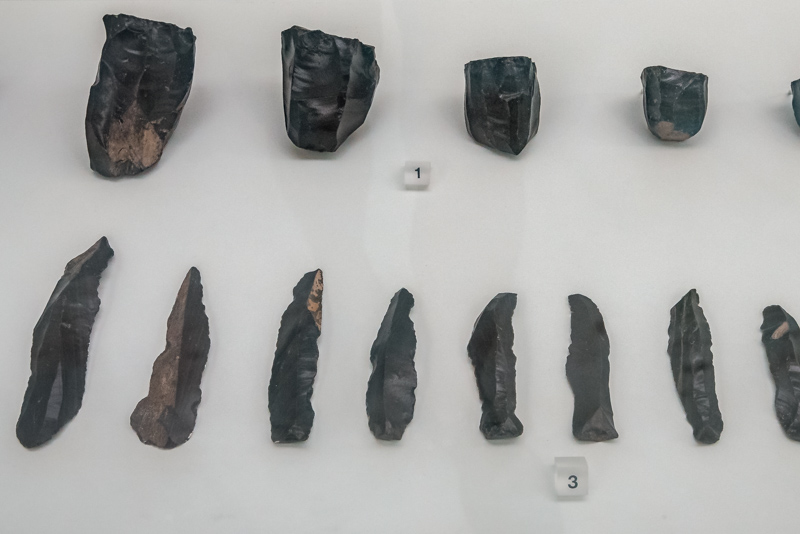
Obsidian on display at the Museum
Adamas Lighthouse
An enjoyable walk (1 km, 20 min), particularly recommended in the late afternoon, leads from Lagada Beach on the western outskirts of Adamas along the coast to the lighthouse at the entrance to Milos Harbor. Along the way, you can see deposits of the distinctive obsidian, which stands out clearly as black spots against the beige-colored rock.
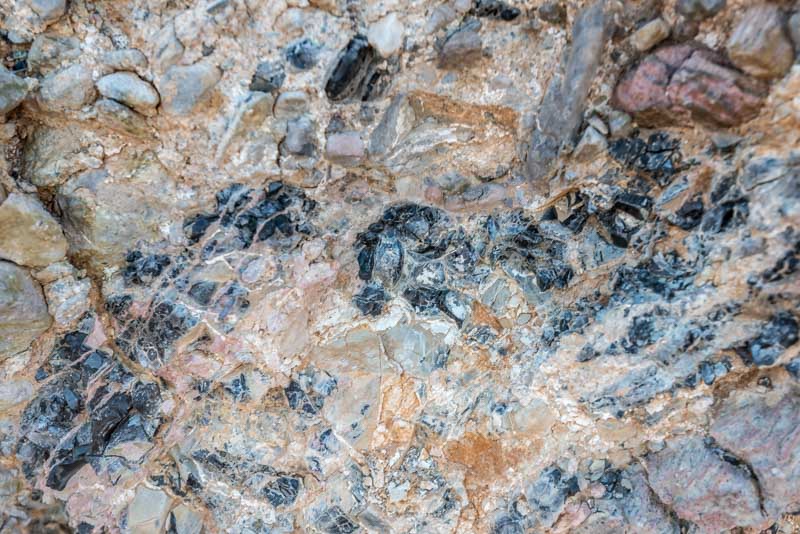
On a pristine beach, there is a French cemetery commemorating the Crimean War (1853–1856) and a small brackish lake from which bubbles rise, a sign of volcanic activity on Milos. After a short climb, the metal Adamas Lighthouse comes into view. The old stone lighthouse fell victim to Allied bombing raids during World War II.

#4 Mandrakia and Firopotamos
The boathouses of Mandrakia in the northwest were one of our personal highlights on Milos. The curved harbor bay, which you can already see from the parking lot upon arrival, looks like a postcard scene. Right at the entrance to the village is the Kantina Oasis, which offers cool drinks and delicious freddo with a magnificent view. A wonderful place to linger.
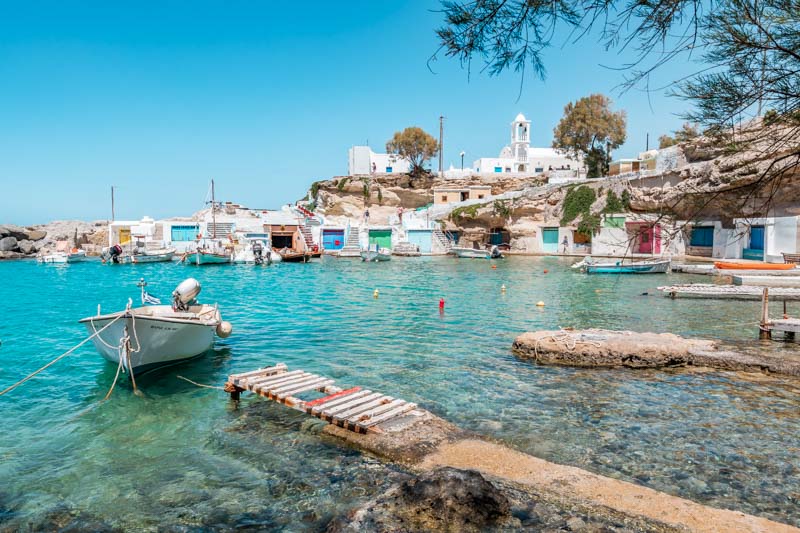
A footpath leads into the small hamlet. The striking blue-and-white Zoodochos Pigi Church is a real eye-catcher; at the time of our visit in early May, the interior was undergoing restoration. Mandrakia’s traditional syrmata are picturesquely lined up around the harbor bay, and the boat doors shine in a wide variety of colors.
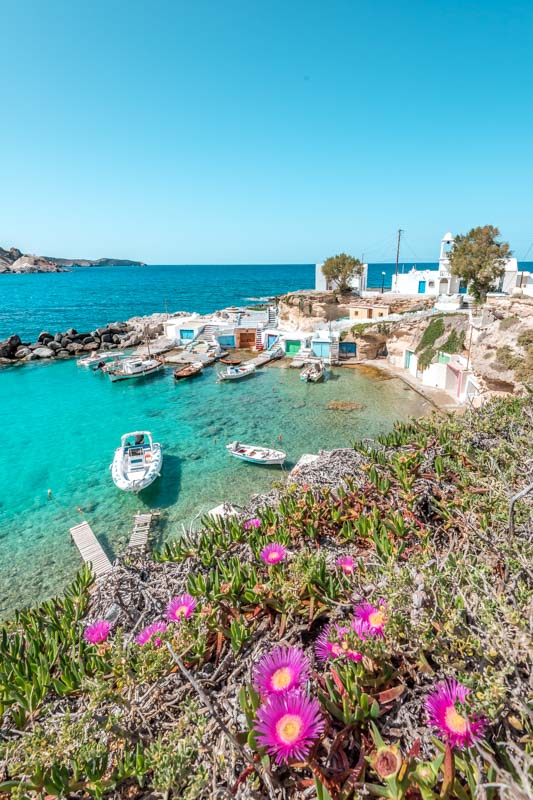
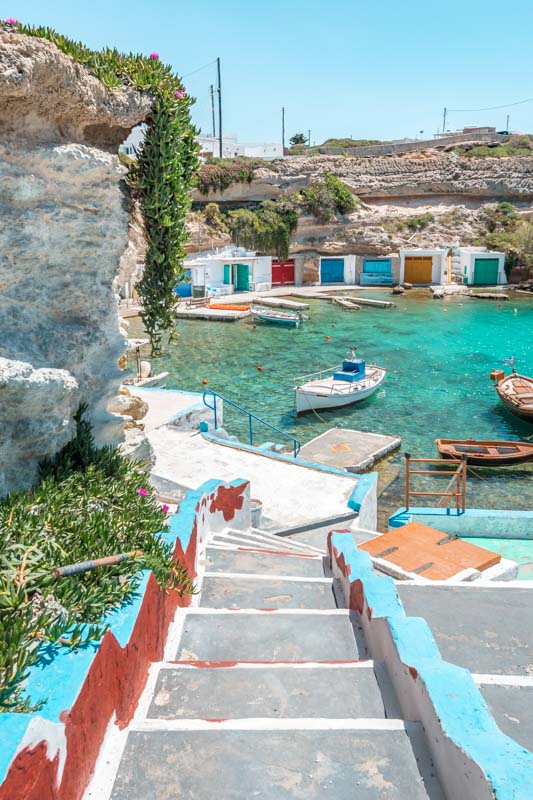
Many of the boathouses are still used traditionally by fishermen, while some have already been converted into vacation rentals. You won’t find a classic beach in Mandrakia, but you will find a very charming backdrop for a few unforgettable photos during your Milos vacation.
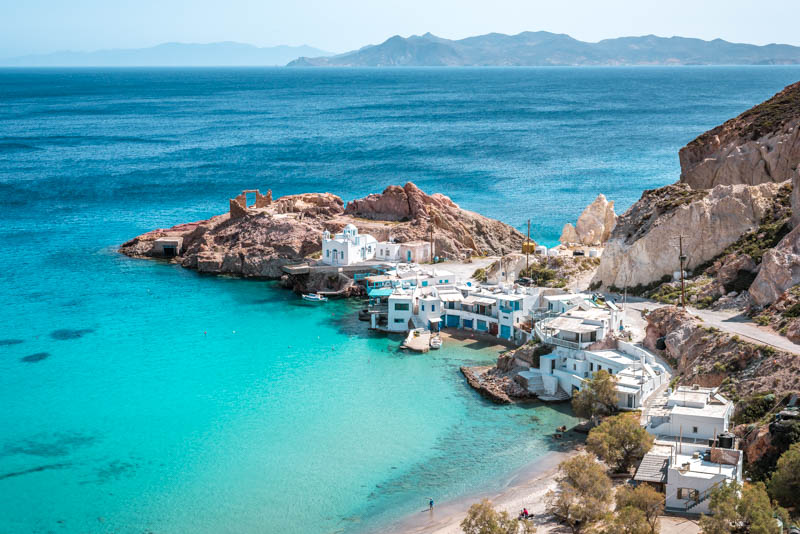
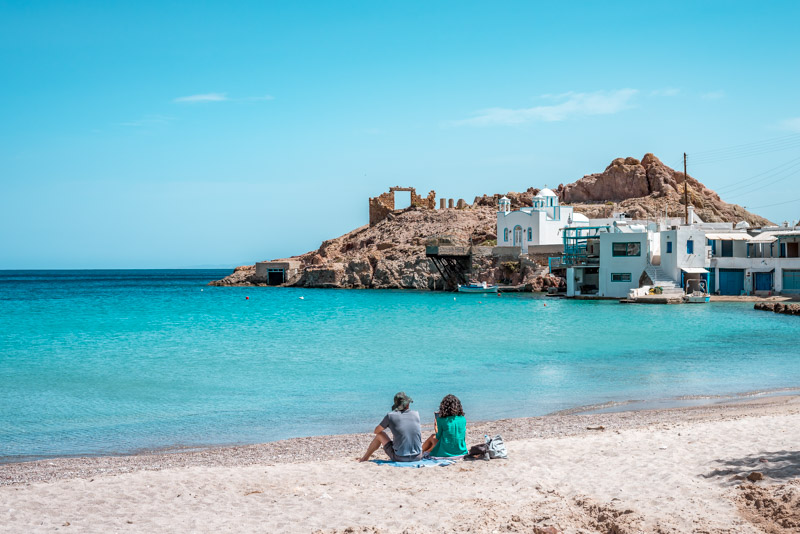
For a beautiful swimming spot with boathouses, head about 4 km further to the coastal village of Firopotamos. Above the road leading to an open-pit mine, you’ll catch your first glimpse of the picturesque settlement. At the sandy and pebbly beach, the sea shimmers turquoise blue, with white cottages clustered against the rugged cliffs behind.
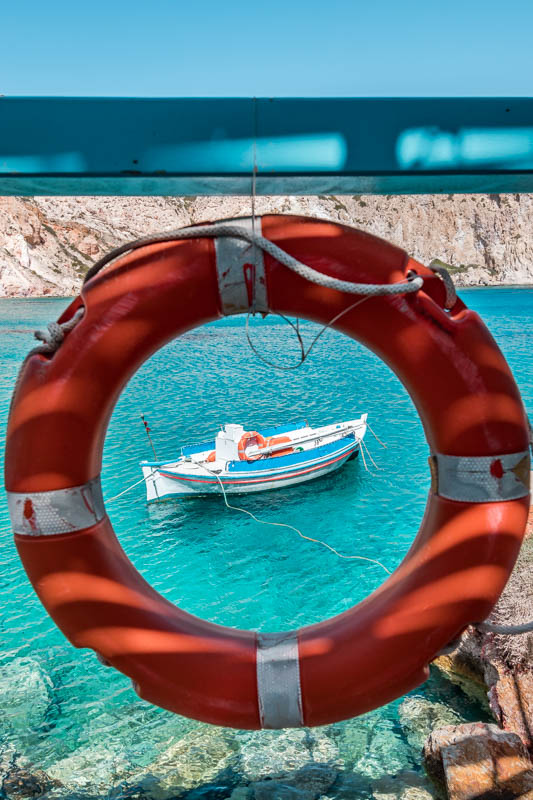
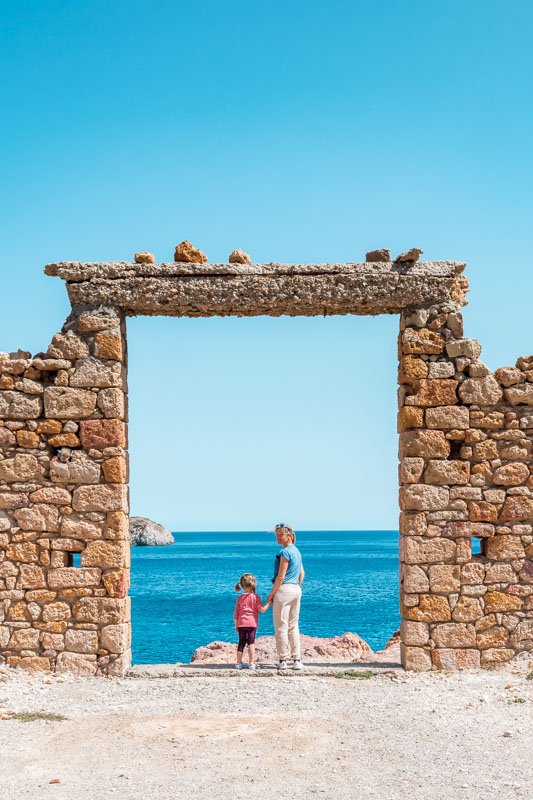
Down at the beach, you can park your car and walk to the Church of Agios Nikolaos. Directly below, fishing boats usually bob in the harbor. When the sea is calm, it’s an extremely idyllic setting! Behind the church, you’ll come across the remains of an old loading station for kaolin, which was mined here until the 1960s. The stone gate offers interesting photo opportunities.
💡 Help with planning your Milos vacation: Not sure where to start or how to go about planning your stay on Milos? No problem—take advantage of our years of experience with trips to Greece and let us help you. We’ll advise you on all your questions and concerns, even via video chat. Book your consultation here: Greece Travel Consultation
#5 Sarakiniko Beach
A boy and a girl go traveling after graduating from high school and meet for the first time on a ferry in the Aegean Sea. The journey takes them to Milos, where they explore the island together and eventually become a couple. The coast of Sarakiniko served as the backdrop for Kungs’ music video “This Girl,” propelling Milos from an insider’s secret to worldwide fame.

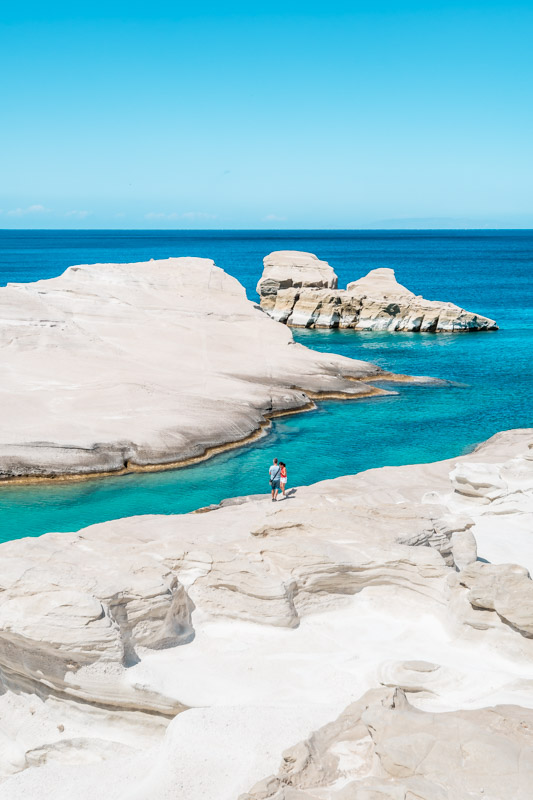
Today, Sarakiniko is the most popular attraction on Milos. The striking, moon-like coastline is located in the north of the island, just about 5 km from the port town of Adamas. In the summer, the area is bustling with people, and the tiny beach at Sarakiniko is completely packed.
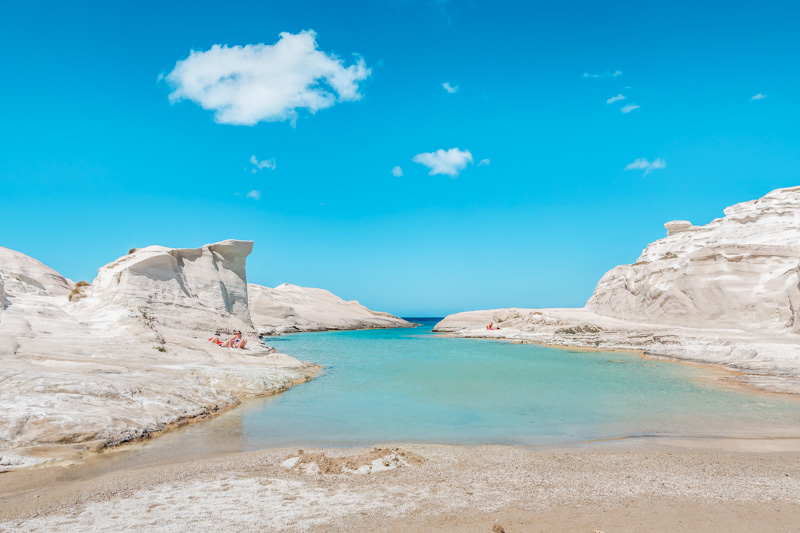
From a distance, the many vacationers scrambling crisscross over the white rocks of Sarakiniko Beach look like scattered ants. At the end of April, we still enjoyed a certain idyll here and shared the bizarre scenery with only a few other people.
→ You can find out everything you need to know about the lunar landscape of Milos in this post: Sarakiniko Milos

#6 Pollonia: Cycladic charm in the north
Pollonia, the former fishing village in the northeast of the island, also known to locals as Apollonoia—named after the Greek god Apollo—captured our hearts immediately. Picturesque white houses in the Cycladic style line both sides of a long, narrow bay.

In the early season, Apollonoia was quiet; everywhere, people were preparing for the season, and only a few restaurants were open. Pollonia Beach, with its gently sloping, fine-sand shoreline lined with numerous tamarisk trees, was still deserted during our visit in late April.
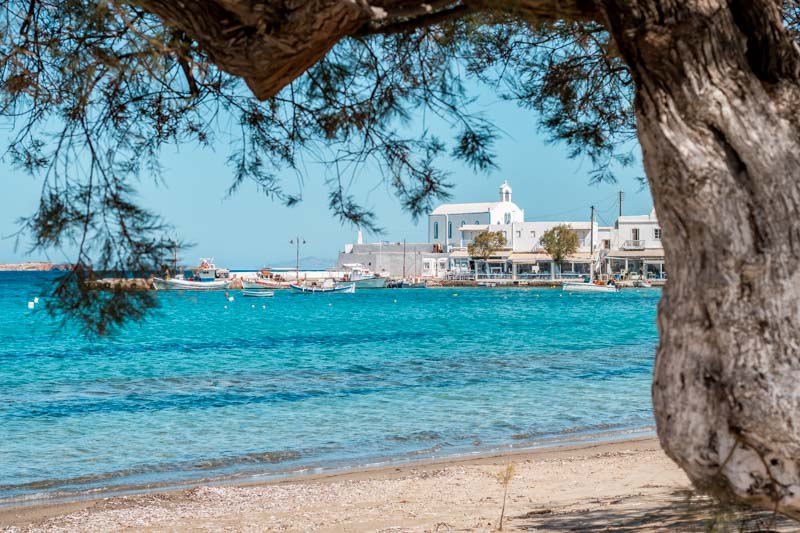
Right on the beach is Pollonia’s playground, a true island idyll for the little ones. You can park your car in the large free car park directly behind the church and stroll along the small waterfront promenade, which is lined with restaurants. Make your way to the blue-and-white Agia Paraskevi Church, which was open during our visit.

Directly below lies the ferry pier with its colorful fishing boats. The Osia Methodia car ferry, which connects the islands of Milos and Kimolos, also docks here several times a day. Pollonia is the starting point for a day trip to the neighboring island of Kimolos, which seems to be just a stone’s throw away.
Pollonia is also perfect for a coffee break. We stopped by Café Deck several times. The view from the terrace is simply magnificent, and you could linger there forever. On the other side of the bay lies a large holiday resort. Worth seeing here is the small blue-and-white church of Agios Nikolaos, which sits right by the sea.
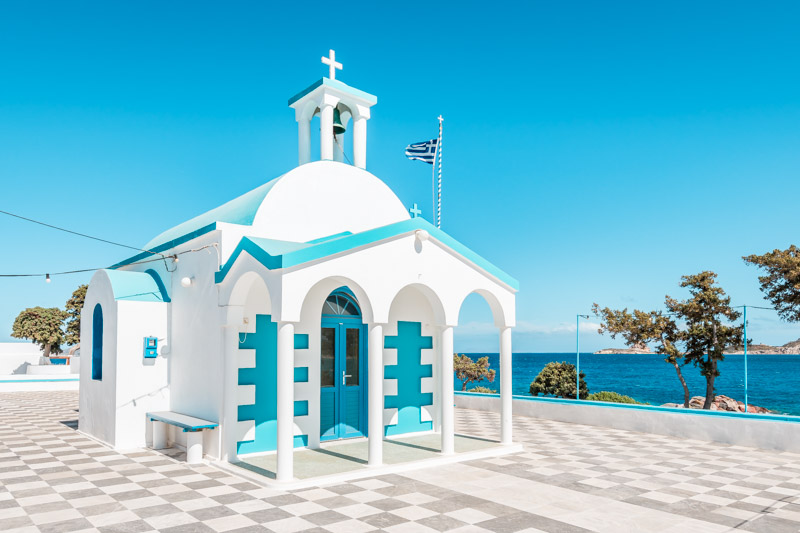
Wine from the island of Milos
Just 500 m outside of Pollonia lies Milos’s only winery. At the Kostantakis Winery, red, white, and rosé wines, as well as a Retsina, are produced under the Spilia brand (Greek for “cave”). The highlight is the extraordinary wine cellar, which was built into the volcanic caves that give the winery its name.
→ You can book your guided tour of the Milos winery directly through our partner GetYourGuide*:
Papafragas & Phylakopi
Just a five-minute drive south of Apollonia lies one of the island’s most curious coastal formations: the Papafragas Caves. Over millions of years, wind and weather have carved several cave-like channels into the rock here, which you can explore at your own risk. The rocky outcrop offering a view of two channels should not be entered in strong winds.
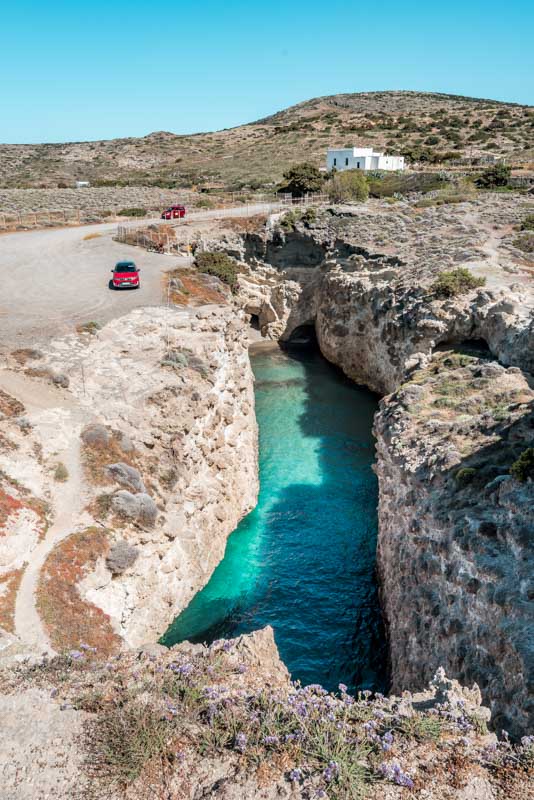

There is also a small beach at Papafragas, but the steep descent is not without danger, and a warning sign cautions against the risk of falling. Next to the Papafragas Caves lies Kapros Beach, which also features a rugged rocky landscape with sea caves and offers particularly interesting photo opportunities for photographers.
The neighboring archaeological site of Phylakopi (dating from 3,000 BC), impressively situated on a rocky cliff directly above the sea and actually one of the island’s most significant historical sites, was not open during our visit in 2024. Valuable ceramics and other artifacts are on display at the Archaeological Museum of Plaka.

Visit to the Aggeria Mine
Those who spend several days on Milos and explore the island by rental car will truly realize the extent of mineral mining on Milos. Mining is actively underway in many places, with trucks constantly driving from the spoil heaps to the loading ports. Nearly 40 percent of the locals are directly or indirectly involved in mining.

Milos is therefore not necessarily dependent on tourism. Nevertheless, the mining industry is open to visitors, and some spoil heaps can even be viewed up close if you’re interested. These include the Aggeria Mine, located 5 km south of Pollonia, which is the largest bentonite mine in Europe and one of the largest in the world.

It was founded in 1968 and has been in continuous operation since the 1980s. The scale of the pit is immense, with countless terraces of multicolored rock layers extending down to emerald-green groundwater lakes. The mining company has set up a viewpoint overlooking the Milos Mine (GPS 36.739710, 24.503651).

With an annual output of 1.3 million tons, Greece is the world’s fifth-largest producer of bentonite. Bentonite is used as a lubricant and sealing material, as well as a binding agent, a base ingredient for many cosmetics, and as cat litter. Around the mine, you can expect oncoming trucks; please be sure to observe the driving restrictions!

#7 Day Trip to Kimolos
While just a few years ago the two islands were worlds apart, Kimolos has, at least in the summer, come closer to the cosmopolitan bustle of Milos. During our visit in May, there was no sign of this yet; aside from mainland Greeks and a dozen French tourists, we experienced Milos’s neighboring island from its quiet side.

Kimolos is also of volcanic origin and can be described as a miniature version of Milos. Aside from the main town of Chorio and the port of Psathi, there are only a few other settlements on the island. Kimolos is now well integrated into the Greek ferry network, with car ferries running to the island from Milos, Sifnos, and Folegandros.
From Pollonia, the Osia Methodia ferry departs for Psathi several times a day in 20 minutes (first departure around 7 a.m.). Those planning a day trip to Kimolos can quickly visit almost all of the island’s highlights by rental car. The main town of Chorio has restricted traffic and can only be explored on foot.
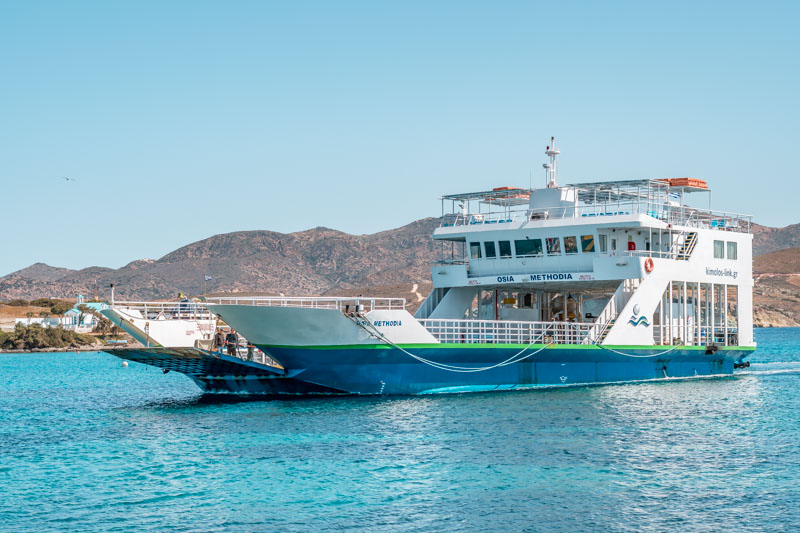
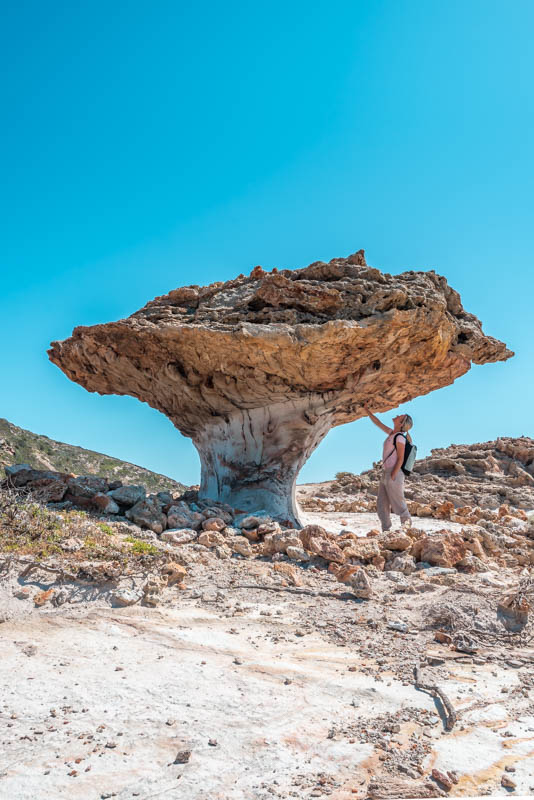
Other beautiful spots on Kimolos include the boathouses of Goupa and Karras, the powder-sugar-white beach of Prassa, and the giant stone mushroom known as Skiadi. The latter can only be reached on foot (about 1.5 hours from Chorio).
→ Everything you need to know about Kimolos and further information on how to get there can be found in this post: Kimolos
#8 Thiorichia: Sulfur Mines of Milos
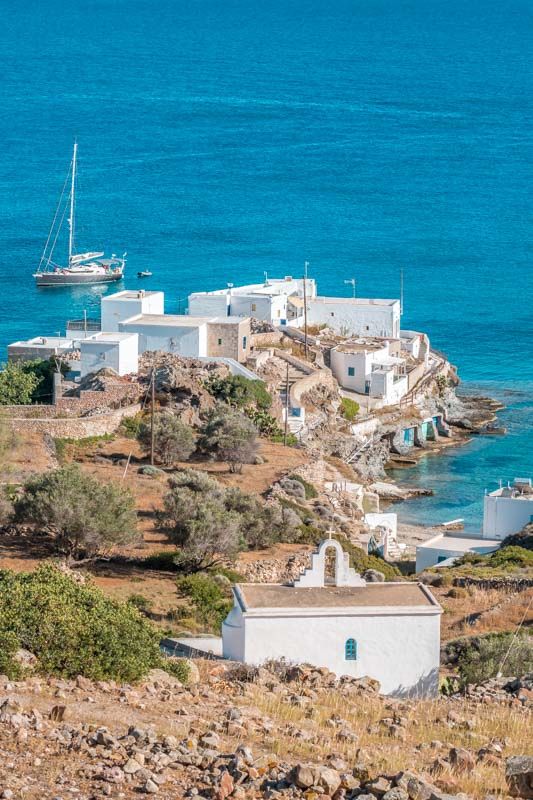
Mining has a very long tradition on Milos; even sulfur was mined in large quantities in past centuries. As early as 79 AD, Pliny the Elder mentioned the island as a site for mining the bright yellow rock. Sulfur has not been mined since the 1960s, but the site of the large sulfur mine in the far southeast of Milos is open to visitors.
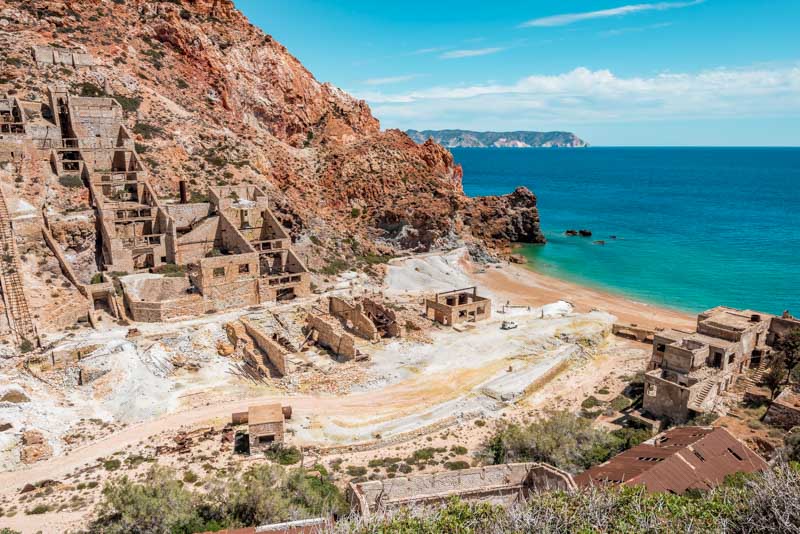
Even though the old facilities and steel structures are now rusting away, a visit to the Old Sulphur Mines Thiorychia is worthwhile not only for fans of abandoned places. The seaside setting, at the end of a long, wild valley, surrounded by red and yellow rock cliffs, is instantly captivating. The only downside: the dilapidated gravel road can only be navigated with a four-wheel-drive vehicle or a quad bike.
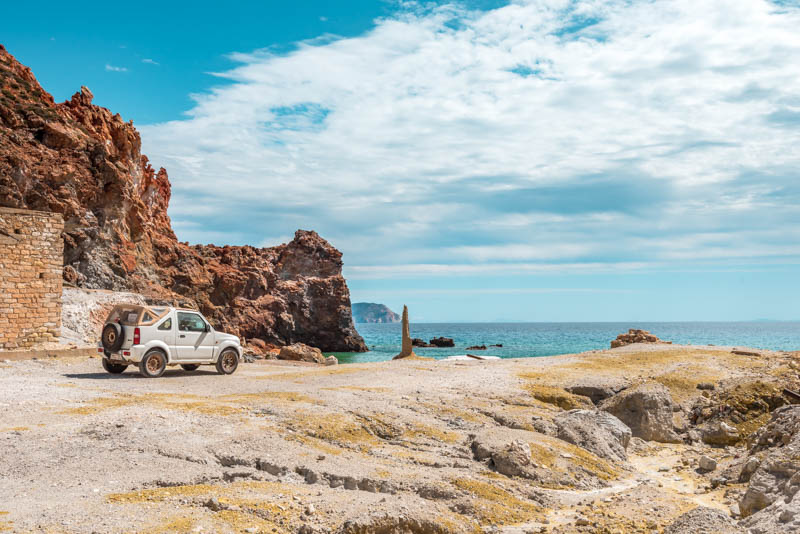
We even parked our four-wheel-drive Suzuki halfway and walked the last stretch. Once down below, the traces of sulfur mining from the past centuries are visible—mining cars on rusty rails, old loading cranes and hoists, warehouses, and workers’ barracks. The ravages of time are evident everywhere; enter at your own risk.
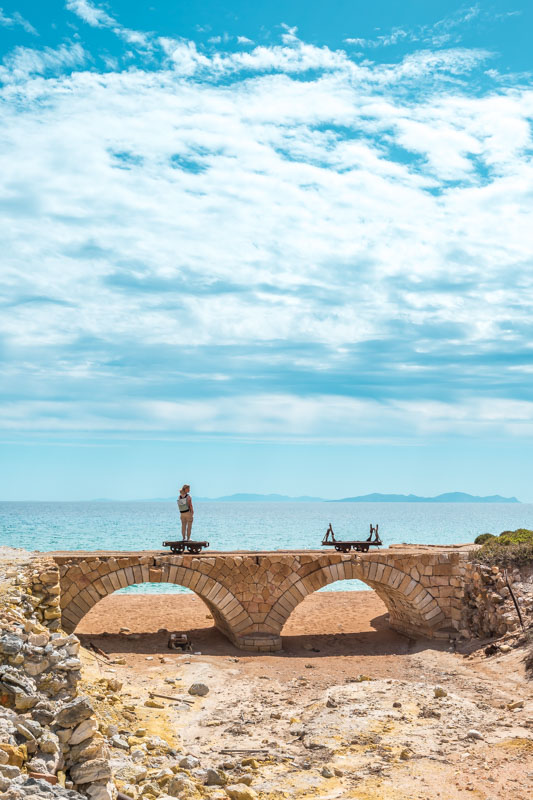
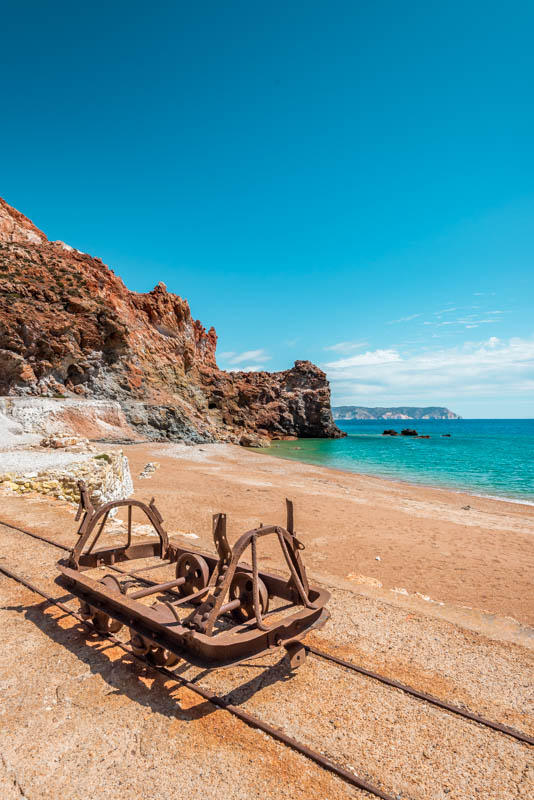
The Paralia Thiorichio beach offers a chance to cool off with its mix of beige gravel and sand. Depending on the current, the water shimmers emerald green to yellowish due to sulfur-containing minerals. To the right of the old loading port, a tunnel provides a glimpse into the underground work and gives a sense of the hard labor the miners once had to perform here.

Today, there is no longer any underground mining on Milos. Instead, bentonite (see #6), pozzolan, kaolin, and perlite are mined in large open-pit mines. Perlite, a white porous rock, is the most important mineral extracted on Milos; the largest piles are located above Tsigrado Beach and directly at Paralia Voudia. With 700,000 tons, Greece ranks third worldwide after China and Turkey.
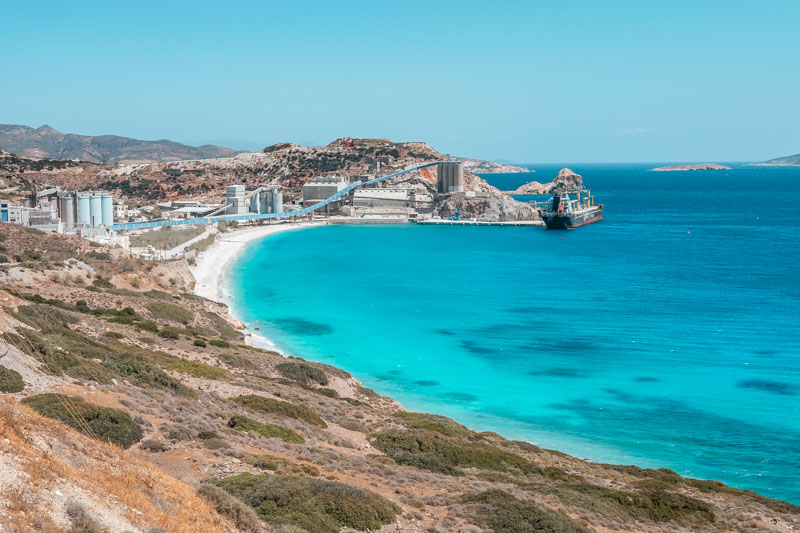
Perlite is a true all-rounder; it is used, among other things, as an additive in paints and plasters, as an insulating and filtering material, and even as a substrate, as well as an additive in toothpaste.
→ An interesting article on the history of mining on Milos can be found on the Milos Mining Museum website: Mining Museum
💡 Milos Book Recommendation: The Greek Island travel guide from Lonely Planet includes an informative chapter on Milos with numerous travel tips and hiking routes: View on Amazon*
Kalamos Fumaroles
Adventure seekers who want to learn more about Milos’ volcanic heritage can take a trip to the extinct Fyriplaka volcano (also known as Tsigrado volcano). Dating back approximately 90,000 years, it represents the most recent volcanic activity on Milos; the 1,700-meter-wide caldera is clearly visible on satellite images.

The Kalamos fumaroles, which still emit steam today, are located directly above the coastal village of Agia Kiriaki. The path there, however, leads from Zefiria along a bumpy gravel road past the recycling plant below the airport, through the fertile caldera where goats and sheep graze today. After crossing the rim of the caldera, you’ll find yourself in a Martian-like landscape of red and beige rocks.

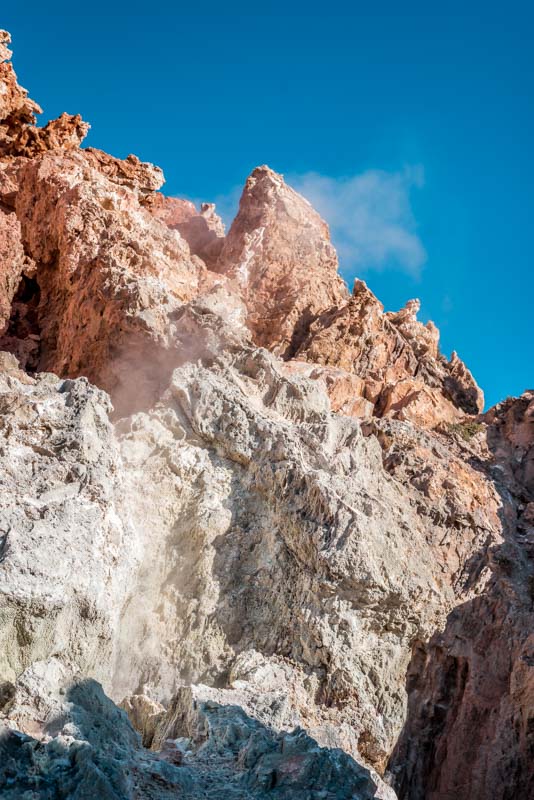
The volcanic fumes are extremely hot and should not be inhaled for too long, as there is a risk of suffocation. Exploration is at your own risk and is recommended only for four-wheel-drive vehicles.
→ An alternative for hikers is the Milos Geowalk No. 2, a description of which can be found here: miloterranean geowalks
#9 Kleftiko Boat Trip
White rock spires, stone arches, and sea caves surrounded by turquoise waters—that’s Kleftiko. Milos’s top attraction is located in the far southwest of the island and is best reached by boat.

The bizarre cliffs of Kleftiko are one of the most photographed spots on Milos and a common motif on many postcards and travel brochures. In the past, the rugged coastline with its numerous sea caves offered pirates an ideal hideout from which to plunder passing ships. This is where the name Kleftiko (kleftis, Greek for thief) comes from.

During the season, countless large and small excursion boats head for the popular coast of Milos. In summer, the bay of Kleftiko can therefore quickly become very crowded. Many people flock here to cool off in the refreshing water. If you wish, you can also rent a small motorboat on Milos without a license and explore Kleftiko.
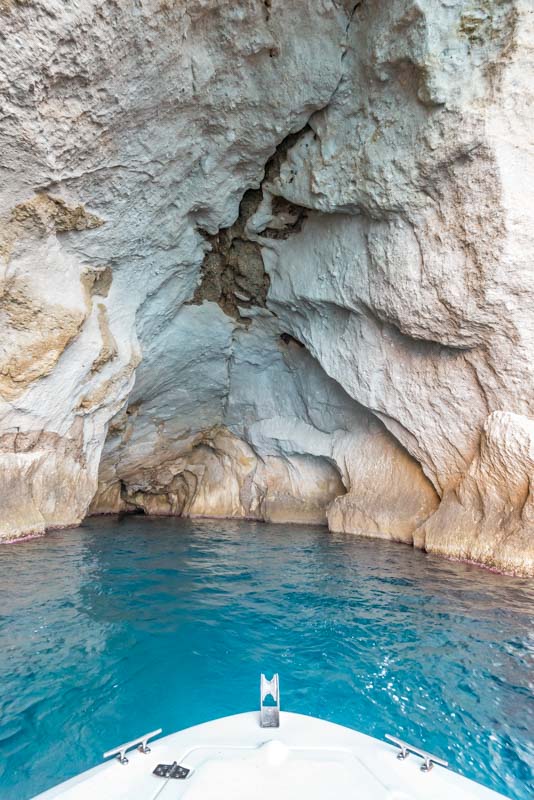

By Motorboat to Kleftiko
We took a private boat tour (approx. 5 hours) with a skipper through the provider Indigo Yachting and highly recommend it. This way, you can avoid the crowds and, with a compact motorboat, even sail into some sea caves to admire the magnificent colors of the water.

The half-day Milos boat tours depart from the coastal town of Agia Kiriaki and cost starting at 250 euros with a skipper and fuel, or 200 euros without a skipper. The travel time from Agia Kiriaki to Kleftiko is approximately 30 minutes (without stops).
→ For more information on private boat tours to Kleftiko, click here: Indigo Yachting

You can find guided tours for larger groups through our partner GetYourGuide*. Click on the links to check prices and availability for trips to Kleftiko:
Hike to the Kleftiko Coast
Would you like to explore Kleftiko on foot? A roughly one-hour hike to Kleftiko, which starts between the usually closed Agios Ioannis Monastery and the hamlet of Xilokeratia (GPS 36.664952, 24.342410), is described on this website: milos-greece

#10 Milos West: From Cape Vani to Profitis Ilias
Two halves of an island could not be more different: Surprisingly green, largely untouched, and almost deserted, the west around Mount Profitis Ilias stands in stark contrast to the tourist-filled east. With Cape Vani at its northern tip, the region also offers one of the most bizarre landscapes on the entire island.
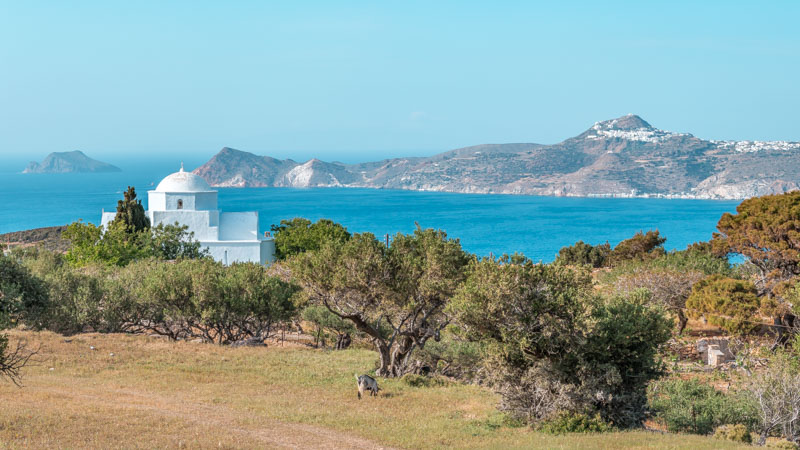
An ideal destination for independent travelers, provided you have an off-road rental car, as many beaches and highlights are only accessible via gravel roads. The paved main road from Milos Airport ends at the large Agia Marina Church. Additionally, west of the hamlet of Provatas, there is only one place to eat, namely in the tiny village of Embourios.
✓ Full coverage & unlimited mileage included
✓ Free cancellation until 24h before pickup
✓ Best price guarantee via Discover Cars
Embourios: In the footsteps of traditional Milos
In Embourios, you’ll embark on a journey through time. The rural settlement with its pretty row of houses right by the sea offers a glimpse into the Milos of days gone by, unspoiled and free from the hustle and bustle. To reach Embourios, turn onto an unassuming road 4 km past Lake Achivadolimni near the Agia Marina Church; this road leads down to the sea.
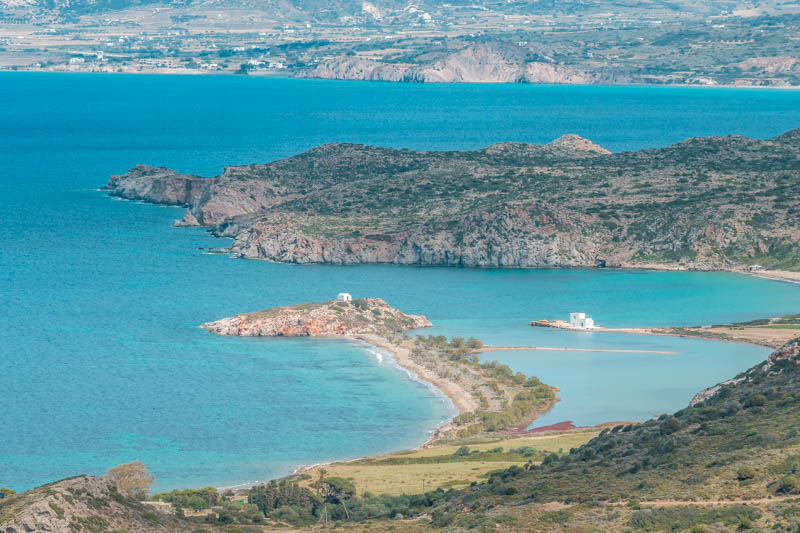
Once you reach the coast, you’ll pass the secluded Fatourena Beach and the Rivari Lagoon, on whose elevated headland stands a snow-white chapel (Agios Nikolaos). A short while later, you’ll reach the hamlet of Embourios with its few houses and a boat landing featuring a restored windmill, accessed via a spiral staircase.
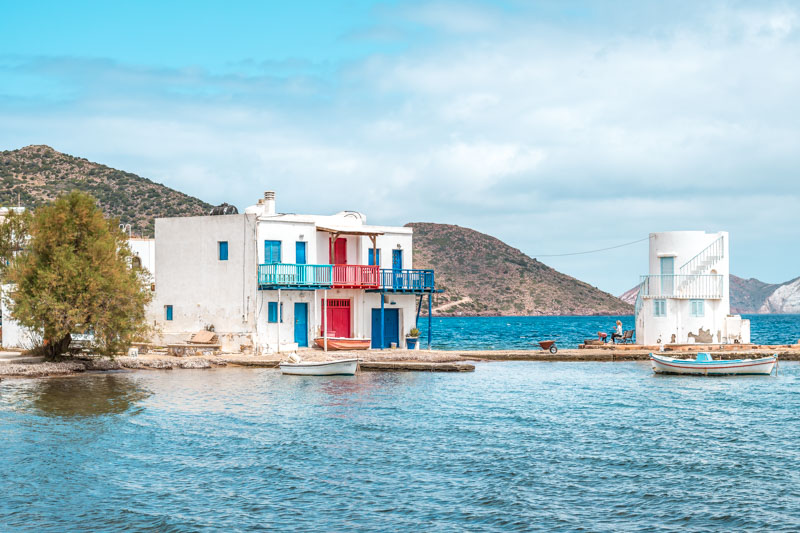
The family-run Taverna Empourios at the end of the row of houses serves traditional dishes made mostly from their own ingredients at prices that are reasonable by Milos standards. During our visit, the quaint family tavern wasn’t open yet (only June through September), but the atmosphere right by the sea seemed very inviting. To continue exploring the western part of the island, we have to head back up to the main road.

Solitude at Cape Vani
A 12-km gravel road leads from the end of the paved road to the northwesternmost point of Milos, Cape Vani, where manganese was mined on a large scale just 100 years ago. The last 4 km, in particular, are littered with potholes. The bumpy drive takes us past old farming settlements and numerous abandoned spoil heaps from the past centuries.

Once you arrive at Cape Vani, you’ll be greeted by the bizarre landscape of Milos’s former manganese mine. If Sarakiniko is the moon, here you’ll find Milos’s Martian landscape. The rocks surrounding the mine, which was shut down in 1928, shimmer in shades of red, black, violet, and rust-brown to beige. To the left and right are numerous adits with branching tunnels, which you are strongly advised not to enter.
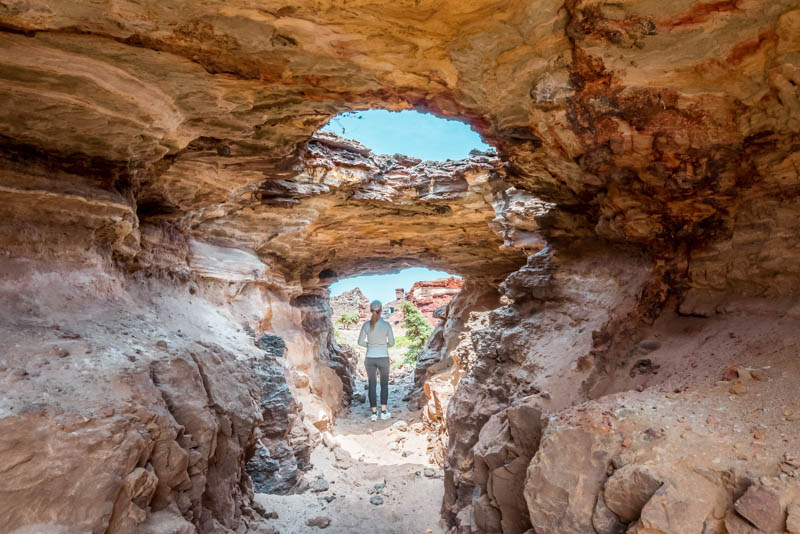
If you make your way through the landscape, furrowed by washed-out gullies and holes, through a rocky gateway to the sea, you’ll be greeted by the wild Vani Beach, which isn’t suitable for swimming due to strong currents. However, it boasts what are likely the most colorful pebbles on the entire island of Milos. Further to the left is an old loading port, behind which rises Vani Rock, a favorite among extreme climbers.
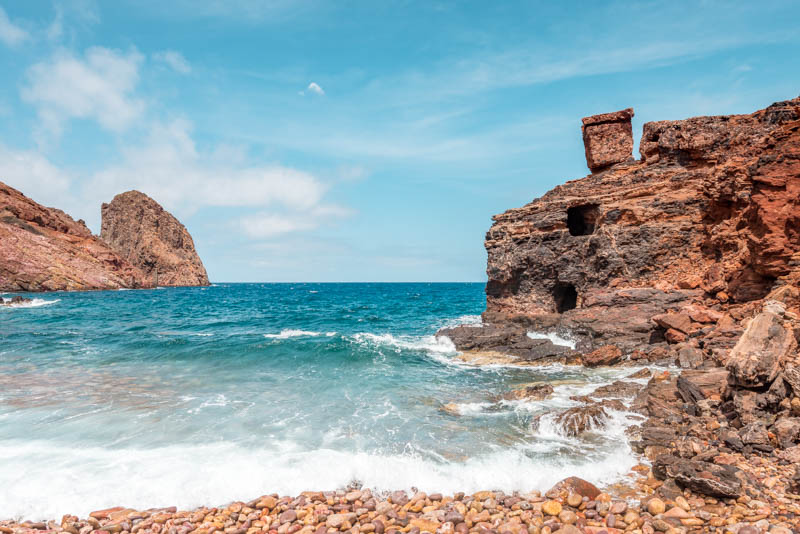
You should plan at least 1.5 hours to explore the slope and bring plenty of water and provisions. A rustic rest area is perfect for a picnic. If you’re in the mood for a refreshing dip afterward, we recommend Kalogries Beach or Agathia Beach. Both are located southwest of Cape Vani and are deserted except for a few anchored sailboats.

Panoramic view from Profitis Ilias Mountain
At 748 m, Profitis Ilias is the highest mountain on Milos. It is a former volcano that went extinct millions of years ago, and its lava domes are still clearly visible. Large gold deposits were discovered inside the mountain, but due to resistance from the local population, they have not been mined to this day.

The ascent to the mountain follows a steep and bumpy dirt road that can be traversed either on foot (5 km from the Ralaki–Xilokeratia road junction) or by off-road vehicle. The drive is not for the faint of heart, as the road is unsecured in places.

From the summit, you can enjoy a magnificent view of Milos and a large part of the Cyclades islands, including the immediate neighbors Kimolos, Sifnos, Serifos, and Folegandros. On clear days, the view extends all the way to Crete. The trail to Profitis Ilias should only be attempted on cloudless and windless days, as the weather can change rapidly at the top.

#11 Milos Beaches: Our Top 5
Milos is also known as the Greek Island of Colors, as its coastline shimmers in the most beautiful hues. On this Cycladic island, you’ll find sandy and pebble beaches in shades of gold, red, white, brown, and even volcanic black. Some beaches are also made up of colorful pebbles.
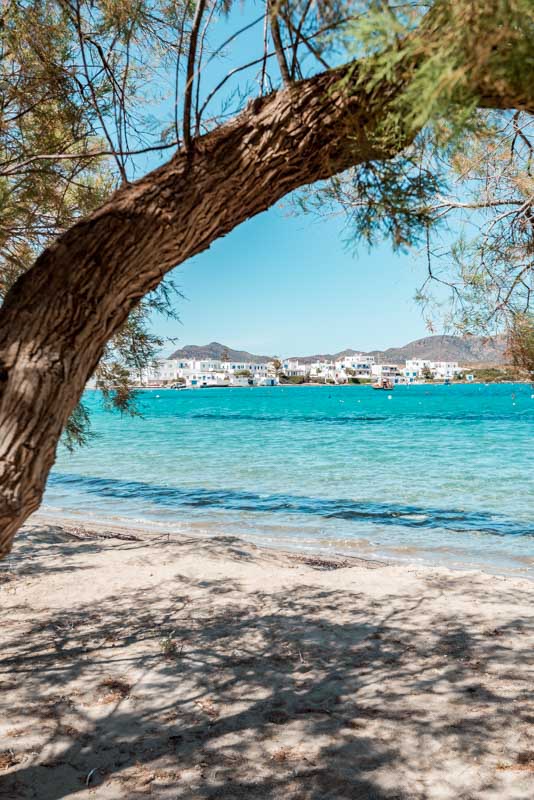

Rarely have we enjoyed such a variety of swimming spots in Greece. Here is a small selection of our personal favorite beaches, which weren’t overcrowded even in the off-season. You can find all of our top 10 beaches and swimming spots on the island in this post: Milos Beaches
Achivadolimni Beach – A sandy beach in the south of Milos Bay, not far from the small lake of the same name. In the summer, a beach bar offers umbrellas and cool drinks. Otherwise, most of the kilometer-long stretch of coastline is untouched; the further east you go, the more deserted it becomes. When the wind blows from the north or west, the surf is strong, and seaweed is occasionally washed ashore.

Agios Sostis Beach – The western neighbor of the popular Provatas Beach (Golden Beach), yet much quieter and more natural. The descent from the Tarantella tavern is via a concrete staircase. The golden sandy beach offers a gentle slope into the sea, making it ideal for children. A few tamarisk trees provide shade.
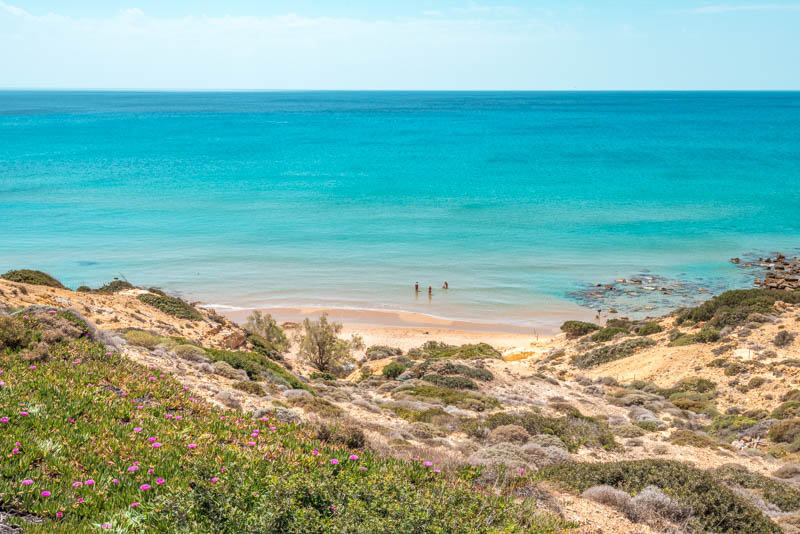
Fyriplaka Beach – One of the beaches that earned Milos the name “Island of Colors” – a turquoise-blue cove with a backdrop of volcanic rocks in shades of red, yellow, and magenta. Due to its length and seclusion in the south of Milos, the beach remains uncrowded even in summer. Parking spots at the beach are scarce.
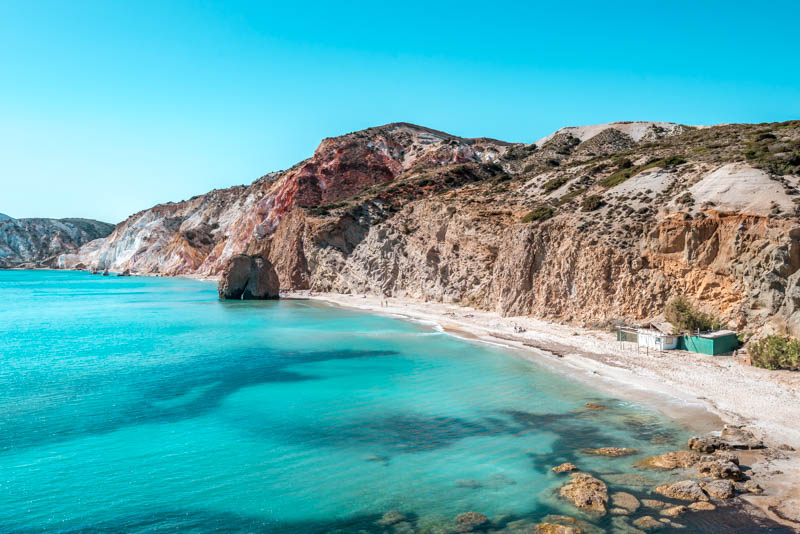
Kastanas Beach – A wild beach in the east of Milos, difficult to reach via a bumpy gravel road and therefore a haven for individualists. The highlight of the beach is the exceptionally colorful round pebbles. There is hardly any shade, and high waves form when the north wind blows.
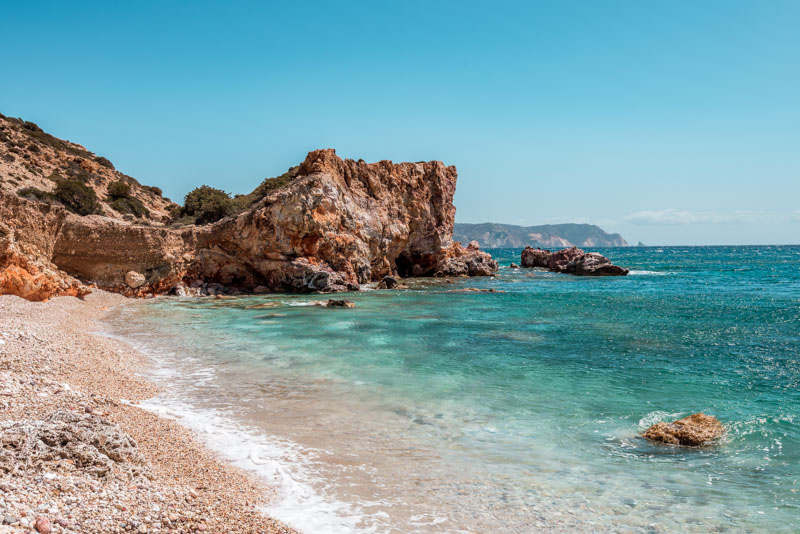
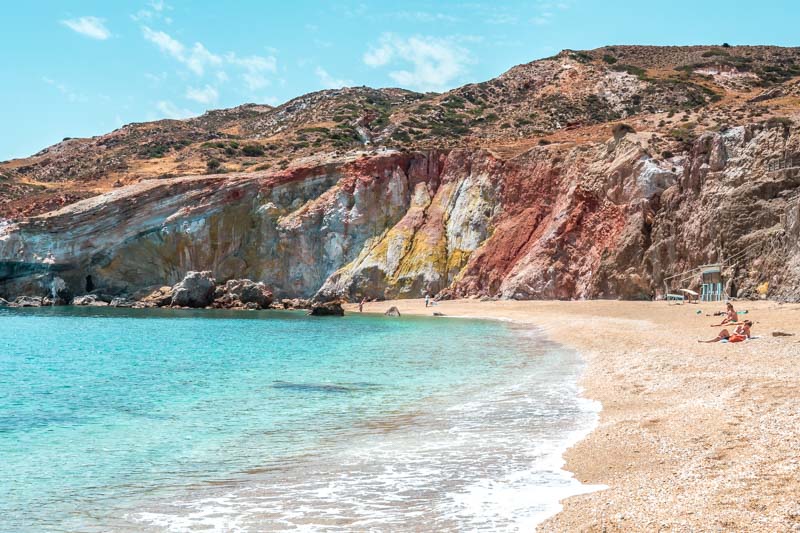
Paleochori Beach – a sprawling, dark-brown volcanic beach with several dining options on-site (including Scirocco Restaurant). A rocky path to the west leads to Tourlos Beach, which also features a bizarre, colorful rock formation as a backdrop. The water is crystal clear, but the entry into the water is very steep.
More Milos Travel Tips
Guided tours on Milos
Milos and the surrounding Greek islands have been popular with sailors for years; the fascinating coastal landscape is simply enchanting. A boat trip around the coast of Milos, including stops at Polyegos and Kleftiko, is a standard part of any vacation. Guided land excursions are also available, such as visits to wineries and e-bike tours.
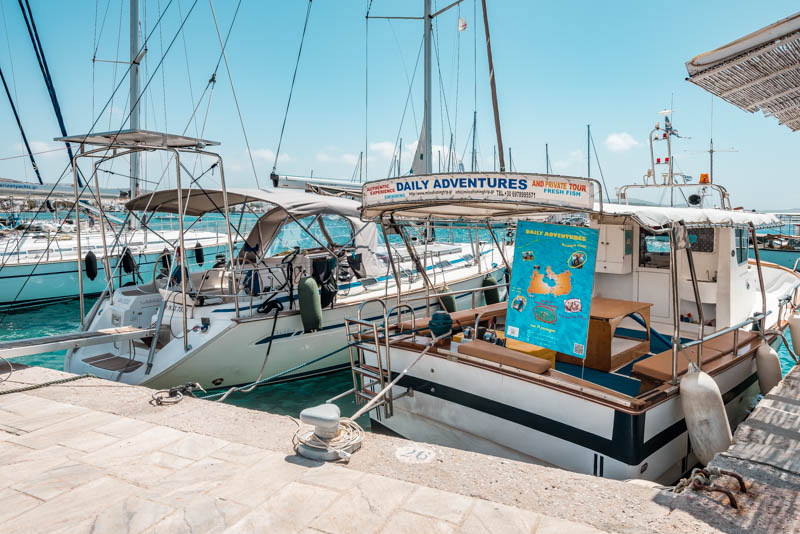
→ Click on the links to GetYourGuide* to find out details such as availability and prices for the tours:
➲ To the sailing excursion incl. lunch*
➲ To the kayaking tour around the coast*
➲ To the e-bike tour into the hinterland*

Accommodations on the island of Milos
Although the island of Milos has become known worldwide in recent years, you won’t find any large hotel complexes (yet). However, there is still a construction boom on the island, with new villas and small boutique hotels popping up in many places. Independent travelers can find beautiful vacation rentals in almost every corner of the island, bookable via Airbnb, among other platforms.
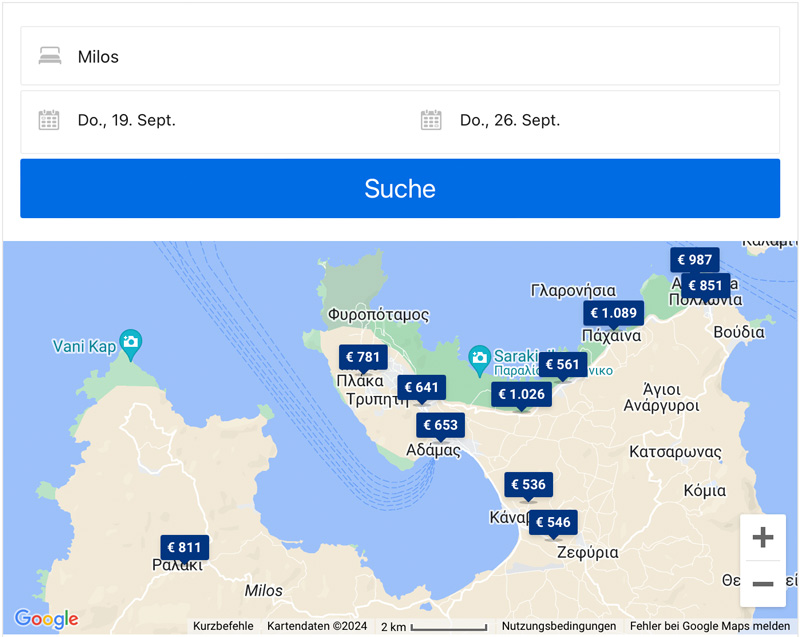
→ On Booking.com* you’ll find many accommodation options on Milos and can compare them directly on a map:
➲ View accommodations on Booking.com*
Advertisement
Here’s where we stayed on Milos
My Suite Milos, Parasporos
Our stay with Athanasia and Yiannis was a true haven of comfort on Milos. The spacious and lovingly furnished apartment offers a magnificent view of the sea and the towns of Adamas and Plaka. A terrace with an outdoor shower, a large balcony, and a fully equipped kitchen—including a breakfast package—round out the excellent overall experience.

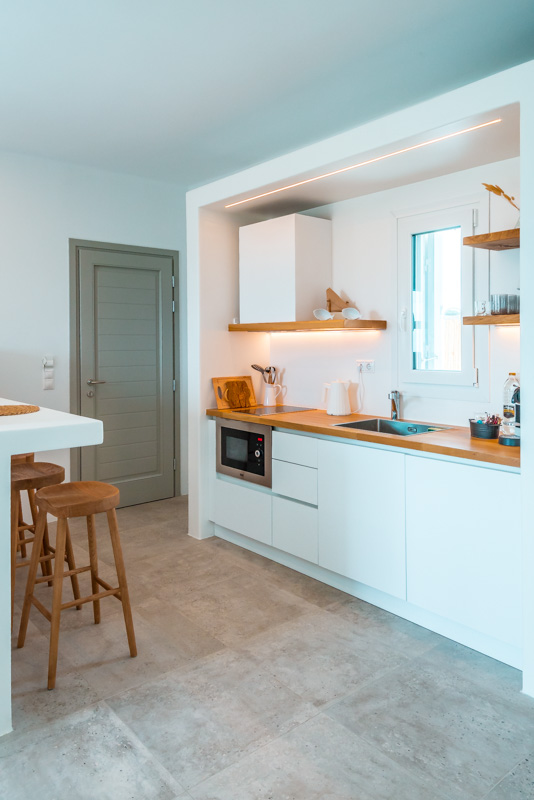
The suite accommodates up to 4 people and is ideal for exploring the island of Milos in depth. Thanks to its central yet quiet location, you can reach the coast of Sarakiniko in just five minutes, for example. You can view our beautiful accommodation and book it if desired via Booking.com*:

More hotel recommendations for Milos
Our recommendations for good hotels on the island of Milos can also be booked on Booking.com*. Click on the links to check prices and availability:
- Domes White Coast Milos (Location: Sarakiniko, Budget: $$$)
- Hotel Milos Sea Resort (Location: Achivadolimni, Budget: $$)
- Hotel Rigas (Location: Adamas, Budget: $)

Restaurants on Milos: Our Recommendations
The culinary diversity has suffered from the hype surrounding Milos; many taverns have already catered to international tourists and serve pizza, pasta, and high-priced fusion cuisine. Traditional eateries with typical Greek cuisine and rustic charm are rare, and prices on Milos are very high.
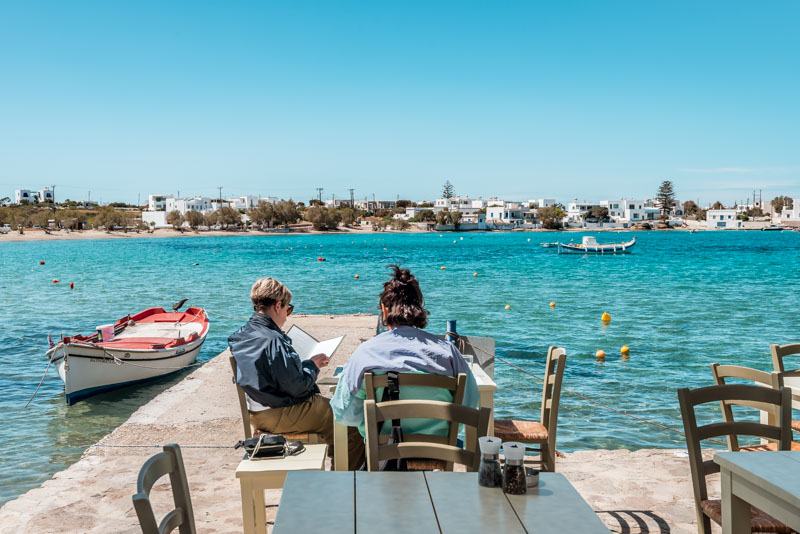
We asked a local about his favorite restaurant on Milos, and he told us with a slightly wistful tone that he prefers to eat at home, which probably says it all… Nevertheless, we’ve tested a few cafes and restaurants on Milos for you and they were pretty good. You’ll find our recommendations below:
Oasis Canteen, Mandrakia
A cozy open-air café with seating right above the pretty village of Mandrakia. Good coffee, delicious cocktails, and small snacks make a stop here worthwhile at any time of day.

Deck Milos, Apollonia
A laid-back café-bar run by the friendly owner Andreas. From the rooftop terrace, you have a magnificent view over Pollonia Bay. Ideal for a lunch break and a light snack. Our tip: Pinsa Burrata and Burrata Salad!

More recommendations for places to eat on Milos:
- EN PLO, Plaka
- Karodromos, Triovasalos
- Kokkino Podilato, Plaka
- …
Looking for more restaurant recommendations in Milos?
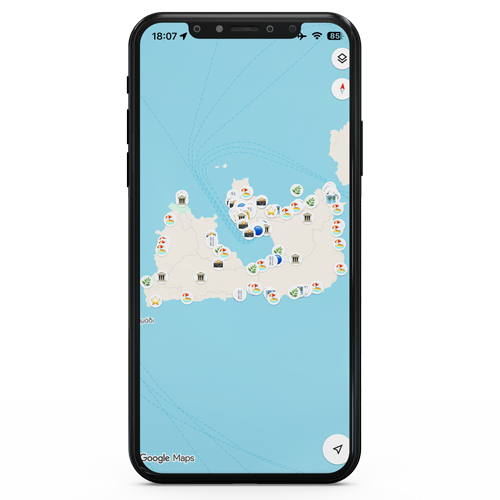
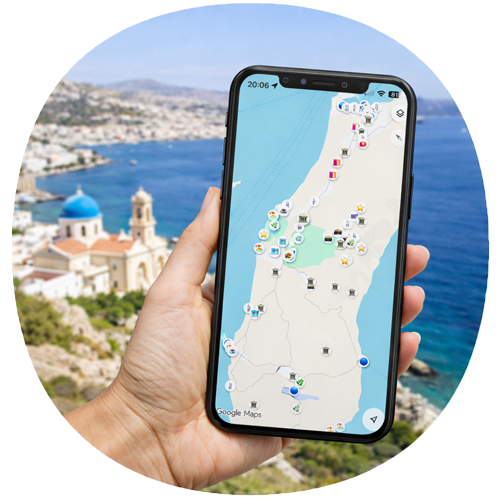
→ Check out our Google Map for all the recommended cafes and taverns on Milos: Go to the Milos Map
💡 Milos delicacies: Like many places in Greece, Milos has its own regional specialties. Almost every tavern offers hearty Pitarakia Milou (Milos cheese pockets), fried pastries traditionally filled with spicy island cheese made from sheep’s milk. In the summer, Karpouzopita (watermelon pie) is baked—a cake made with watermelon chunks, flavored with honey and cinnamon. A great culinary souvenir from the island is Beltes (Milos tomato juice), an aromatic paste made from sun-dried tomatoes, available at some specialty shops in Adamas and Plaka.
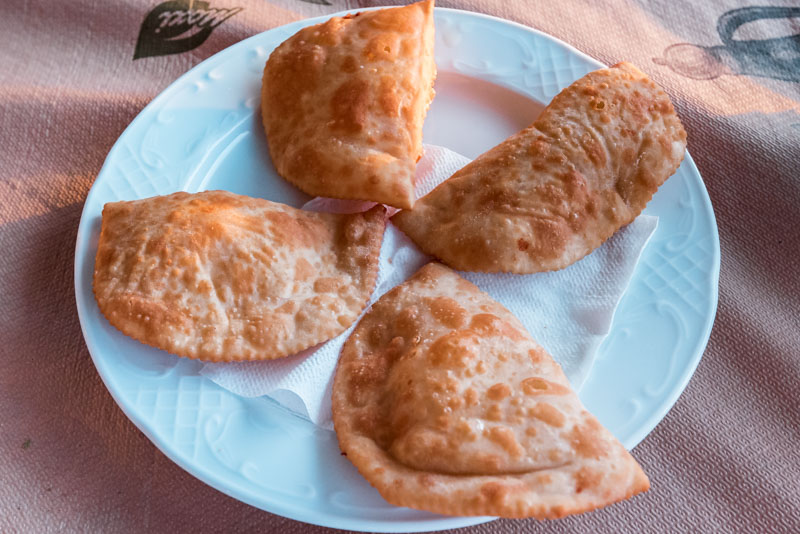
Cheese pockets from Milos
Rental cars for the island of Milos
As a diverse island, Milos invites you to explore. Many roads in the northeast and center are paved, but if you want to discover the hidden treasures in the south and west, you’ll need a sturdy vehicle (e.g., Jeep, Suzuki) for the gravel roads. Adamas is teeming with car rental agencies and we recommend the reliable and family-friendly provider Giourgas Rent a Car.
→ You can reserve your Milos rental car in advance through our partner Discover Cars*:
➲ View offers on Discover Cars*

Getting around Milos by taxi and bus
Milos has a reliable bus network. Buses run several times a day from Adamas to Plaka and Apollonia. There is even a bus to Sarakinko, and at €2 per ride, the fares are very affordable. The municipality of Milos makes every effort to keep the bus schedules up to date, and the bus routes are also available online.
→ You can view the current bus schedules for Milos here: Milosbuses

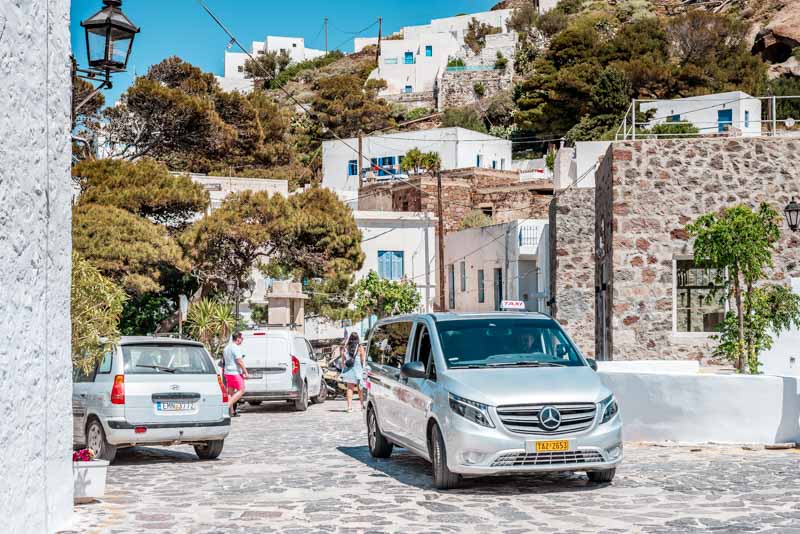
Taking a taxi on Milos, on the other hand, is not a cheap endeavor, €30 for a 10-minute ride is not uncommon. The taxi stand is located at the port of Adamas. There are no taximeters, so the price must be negotiated in advance. If you need an airport transfer, you should contact your hotel or use Andreas’s Milos Concierge Service.
→ More information about the concierge service on Milos is available here: Milosconcierge
Getting to the island of Milos
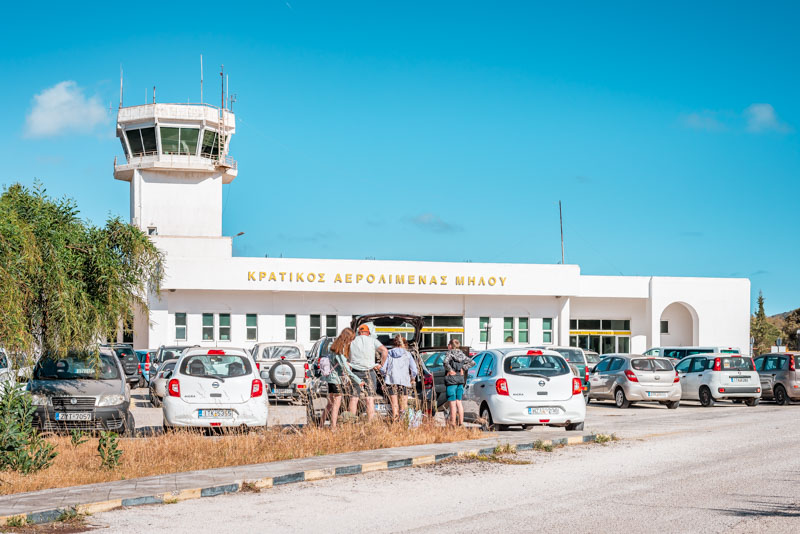
Although the island of Milos has a national airport, most visitors reach this Cycladic island by ferry. Milos Airport (MLO) is located in the center of the island near the village of Zefiria. Propeller-driven aircraft (including Olympic Air) fly year-round from Athens International Airport to Milos; however, the small airport cannot accommodate direct flights from abroad.
→ You can find affordable flights with a stopover in Athens through our partner Skyscanner*:
➲ Search for flights on Skyscanner*
Ferry Connections to Milos
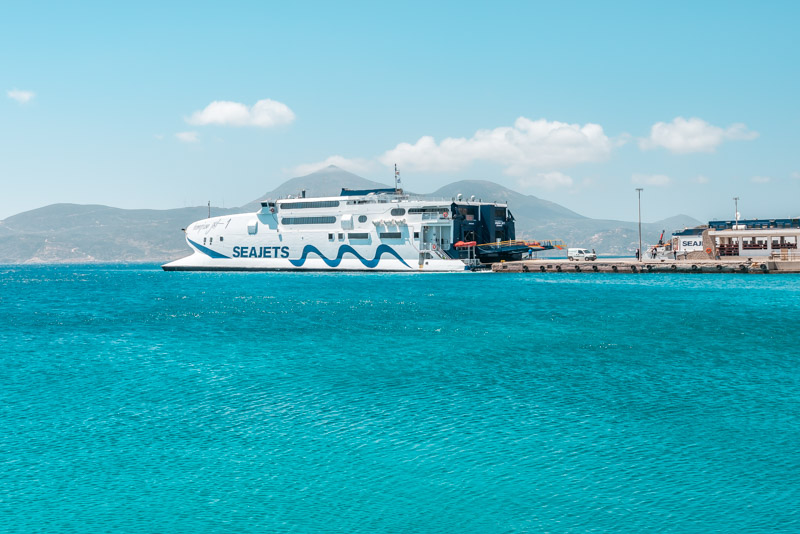
Milos, the most important tourist destination in the Western Cyclades, is served several times a day by various ferry companies from Piraeus. The journey takes just 2.5 hours by high-speed catamaran. During the summer months, ferry service is even expanded, making Milos accessible from Crete (5 hours) and Santorini (2 hours) and allowing for onward travel to those destinations.
→ The following ferry companies serve the island of Milos from Piraeus (Athens):
- SeaJets (from 2.5 hours)
- Aegean Sea Lines (approx. 6.5 hours)
- Minoan Lines (approx. 4 hours)
- Zante Ferries (approx. 5.5 hours)
→ This article provides all the necessary information for traveling to Milos by ferry: Ferries in Greece
→ Through our partner Ferryhopper*, you can search for ferry schedules and conveniently book your ferry ticket to Milos:
➲ Search for ferries on Ferryhopper*
Milos sights in the video
Check out the video by Tomas Polasek © for impressions of the island of Milos:
🔍 Our conclusion about Milos: After 10 days on the island and many impressions later, we can say: Milos is a great island and really surprised us in a positive way! We never would have thought that Milos is so diverse: the colorful boat garages, the bizarre rock formations of Sarakiniko, the wild, untouched west, the island’s capital Plaka, which can be seen from almost everywhere thanks to its Kastro—Milos has its own identity, and that’s what makes an island for us. Add to that the truly lovely locals, who proudly showed us their beautiful island. What we didn’t like: The trash problem and the generally high prices on the island (expensive restaurant prices without better quality). Overall, we found it difficult to find a truly good traditional taverna. We didn’t discover the authentic Greece on Milos anymore; due to international tourism, much of it is already very cosmopolitan—for example, traditional village structures with quaint kafenia are missing. Milos is definitely worth a visit, but if you can, you should (according to the locals) avoid the summer.
→ You can find more travel reports and tips for the Cyclades on our overview page: Cyclades Islands
*Support our blog Greece-Moments
This post contains affiliate links marked with an asterisk (*). If you book or purchase something through one of these links, we receive a small commission. The price remains the same for you. This helps us continue to provide high-quality content for free. Did you enjoy this post and want to say thank you? Then simply buy us the next Greek coffee ☕️ To the coffee fund
Did you enjoy this post? Then save it on Pinterest!