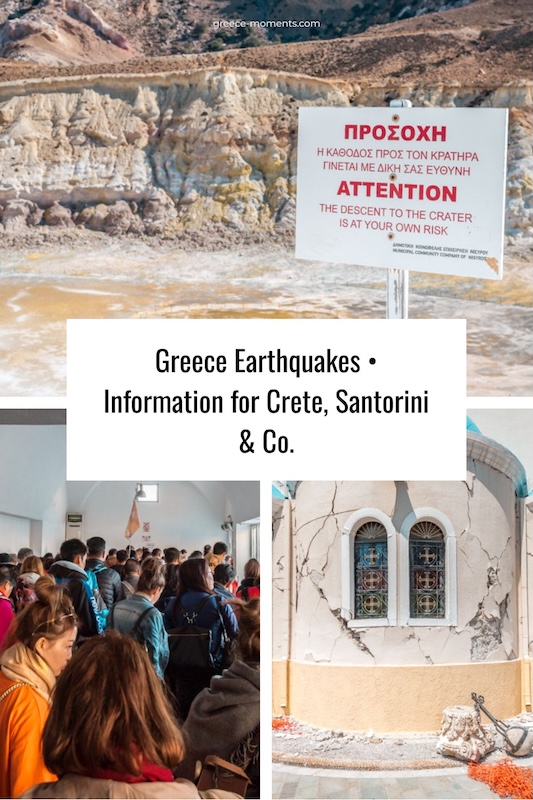

Greece is one of the sunniest holiday destinations in Europe, but also one of the most seismically active regions in the world — true to the motto: even in paradise, the ground can rumble. The ancient Greek word ‘seismos’ means ‘shaking’, and while the gods were said to be at work in the past, we now know what causes Greece earthquakes.
“Greece has more earthquakes per year than any other country in Europe — fortunately, most of them are barely noticeable.”
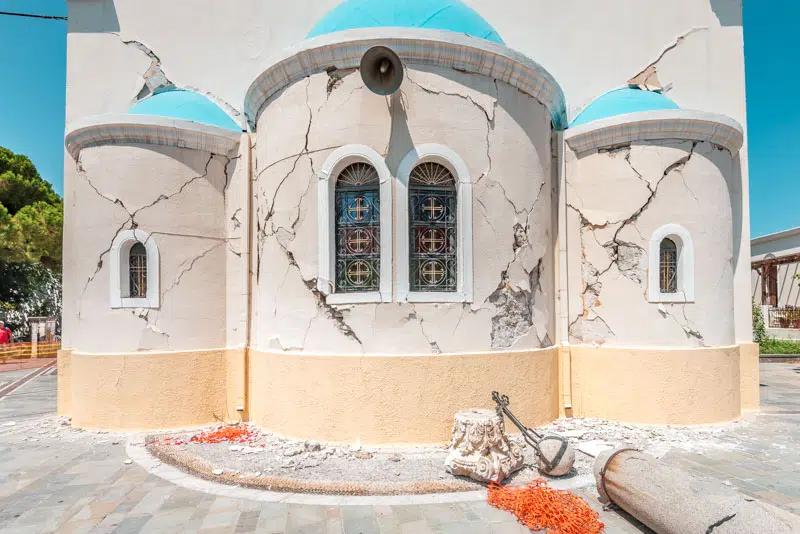
Personally, in the more than 15 years that we have been travelling to Greece, we have experienced earthquakes on the Greek islands ourselves. Nevertheless, there is no reason to panic — people in Greece have been living with them for thousands of years. Even in ancient times, temples were built to be earthquake-proof.
If you hear about an earthquake on Crete, Santorini & Co., you may wonder: why are there earthquakes on the Greek islands and how do they occur? Is your destination affected, and are there any safety warnings or travel restrictions for your holiday?
In this post, you’ll find answers to these questions and important tips for your trip. We also look at the influence of the volcanoes on the Greek islands — such as Santorini, Milos and Nisyros — and whether you should let them affect your holiday plans in Greece:
#1 Why are there earthquakes and volcanoes in Greece?
In the eastern Mediterranean, there are several plate tectonic phenomena that can lead to earthquakes in Greece. Since we are not geologists, we will stick to the essentials. In the south of the country, at the so-called Hellenic subduction zone, the African Plate pushes northwards and dives under the Eurasian Plate.
The folding of the earth’s crust created Crete with its mighty mountains. At the same time, magma emerged and formed the Greek volcanoes of the Hellenic island arc. In the east, near the islands of Kos, Samos and Lesbos not far from the Turkish coast, the Anatolian Plate grinds against the Eurasian Plate, and the resulting fault line leads to earthquakes.
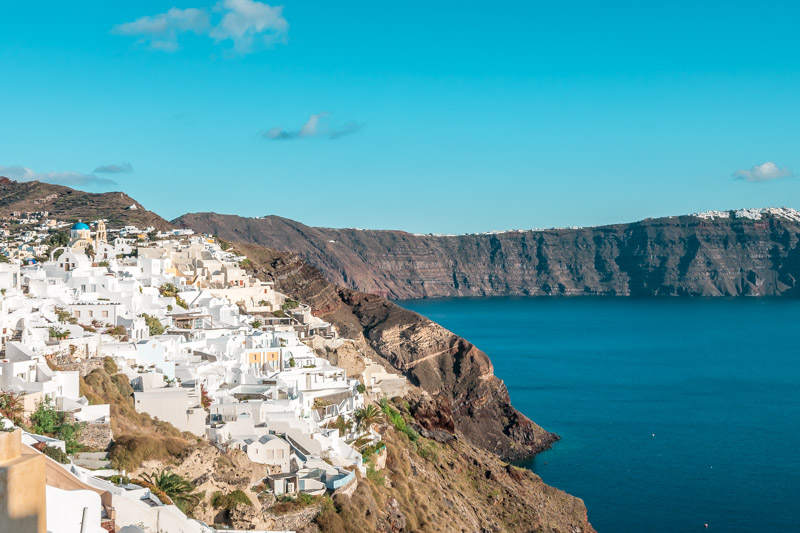
The central stage of this “plate battle” is the Aegean Sea with its many beautiful Greek islands like Santorini & Co. The plates move extremely slowly towards each other, typically only 50 millimetres per year, so the friction between them is barely noticeable. This continues without incident until Mother Earth has had enough and really “lets off steam” every few years or decades.
💡 Volcano god Hephaestus: Earthquakes and volcanic eruptions were seen as signs from the gods 2,000 years ago. The ancient Greeks regarded volcanoes as the forge of the god Hephaestus, who created weapons and armour deep underground. When lava flowed from the vents, the volcano god was at work. He was particularly fond of the island of Limnos in the North Aegean. Incidentally, the Romans called the god Vulcanus, from whom today’s word “volcano” is derived.
Plate tectonics simply explained
The outermost layer of our earth (the earth’s crust) consists of several tectonic plates, which fit together like a giant puzzle made up of pieces of varying sizes. Currents in the liquid mantle keep them in constant motion, allowing them to shift by several centimetres per year.
At some point, the plates get stuck, get caught and tensions build up. At the boundaries of two or more plates, the pressure increases and sudden releases occur — the earth shakes, volcanoes can form, and even deep-sea trenches can appear in the ocean.
Geologists distinguish three different types of plate movements:
- Divergent plate boundaries: two plates move away from each other, creating fissures in which hot magma rises (e.g. Iceland, East African Rift)
- Convergent plate boundaries: two plates collide, one plate can slip under the other, and the pressure creates mountains and volcanoes (e.g. the Himalayas, the Japanese islands)
- Transform plate boundaries: two plates slide past each other along tectonic fault lines, so-called faults (e.g. the San Andreas Fault, the Anatolian Fault)
#2 Santorini earthquake 2025
The earthquakes on Santorini increasingly came into the public eye in February 2025. The volcanic complex around Santorini (see point #3) had been showing increased seismic activity since the beginning of the year. The initially small quakes had expanded into strong earthquake swarms since the end of January.

Up to 150 earthquakes per day were recorded just a few kilometers northeast of the Greek volcanic island, with the epicenter only a few kilometers deep. The cause was probably the Kolumbos volcano (also Koloumbo), which is located in the sea and belongs to the volcanic field of Santorini. A current map of Santorini earthquakes can be found here: Volcano Discovery
The Kolumbos volcano is located between the islands of Santorini, Amorgos, Ios and Anafi. For decades, this underwater volcano, which reaches a depth of 500 meters, has been closely studied. In many places, hot thermal water (approx. 225 degrees) emerges from submarine chimneys up to 4 m high.
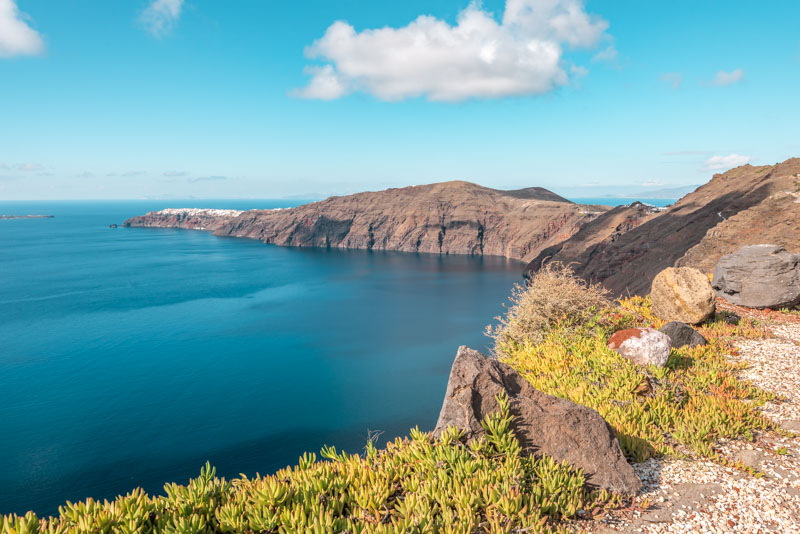
Experts believe that, over the centuries, an extremely high-pressure magma chamber has formed beneath Santorini. The approximately 13,000 inhabitants of Santorini are alarmed — especially among the elderly, memories of the severe earthquake of 1956 have been reawakened, in which the village of Oia was almost completely destroyed.

By 5 February 2025, most residents had left the island. The first strong earthquakes had already triggered landslides on Santorini. On 6 February 2025, a state of emergency was declared and schools and public institutions were closed. By mid-February, the Santorini earthquakes had begun to subside. In March 2025, everyday life returned to the island. Seismic activity has calmed down, the earthquakes have eased, and holidays on Santorini are currently possible again.
#3 Greece earthquakes at a glance
As already mentioned, parts of the Greek islands and some mainland regions are potentially vulnerable to earthquakes due to local plate movements. However, as a holidaymaker, you can also encounter this elsewhere in Europe, e.g. in southern Italy, Turkey, and the Canary Islands.
Earthquakes occur in Greece every day, most of them in the imperceptible range of magnitude 1–3. If you’re traveling to seismically active Greece as a vacationer, it’s wise to be aware of these natural forces. Under point #5 in this post, we have shared our personal experiences with earthquakes in Greece.

But don’t worry — new buildings and hotels are constructed to be earthquake-proof, and many Greek construction companies have made a name for themselves as earthquake experts throughout Europe. We would like to point out again that severe earthquakes with magnitudes above 6 or 7 are extremely rare in Greece.
💡 The strength of an earthquake is indicated by its magnitude, i.e. how much energy was released. The larger the number, the stronger the tremor. A magnitude (abbreviation M) of 1.0 to 3.0 is often imperceptible and causes no damage. From a magnitude of 4.0, you can feel the quake — for example, when pictures on the wall start to wobble — but it rarely causes significant damage. A quake of 5.0 or more can throw you off balance, while magnitudes of 7.0 or more are extremely powerful and can cause widespread destruction, especially near the epicenter.
The consequential damage of an earthquake depends not only on its magnitude, but also on the duration and depth of the quake (kilometres below the earth’s surface), the epicenter (the point on the earth’s surface directly above the origin), and the type of ground (e.g. under the sea or on the mainland). For example, an earthquake of magnitude 7.0 can sometimes have less impact than one of magnitude 6.5.
How often does the earth shake in Greece?
Active earthquake research in Greece has been ongoing since the mid-19th century. In 1898, the first seismograph was installed in Athens, and early warning systems were introduced on the Greek islands as early as 1965. Since then, earthquakes in Greece have been recorded almost continuously.
In 2024, there were around 200 earthquakes with a minimum magnitude of 4.0 (source: earthquakelist.org). Earthquakes occur with varying degrees of intensity across almost the entire country. On the islands, the epicenters are often located on the Turkish coast, and severe earthquakes have frequently struck Samos, Chios, and Kos.
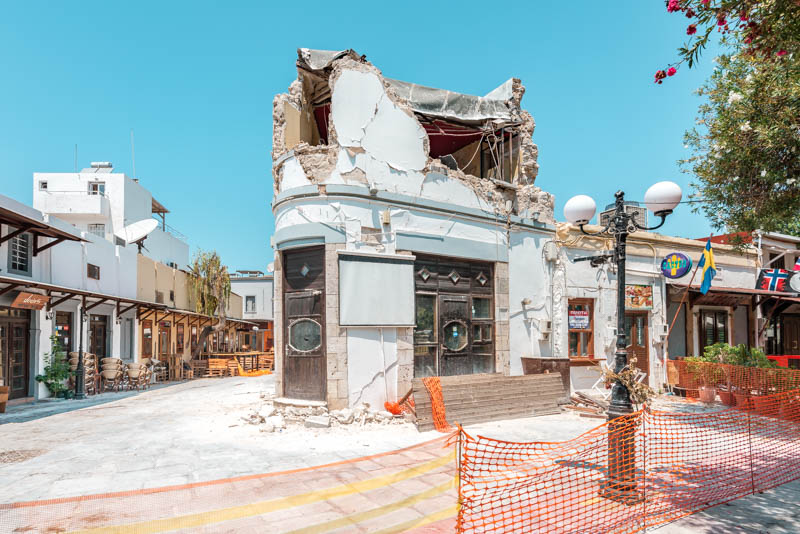
In the last 10 years, however, only one earthquake in Greece reached a magnitude of 7.0 (Izmir – island of Samos, October 2020), along with 10 earthquakes of magnitude 6 or greater, which caused damage to buildings and resulted in civilian casualties. The most destructive earthquake of the last 150 years was the Chios earthquake in 1881 (M 6.5).
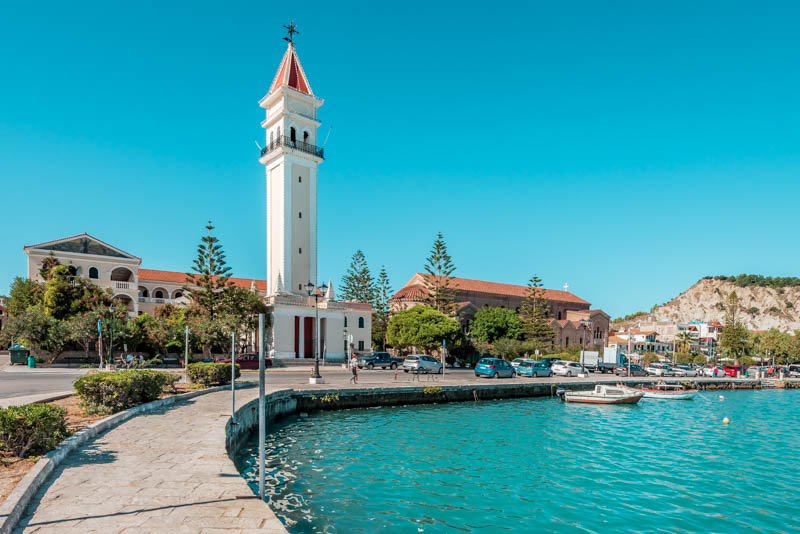
Frequently affected by earthquakes are Crete and the islands of the Eastern Aegean, but also the Ionian islands such as Kefalonia, Lefkada and Zakynthos. The reason for this is the African Plate, which advances far to the north and makes up a large part of the seabed of the Ionian Sea and burrows further every year. West of the island of Zakynthos the water depth reaches up to 5,000 meters.
Are there earthquake-free regions in Greece?
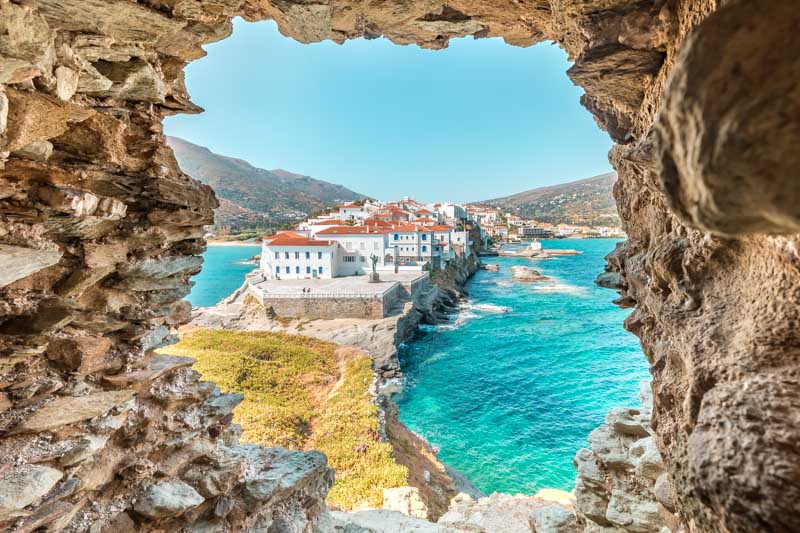
Besides the central and eastern parts of northern Greece, most of the Cycladic islands have proven to be almost earthquake-free. An analysis of earthquakes (M 4 – M 7) between 1900 and 2023 showed that islands such as Mykonos, Naxos, Tinos, and Andros experience hardly any seismic activity in their vicinity.
An exception is Santorini and the surrounding islands such as Amorgos and Anafi. Among the Ionian Islands, Corfu is considered to be an earthquake-free region in Greece.
History of the strongest earthquakes in Greece
Since people have been living in the Mediterranean region, they have been reporting violent earthquakes. The reports go back several millennia, even if their accuracy is difficult to verify today. Strong earthquakes do not occur suddenly, but are usually preceded by a swarm of smaller quakes.
Nevertheless, many earthquakes in Greece’s history have caught the population unprepared. Quite a few ancient cities were completely destroyed by the tremendous tremors. The most famous is Akrotiri on Santorini, which was devastated during the Minoan eruption and lay buried under ash for centuries.
→ Here is an overview of the strongest earthquakes in Greece:
- September 27, 2021 – Earthquake in Crete (M 6.0): near Arkalohori, 30 km southeast of Heraklion, more than 1,000 buildings damaged
- October 30, 2020 – Earthquake off Samos (M 7.0): numerous buildings damaged and 2 fatalities
- July 21, 2017 – Earthquake off Kos (M 6.6): significant damage on Kos, one fatality
- September 7, 1999 – Earthquake near Athens (M 6.0): 1,600 injured, 50,000 people left homeless
- July 9, 1956 – Amorgos earthquake (M 7.8): Oia on Santorini badly damaged, as well as settlements on Amorgos
- August 12, 1953 – Earthquake near Kefalonia and Zakynthos (M 6.8): many settlements destroyed
- April 23, 1933 – Earthquake near Kos (M 6.4): damage on Kos and Nisyros, including the village of Emporios, which was severely destroyed
- September 26, 1932 – Earthquake in Halkidiki (M 6.9): Ierissos and other villages in the east were destroyed
- June 26, 1926 – Earthquake off Rhodes (M 7.4): large tsunami and several aftershocks
- April 3, 1881 – Chios earthquake (M 6.5): Chios town almost completely destroyed
- February 4, 1867 – Kefalonia earthquake (M 7.9): Lixouri completely destroyed
- February 16, 1810 – Earthquake off Crete (M 7.5): Heraklion severely affected
- June 7, 1750 – Kythira earthquake (M 7.0): almost all settlements severely damaged
- September 30, 1636 – Earthquake off Kefalonia (M 7.2): Hundreds of victims and damage on Kefalonia and Zakynthos
- May 29, 1508 – Earthquake off Crete (M 7.2): severe damage in eastern Crete and Ierapetra
- August 6, 1384 – Lesbos earthquake (M 6.8)
- August 8, 1303 – Earthquake near Crete (M 8.0)
- December 856 – Corinth earthquake (M 7.9): Corinth devastated, probably 45,000 victims
- July 7, 551 – Gulf of Corinth (M 7.1)
- 365 AD – Earthquake off Crete (M 8.0): devastating catastrophe across the entire Aegean Sea
- 426 BC – Earthquake in the Gulf of Euboea (M 7.1)
- 1620 BC – Minoan eruption: eruption of the Santorini volcano, with impact throughout the Mediterranean

#4 Volcanoes in Greece
For us personally, Greece is one of the most fascinating regions in the world. The Aegean Sea, as part of the Mediterranean, is not only a popular holiday destination, but also the stage for powerful natural forces. Between turquoise-blue waters and enchanting beaches lies a chain of still active volcanoes.
Stretching over a length of 450 km, the Greek volcanic arc (also known as the Cycladic fire arc) extends from the mainland near Methana in the west to the Greek islands of Kos and Nisyros, and on to Bodrum in Turkey in the east. Even though part of it is considered extinct, there is still plenty of volcanic activity in Greece.

As in other countries of the world (e.g. New Zealand and Indonesia), volcanoes have become a major focus of tourist interest in Greece. From the picture-book flair of the volcanic islands of Santorini and Milos to the possibility of descending into an active volcanic crater on the island of Nisyros, the volcanoes of Greece are already attracting crowds of holidaymakers.

Volcanoes of Santorini
Thera Volcano – Last eruption: c. 1520 BC
The Thera volcano was formed 360,000 years ago on the island of Santorini and is the largest volcano in the Christiana-Santorini-Columbo Volcanic Field complex. Around 3,500 years ago, it erupted in a massive explosion (the Minoan eruption) and was flooded by the sea. Ash and pumice were hurled hundreds of kilometres.
Today, the remaining Santorini Caldera, with the islands of Thira (Santorini), Thirasia and Aspronisi (uninhabited), is a dream destination for holidaymakers from all over the world. Against this backdrop, scientists have been alarmed for years, as the 60 km long volcanic field around Santorini has the highest activity of all Greek volcanoes.
Paleo Kameni – Last eruption: 726 AD
The volcanic island of Paleo Kameni is only 900 by 200 meters in size and 98 meters high. The barren island is located in the center of the Santorini caldera, right next to Nea Kameni (nea = new, paleo = old), and was probably formed in several phases from 46 AD. Today, Paleo Kameni with its sulphurous thermal springs is a popular destination for Santorini tourists.
Nea Kameni – Last eruption: 1950
At 2 km by 2 km, Nea Kameni is larger than the neighboring volcano Paleo Kameni and was probably formed through a series of submarine volcanic eruptions in the 16th and 17th centuries. Repeated eruptions with lava flows caused the island to grow over time. Fumaroles on the upper twin crater bear witness to the ongoing activity of this Santorini volcano.

Columbos – Last eruption: 1650
The submarine volcano Koloumbo (also known as Kolumbos) lies about 7 km northeast of Santorini. The entire volcanic chain, with more than 24 submarine cones, stretches for several kilometers toward the island of Amorgos. The last eruption in 1650 caused devastating damage to Santorini and the neighboring islands. The earthquakes that occurred in early 2025 have been linked to this volcano.
More information and tips about Santorini can be found in our article: Santorini
Nisyros volcano
last eruption: 1888
The Volcano of Nisyros is located in the eastern Aegean Sea, just a few kilometres south of the famous Greek island of Kos. The volcanic island is a popular destination, with boats crossing from the large neighbouring island every day. We were also captivated by the wild nature of Nisyros — we have already visited the island, which is only 49 km² in size, eight times.
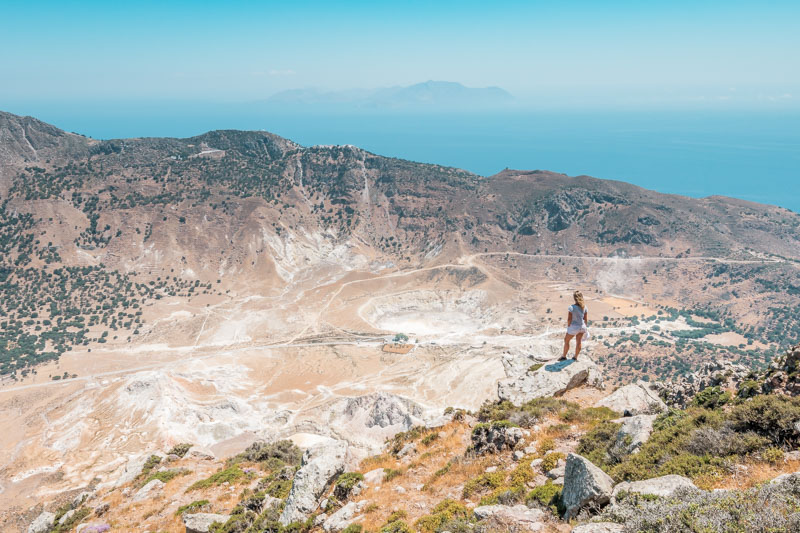
The volcano erupted 150,000 years ago, leaving behind a collapsed caldera almost 4 km wide in the interior of the island. The last hydrothermal explosions took place 140 years ago and left behind small craters. On Nisyros, you even have the opportunity to walk down into the largest crater in the caldera. A unique spectacle — everywhere it steams and seethes.
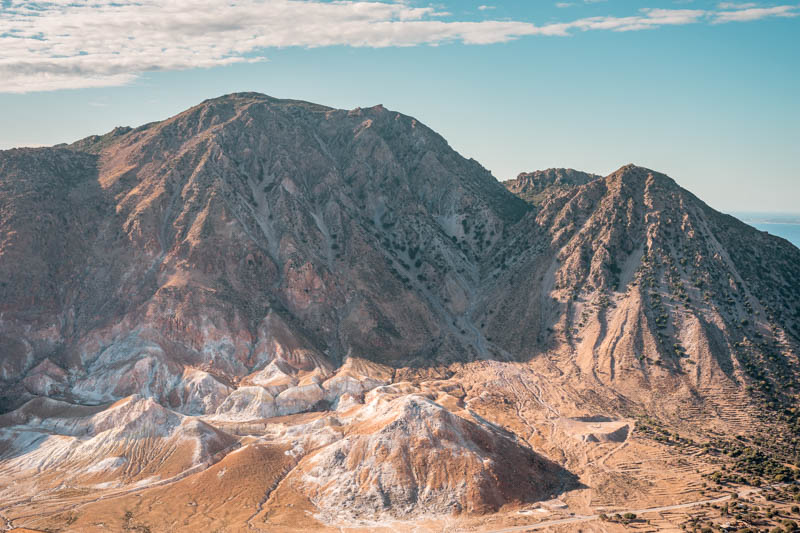
There are also several thermal springs around Nisyros and a bizarre landscape that can be explored on countless hiking trails. The surrounding islands, such as Strogyli and Gyali, are also of volcanic origin but have been extinct for thousands of years. Today, pumice stone is mined on a large scale on Gyali.
More information and tips about Nisyros can be found in our article: Nisyros
Milos Volcano
Last eruption: about 2nd century AD
The Volcano of Milos is believed to have originated 3 million years ago and has changed over time through several eruptions, the largest of which occurred 90,000 years ago. It has been quiet for almost 2,000 years, and only at the crater Fyriplaka (also called Tsigrado) can you still admire volcanic vapors in the form of fumaroles.

Nevertheless, the island of Milos captivates with its volcanic landscape — the coastal scenery of this Cycladic island shimmers in shades of red, black, beige, and gray. The volcanic complex of Milos also includes the islands of Andimilos and Polyegos (both uninhabited), as well as the tranquil islet of Kimolos, which is considered a hidden gem of Greece among those in the know.
More information and tips about Milos can be found in our article: Milos
Kos Volcano
Last eruption: 160,000 years ago
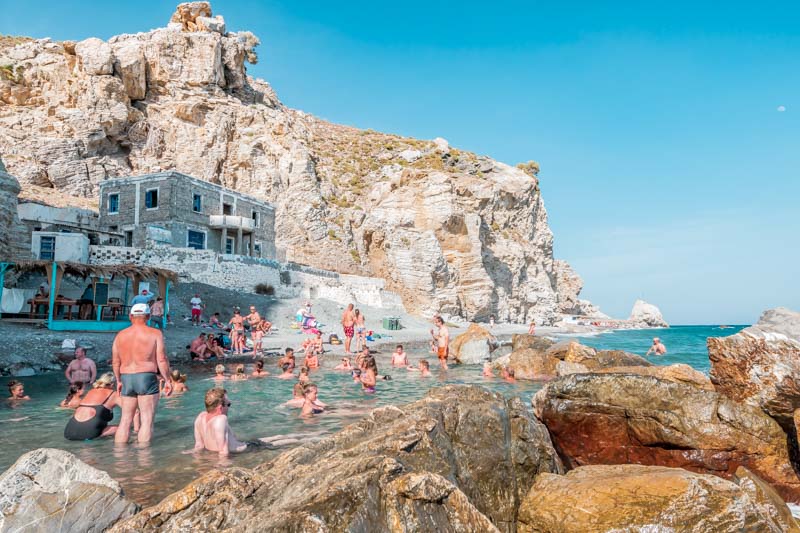
Part of the popular island of Kos is of volcanic origin, even if you don’t notice it at first glance. The last major eruption shaped the western part of the island, known as the Kefalos peninsula. Today, small gas bubbles near Paradise Beach and the Embros Thermal Baths Kos are a reminder of the geothermal activity of the extinct volcano.
More information and tips about Kos can be found in our article: Kos Travel Tips
Sousaki Volcano
Last eruption: 2.5 million years ago
The Sousaki Volcano is located about 7 km east of the Gulf of Corinth. It is considered one of the oldest volcanoes in Greece and still shows signs of activity, with hot vapours rising in many places. The thermal springs of Loutraki, not far from the Corinth Canal, are likely connected to the Sousaki.
Methana Volcano
Last eruption: around the 3rd century AD
Methana is a small peninsula in the Saronic Gulf, near the islands of Poros and Aegina. Its volcanic origin is unmistakable, with lava domes and colorful rocks, and the activity is evident in the form of hot thermal springs that have been used for therapeutic purposes for centuries.
#5 Earthquake on holiday: How Safe is Greece?
While on holiday in Greece, as in many European countries, you may encounter the forces of nature in the form of earthquakes. In neighboring Turkey, the Anatolian, Eurasian, and Arabian plates meet, which leads to frequent and sometimes powerful earthquakes along the Turkish coast and in Istanbul, among other places.
In southern Italy, several earthquakes occur every year, and the Eurasian and African plates also interact here. Calabria, the island of Sicily, and the Aeolian Islands are all affected. In the summer of 2024, Mount Etna erupted, ejecting ash into the atmosphere and temporarily closing Catania airport. Since February 2025, Mount Etna has been active again, with lava flowing down its slopes.
The Canary Islands, including Tenerife, El Hierro and La Palma, are also affected by earthquakes caused by volcanic activity (including rising magma). The last major volcanic eruption on La Palma in 2021 triggered earthquakes that lasted for weeks. In addition, lava swept over large parts of the island, and numerous houses were destroyed.

Why Greece is safe despite earthquake risk
Greece is as safe as any other country where earthquakes can occur. If you are very anxious about this, you should avoid all earthquake-prone areas in the world, and therefore large parts of the Mediterranean region as well. In many holiday destinations, earthquakes or volcanic eruptions can occur unexpectedly. Early warning systems now enable timely alerts.
However, the probability of other “accidents” or “attacks” is likely much higher than the natural disasters mentioned. In the end, though, nature plays by its own rules. Greece does have a very good network of seismological measuring stations installed by the University of Athens throughout the country.
Centuries of experience in their own country, as well as with neighbours such as Turkey, have made the Greeks well-versed in dealing with earthquakes. The example of Santorini in 2025 shows that local authorities, the government and international experts are working flat out to find solutions that keep damage to the population and infrastructure as low as possible.
Rules of conduct in the event of earthquakes
If your destination is in an acutely earthquake-prone area and your holiday hasn’t started yet, it makes sense to follow the recommendations of the Federal Foreign Office or contact your tour operator.
If you are already there and seismic activity has been ongoing for a longer period of time and is constantly increasing, it is advisable to leave the island or region and move to safer areas if possible.

In the event of a sudden earthquake in Greece, the Greek Civil Protection Authority automatically notifies all persons in the affected area by SMS. It’s also helpful to know the right way to behave depending on where exactly you are:
1. Indoors (e.g. hotel, apartment, supermarket, museum)
- Stay calm and don’t panic.
- Don’t run outside – falling debris or broken glass can be more dangerous than the quake itself.
- Seek shelter under sturdy furniture such as a solid table to protect yourself from falling objects.
- Keep away from windows, mirrors, shelves, cabinets, and loose items that could fall over or break.
- If there is no furniture nearby, kneel with your back against an interior wall, protect your head with your arms, and wait.
- Do not use elevators as they could get stuck.
- Don’t panic if sprinklers or fire alarms go off – that’s normal.
- After the quake, leave the building calmly via the stairwell.
2. Outdoor (street, park, open space)
- Keep away from buildings, trees, power lines and bridges, as falling debris or objects can be dangerous.
- Stay in open areas until the quake is over.
- Watch out for rockfall and landslides.
- Move away from cliffs, slopes and loose rocks.
- If in a dense urban area, seek shelter under a stable structure or move away from tall buildings as much as possible.
3. At or near the sea (tsunami danger!)
- Flee immediately to higher ground if the earthquake was strong or lasted a long time.
- Do not watch the sea or stay on the shore, as a tsunami wave can arrive minutes or even hours later.
- Follow official warnings and only return to the water once the all-clear has been given.
4. In the car
- Pull over slowly to the side of the road, but avoid stopping on bridges, overpasses, under trees, or in tunnels.
- Stay in the car until the quake is over.
- After the quake, continue driving carefully, as roads may be damaged or blocked.
Personal experiences with earthquakes in Greece
In all the years we have been travelling in Greece, we have only experienced four earthquakes. We felt our first quake in July 2017 on the island of Leros. Since the epicentre was several kilometres away from us, near the island of Kos (M 6.6), we woke up during the night and could only notice a slight tremor.

Kos was followed by a magnitude 5.8 earthquake in August of the same year, which was short but still forced us to brace ourselves against the walls of the apartment. After this experience, we looked closely into Greece and its natural forces, and an earthquake app (e.g. Last Quake) has been installed on our smartphones ever since.
In 2023, we experienced a small earthquake (M 3.8) on the island of Trizonia in the Gulf of Corinth, and in 2024 a magnitude 4.6 earthquake on Halkidiki. Only we noticed the earthquake — our friends didn’t even register it as such. We would recommend that you, as a holidaymaker in Greece, take a closer look at the topic.
Our minds can only mature and make the right decisions if we are sufficiently informed. Ultimately, knowledge is power over oneself, and at the same time gives a sense of security — helping us to assess situations correctly, appreciate nature more fully, and keep track of things even in unpredictable circumstances.
When you realise that you are living on a sphere floating in the middle of the infinite universe, with a scorching hot interior covered by a thin, fragile crust, you cannot help but feel a sense of awe at the wonders of nature.
→ More Tips for the Greek Islands can be found here:
- Greek Islands (overview of all island groups)
- Popular Greek Islands
- Which Greek island is right for me?
- Island hopping Greece
*Support our blog Greece-Moments
In this post, you will find affiliate links marked with an asterisk (*). If you book or buy something through one of these links, we receive a small commission. For you, the price remains the same. This way, you help us continue to provide high-quality content for free. Did you enjoy this post and want to say thank you? Then just buy us a Greek coffee ☕️ To the coffee fund
Bookmark this post on Pinterest!