
A rusty shipwreck on a white beach framed by limestone cliffs and a turquoise sea, with perhaps a few turtles to complete the postcard scene. This is probably how every holidaymaker imagines the Greek island of Zakynthos before their trip.
With its lush vegetation, Zakynthos, also known as Zante, is a wonderfully green island. But the former beauty of the island is increasingly losing its charm.
Tom & Ella
Zakynthos is the third largest island in the Ionian Sea after Corfu and Kefalonia. About 40,000 inhabitants live on the island, which the Venetians already called »Fior di Levante« (Flower of the East).
The sell-out of Zakynthos is unfortunately in full swing. The masses of tourists not only leave tons of rubbish behind, but also threaten the population of the loggerhead turtle (Caretta caretta), whose egg-laying sites are mainly located on the southern beaches of Zakynthos.
For two weeks we explored the island intensively – surprised, amazed, horrified and thrilled in equal measure. Whether we found the original Zakynthos, and our personal conclusion about the island, can be found at the end of the article. First, we’ll show you the best sights of Zakynthos and our 10 personal Zante highlights:
- #1 Walk through Zakynthos Town
- #2 Skopos Peninsula
- #3 Turtles of Zakynthos
- #4 Mizithres Rock and Keri Region
- #5 Agalas and Cave Damianos
- #6 Zante West Coast: From Korakonissi to Porto Vromi
- #7 Navagio Shipwreck from Zakynthos
- #8 Zakynthos Blue Caves
- #9 Zante East Coast: From Mikro Nisi to Alikanas
- #10 Zakynthos Heartland Tour
- More Zakynthos travel tips for your holiday
🏖️ Dream beaches & hidden bays
🍽️ Restaurants, tavernas & cafés
🏛️ Must-see highlights & ancient sites
🗺️ Worthwhile spots & insider tips
🚘 Practical info like rentals & parking
♾️ Lifetime access & updates

#1 Walk through Zakynthos Town
The capital in the east of Zakynthos, also called Chora, has just under 10,000 inhabitants and is the central hub and supply centre of the island thanks to its ferry port. Zakynthos Town was founded in ancient times on a hill above today’s settlement.

The largest footprint was left by the Venetians, who built the current district below the Kastro Hill on the coast around the 16th century. Unfortunately, the severe earthquake of 1953 destroyed a large part of the historic buildings, which were largely rebuilt true to the original in the years that followed.
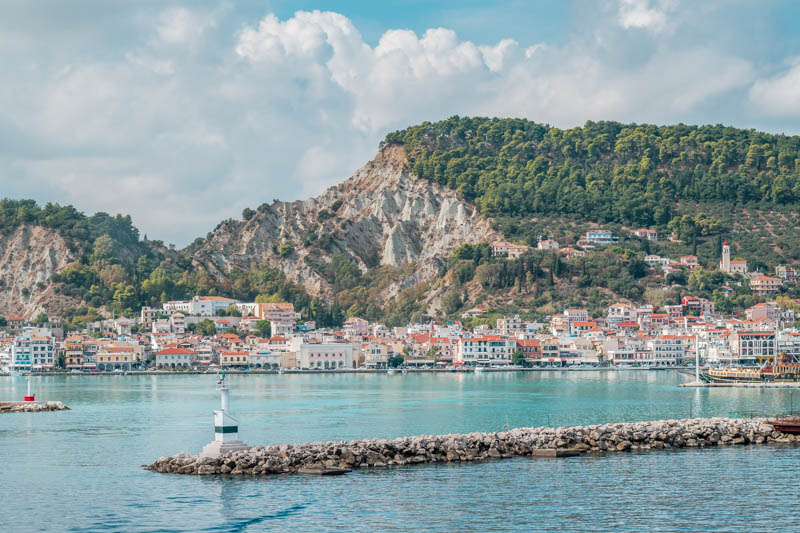
Our tour of the lively city starts at Platia Solomou. The main square is located at the northern end of the elongated harbour pier, not far from the marina. With a bit of luck, you will also find one of the free parking spaces along the harbour pier.
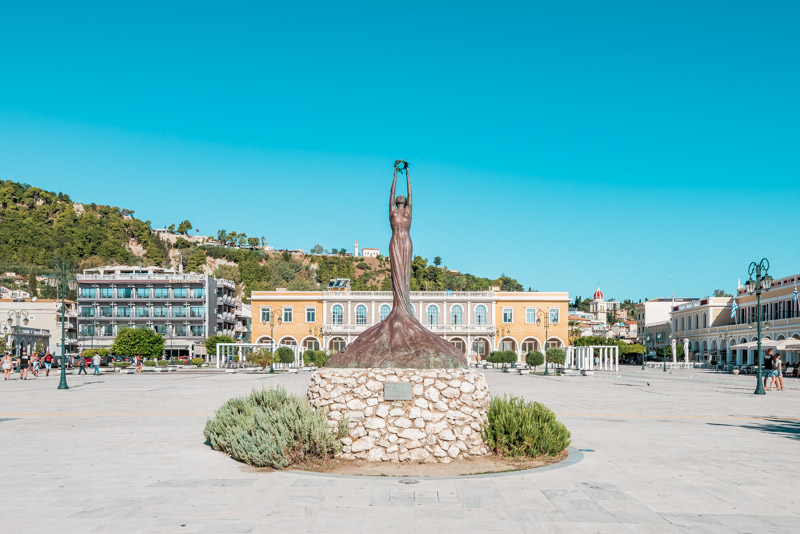
Walking through the large square, you will pass the church of Agios Nikolaos on the right, which is worth a quick look for its golden iconostasis. Behind it are the city library and the cinema.
History buffs can make a detour to the Archaeological Museum of Zakynthos. The pretty alley of Dimokratias leads past numerous shops, cafés and restaurants to St. Mark’s Square.
Platia Agiou Markou is located in the heart of the city and is home to the Catholic St. Mark’s Church with its striking bell tower. The restaurants on the triangular square invite you to take a short break.
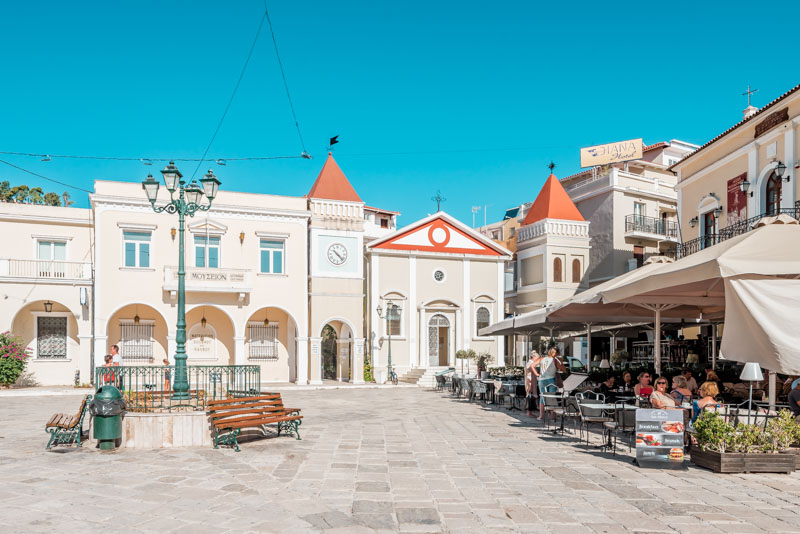
We continue along the long shopping street of 21st Maiou. Here you can stroll at leisure and find a nice island souvenir in one of the numerous shops. We loved the shop Anamnesia, which stands out for its original souvenirs from Greek designers.
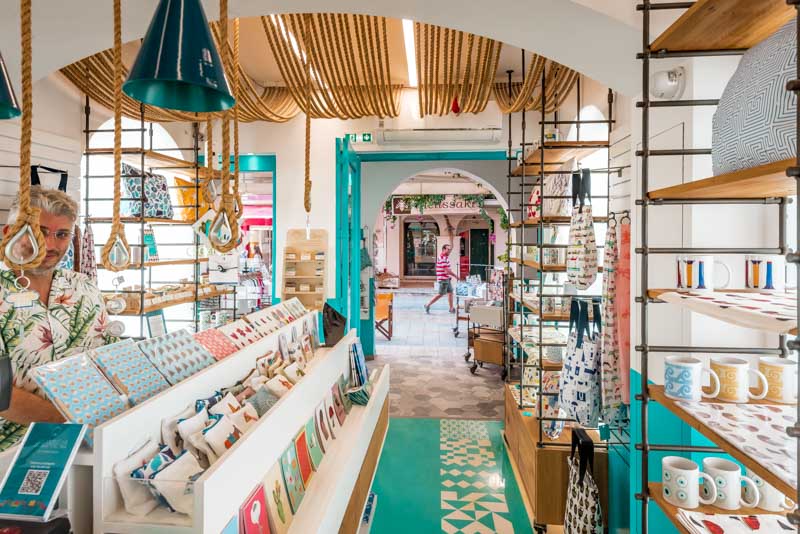
We can follow the shopping street in a southerly direction to Platia Agios Pavlos. For a lunch break, we recommend the rustic tavern Kantouni Estiatorio. From here it is only a five-minute walk along Agiou Dionisiou Street to the main church of the same name.
Church of Agios Dionysios
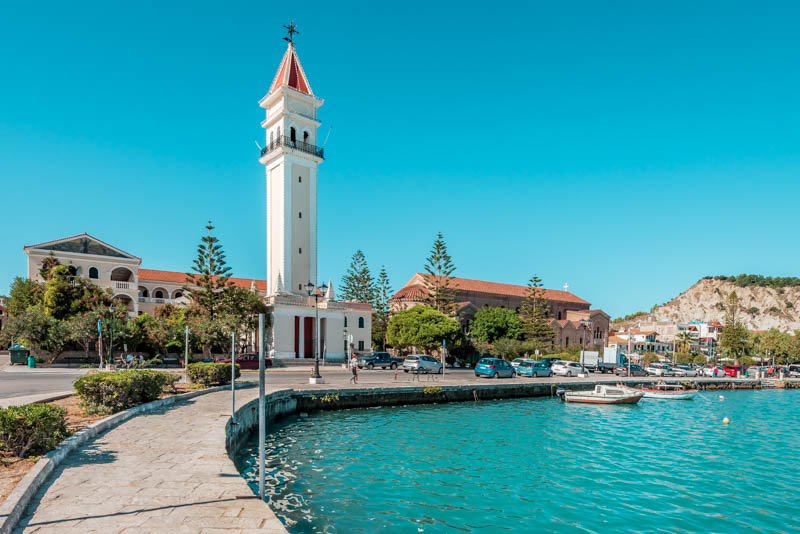
The Church of Saint Dionysius of Zakynthos is located directly behind the ferry pier. It is the symbol of the city and stands out for its distinctive free-standing bell tower (campanile).
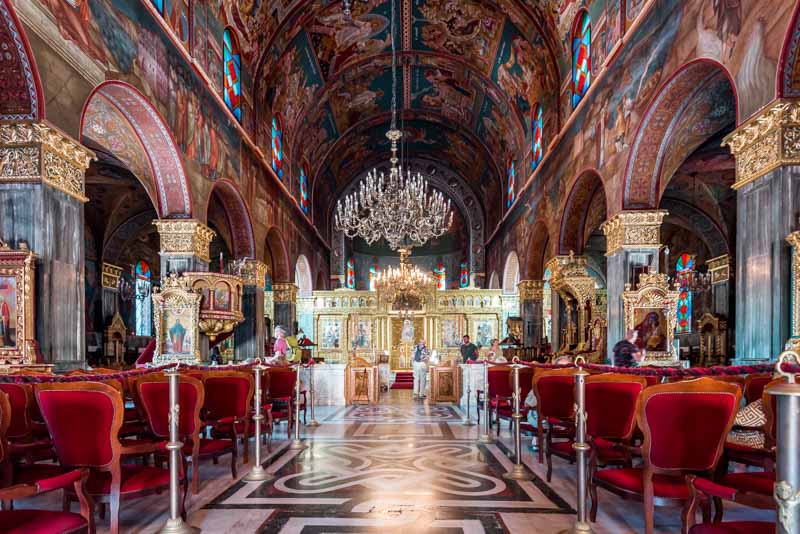
Since it was one of the few buildings to survive the earthquake of 1953 (see article: Greece Earthquake), the magnificent interior of the majestic cathedral is still well preserved and well worth a visit. The numerous frescoes and the gold-decorated iconostasis are truly impressive.
The bones of St. Dionysius, the patron saint of the island, are kept in a silver sarcophagus in the right side chapel. Every year on 24 August, a lavish festival is held in Zakynthos Town in honour of the island’s saint.
After visiting the church, we walk along the harbour promenade »Strada Marina« back to the car park at Solomos Square, and then head up to the Bochali district, including Kastro Hill.
From the Church of Panagia Pikridiotissa you have the option to walk up to the Kastro district. Alternatively, a road leads directly to the Venetian Castle.
Venetian Fortress (Bochali Hill)
Bochali district is located on a hill and offers a great view over Zakynthos Town and the coastal plain. Several higher-priced restaurants with terraces have opened here. If you don’t feel like eating, simply enjoy the magnificent panorama from the viewpoint before continuing up to the Kastro.
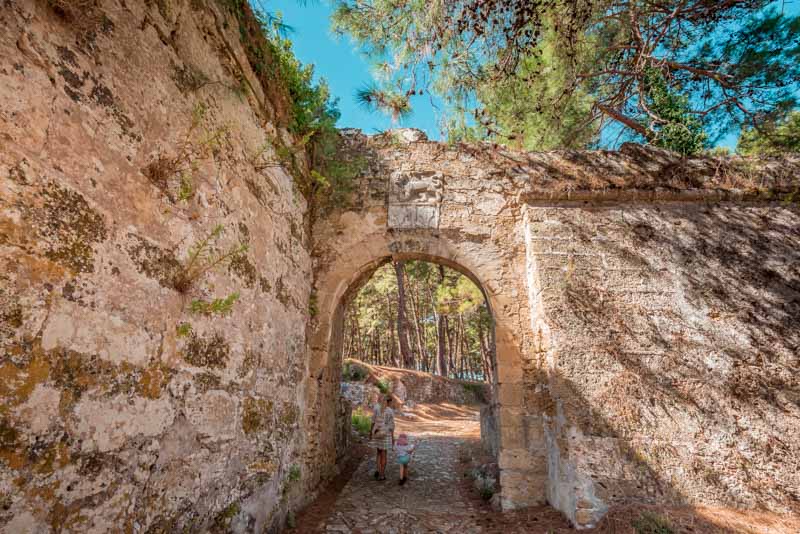
The Castle of Zakynthos dates back to Venetian times, though an acropolis is said to have stood on this site in antiquity. You can explore the extensive and wooded grounds of the Kastro at leisure. As much was unfortunately destroyed by past earthquakes, you mostly walk among ruins.
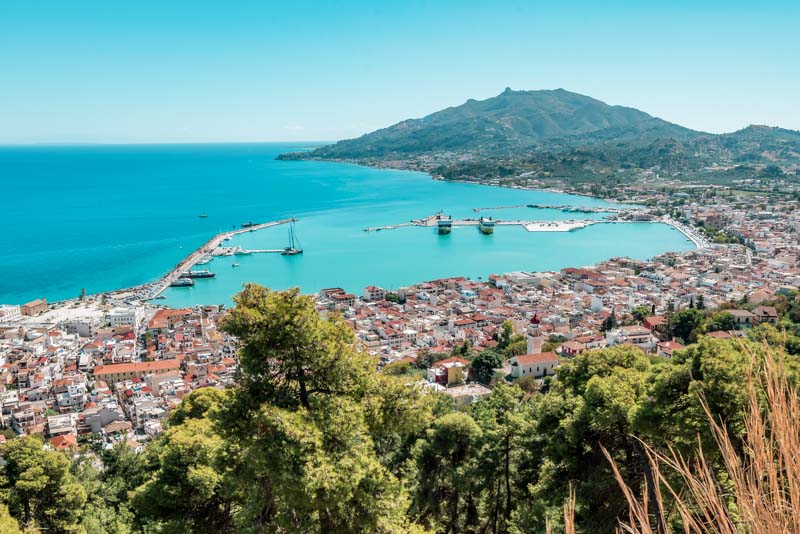
There are still powder magazines, prison cells, a barracks building and remains of old chapels to see. The shady grounds are also wonderfully suited to a short rest after a stroll through the city. The view of Zante city from the Grimani bastion in the north-east of the complex is terrific! (Wed–Mon, 8:30 a.m.–3:00 p.m. | Admission: €4)
💡 Zakynthos book tip: The travel guide to Zakynthos from Rough Guides contains valuable tips and background information for your stay on the island: View on Amazon*
#2 Skopos Peninsula
The Skopos peninsula not far from the capital is a scenic area. The green headland in the southeast of the island is well worth a day trip, as it packs in several Zakynthos highlights.
Coming from Zakynthos Town, we first pass Argassi, the tourist centre of the peninsula. There is a lot of through traffic in the busy holiday resort, and except for the old Argassi Bridge from 1885, there is not much to see. It merits a short photo stop, though finding a parking space can be quite a challenge.

Monastery of Panagia Skopiotissa
A few kilometres after leaving Argassi, we turn right and head towards Mount Skopos. Below the 492-metre-high peak lie the ruins of the 17th-century monastery of Panagia Skopiotissa. In ancient times, a temple of Artemis stood on this site. The entire complex with its restored church is a place of silence on the otherwise bustling island.
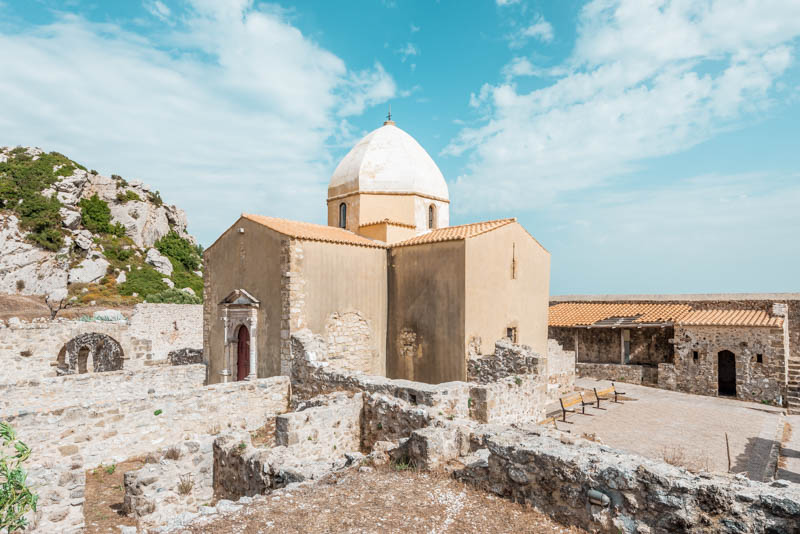
From up here you can enjoy a fabulous panorama of the island. On days with good visibility, the view extends as far as the neighbouring island of Kefalonia. Below the monastery complex there is also a simple kiosk, whose owners sometimes open the church for interested visitors.
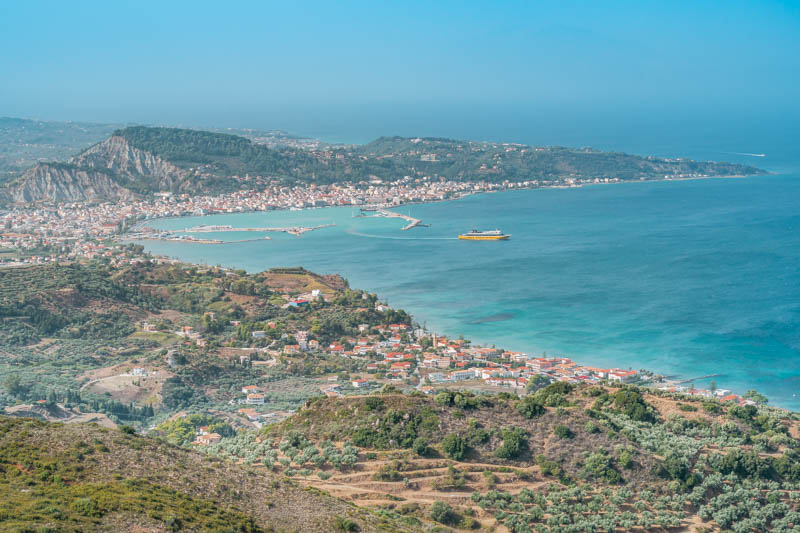
The approach to the monastery is mostly via a bumpy gravel road, but Mount Skopos can be reached comfortably with an off-road vehicle. Alternatively, the 4 km can be covered on foot in around 1.5 hours.
Zakynthos beaches on the Skopos Peninsula
Back on the main road, we drive via Xirokastello to Vasilikos. Several roads branch off to frequented eastern beaches on this section, including Porto Zorro Beach and Banana or Plaka Beach.
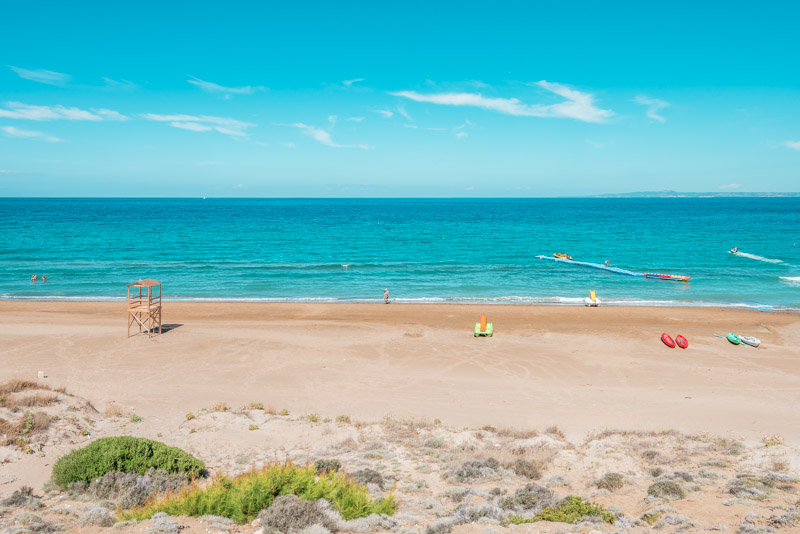
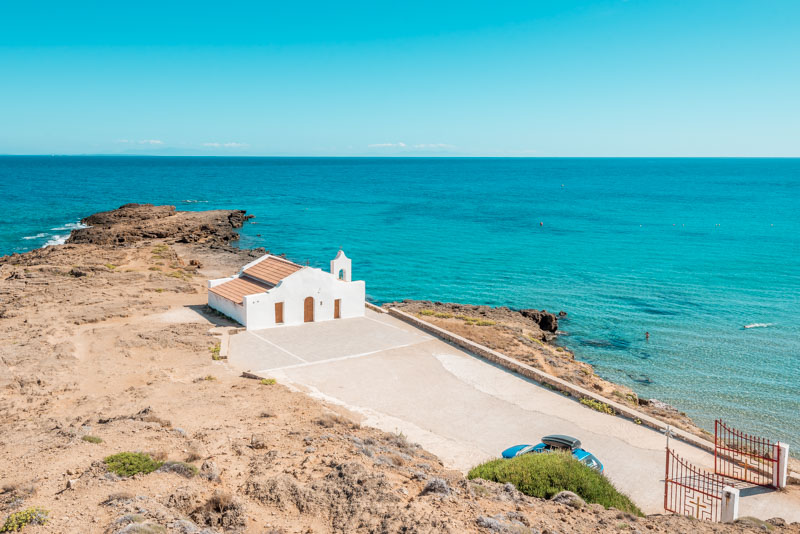
Of all the beaches, we especially liked St. Nicholas Beach, with its small chapel of Agios Nikolaos perched on a rocky outcrop directly above the sea – a popular photo motif.
The golden sandy beach next door is wonderful for families with children, as it slopes very gently into the sea. A visit is especially recommended in the quiet low season. Parasols and sunbeds are provided by the on-site restaurants for a fee.
→ In this post, we’ll reveal our top 15 best swimming spots on the island: Zakynthos Beaches
Logothetis Organic Farm
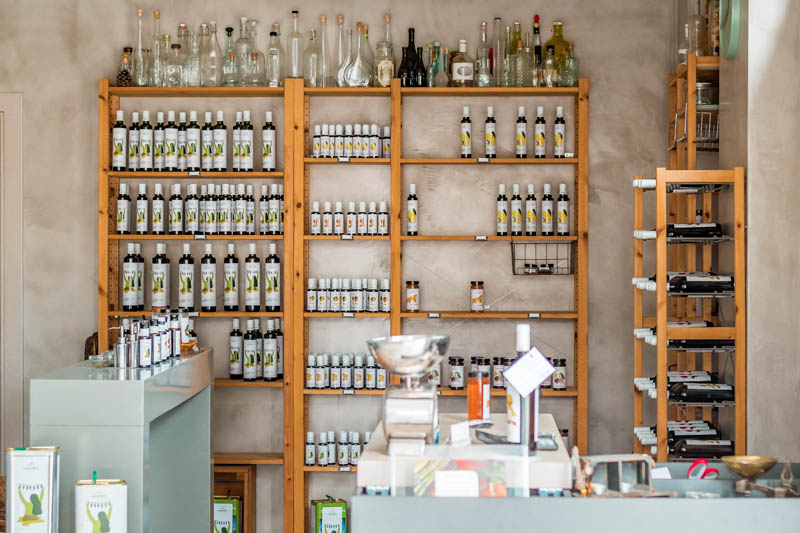
Before entering Vasilikos, it is worth taking a detour to Logothetis Organic Farm. The farm produces olive oil, wine and honey in organic quality, among other things. The products can be tasted and purchased on site. The team around owner Dionysios also organises cooking courses and other events (including yoga) by appointment.
💡 Coffee break at Vasilikos: A little hungry? At Tranakas Bakery in Vasilikos, you can not only get a good coffee, but also delicious sweet and savoury snacks. We found the dumplings with chicken particularly tasty.
Ceramics from Zakynthos
Only a few metres after the Tranakas bakery, a road branches off to the right to Hanne Mi’s ceramics workshop. The friendly Norwegian sells very tasteful ceramics and pottery in her studio.
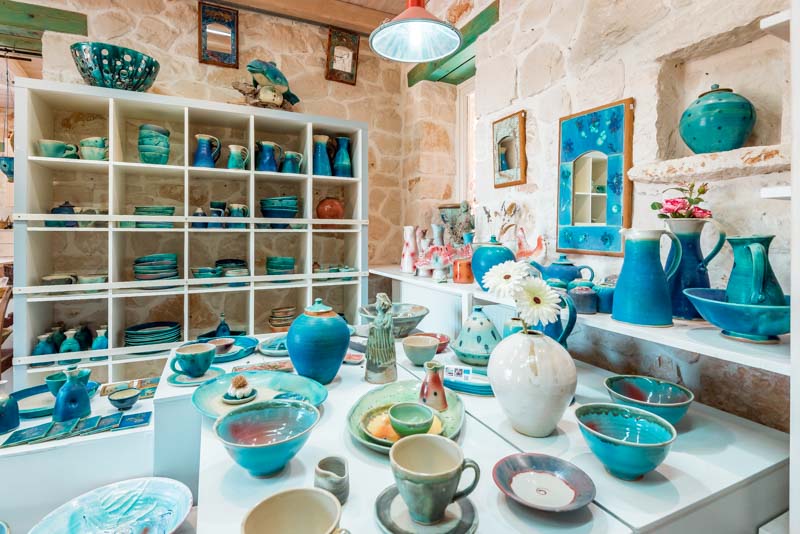
Even if the handmade pieces are on the pricey side, ceramic lovers are sure to find a beautiful souvenir from Zakynthos here. Hanne and her team also offer pottery courses on Tuesdays and Fridays by appointment. (Shop opening hours: daily 9 a.m. to 7 p.m., April–end of October)
Cape Gerakas: Home of the turtles
Our tour across the Skopos Peninsula ends at Cape Gerakas. Before visiting the beach of the same name, it is worth stopping at the Mediterranean Marine Life Centre, run by environmental activist Jannis Vardakastanis. The small visitor centre provides extensive information about the loggerhead turtle (Caretta caretta), which lays its eggs every year in the fine sand of Zakynthos’ southern beaches.
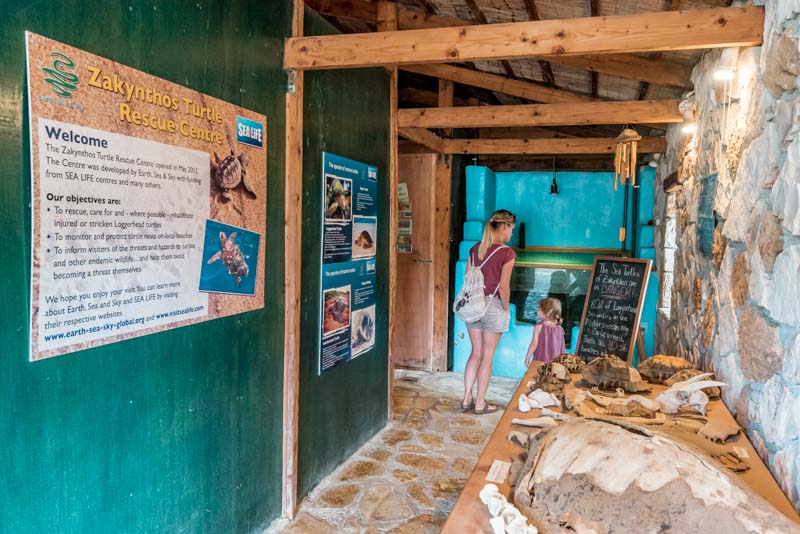
The population of the loggerhead turtle is now severely threatened by the intensive development and use of the beaches for tourism around the resort of Laganas. What we can do as holidaymakers to help protect these animals, and how to behave correctly on site, you can find out in the following section #3 Zakynthos turtles.
Behind a large park area, we pass the turtle information centre and walk down a wooden boardwalk to the beach. The kilometre-long Gerakas Beach with its striking Jason’s Bite rock formation is an important nesting site for sea turtles. If animal welfare is important to you, we recommend avoiding this beach as a swimming spot between May and September.

Alternatively, you can take a short walk along the northern stretch of beach, which is covered by gravel and not used by the turtles. After a few metres you will reach a hidden valley with curious sandstone formations, also known as the »White Sandstone Mountains«.
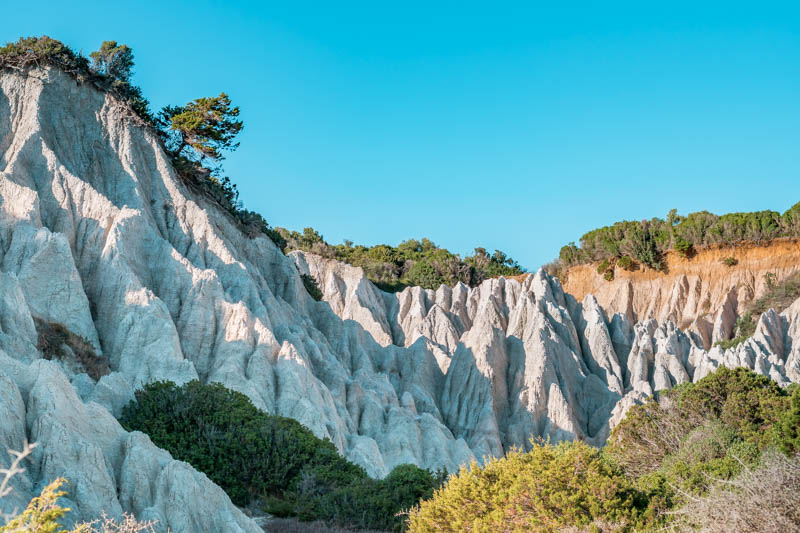
These erosion-sculpted stone formations are worth a visit, especially in the late afternoon when the sun casts fascinating shadows across them. A real Zakynthos highlight for us!
#3 Turtles of Zakynthos
The island of Zakynthos is one of the most important egg-laying sites of the loggerhead turtle. In the past, the dune-like beaches in the very south of the island offered sea turtles ideal conditions to bury their eggs in the fine sand.
The population of Caretta caretta on Zakynthos has decreased in recent years due to the heavy development of the coast and the intensive use of the sandy beaches for beach tourism around the resort of Laganas.
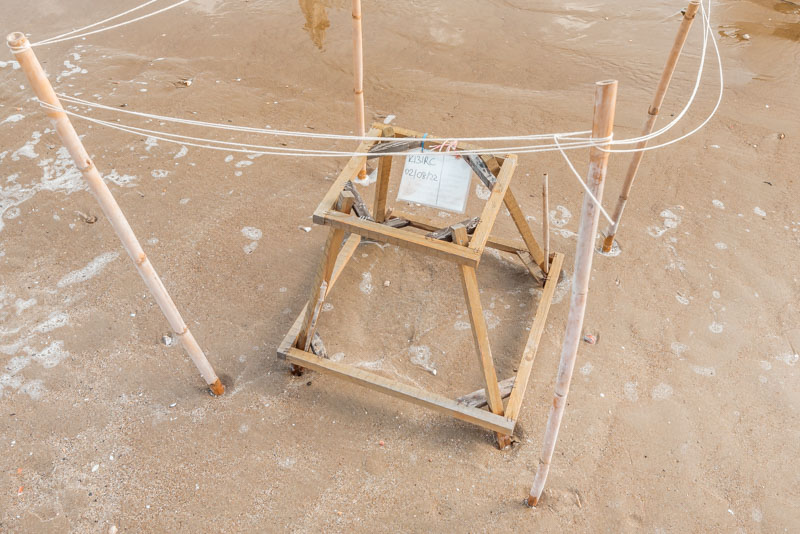
As holidaymakers, we can make an active contribution to the protection of these vulnerable sea creatures – for example by refraining from turtle-spotting excursions or motorboat tours on site.
→ We have summarised all the important information on this topic in the following article: Zakynthos Turtles
#4 Mizithres Rock and Keri Region
In the southwest of Zakynthos, the headland of Keri juts almost circularly into the Ionian Sea. The highlights of this region are the dramatic Mizithres Rocks, located off the cliffs, and the Keri Sea Caves.
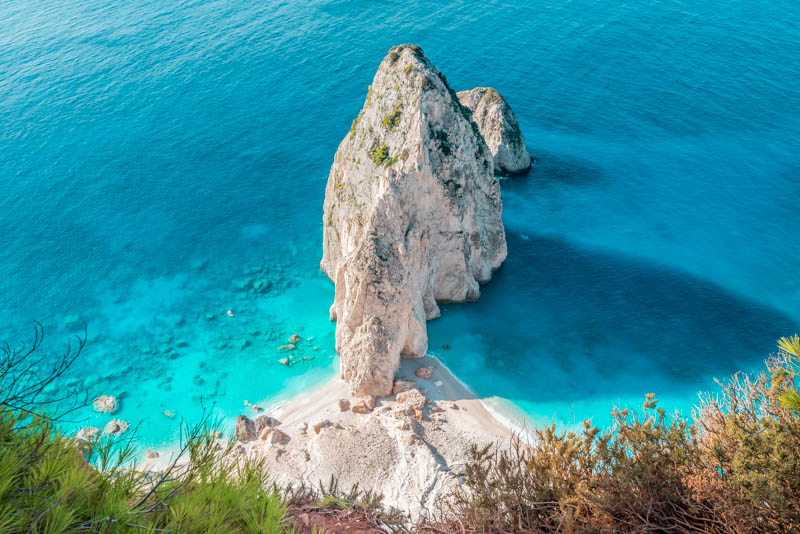
But besides these scenic highlights, the former fishing village of Limni Keriou, located west of Laganas and Agios Sostis, is well worth a visit. A large wetland, also known as the Lake of Keri, characterises the townscape.
Numerous small hotels, apartments and studios have settled near the coast. You will also find tavernas and cafés, supermarkets and boat rentals in the resort, although some facilities were already closed when we visited in early October.
The narrow pebble beach behind the wetland is lined with a few tamarisk trees. The stony shore slopes gently and is also suitable for families with children. Keri Beach is not a dream beach, but it is perfectly adequate for a short refreshment.

During the season, daily boat tours depart from Limni Keriou to Cape Marathia, the Keri caves and the Mizithres rocks. The coastline in the southeast is defined by towering white limestone cliffs, crisscrossed by numerous caves and grottos where the sea sparkles in the most beautiful shades of blue.
💡 A note from Keri: Since ancient times, pitch has been mined in the Keri region, which was used to seal ship planks. Of the former sources, only the “Herodotus Spring” remains, which lies behind the studios of the same name in Limni Keriou. This pitch pond has also largely dried up and unfortunately looks a little neglected.
Mountain village of Keri
From the coastal town of Limni Keriou it is about 10 minutes by car to the mountain village of Keri. The tranquil village has about 470 inhabitants and is mostly only a transit stop on the way to the Mizithres rocks. It is worth taking a short walk through the narrow streets.
On the northern outskirts of the village, the church of Panagia Keriotissa is well worth a visit, with its sunny yellow façade and free-standing bell tower. Unfortunately, the church is usually locked.
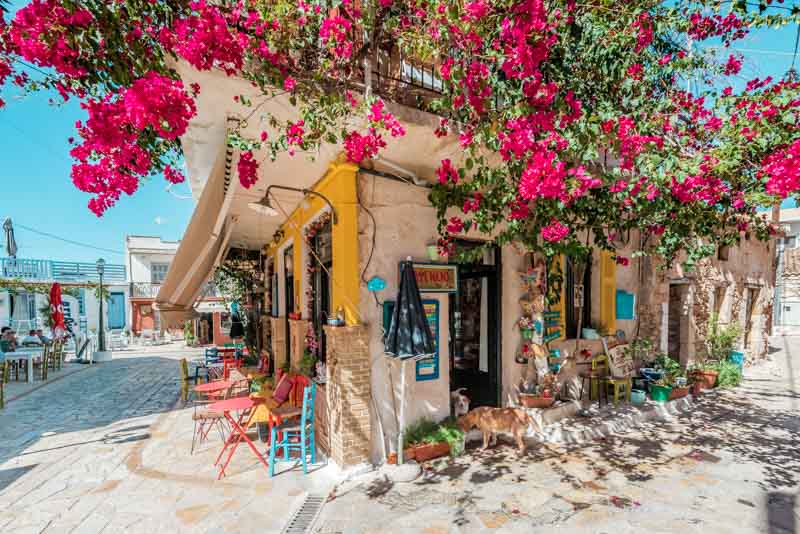
In the centre, it is wonderful to linger on the cobbled Platia. For a coffee and a small snack, we can recommend the colourful Nitzi Café. For a bigger appetite, the Allegro Restaurant opens from 1 p.m. and has a beautiful roof terrace.
Mizithres Rock and Lighthouse
From Keri, it is a five-minute drive to the lighthouse and the associated restaurant, which is also home to what is reportedly the largest Greek flag in the world. Unfortunately, it was not hoisted during our visit.
The entire site of the Lighthouse of Keri is currently not accessible, and the rather pricey restaurant below requires a minimum spend to enjoy the view of the Mizithres rocks.
Above the lighthouse there is also a simple snack bar whose owner charges around €2.50 entrance fee for the sea view. Alternatively, you can enjoy a free view of the spectacular coastline with its rock pyramids by following the gravel road to the left in front of the restaurant.
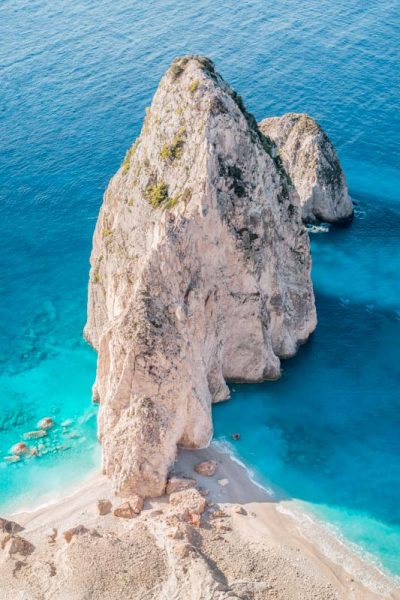
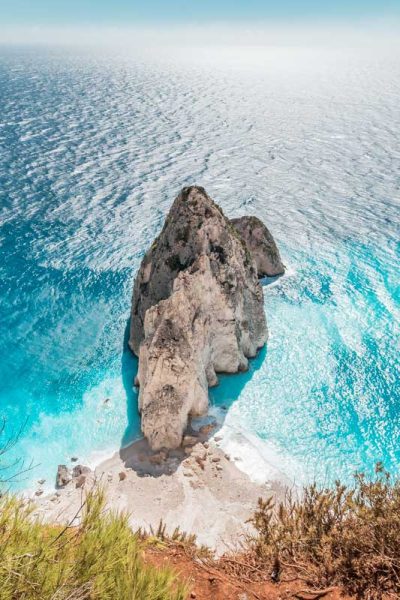
The “Scenic Viewpoint” at the end of the gravel road, directly in front of the Mizithres Rock, is breathtakingly beautiful – but be careful: the rocks fall steeply into the sea and there are no barriers. On organised Zakynthos boat tours you can explore the spectacular coastline and the so-called Keri sea caves.
Have you booked your Zakynthos boat tour yet? Click here to check prices and availability via GetYourGuide*:
➲ To the boat trip to Mizithres*
Cameo Island (Agios Sostis)
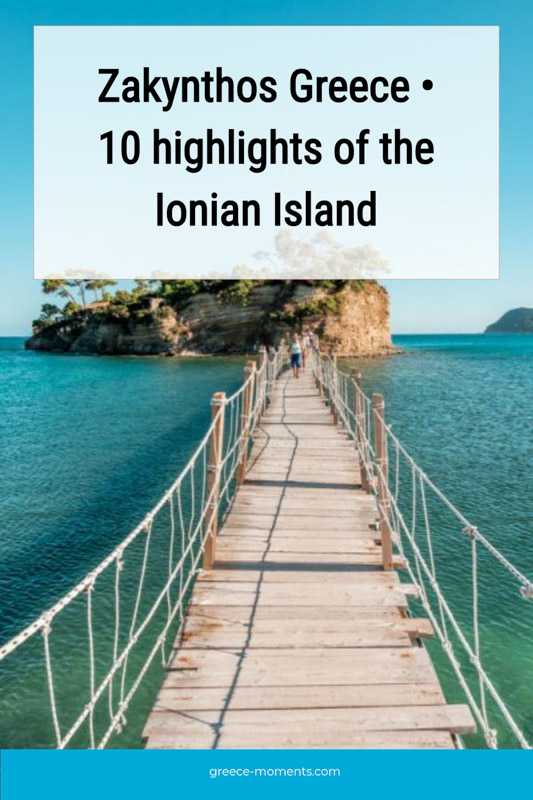
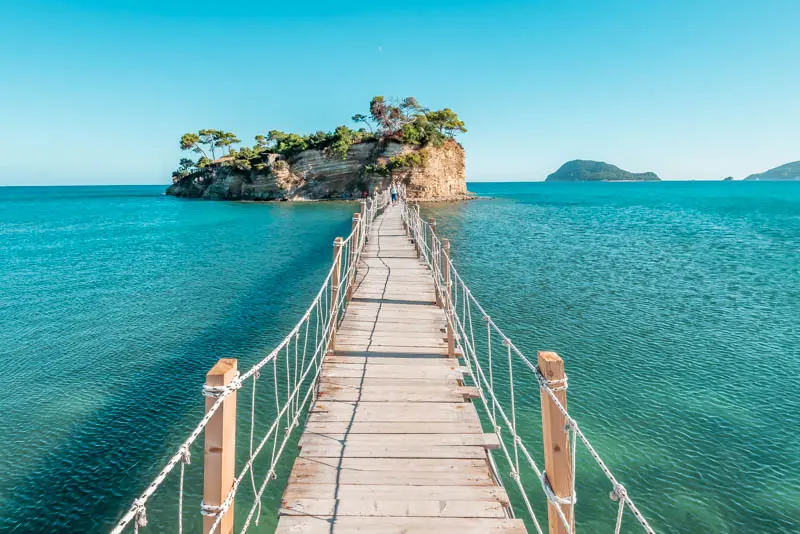
The small rocky island is located off the village of Agios Sostis and is connected to it by a photogenic wooden walkway. Cameo Island is privately owned and can be entered for a fee of €10 per person. In return, you receive a souvenir photo and a key ring.

In summer, there is a beach bar on the small islet. Prices are on the higher side. Otherwise, you can bring your own drinks and enjoy a short swim on the narrow stretch of beach.
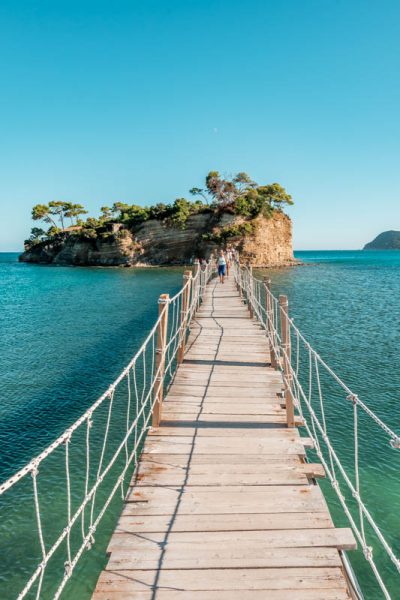

Cameo Island is also a popular location for weddings and other events, with white sheets waving in the wind on a line over the beach. A selfie at this popular spot is a must in Zakynthos.
#5 Agalas and Cave Damianos
The mountain village of Agalas, located in the south-west of the island, is well worth a visit, as it is home to several Zakynthos highlights.
Below the Cave Damianos restaurant lies the cave of the same name, which can be reached in a few minutes via a well-developed footpath. The double-storey Cave of Damianos is dedicated to the former village hero of Agalas, who, according to legend, protected the inhabitants from the evil dragon Andronios.
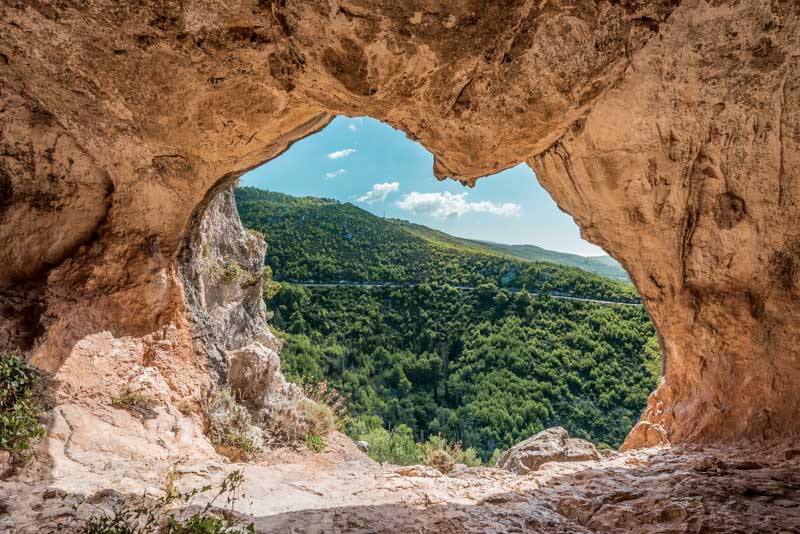
The double cave is spectacular to look at, especially from the outside. To reach the upper level, you need a good head for heights and some climbing ability, but the view from the cave’s natural balcony is wonderful. The ascent is at your own risk!


According to legend, the twelve fountains were also created thanks to the commitment of the village hero Damianos. The fountains known as Andronios Wells were built, so the story goes, by the dragon himself as punishment.
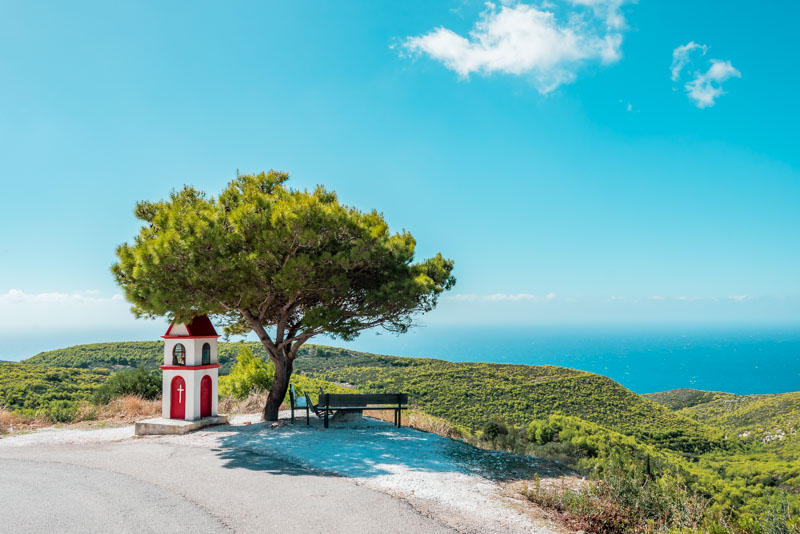
The fountains are only ten minutes away from the cave and were probably built in the 15th century under Venetian rule. Coming from Agalas, you can stop at a park bench with a small devotional chapel and enjoy the idyllic landscape with its lush green nature.
The most beautiful sunset of Zakynthos
As the day draws to a close, it is worth enjoying the sunset on the coast of Agalas. As the Cave Damianos restaurant was closed when we visited in early October, we headed to the cosy Sunset Agalas bar run by Adonis and his wife – and we didn’t regret it.
Not only will you experience a fantastic sunset in a romantic atmosphere, but you will also encounter genuine Greek hospitality, which is sadly becoming a rarity in Zakynthos these days.
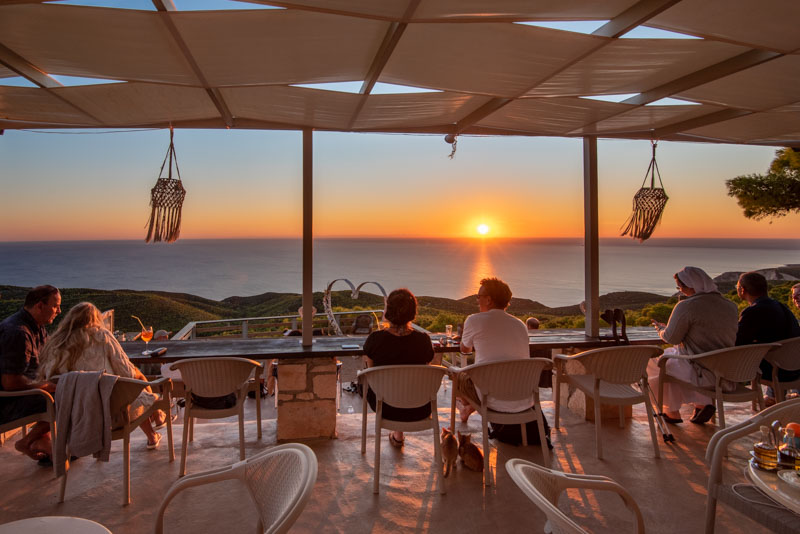
In addition to drinks, the Sunset Agalas bar also offers simple snacks such as farmer’s salad, gyros, burgers and pizza. The prices are very fair and the atmosphere in the evening is simply magical!
Forest fire on Zakynthos: The devastating fires around Agalas severely affected nature in the region. The local restaurant ceased service in August 2025. It remains to be seen whether this beautiful place will be rebuilt in the coming years – we sincerely hope so.
→ Here you can find up-to-date information about fires on Zakynthos and other islands: Forest fires Greece
Hike to Paralia Plakaki
From Agalas it is about 8 minutes to the Plakaki Viewpoint and the car park above the bay. Even from the vantage point above the beach you can enjoy a magnificent view of the dramatic west coast and a large offshore boulder in the sea.
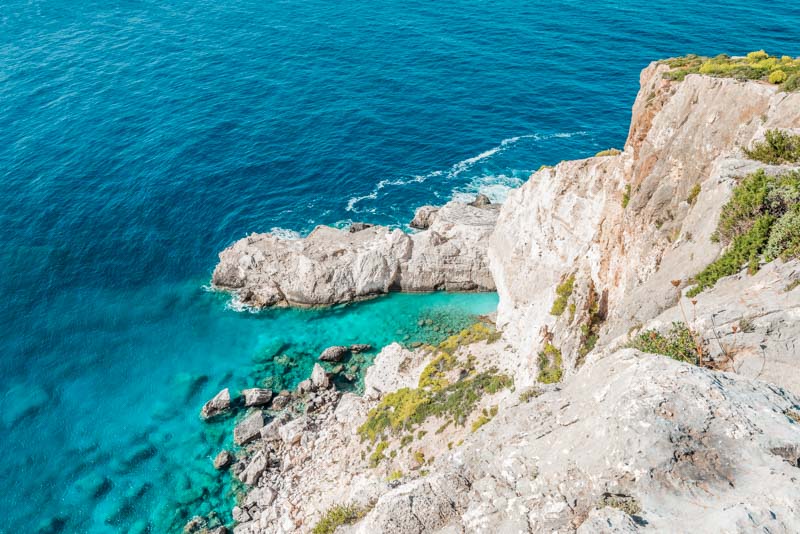
A very steep path leads down to Plakaki Beach and requires some climbing skills and a head for heights, particularly in the final section. But when you reach the bottom, you will be rewarded with a dream backdrop.
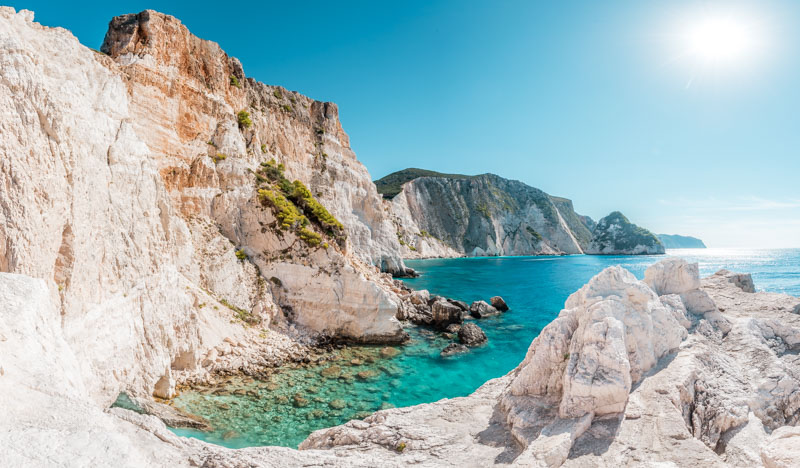
The plateau with its white limestone cliffs looks like a lunar landscape. In the deeply cut bay, the sea sparkles in wonderful turquoise tones. There is no classic beach – you can only enter the water via the rocks. When the sea is calm, you can snorkel here and peer into the blue sea caves.
#6 Zante West Coast: From Korakonissi to Porto Vromi
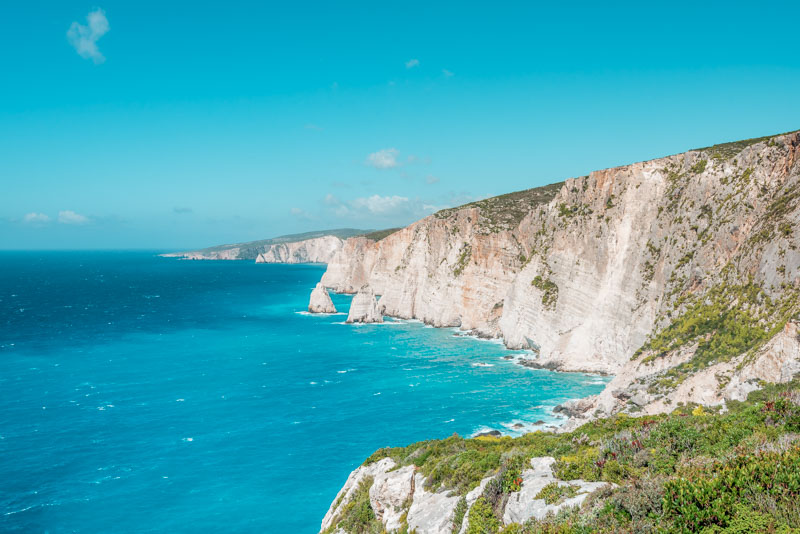
The sparsely populated west of Zakynthos is almost entirely characterised by vertically sloping cliffs. There are no classic beaches here, but instead deeply cut bays with sometimes dramatic rock formations, sea caves and grottos.
Korakonissi Peninsula
A very nice spot for snorkelling or simply relaxing is Korakonissi. The small peninsula juts out into the sea as a massive boulder, and a rock window provides interesting photo opportunities.
A narrow trail leads along the coast to the Islet of Korakonissi. Water shoes are recommended for swimming in the narrow bay, as the ground is very rocky. In high season, the snack bar opposite Korakonissi is a great place for a short break.

As there is no coastal road connecting the various bays, such as Korakonissi, you have to drive back via the mountain villages and the main road to reach the next bay.
Porto Roxa
Popular in midsummer is the fjord-like Porto Roxa Bay with its chilled beach bars. Here again, you can only enter the sea via rocks, concrete paths and ladders, as the coast is crisscrossed by large boulders.
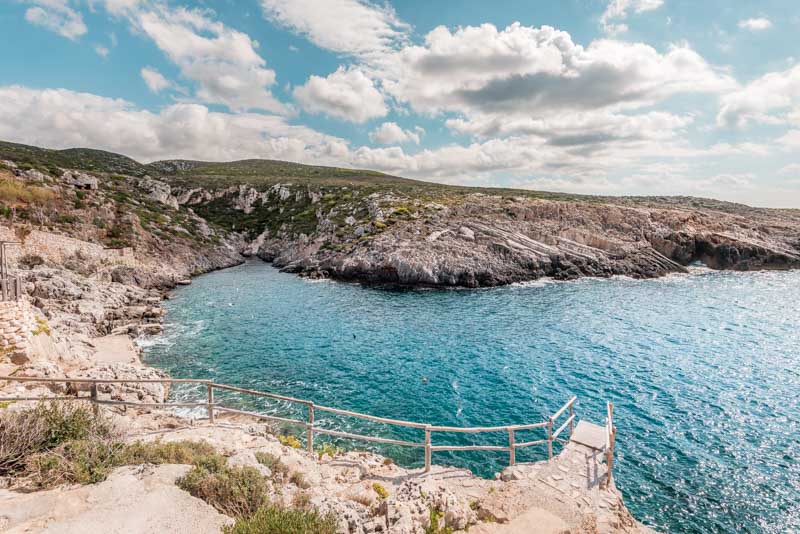
Water shoes are recommended, as the shoreline drops steeply and is only suitable for confident swimmers. At sunset, the ambience in Porto Roxa is particularly beautiful.
Porto Limnionas
From Porto Roxa you can continue north to Porto Limnionas along a fairly flat stretch of coast. The deeply cut bay sparkles in magnificent emerald green, and the bright rocky cliffs are draped in shrubs.
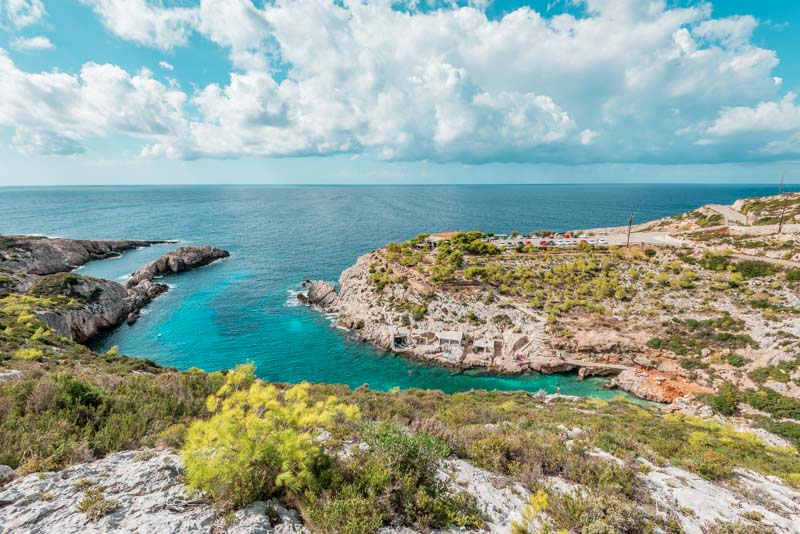
The setting of Porto Limnionas is very photogenic, but you have to share the concrete shore area with numerous other holidaymakers in high season. There are hardly any places to lie down, and accessing the water requires a little climbing skill or a leap of faith.
Especially in the low season, it is worth bringing your snorkelling equipment. The taverna above the bay is a good spot to eat, though it tends to get very busy, as does the bathing area.

For a sundowner in Kampi
From Porto Limnionas, the road leads via the mountain village of Agios Leon to Kampi (also Kambi). You could almost drive straight past the small hamlet, were it not for the several tavernas here, whose panoramic terraces are perfect for a sundowner.
The beautiful sunset from Kampi has become well known, and every evening busloads of tourists are dropped off here for dinner. You are spoilt for choice when it comes to restaurants – we have not tested any, due to the crowds.
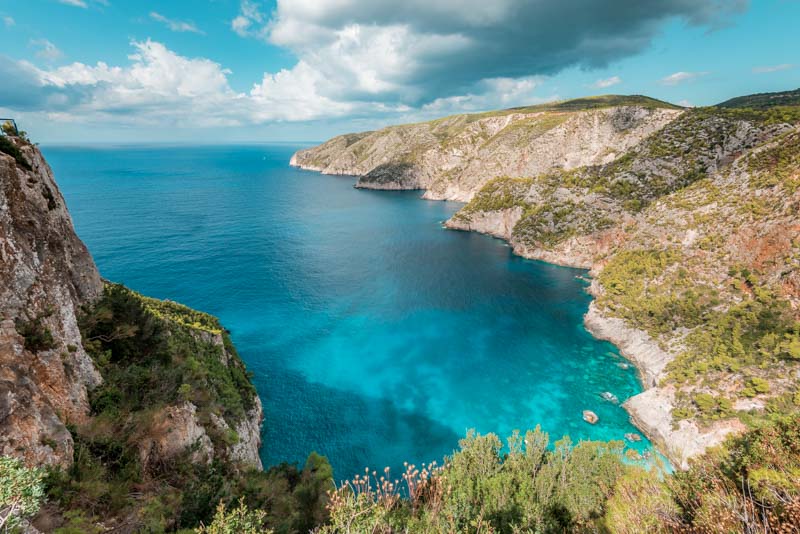
However, the locals recommended Taverna Stavros in Kampi to us several times. Alternatively, you can of course admire the sunset from the Cliffs of Kampi viewpoint without stopping for a bite to eat.
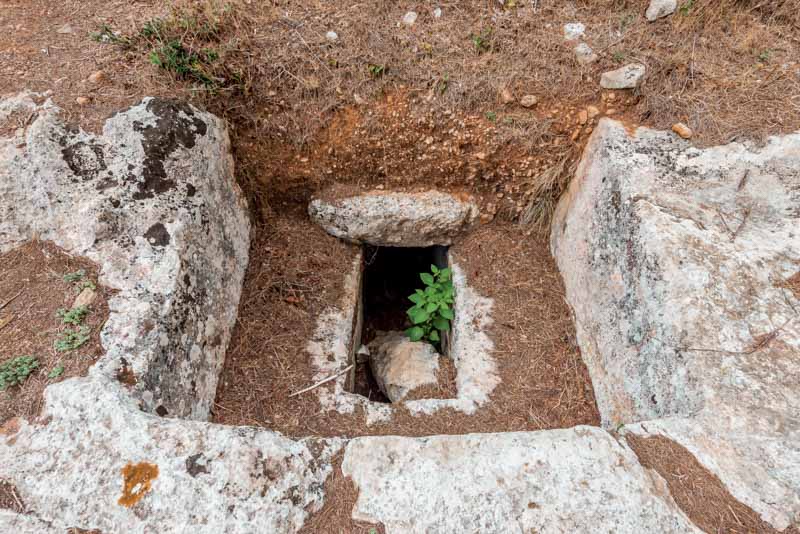
Those interested in history can take a short detour to the Mycenaean cemetery of Kampi. The archaeological site was uncovered in the 1970s and unearthed 14 rectangular tombs, believed to date back to 1,400 BC. The inconspicuous excavation site is located halfway between the Cliffs of Kampi viewpoint and Taverna Stavros.
💡 Sunset on Zakynthos: If you want to enjoy the evening light spectacle completely undisturbed, stop by the Venetian Tower north of Kampi. The former watchtower from Venetian times stands alone in the landscape and offers a magnificent view of the west coast.
Porto Vromi
In about 20 minutes we reach Porto Vromi from Kampi via the villages of Exo Chora and Maries. The western bay, which can only be reached via the hamlet of Anafonitria, is a popular starting point for tours to Shipwreck Beach (see next point).
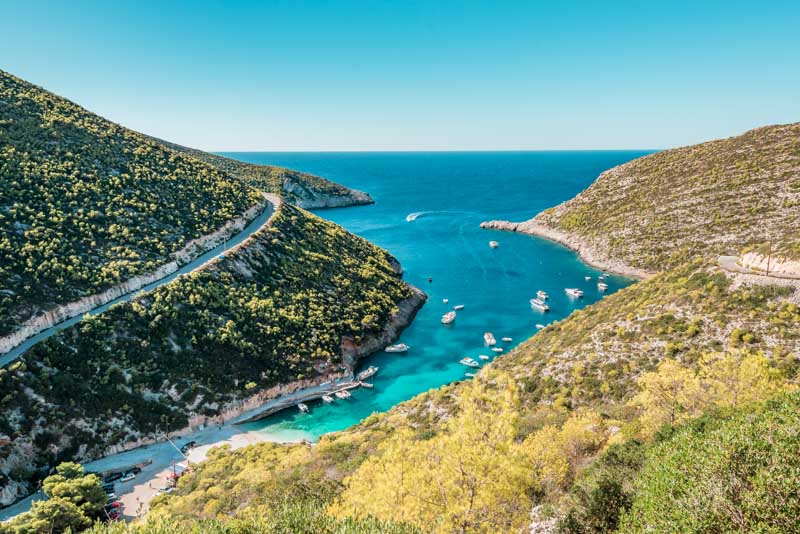
Both bays of Porto Vromi have a narrow pebble beach with crystal-clear waters, which is less frequented in the low season and makes a perfect refreshment stop. The eastern bay can be reached via Maries and is not connected to the western beach by road.
#7 Navagio Shipwreck from Zakynthos
The top highlight of the island and one of the most popular Things to do in Greece is the rusty shipwreck in Navagio Bay. Shipwreck Beach is located in the northwest of Zakynthos and can only be reached by boat. Anchoring directly at the beach is no longer permitted due to the risk of rockfall and landslides, and entering Shipwreck Beach itself is now prohibited.
→ All information about Greece’s most famous shipwreck can be found in our article: Zakynthos Shipwreck
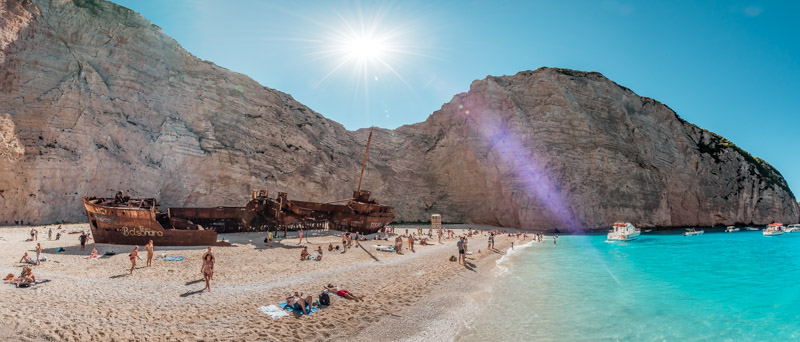
With a rental car you can also reach the viewpoint “Navagio View Point” above the cliffs. During the summer months, there is a lot of activity at Shipwreck Bay, with several dozen excursion boats heading for the site. In the low season, on the other hand, it is much quieter. On GetYourGuide* you can check prices and availability of the tours:
Visit to the Monastery of Agios Georgios
On the way to the shipwreck viewpoint, you should definitely stop at the Monastery of Agios Georgios Krimnon. The well-kept complex was built in the 16th century under Venetian rule and is considered one of the best-preserved monastic complexes on the island.
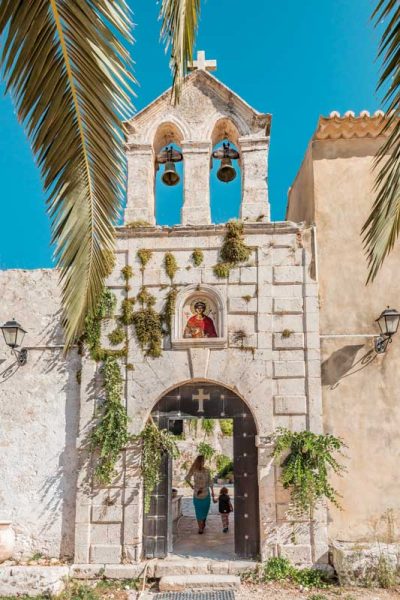
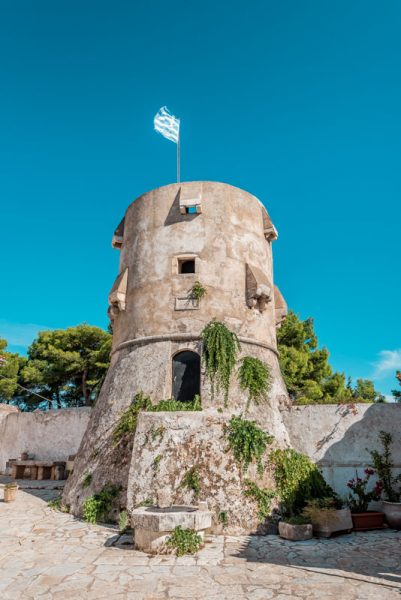
In the courtyard you can visit the massive fortified tower with its machicolations and the monastery church. Opposite the monastery is the mosaic workshop of the monks, where you can discover the art of mosaic-making from tiny pebbles – finished works can also be purchased on site.
✓ Full coverage & unlimited mileage included
✓ Free cancellation until 24h before pickup
✓ Best price guarantee via Discover Cars
Stroll through Volimes
The mountain village of Volimes consists of several districts and remains for many only a transit stop on the way to Shipwreck Beach. It is well worth taking a short stroll through the village of 700 inhabitants with its narrow streets and old churches from Venetian times (including Agios Spyridon).

Even though there are souvenir shops on many corners catering to day-trippers heading to Navagio Beach, Ano Volimes in particular remains an authentic farming village that offers a genuine glimpse into Greek rural life.

For a lunch break, we can recommend the Elatino Tavern from Panos. Here you can enjoy tasty Greek cuisine and simple snacks at very fair prices.
#8 Zakynthos Blue Caves
In the very north of Zakynthos is Cape Skinari. The lonely northern tip of Zante is only 15 km away from the island of Kefalonia. From the former fishing village of Agios Nikolaos, daily day trips run to the neighbouring island during the season.
However, it is the so-called Zakynthos Blue Caves that draw most holidaymakers to this remote area. The sea caves are one of the top sights on the island. Particularly impressive are the three arches that follow one after the other.
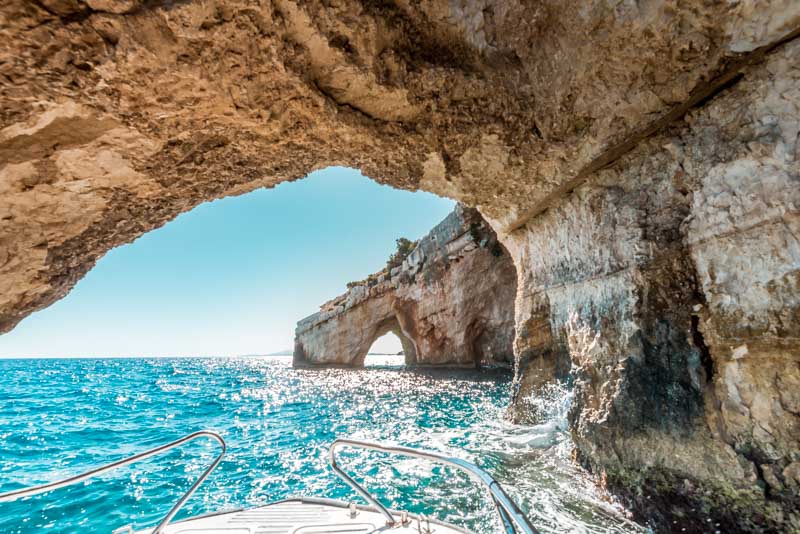
The Potamitis family owns land north and south of the Skinari Lighthouse, and from a pier, boat tours to the dramatic cave formations depart daily. Depending on the angle of light, the water sparkles in the most beautiful shades of blue. Don’t miss this boat tour on Zakynthos – secure your online ticket via GetYourGuide* now:
➲ To the Blue Caves boat tours*

Some grottos can even be entered by boat, and swimming stops are part of the programme. The excursions are especially worthwhile in the morning, when the sunlight is at its best. Afterwards, you can even continue to Shipwreck Beach.
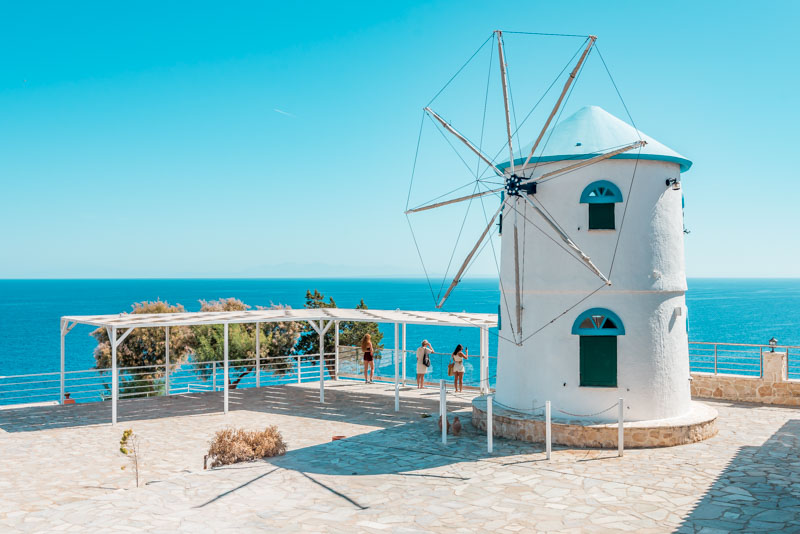
Even without a boat tour, a visit to the Taverna Potamidis Windmill – a bright white windmill – is well worthwhile, as is the magnificent coastal landscape of Cape Skinari.
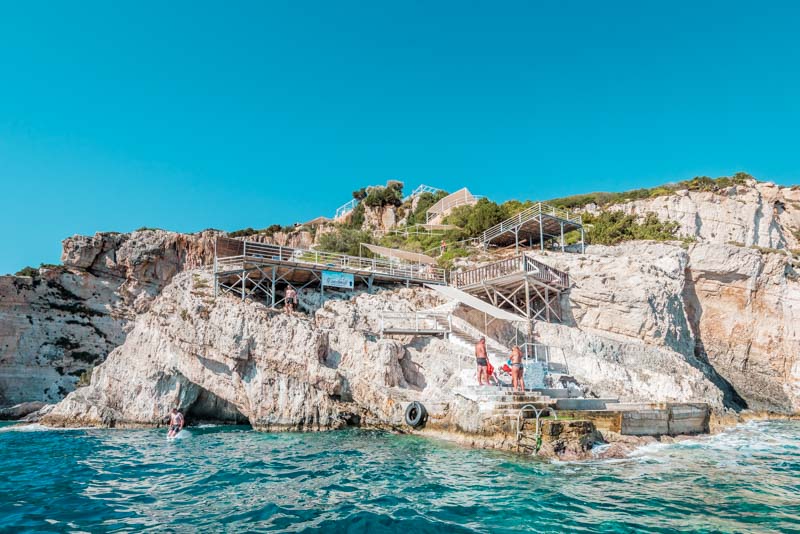
A long whitewashed staircase leads from the Skinari View Point down to the sea. A small bathing spot (with boarding ladders) invites you to take a dip, and daredevils can dive into the turquoise-blue sea from a seven-metre-high board. The picturesque bay is also great for snorkelling!
💡 Olive oil on Zante: The many sunny days a year and abundant winter rainfall provide perfect conditions for the local olive trees. Several oil mills have settled on Zakynthos, many with glass production facilities open to visitors in summer, including the “Elies Olive Press” in the hamlet of Elies (Greek for olives), just 5 km from Cape Skinari. Other recommended oil producers on Zante: Therianos, Lekkas and Aristeon.
Harbour town of Agios Nikolaos
On the way back from Cape Skinari to the south, you will pass the coastal town of Agios Nikolaos. Although the former fishing village and the islet of the same name look peaceful from above, the harbour is bustling in summer.
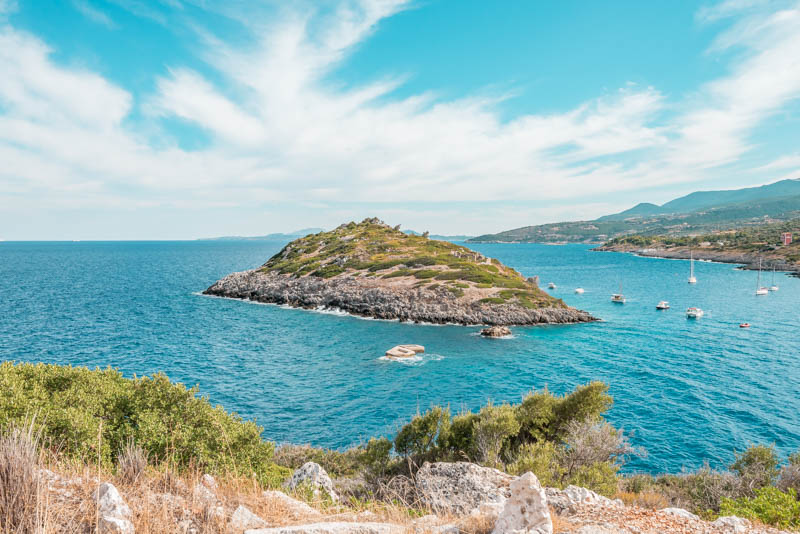
The oversized concrete jetty of this small village immediately catches the eye, as Agios Nikolaos serves as an important crossing point between Zakynthos and the neighbouring island of Kefalonia (Port of Pesada).
Two ferries run daily between the two islands during the summer. Many Zante holidaymakers take advantage of a day trip to get a brief taste of the much quieter Kefalonia. More tips for the neighbouring island can be found in our separate article: Kefalonia
Boat trips to the Blue Caves also depart from Agios Nikolaos. In July and August, the narrow harbour road is often clogged with buses unloading tourists. A handful of tavernas line the waterfront. For a cool drink or coffee, we recommend the Zanzzi Bar.
It is much quieter in the mountain village of Korithi above Agios Nikolaos. Many of the old stone houses have been extensively restored in recent years and now serve as holiday homes. At the end of the village, Reni and her husband Takis have created a cosy oasis far from the hustle and bustle, in the building of a former village school.
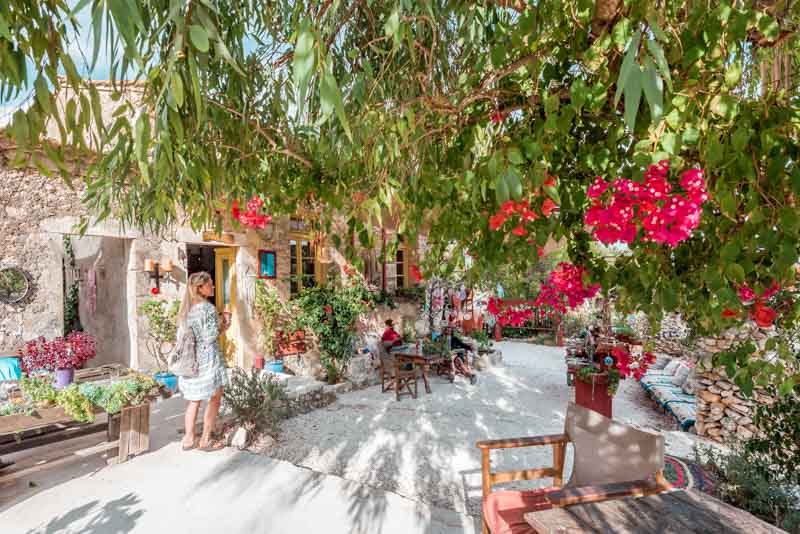
In their charming souvenir shop, Reni’s Place, you can find all kinds of handmade items, as well as olive oil, honey and jams. Takis is generous with his hospitality and often invites visitors for a Greek coffee, raki or homemade lemon schnapps.
#9 Zante East Coast: From Mikro Nisi to Alikanas
From Cape Skinari, a charming panoramic road leads along the picturesque coast to Alikanas. Away from the main road, there are hidden bays that can only be reached via gravel tracks or on foot, including Kremidi, Vathi Lagadi and Climati.
Directly on the road is Makris Gialos Beach, for many locals probably the most beautiful beach on the island. Especially in the low season, this bright pebble beach is wonderfully quiet.
A photo stop is worthwhile at Mikro Nisi (Greek: tiny island), where a narrow headland dotted with houses juts out into the sea. In the maze of houses there is still a watchtower from Venetian times; around Mikro Nisi the sea shimmers in the most beautiful shades of blue.
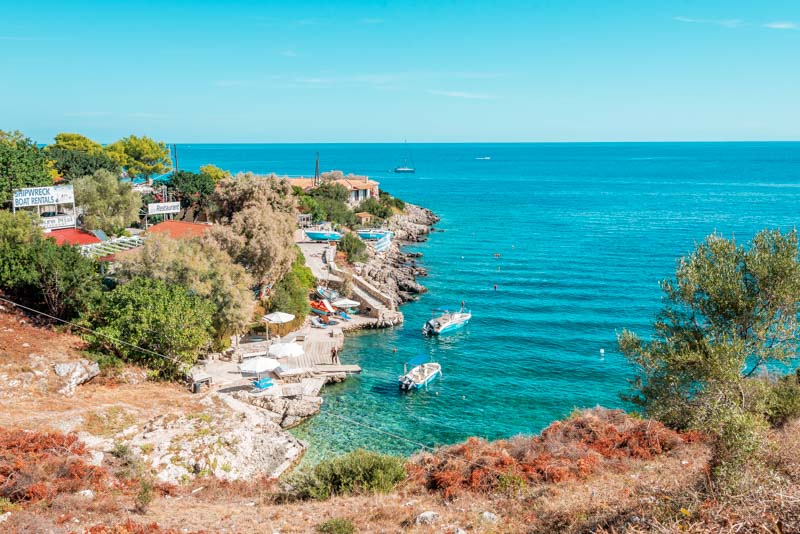
In season, two tavernas cater to hungry visitors. Swimming on the rocky coast is made possible via boarding ladders.
Xigia Beach: Sulphur Beaches of Zakynthos
Shortly after Mikro Nisi come the Xigia Beaches, Zakynthos’ sulphur beaches, where you can find sulphurous water near the shore.
The strong smell along the coast has been known to send holidaymakers quickly on their way. Nevertheless, at least a photo stop is worthwhile – the sulphur springs make the seawater shimmer milky blue.
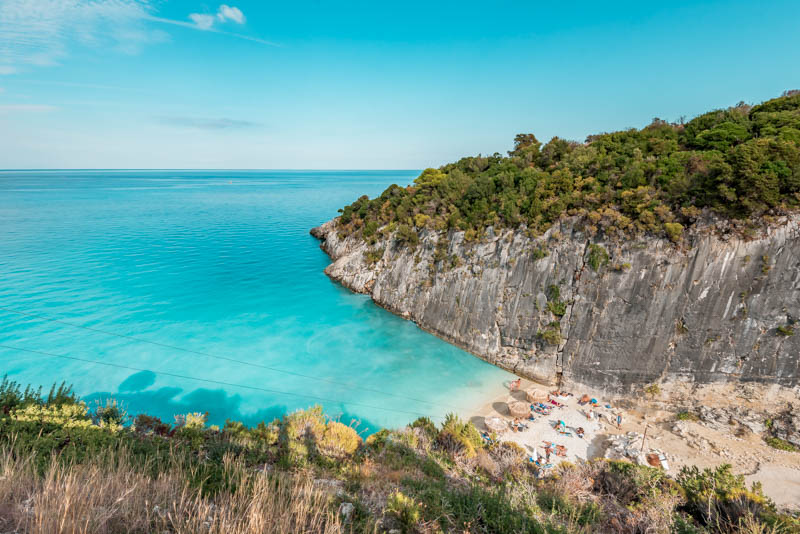
Even a short stay at the beach carries no health risks. On the contrary, locals attribute healing and therapeutic properties to bathing in the sulphur springs – muscle and arthritis pain, as well as cellulite and skin conditions, are said to be alleviated.
In summer, the narrow section of Xigia Beach becomes completely overcrowded. Only 600 m further south is Little Xigia Beach, reached via a steep staircase – and considerably quieter. The friendly Magda runs a small canteen above the beach, supplying bathers with snacks and drinks via a pulley.
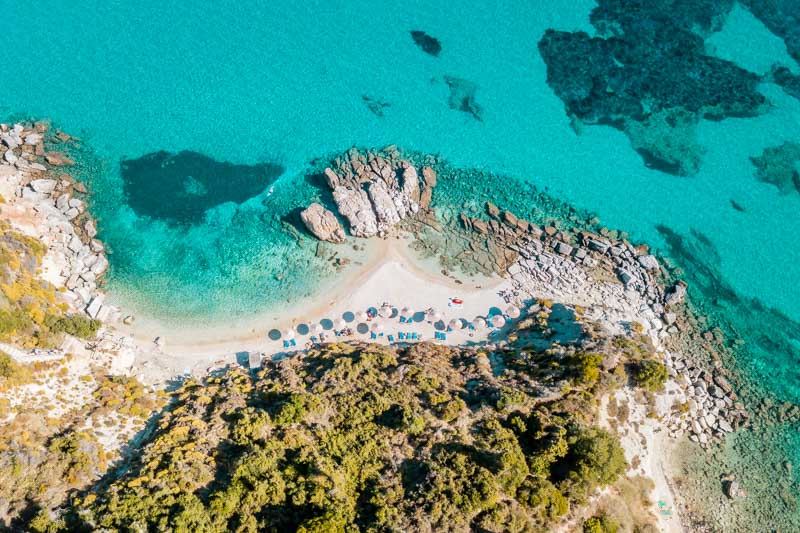
Beer from Zakynthos
Between Mikro Nisi and the sulphur beaches lies the microbrewery Levante Beer, founded in 2017. The Zakynthos Brewery, under the direction of Bavarian master brewer Klaus Schober, has already made a name for itself on the island with its tasty unfiltered craft beers.
There are now 6 types of beer on the market and in many restaurants on Zakynthos. A brewery tour at Levante Beer can be arranged by appointment. More information at: Levante Beer
Alikes and Alikanas
From the sulphur beaches, the coastal road leads to the resorts of Alikes and Alikanas. Both places have now grown together due to the pronounced tourism.
Older British visitors in particular feel very comfortable here. The resort is popular for its elongated bay, which is largely covered by bright sandy beaches. Especially at Alikanas, the sand is very fine and the sea is extremely shallow at the water’s edge – perfect for families with children.
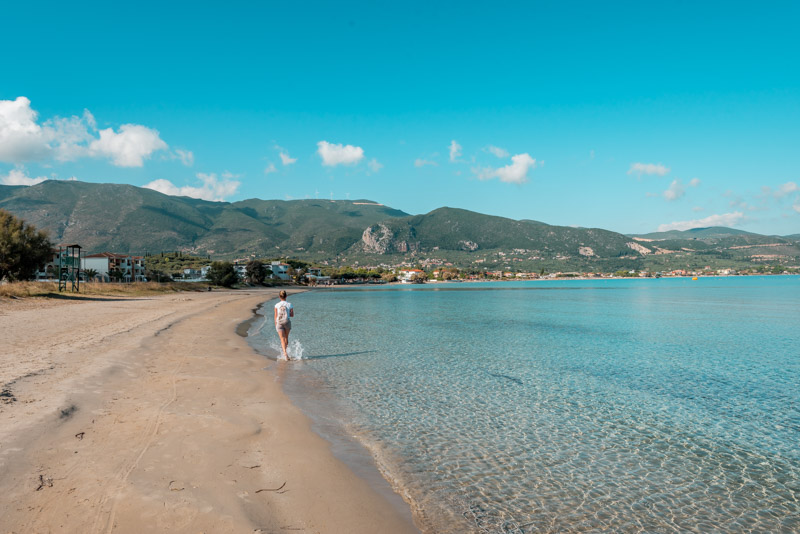
The most beautiful view of the villages is from the mountain road coming from the north, at the viewpoint known as »Pika’s Corner«. On a clear day, you can see as far as Mount Skopos in the south of Zakynthos.
The large former salt lakes, which give the villages their names, immediately catch the eye. Just a few decades ago, salt was mined here on a large scale. Today, the old salt pans serve as breeding grounds for birds.
The old Pentakámaro Stone Bridge, a remnant of the Venetian occupation, is located between Alikes and Alikanas. Below the pedestrian bridge flows the Skourtis River, also known locally as Potamos.
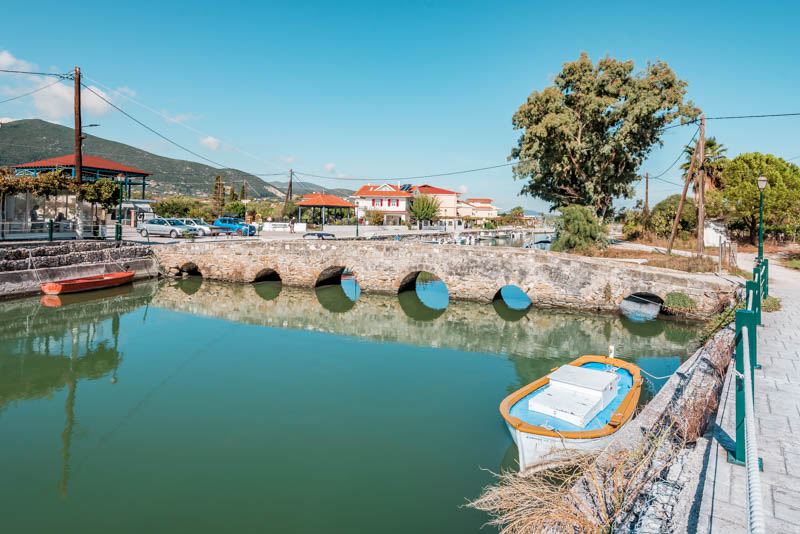
It is wonderful to walk along the river, with a few colourful fishing boats anchored on the shore. The river flows into the sea, and many bars and cafés have settled here. The atmosphere at the Hakuna Matata Beach Bar is amazing, particularly at sunset when you can enjoy the view across to Kefalonia.
#10 Zakynthos Heartland Tour
In contrast to the south and east coasts, the mountainous heartland of Zakynthos has barely been developed for tourism. On a tour through the green heart of the island, with its traditional villages and lonely monasteries, you will get a glimpse of Zakynthos before the great tourist boom.
Panoramic View from Ano Gerakari
Coming from Zakynthos Town, we first stop in Gerakari. From the Agios Nikolaos Church in Ano Gerakari (Upper Village) you can enjoy a great panoramic view of the island.
Even though the church with its free-standing bell tower is usually closed, the drive up the hill is well worthwhile. Next to the church, you can relax on the panoramic terrace of the rustic café »Fioro Tou Levante« and enjoy a Greek coffee or cold drink.
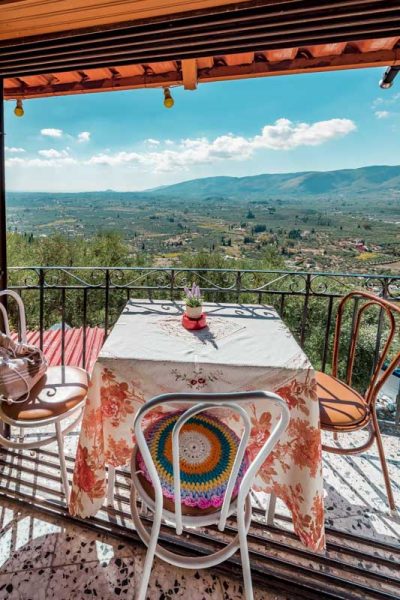
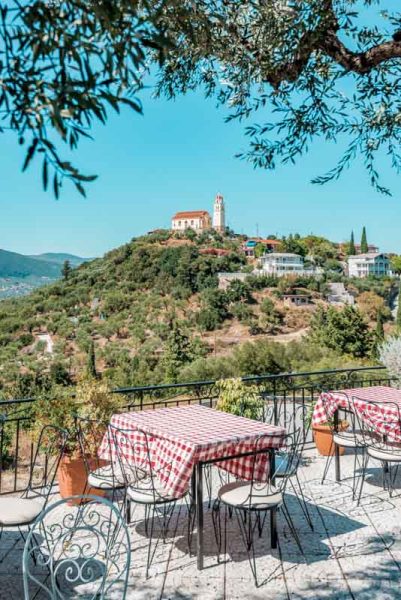
Incidentally, the best view of Ano Gerakari and its church is from the Lofos Restaurant on the opposite hillside. Host Christos serves delicious pizzas and typical Greek dishes in a cosy atmosphere.
We continue our journey into the heartland, following the main road via Kallithea and Katastari to the north. At the junction to Cape Skinari we keep to the west, and shortly after the concrete plant we reach the Goumas winery, nestled in an idyllic valley.
Goumas Estate Winery
The friendly couple Giannis and Despina Giatras-Gkoumas have spent more than 20 years painstakingly renovating the old family property from the 18th century and turning it into an organic winery on Zakynthos. The focus is on traditional cultivation methods and old Zakynthos grape varieties such as Avgoustiatis and Vostilidi.
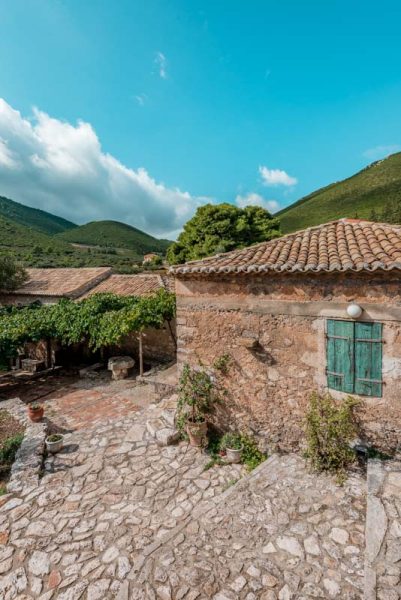
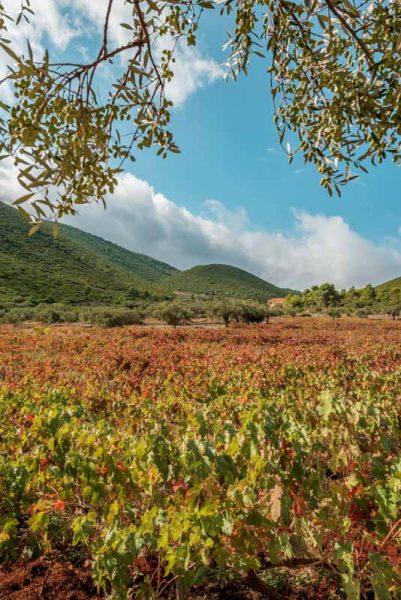
Today, various red, white and rosé wines are available to buy, including a variety with a distinctive smoky aroma. Due to the microclimate and soil conditions, the slightly acidic wines develop strong, complex aromas. For a wine tasting (from €10 p.p.), it is advisable to make a reservation in advance.
In addition to viticulture, Giannis is also dedicated to icon and church painting. Some of his creative works can be viewed in the attached workshop. He has already decorated several churches on Zakynthos and in Athens with magnificent murals. All information about the Zakynthos winery at: Art & Wine – Winery Zante
Monastery of Panagia Spiliotissa in Orthonies
From the Goumas winery, the route heads west via the mountain village of Orthonies. Orthonies is often overlooked by Zakynthos holidaymakers, who treat it as a mere transit stop.
Nevertheless, a short stop is worthwhile: away from the tourist hustle and bustle, two family-run tavernas and a kafeneion offer authentic home cooking at fair prices. The Botega Café Museum in the centre of the village even has a small folklore museum worth seeing.
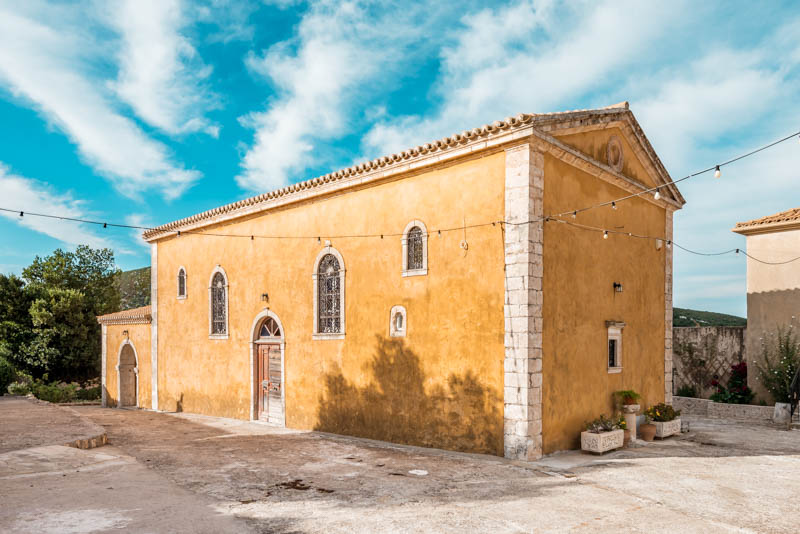
Just outside Orthonies lies the Monastery of Panagia Spiliotissa (Blessed Mother of the Cave). The nunnery was revived a few years ago, and many Zakynthians make a pilgrimage here for the feast day on 8 September.
The inner courtyard is a place of silence, and the main church impresses with its striking design. The eponymous cave, home to the Marian icon, lies in the valley below and can be reached on foot (approx. 2 km).
💡 Shopping in Zakynthos: You can find beautiful dresses and accessories by Greek designers at Barbara’s boutique Ble in the village of Anafonitria. On the way from Orthonies to Maries, it is worth stopping here for a short shopping trip.

Traditional villages of Loucha & Kiliomenos
We continue our tour, taking the road south from Maries. Maries, Exo Chora and Agios Leon benefit from the transit tourism to Shipwreck Beach, and numerous traders have set up stalls along the road.
Above Agios Leon, cheese lovers can visit the Agrodesmos Cheese Factory and taste and buy homemade cow, goat and sheep cheese from the island. We found the Graviera in olive oil (Ladograviera) particularly delicious.
If you want to get an insight into what Zakynthos’ villages looked like before the devastating earthquake of 1953, take a short detour to the north. Just 3 km away, the mountain village of Loucha awaits.
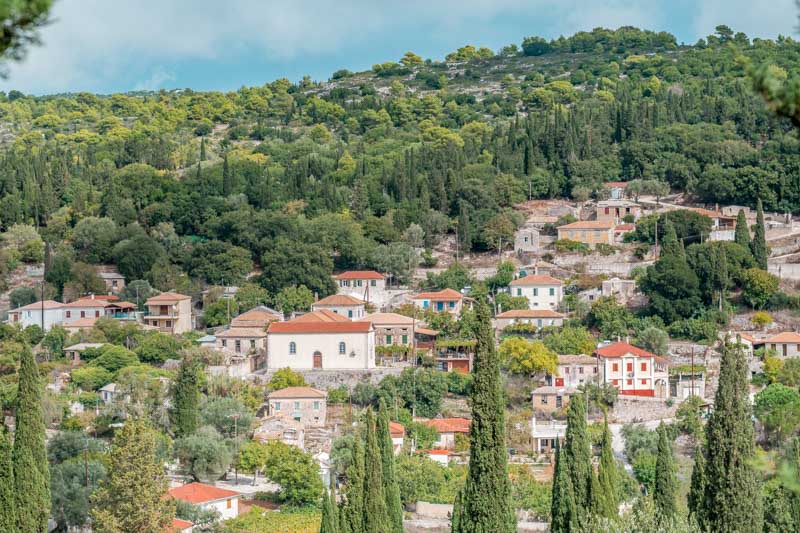
The small village below a mountain ridge was largely spared from the catastrophe and impresses with its historic buildings. As you wander through the cobblestone alleys, time seems to have stood still. The simple kafeneion on the outskirts of the village invites you to take a short break.
Our tour of the Zakynthos heartland ends in the mountain village of Kiliomenos. At the entrance, you have a sweeping view down over the village to the sea.
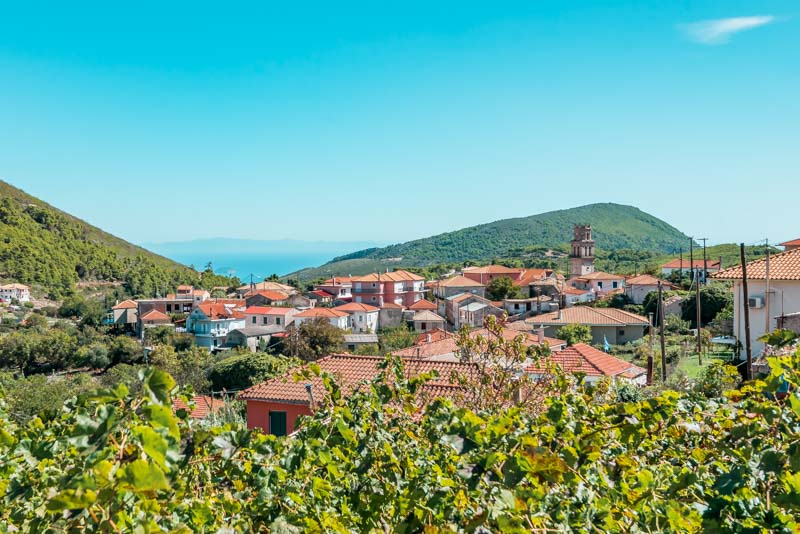
Kiliomenos is wonderfully authentic. The focal point is the village church of Agios Nikolaos with its imposing bell tower, whose upper section features partial Gothic elements. Several tavernas and cafés invite you to linger.
At the southern end of the village, you can visit the Women’s Cooperative Melissiotises (meaning ‘honey bee’ in Greek). As well as selling herbs, honey and olive oil, they also sell cheese and wine produced on the premises. Our recommendation: the red wine!
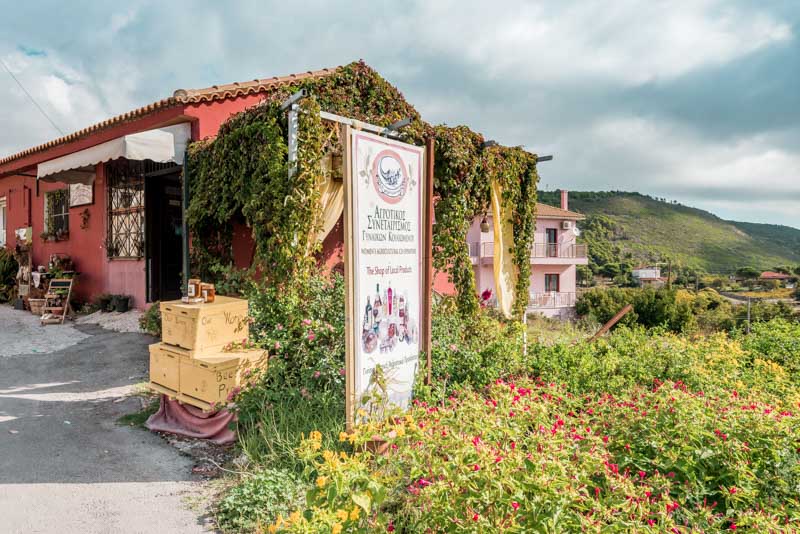
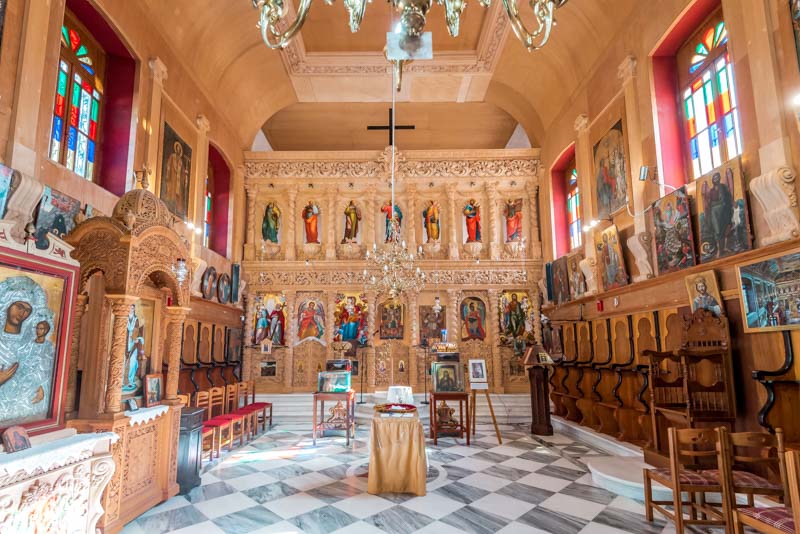
Via the village of Macherado, we return to Zakynthos Town. If you’re lucky, you can take a look inside Agia Mavra & Agios Timotheos Church. Its interior has now been adorned with numerous icons from surrounding churches, following a devastating fire.
More Zakynthos travel tips for your holiday
Guided tours on Zakynthos
In addition to Shipwreck Beach as a top attraction, there are numerous other highlights on the Ionian island. The most popular tours on Zakynthos are listed below. Click on the GetYourGuide* link for details and to check availability and prices:

Recommendations for accommodation on Zakynthos
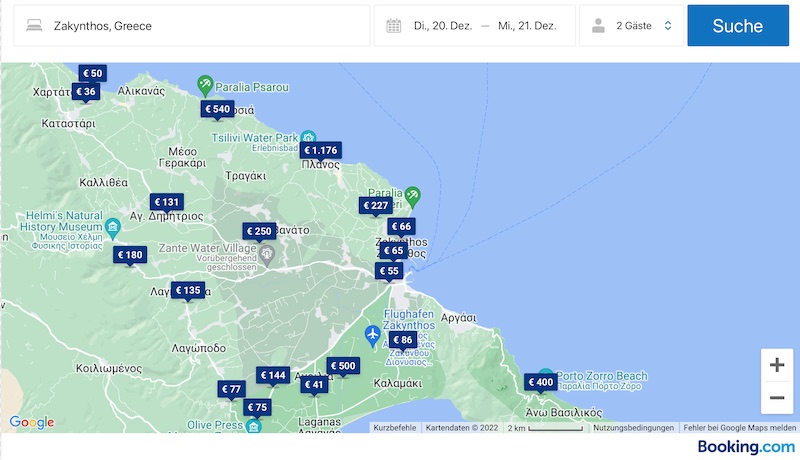
You can travel to Zakynthos wonderfully independently without a package deal. On site, there are numerous apartments, studios and villas for self-catering, as well as cosy family hotels with breakfast or half board for a carefree holiday.
→ Via Booking.com* you will find many places to stay on Zakynthos and can check prices here:
Bitzaro Boutique Hotel, Zakynthos Town
Probably the best hotel in Zakynthos Town, with modern rooms, some with balconies and sea views. Central location, varied breakfast, friendly staff and hotel-owned parking.
➲ Book Bitzaro Hotel (Booking.com)*
Chris & Jo Villas, Bochali
Two new villas set in nature near Bochali. Space for up to 6 people (2 or 3 bedrooms), a stylishly furnished living room and beautiful wooden veranda, a well-equipped kitchen (including dishwasher) and a small pool with sea view.
➲ Book Chris & Jo Villas (Booking.com)*
Armonia Hotel & Studios, Ammoudi
Dionysios runs a very well-kept aparthotel in a quiet location in the central northeast of the island. Spacious rooms and apartments, friendly hosts and a large pool in the well-tended outdoor area. A great base for exploring the island!
➲ Book Armonia Hotel (Booking.com)*
→ You can find our personal selection of the 20 best accommodations on Zakynthos in this article: Zakynthos Hotels
Where we stayed on Zakynthos
Paliokaliva Village, Tsilivi
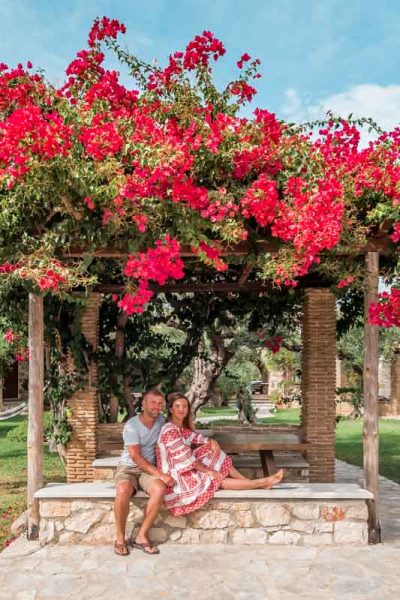
A real gem on Zakynthos, especially for families with children, is the Paliokaliva Village near Tsilivi. We spent a week in the very well-kept complex and particularly enjoyed the family-friendly and private atmosphere.
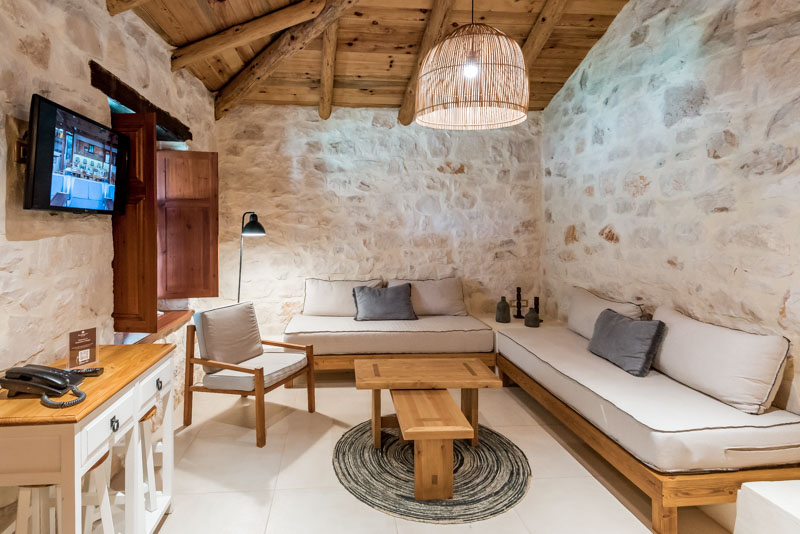
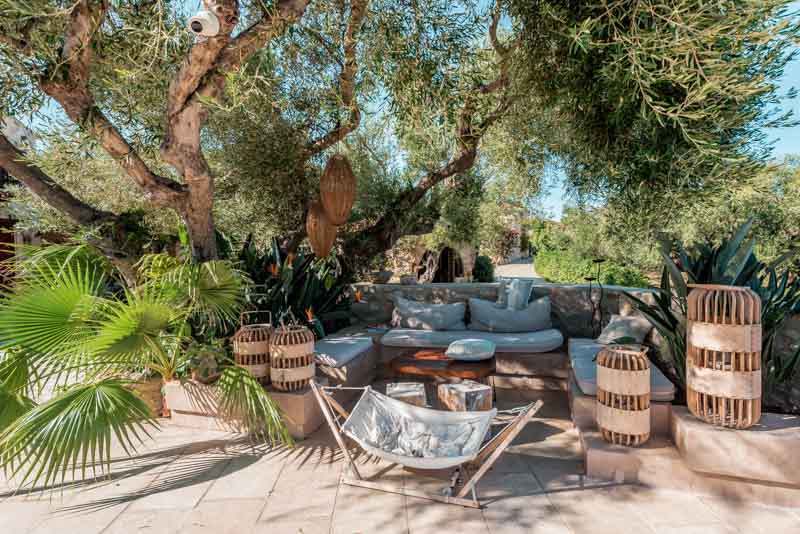
The traditional stone houses can be booked as an entire villa or as an apartment or studio. They are set in a wonderfully green garden that also offers plenty of space for little explorers, while grown-ups can relax by the pool with sea views or enjoy a drink at the bar-restaurant.
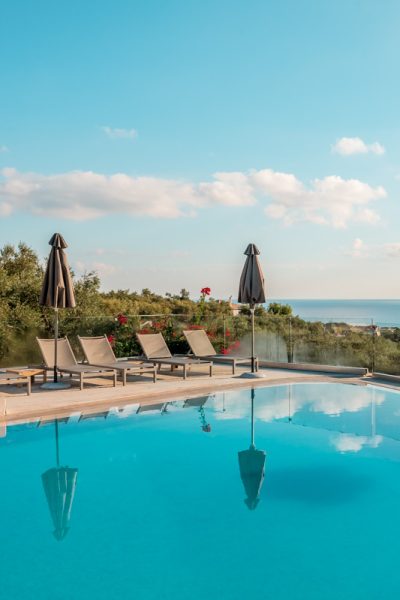
The generous breakfast buffet leaves nothing to be desired, and for lunch and dinner you can eat excellently à la carte. The nearest beach (Bouka Beach) is about a five-minute drive away. Click on the Booking.com* link to check prices and availability:
Zakynthos restaurants: Our recommendations
Zakynthos offers an incredibly wide range of restaurants and tavernas across all price brackets. In addition, there are numerous cafés in the villages as well as at least one or two beach bars on almost every stretch of beach. Below you will find a small selection of our favourite cafés and restaurants on Zakynthos:
Ampelostrates, Kiliomenos
Rustic taverna in the quiet village of Kiliomenos. Charming interior, as well as a timeless and cosy atmosphere on the farm. Tasty dishes of typical Greek cuisine and good self-produced wine. Open from April to October, Friday to Sunday only.
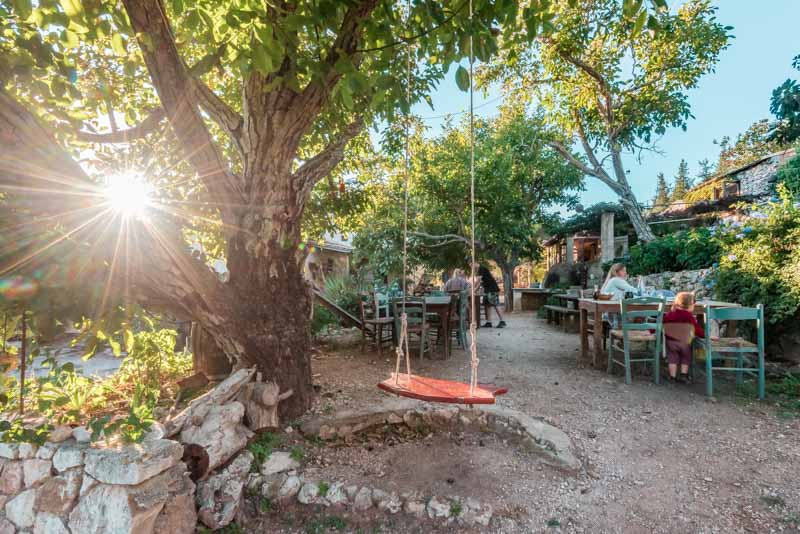
Elatino, Volimes
Panos and his family run a café-taverna in the village square of Kato Volimes, offering drinks of all kinds (including cool Levante beer) as well as delicious home cooking. We found the moussaka and the homemade potato wedges particularly delicious. Fair prices, genuine hospitality and generous portions!
More restaurant recommendations for Zakynthos:
- Erietta Restaurant, Tsilivi
- Porto Niova Beach Bar, Alykes
- Kantouni, Zakynthos Town
- …
Want more restaurant tips for Zakynthos?
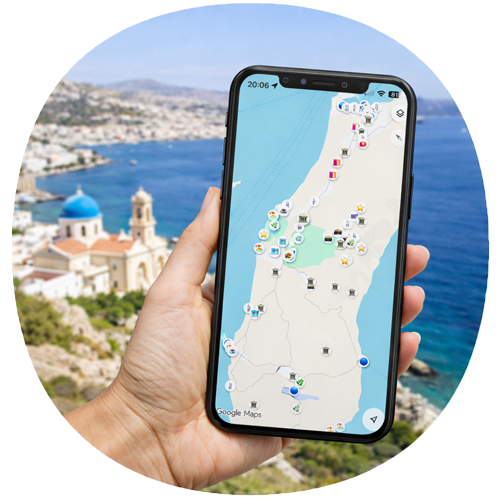
→ In our Google map you will find all recommended cafés and tavernas on Zakynthos: To the Zakynthos map

Getting around Zakynthos
While the west of Zakynthos is crossed by a mountain massif up to 756 m high and is sparsely populated, the east is only gently hilly and home to numerous settlements and tourist resorts on its flat coastal plain.
If you want to explore this Ionian island, which is 40 km long and 20 km wide, away from the crowds, or if you want to visit the Shipwreck viewpoint, it is very difficult to get around without a rental car on Zakynthos.
We recommend booking a vehicle in advance so you are mobile immediately upon arrival and can avoid transfer costs. Via Discover Cars* you can compare prices for affordable rental cars:
➲ To offers for cheap rental cars*

Public buses on Zakynthos mainly connect the capital with the south of the island (including the Skopos Peninsula) and the east. There are only a few connections to the inland and to the north and west of the island. There are no public buses to the Shipwreck Beach viewpoint. Timetables are available at: KTEL Zakynthos
💡 Help with Zakynthos Holiday Planning: Not sure where to start with planning your Zakynthos holiday? No problem – benefit from our years of experience travelling to Greece and let us help. We advise on all your questions and concerns, even via video chat. Book your consultation here: Travel Advice Greece
Getting to Zakynthos
Zakynthos can be reached by direct flight during the season, from May to October. Several airlines, including Condor and Eurowings, fly to the island roughly once or twice a week, including from Düsseldorf and Munich. The airport is located in the south of the island, with transfer times of up to 50 minutes to the north.
Via Skyscanner* you will find an overview of flight connections to Zakynthos and can compare prices:
➲ To the flight search at Skyscanner*
→ Travelling to Zakynthos by ferry? This article has all the information you need: Ferries in Greece
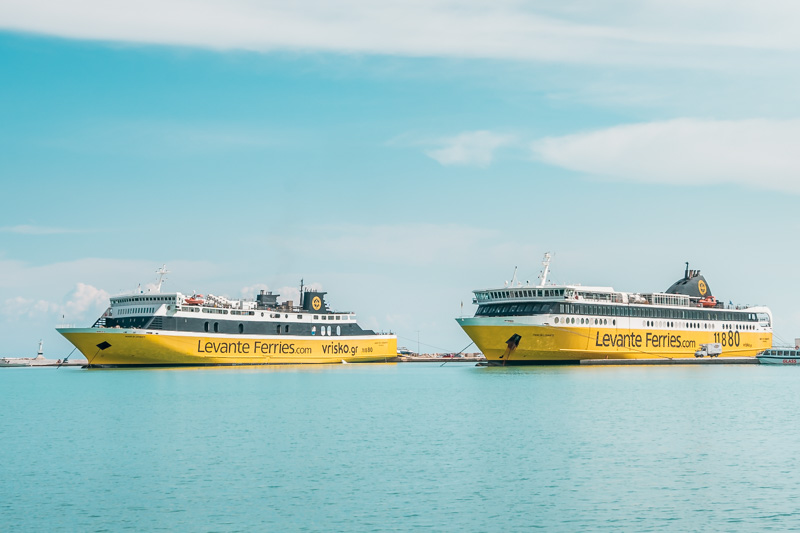
Coming from the mainland by camper or car, you can reach Zakynthos from the ferry port of Kyllini on the Peloponnese. The ferry company Levante Ferries sails to Zakynthos Town several times a day during the season. The crossing takes about 1 hour 15 minutes. Current timetables and tickets are available from our partner Ferryhopper*:
➲ To the ferry search with Ferryhopper*
Zakynthos sights in video
A beautiful visual impression of the island can be found in this video by Tomas Polasek ©:
→ All our travel reports of the Ionian Islands and more Zakynthos tips can be found here: Ionian Islands
🔍 Our conclusion about Zakynthos: Admittedly, it wasn’t love at first sight. But after 14 days of intensive research, we were surprised how diverse this island is. In addition to the classic tourist attractions such as the shipwreck, Zakynthos offers beautiful beaches, pockets of unspoilt nature, traditional villages and a charming capital to stroll through. Both package tourists and independent travellers get their money’s worth. But mass tourism has its downsides: litter lines the roadsides and some restaurants are focused purely on quick turnover. As a place to stay, we recommend avoiding the party strip of Laganas – not our favourite part of the Greek islands. If the protection of the Caretta caretta turtles were given greater priority and the construction boom brought under control, we would have taken this island even more to our hearts.
*Support our blog Greece-Moments
In this post, you will find affiliate links marked with an asterisk (*). If you book or buy something through one of these links, we receive a small commission. For you, the price remains the same. In this way, you help us continue to provide high-quality content for free. If you enjoyed this post and would like to say thank you, why not buy us a Greek coffee ☕️ To the coffee fund
Bookmark this post on Pinterest!