

Southern Crete is quieter, more unspoiled, and far less developed for tourism than the north of the island. Even the most popular resorts, such as Plakias, Agia Galini, and Myrtos, still retain their charm and attract mainly independent travelers. While Matala is the quintessential tourist hotspot in southern Crete, just ten kilometers inland in the Messara Plain, an idyllic setting awaits.
Whether it’s Plakias, Lentas, or Myrtos: In southern Crete, there are hardly any large hotels, but plenty of inviting taverns right by the sea and cheerful locals who make you feel like part of the family.
Tom & Ella
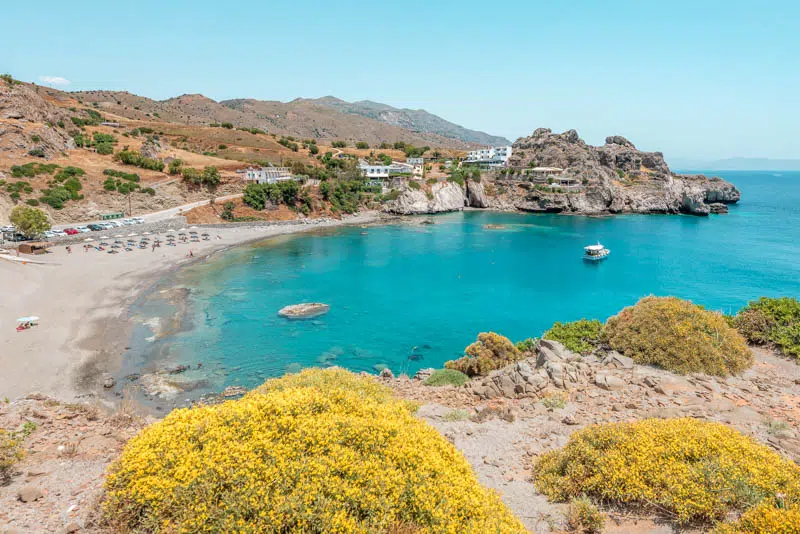
In southern Crete, life moves at a different pace. Here, there are no all-inclusive hotel complexes, but rather family-run taverns where the mother or grandmother still stands at the stove. Between Plakias and Ierapetra, spectacular gorges, secluded beaches on the Libyan Sea, and an ever-changing landscape characterized by barren mountain ranges and fertile plains await you.
You’ll discover the real Crete away from the tourist crowds during a stroll along the beach in tiny coastal villages like Triopetra or Tripiti, in the village squares of authentic mountain villages like Anatoli or Kalamafka, where time has stood still, or during a visit to the historic sites of Phaistos and Gortys, without being rushed by crowds.
In this post, we’ll introduce you to our personal favorite spots and the most beautiful sights of Southern Crete:
- #1 Frangokastello
- #2 Plakias: Southern Crete’s Beach Paradise
- #3 Kotsifou and Kourtaliotiko Gorges
- #4 Preveli Beach and Monastery
- #5 Visiting Spili
- #6 Agia Galini, Agios Pavlos, and Triopetra
- #7 Messara Plain
- #8 Matala and the Caves
- #9 Agiofarango Gorge and Odigitria Monastery
- #10 Asterousia Mountains
- #11 Myrtos and Sarakina Gorge
- #12 Ierapetra and Kalamafka
- More tips for southern Crete
- FAQs about Southern Crete
🏖️ Dream beaches & hidden bays
🍽️ Restaurants, tavernas & cafés
🏛️ Must-see highlights & ancient sites
🗺️ Worthwhile spots & insider tips
🚘 Practical info like rentals & parking
♾️ Lifetime access & updates
#1 Frangokastello
It’s no surprise that Frangokastello, located 1.5 hours from Chania, is so peaceful. While the southern coast of Crete is otherwise characterized by steep cliffs, a wide coastal plain suddenly opens up at Frangokastello. Directly above the beach rises a mighty 14th-century Venetian fortress, whose outer walls are still remarkably well-preserved. In front of it, a gray sandy beach forms a shallow lagoon.

In the background rises an impressive mountain range, on whose slopes ancient, partly abandoned villages like Kolokasia cling. In the off-season, much of Frangokastello feels sleepy, and a wonderful silence hangs over the widely scattered settlement. There are several great beaches in the area, such as Orthi Ammos or Volakas. For a day at the beach, we recommend Cafe Taverna Stavros west of Hondros Volakas Beach, with its laid-back atmosphere and free sun loungers for restaurant guests.
→ In this post, you’ll discover what there is to explore in southwestern Crete: Western Crete

Solitude in Kallikratis
If you have enough time, you should definitely explore the wild mountain landscape above Frangokastello. From Kapsodasos, the road winds past the Kallikratis Gorge and climbs over 500 meters in elevation via countless switchbacks up to the Kallikratis Plateau. The winding drive is an adventure, but once you reach the pass, you should stop briefly to enjoy the breathtaking panorama of the south coast. On days with clear visibility, you can even see the island of Gavdos, the southernmost point of Europe.

Time seems to have stood still on the Kallikratis plain. A hundred years ago, over 130 families lived here; today, there are only a handful left. Be sure to stop by the traditional tavern T’Armi Tou Kallikrati, where the charming host family (who speak only Greek) serves Cretan classics made with ingredients from their own garden. In Asfendos, seven kilometers away, you can marvel at rock paintings in the Skordalaki Cave that are up to 10,000 years old. You can get the key to the cave at the Kafeneion in Asfendos.
🗺️ 10 road trip routes with maps
🏖️ Beautiful beaches & swimming spots
🏛️ All top sights & attractions
🤫 Unpublished insider tips
🍽️ Accommodation, tavernas & cafés
#2 Plakias: Southern Crete’s Beach Paradise
If you’re looking for good tourist infrastructure in southern Crete—with classic hotels, apartment complexes, and numerous cafés, restaurants, and supermarkets, you’ll find it in Plakias. While the resort is no longer a hidden gem, the long stretch of Plakias Beach offers plenty of space so you won’t be stepping on each other’s toes. In the evening, you can sit in one of the seaside taverns with a glass of wine and listen to the waves. Hiking enthusiasts can conquer the surrounding mountain peaks and enjoy breathtaking views of the coast.

Northeast of Plakias, Damnoni, Ammoudi, and Skinaria Beach form a string of three beautiful beaches along a bay, ranking among the most stunning swimming spots in southern Crete. Damnoni is the largest and best-organized beach, and yes, the tourism industry has certainly left its mark here and the Hapimag Resort is impossible to miss. Our favorite is Ammoudi Beach, where the beach restaurant Chyma Sto Kyma evokes a pure vacation vibe. All three beaches can be reached via a coastal path.

The balcony villages of Myrthios and Sellia
Perched above Plakias, the villages of Myrthios and Sellia sit at an altitude of about 200 meters, like balconies overlooking the Libyan Sea. Of course, there are some excellent taverns where you can let your gaze wander over Plakias Bay at sunset, including the Elia Restaurant in Sellia and Taverna Plateia in Myrthios. But the peaceful atmosphere in the narrow streets also invites you to take a short stroll during the day.

#3 Kotsifou and Kourtaliotiko Gorges
Two impressive gorges lead from Rethymno to the south coast. Both are accessible by car and each features chapels built directly into the rock. The westernmost of the two is the Kotsifou Gorge (Blackbird Gorge), which connects Rethymno to the south coast via Plakias. At its narrowest point, the nearly vertical rock walls rise up to 200 meters high, and you drive right through them in your rental car.
✓ Full coverage & unlimited mileage included
✓ Free cancellation until 24h before pickup
✓ Best price guarantee via Discover Cars
In 2024, a landslide occurred in the gorge, closing the road for several months. Everything has since been repaired, and you can once again enjoy your panoramic drive through the Kotsifou Gorge to the fullest. From the plateau of the Agios Nikolaos Chapel, you have a fantastic view of the gorge and the sea near Plakias. On December 6, St. Nicholas Day, a cozy parish festival is celebrated here. If you’re in Crete during the winter, you shouldn’t miss it.

The Kourtaliotiko Gorge is even more spectacular in terms of scenery and leads past the hamlet of Koxare toward Preveli. Right after the gorge entrance, you’ll find the small Agia Kyriaki Chapel nestled beneath a rock—a great photo opportunity. The absolute highlight, however, is the Kourtaliotiko Waterfall, which you reach via hundreds of stone steps. Once you reach the bottom, you’ll find small waterfalls, natural pools in the river, and an impressive rocky backdrop. In the summer, however, the waterfall is hopelessly overcrowded.

Before you reach either of the two gorges from the north, we recommend stopping by Cretan Aroma near the village of Agkouseliana. In this small shop, you can browse at your leisure over a cup of coffee and stock up on organic herbs from Crete to take home. Back then, we stocked up on Malotira, the typical Cretan mountain tea, which turned out to be one of the best souvenirs ever—especially as a throat soother during the winter back home. 🙂

#4 Preveli Beach and Monastery
One of the most beautiful highlights in southern Crete is undoubtedly the palm-lined beach of Preveli. Where the Megalopotamos River flows into the Libyan Sea, a forest of Cretan date palms stretches out, giving the beach an almost tropical atmosphere. While only hikers got to see this natural paradise 20 years ago, the place is now a popular destination for many Crete vacationers.
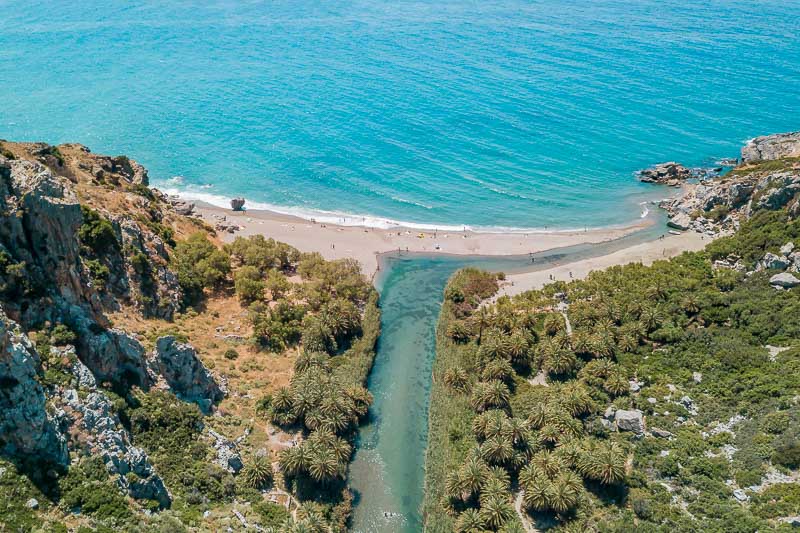
If the summer crowds are too much for you, head to the neighboring beach of Drymiskiano Ammoudi and treat yourself to a break at Cuppa Cafe. From Rethymno, you can reach Preveli in about an hour by car. On the way to the beach, it’s worth stopping at the Moni Preveli Monastery, which sits high above the palm-lined beach and has a turbulent history as a center of the Cretan resistance. From the monastery terrace, you’ll have a magnificent view of the coast.
→ Find all the details for your trip to Preveli in this post: Preveli Crete
#5 Visiting Spili
The mountain village of Spili is located on National Highway 97, halfway between Rethymno and Agia Galini in the south. The village is best known for its Venetian Lion Fountain, from whose 25 stone lion heads crystal-clear spring water flows. We had a wonderful time here with our little daughter, as she was completely fascinated by the lion heads that seemed to spit water as if by magic. The pretty village square surrounding the fountain, with its dozen or so cafés, invites you to linger.

In the narrow streets, you’ll also find small shops (Tip: Brilliant) offering local products and souvenirs. In the town center, you can also visit Spili’s fascinating local history museum, which provides insights into the region’s history and culture. For a truly delicious meal in Spili, we recommend To Sideradiko. The cuisine was a feast for the palate, and the interior decor feels like a journey back in time to decades past.

Just outside Spili lies Maravel Garden, a botanical garden spanning over 40 hectares that showcases the flora of Crete in all its diversity. Medicinal plants, ornamental plants, trees, and shrubs often grow here in dozens of varieties. Butterflies flutter among the flower beds, red and blue dragonflies buzz over the large pond, and further down, a stream babbles. There is even a small chapel dedicated to Saint Cyril. Afterward, you can recharge with coffee and cake at the on-site bistro.
#6 Agia Galini, Agios Pavlos, and Triopetra
About 45 kilometers from Preveli lies the coastal town of Agia Galini, which is touted in many travel guides as the pearl of southern Crete. Our first impression, however, was rather sobering, as Agia Galini struck us as a hastily built-up town, so we weren’t particularly enthusiastic. The promenade is lined with countless taverns and café-bars (Tip: CØVE), which is too much for our taste. On the other hand, the view of Agia Galini from the pier is truly worth seeing.
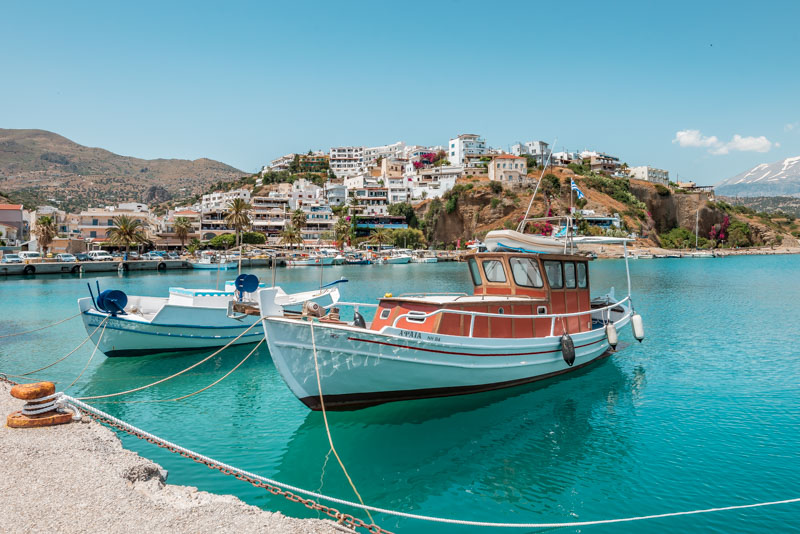
Below the modern amphitheater stand statues of the ancient scientist Daedalus and his son Icarus. From here, they once took flight with their self-made wings and soared toward the sun, though the son plunged into the sea near the island of Ikaria. Also worth seeing is a World War I tunnel beneath the town, which can be explored on guided tours. The Agia Galini campground is an affordable destination for camping enthusiasts looking to spend their vacation in southern Crete.
→ You can find everything you need to know about camping in southern Crete in this article: Camping in Greece
Triopetra
We were much more impressed by Triopetra, which lies about 20 kilometers west of Agia Galini. It’s actually just a scattered settlement, but the wide beach is stunningly beautiful, and to the south, striking rock formations rise out of the sea, looking like giant pancakes. As a family, we enjoyed a long walk along the beach and were able to take great photos on the rocks of Triopetra. Triopetra is one of those typical places in southern Crete where time seems to stand still, especially at the Hill Of Calm taverna.


Agios Pavlos
Things get even more secluded in Agios Pavlos, a tiny coastal hamlet on Cape Melissa that truly lies at the end of the Cretan world. Geologists are fascinated by the bizarre rock formations (Apoplystra) at the cape. Everyone else enjoys the impressive sand dune that drops steeply down to the sea. Tom rolled all the way down the dune once, because unfortunately, you can’t rent sandboards in Crete like you can in Australia. Still, it was a blast and a place that will stay in your memory for a long time with its wild beauty.

#7 Messara Plain
The Messara Plain is the largest lowland plain in Crete and one of the most fertile regions in the entire Aegean. From Heraklion, you can reach Mires, the main town of the Messara, in about 50 minutes. At the foot of the mighty Psiloritis Mountains, nestled among olive groves and vineyards, lie some of the island’s most significant archaeological sites, including Gortys, Phaistos, and Agia Triada. The Messara is already very popular among long-time Crete enthusiasts, and in the quaint villages, you’ll encounter a few expats from German-speaking countries.

Palace of Phaistos
One of the most impressive sites in Messara is Phaistos (also known as Festos), the second-largest Minoan palace in Crete after Knossos. The 8,500 m² complex sits atop a hill with a magnificent view over the fertile plain all the way to the Ida Mountains. Unlike at Knossos, controversial reconstructions were avoided at Phaistos, allowing you to experience the original ruins in their original form. This makes the visit particularly authentic for history enthusiasts.

Gortyn
Just a few kilometers north of Phaistos lie the ruins of Gortyn (Gortys), once the most powerful city in Roman Crete and the capital of the province of Creta et Cyrenaica. Today’s archaeological site encompasses only a portion of the former city and extends far beyond the fenced-in main area. In the olive grove next door, just before the village of Mitropoli, you’ll find a freely accessible Temple of Apollo and an early Christian basilica; marble stumps and column fragments are scattered throughout the grass.

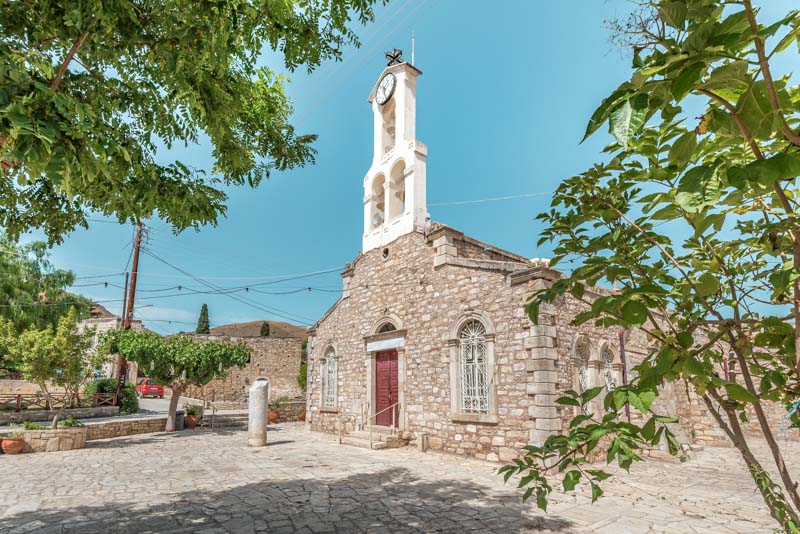
If you come here in the summer but don’t want to visit all of Gortyn’s sites under the blazing midday sun, why not stop by the Messara Archaeological Museum? It opened in 2024, is very close by, and features four rooms of interesting and well-explained exhibits dating back to 4900 BC. Afterward, it’s worth visiting the village of Agii Deka, which boasts plenty of historic architecture. You can enjoy a nice meal here at the Aloni Traditional Cretan Restaurant.
Messara Villages and Kommos Beach
A detour to the tranquil villages of Sivas, Pitsidia, and Kamilari, located northwest of Matala, is well worth it. German voices are not uncommon in the narrow streets, as many have found their vacation haven here. In every village, you’ll find at least one really good tavern for the evening. During the day, you can soak up the sun at Kommos Beach. In the summer, the long dune-lined beach is even a gathering spot for caretta caretta sea turtles, which lay their eggs there.

#8 Matala and the Caves
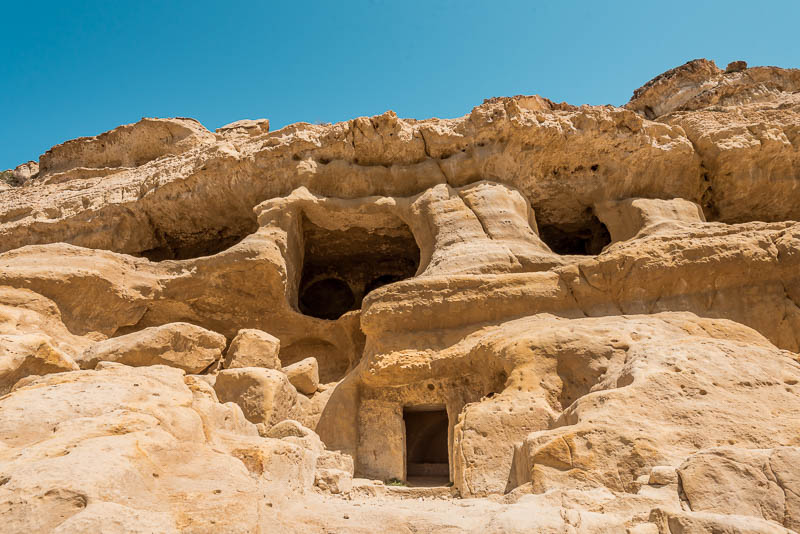
The famous caves of Matala date back to prehistoric times and were used by the Romans as burial sites. During the hippie era between 1965 and 1975, they served as a refuge for many dropouts and gave the place its legendary reputation, which endures to this day. You can still visit the caves today, and the more skill and stamina you bring, the higher you can climb. But be careful—the entire site is unsecured and there is a risk of falling!
→ You can find all the tips about the hippie village of Matala in this post: Matala Crete
Just outside Matala lies Kokkini Paralia (Red Beach), one of the most beautiful beaches in southern Crete. It’s only accessible via a short hike, but once you’ve conquered the gentle climb, you’ll be rewarded with a magnificent view. The reddish-brown sandy beach, nestled between high cliffs, is significantly quieter than Matala’s main beach and a real highlight for nature lovers in southern Crete.


#9 Agiofarango Gorge and Odigitria Monastery
The unspoiled, gray pebble beach of Agiofarango (also Agiofarago) lies about 20 kilometers south of Matala at the end of the gorge of the same name, nestled between imposing sandstone cliffs. While Agiofarango Beach may not be a dream beach, the hike leading there is a true highlight of southern Crete. The easy hike (no incline) takes about 25 minutes. A wide path follows the dry riverbed through a landscape overgrown with wild oleander bushes.

Along the way, you’ll pass the imposing Agios Antonios Church, and the cliffs feature several caves and grottos that were used as hermitages by monks during the Ottoman occupation. Once you reach the Libyan Sea, you’ll find yourself at one of the southernmost points of Crete, just 350 kilometers from Africa. Experienced hikers can also explore the neighboring Martsalos Gorge, which is significantly more challenging and rugged.

Odigitria Monastery
On the way back from Agiofarango, it’s worth visiting the Odigitria Monastery, which lies directly on the access road to the south. Founded in the 14th century, the monastery is one of the most significant on the island. Its location in the far south of Crete is no coincidence, as this is where the Apostle Paul is said to have stopped on his journey to Rome. The barren, treeless landscape south of Matala resembles a Wild West setting, in which the monastery appears like a blooming oasis.

The Odigitria Monastery was built in the Venetian style typical of Crete and has recently undergone extensive restoration. The massive Xopatera Tower is a remnant from the Middle Ages, when the region was attacked by pirates. Just a few kilometers north of the monastery, in the hamlet of Listaros, is the Botano herb shop, known from television. Anyone staying in the area should definitely stop by the local Cafe Bistro Wine Bar Zoi in the evening for a drink with the friendly owner Manolis (who speaks German).

#10 Asterousia Mountains
South of the Messara Plain rise the Asterousia Mountains, one of the most mysterious and unspoiled regions of Crete. As the name suggests, the Asterousia (Greek: Asteri means “star”) truly make this place seem like it’s from another planet. The barren, rugged mountains soar up to 1,231 m (Kofinas) and drop steeply into the Libyan Sea. Tiny hamlets are hidden along the coast, some of which are accessible only via adventurous gravel roads. Anyone who comes here has left touristy Crete far behind.

In recent years, Lentas has evolved from a sleepy hamlet into a small hotspot for individualists. Around a dozen bars and taverns have sprung up around the village beach, which are especially popular with Greeks on weekends (Tip: Nikitas Tavern). We particularly enjoyed Bistro Meeraki, where friends Leoni, Giannis, and Maria serve delicious burgers and vegan dishes and bring a breath of fresh air to the village with their laid-back vibe.


Further east lie the even more remote villages of Tripiti and Agios Ioannis, where wild gravel roads lead to secluded bays where you’re often the only visitor. The hamlets of Treis Ekklisies and Maridaki are also worth a detour for anyone seeking authentic Crete far off the beaten path. However, don’t underestimate the distances and winding gravel roads: the 70 km from Matala to Maridaki takes nearly two hours. Seclusion and tranquility do come at a price!
#11 Myrtos and Sarakina Gorge
The small coastal village of Myrtos is located about 20 minutes from the town of Ierapetra and has been a retreat for years for those who appreciate authentic Crete. We only visited the village briefly on a day trip, but the relaxed atmosphere immediately won us over. The waterfront promenade is accessible only on foot, and in the cafes (our tip: Petrino Cafe) by the sea, you can sip a freddo coffee in peace, watch the waves, and enjoy the day. Pure southern Crete, just the way we love it!

Sarakina Gorge
Just a few kilometers north of Myrtos lies the Sarakina Gorge, one of Crete’s many lesser-known gorges. With our daughter in her baby carrier, we walked through the initial section of the gorge, past smooth, polished rocks that rose steeply overhead. Then we climbed over rocks to a small pool with a tiny waterfall. The short hike was a special experience that we were able to enjoy without much effort, and we highly recommend it to nature lovers and families with children.
→ You can find the best activities for kids, as well as family-friendly beaches and hotels, here: Crete with kids


The Ghost Village of Christos
The villages of Christos and Males are located about twelve kilometers north of Myrtos at an altitude of around 550 meters in the Spathi Mountains. The two mountain villages cling to the hillside like an amphitheater. While just under 400 people still live in Males, Christos is already half a ghost village with a unique atmosphere. The journey there is arduous and winding, but it takes you through a pristine landscape that will amaze you anew with every hairpin turn.

In Christos, nostalgic photo opportunities await you among abandoned stone houses, overgrown courtyards, and crumbling facades. The absolute highlight of Christos is the Agia Paraskevi tavern on the church square of the small chapel of the same name. Under ancient plane trees, the host family serves delicious Greek cuisine; the tap water comes from the mountain spring next door, and the pots simmer over open fire pits. On weekends, live music is performed in the small square—a slice of authentic Crete to experience firsthand!


#12 Ierapetra and Kalamafka
Ierapetra lies at the narrowest point of Crete; with around 12,000 inhabitants, it is the southernmost city in Europe. Due to its proximity to North Africa, the climate here is warm year-round, making the region Crete’s vegetable pantry. The greenhouses around Ierapetra clearly shape the landscape and even allow vegetable farmers to harvest up to three times a year. Ierapetra itself didn’t really win us over; somehow, it just didn’t click. Maybe it’ll be different for you, because the surrounding countryside definitely has a lot to offer.
→ You can find all our tips for a trip to Ierapetra in this post: Ierapetra Crete

Kalamafka and Anatoli
You get the best view of the coastal plain of Ierapetra from the panoramic road from Kalamafka to Anatoli. Kalamafka itself is a typical Cretan mountain village. It’s rustic, not spruced up for tourism, and thus authentic, which makes it instantly likable. Perched above the village is the Timios Stavros Chapel, accessible via 224 steps (Ella counted them exactly!). From the striking rock, you can enjoy a magnificent view of the village nestled in the mountains and the coastline far below.


The restaurants in the village (tip: Tavérna Oasis) may be very rustic, but they transport you to the culinary heart of Crete. Kalamafka lies on a roughly 7.5 km circular hiking trail through the region’s limestone landscape, which also leads through the Havgas Gorge behind it. A stop in the neighboring mountain village of Anatoli is also well worth it. The village features beautiful narrow streets and a fantastic view of the Libyan Sea. Anatoli is truly very sleepy; even in summer, as a tourist, you’ll feel like a rare sight.

Mylonas Waterfall
About 18 kilometers east of Ierapetra, above the village of Ferma, lies the Mylonas Gorge. Here you can take a roughly 5-kilometer hike (round trip) to a waterfall about 40 meters high, at the base of which a small lake forms. In midsummer, the Mylonas Waterfall may not be flowing, but the hike through the gorge is still worth it, as it is easy and accessible year-round.

→ After that, eastern Crete begins, stretching from Makrygialos in the south to Sitia in the north: Sitia and Eastern Crete
More tips for southern Crete
The most beautiful spots in southern Crete are off the beaten path and can hardly be explored without a rental car. If you really want to get to know the south coast, you should plan at least two weeks and ideally choose two to three locations, as the roads along the coast are often winding and very time-consuming. To ensure your vacation in southern Crete is an unforgettable experience, we’ve compiled helpful links* for you.
→ Find accommodations in Crete here: Go to Booking.com*
→ Book a rental car for Crete here: Go to Check24*
→ Excursions and tours in Crete: Go to GetYourGuide*
→ Find cheap flights to Crete here: Skyscanner*

→ You can find more useful articles and numerous tips for Crete at:
- Crete Attractions – All Must-Sees in Crete
- Crete Travel Tips – From Getting There to Accommodations
- Crete Highlights – Our 20 Most Beautiful Places
- Crete Vacation Destinations – Where is a vacation worth taking?
- Crete Vacation – Our Experiences in Crete
FAQs about Southern Crete
Is a rental car absolutely necessary for southern Crete?
Yes, even more so than in the north. The south coast has very limited bus service, and many of the most beautiful places, such as Agios Pavlos, the Asterousia villages, or Moni Kapsa, are practically inaccessible without your own vehicle. A small car is sufficient for the main roads, but for gravel roads—such as the access roads to the Asterousia beaches—increased ground clearance is an advantage.
When is the best time to visit southern Crete?
May, June, and September through October are ideal. In spring, the landscape is in bloom and the gorges are full of water; in fall, the sea is still pleasantly warm and the summer heat subsides. In July and August, it can get extremely hot on the south coast, but even the most popular beaches are never as crowded as in the north.
What is the best way to get to southern Crete?
From Heraklion, you can reach Matala in about an hour and Plakias in just under two hours. From Rethymno, the south coast can be reached in an hour via the Kourtaliotiko Gorge. Keep in mind that the roads along the south coast are often winding and take longer than the mileage suggests.
Can you drive along the entire southern coast?
No, there is no continuous coastal road. Between the individual sections, you’ll have to drive inland and over the mountains repeatedly. This makes the stages more time-consuming, but rewards you with spectacular mountain panoramas and unspoiled villages.
Where is the best place to stay in southern Crete?
Plakias offers the best infrastructure with hotels, supermarkets, and restaurants. For the Messara region and Matala, Pitsidia is a good starting point. In the southeast, we recommend Myrtos or Makry Gialos as a base. If you want to explore Sfakia and Frangokastello, it’s best to stay right there in one of the small apartments.
Are the beaches in southern Crete sandy or pebbly?
Both. The south coast is dominated by gray pebble and natural beaches, which are often unspoiled and less crowded. You’ll find sandy beaches in Frangokastello, Preveli, Matala, and Makry Gialos, among other places. The water quality is excellent along the entire south coast.
How much time should you plan for southern Crete?
At least a week, but preferably ten days to two weeks. The distances along the southern coast are greater than you might think, and the best experiences come when you take the time to explore the hidden gems. We recommend two to three locations, such as Plakias, the Messara region, and the southeast around Myrtos.
*Support our blog Greece-Moments
This post contains affiliate links marked with an asterisk (*). If you book or purchase something through one of these links, we receive a small commission. The price remains the same for you. This helps us continue to provide high-quality content for free. Did you enjoy this post and want to say thank you? Then simply buy us the next Greek coffee ☕️ Go to the coffee fund
Save this post on Pinterest too!