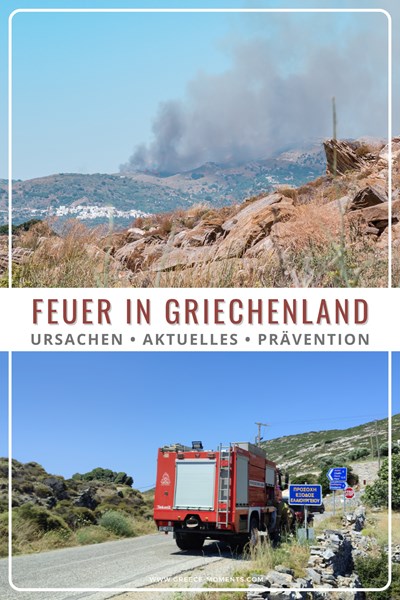

Forest fires in Greece: an annual occurrence, you could say, if it weren’t so tragic. In July and August, the country experiences extreme temperatures, leading to devastating fires on the mainland around Athens and the Peloponnese, as well as on popular Greek islands like Crete and Rhodes.

Fortunately, people rarely come to direct harm, but fires in Greece inevitably destroy the livelihoods of many. Both wild and farm animals perish miserably, and entire stretches of forest are razed to the ground within hours. Where a lush green coniferous forest stood just moments before, only blackened wasteland remains.
In this post, we want to give you an overview of why Greece faces forest fires every single year. We will also show you where fires are currently burning and explain why you can still enjoy your holiday without having to worry.
- #1 Where is it currently burning in Greece?
- #2 Map of forest fires in Greece
- #3 Why are there so many forest fires in Greece?
- #4 Causes of forest fires on the islands
- #5 What do I have to consider in the event of a forest fire?
- #6 Travel cancellation in case of forest fires in Greece
- #7 Severe forest fires in Rhodes, Crete & Co.
#1 Where is it currently burning in Greece?
Generally speaking, the forest fire situation across Europe can be quite complex to track. Fortunately, the overall number of forest fires across the continent has recently dropped below previous years’ levels (source: Statista). In Greece, forest fires happen repeatedly, particularly in the heavily forested metropolitan area of Athens (home to almost 5 million inhabitants), whereas large-scale fires on the islands are actually much less common.
→ Please check NASA’s wildfire information portal for the latest updates on the situation on the ground: FIRMS NASA

#2 Map of forest fires in Greece
Because of the dynamic nature of these events, a completely real-time forest fire map showing exact fire fronts simply does not exist. However, the Greek Meteorological Service regularly publishes forest fire danger levels for all regions. Google Maps also shows the approximate locations of active forest fires, though it does not map out their full extent.
If you are embarking on a longer road trip through Greece (for example on the Peloponnese Peninsula), it makes sense to regularly check for possible forest fires and danger levels at your next destination during the summer months. Highly reliable maps with fires in Greece are provided by NASA’s FIRMS (Fire Information for Resource Management System) portal and the EU’s Copernicus Emergency Management Service.

#3 Why are there so many forest fires in Greece?
When local media report on forest fires in Greece, it certainly does not mean that the entire country has been consumed by an inferno. As a Mediterranean nation, Greece is affected by severe bushfires, but even more fires—and sometimes even more violent ones lasting several days—actually rage in Italy and Portugal (source: Statista EU).
In Greece, however, many areas see absolutely no rain from June onwards. The landscape dries out entirely, and temperatures peak between mid-July and mid-August. This marks the most dangerous phase of the forest fire season in Greece. Intermittent heatwaves, where the thermometer climbs above 40 degrees, only exacerbate the situation. Under these conditions, a tiny spark is all it takes to trigger a catastrophe.

Nevertheless, these are almost always highly localised fires that the fire brigade can usually extinguish within 1 to 3 days. On the Greek islands, firefighting efforts are significantly hindered by geographical remoteness and the strong Greek summer wind, the Meltemi.
Volunteer firefighters also frequently point to the soil conditions in Greece as a critical factor. Embers manage to penetrate deep into the earth, creating immense heat below the surface. Furthermore, the sheer inaccessibility of the terrain makes deployments and the supply of extinguishing water incredibly difficult.
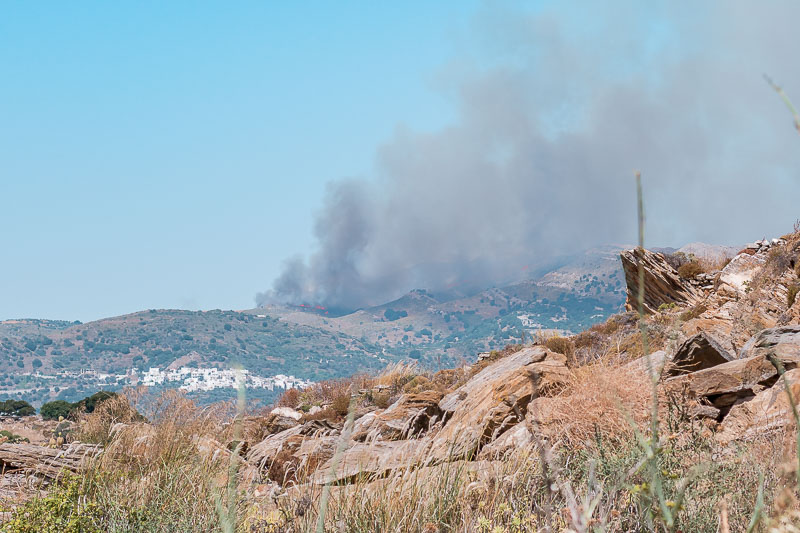
Moreover, the Greek fire brigade is arguably still under-equipped, despite years of public criticism and the bitter experience of massive forest fires (such as those on Evia in 2021). In many regions, there is a severe lack of professional equipment, additional personnel, and modern emergency vehicles. When things get serious, helicopters and firefighting planes often have to be requested all the way from Athens.
💡 Aid for Greece: Erwin Schrümpf’s association ‘Griechenlandhilfe’ is currently collecting donations for firefighting equipment and essential supplies. You can donate directly here: Griechenlandhilfe.at
#4 Causes of forest fires on the islands
Unlike the largely treeless Cyclades, the islands of the eastern Aegean Sea, such as Ikaria and Samos, as well as the Dodecanese archipelago (including Rhodes and Karpathos), are still covered in dense pine forests.
However, during forest fires on the Greek islands, the essential oils within these pine trees act as an accelerant, causing flames to spread rapidly through the canopy. When it comes to extinguishing the blaze, every single minute and every square metre counts.
Based on our own experiences and countless conversations with locals, the causes of fires in Greece remain frustratingly consistent: carelessness and deliberate arson. Arson is often committed to clear land for new construction, as building in forested areas is strictly prohibited by Greek law. Sadly, once an area has burned down, the land is frequently sold to investors for olive groves, hotels, or wind farms.
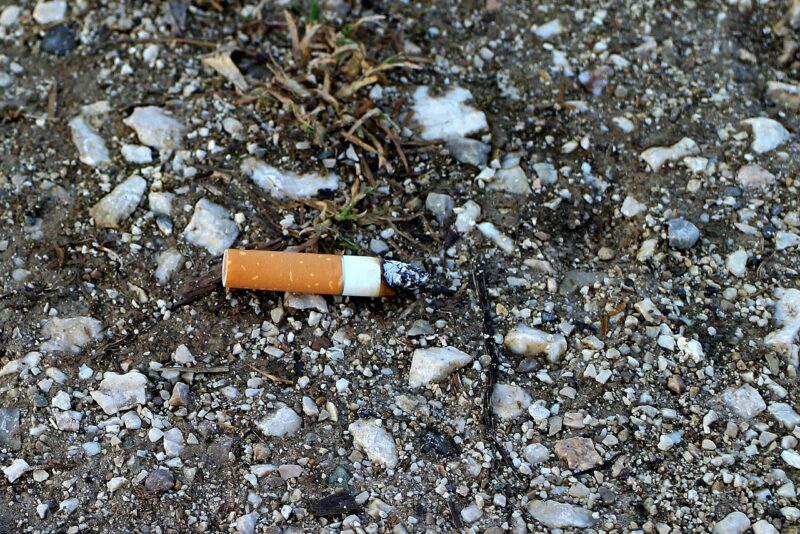
Added to this is a remarkably careless attitude towards nature. We have often witnessed people simply throwing their cigarette butts out of moving cars. Depending on the weather, the dry grass along the roadsides can ignite in a matter of seconds. The reckless burning of garden waste, straw, and rubbish during the peak of summer is another major cause of forest fires in Greece.
Important rules of conduct for the prevention of fires in Greece:
- Do not smoke near forests or dry meadows.
- Never throw cigarettes out of a car or stub them out in nature.
- Campfires near forests are strictly prohibited in Greece during the summer.
- Be extremely careful with torches, lanterns, and candles (even outside churches).
- Avoid wild parking in the forest; never park your car on dry grass.
- Do not hesitate to speak to others if you notice them behaving recklessly regarding fire risks.
- Report any fires, even small smouldering ones, immediately by calling 112 or 199.
#5 What do I have to consider in the event of a forest fire?
In almost 15 years of travelling around Greece, we have only ever witnessed one forest fire first-hand, which happened in July 2023 on the island of Naxos. We had to cut our stay in a cosy mountain village short because of the blaze. After just a few hours, the smoke from the fire—which was about 6 km away—became so overwhelming that we hastily packed our bags and eventually sought alternative accommodation.
Based on that experience, here are our personal tips for forest fires in Greece:
- Keep calm and take a moment to assess the situation.
- If you spot smoke, determine the wind direction, and close all your windows and doors.
- Contact your hotel or local host to find out exactly what is happening.
- Depending on the situation, consider whether it makes sense to relocate to a different hotel.
- It is often better to act proactively yourself rather than waiting to be evacuated by others.
- Pack your essential belongings in good time, have your rental car ready, or arrange a taxi if necessary.
- If you need to move or evacuate, always travel perpendicular to the wind direction (e.g. if a westerly wind is blowing, head north or south).
- If the smoke is thick, wearing an FFP2 or FFP3 mask is highly recommended.
→ You can find more helpful advice in the Allianz Insurance Fire Guide.
#6 Travel cancellation in case of forest fires in Greece
Generally, it pays to stay alert when forest fire warnings are issued. However, severe fires are relatively rare. The Greek islands are massive, and a fire simply cannot jump from one island across the sea to another.
“Just because a fire is burning hundreds of kilometres away from your resort doesn’t mean you need to cancel your entire holiday.”
Keep yourself informed about the local situation and make a decision based on what feels right for you. Generally speaking, forest fires are considered an act of God (force majeure); they are an unpredictable phenomenon caused by external circumstances completely beyond your control as a traveller.
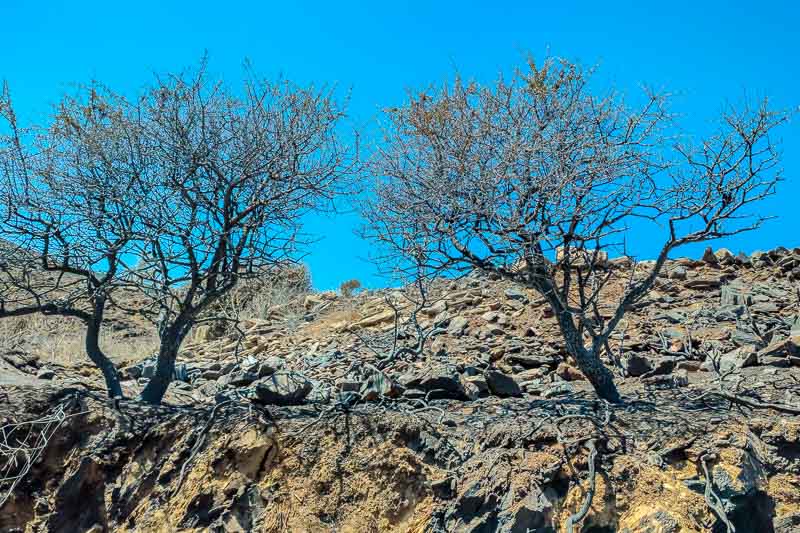
Even if your specific hotel is not directly threatened by the flames, you may still have the right to cancel a trip due to fires in Greece. This applies if the primary purpose of your trip—relaxation—is fundamentally compromised by heavy smoke or severe local restrictions. You should contact your tour operator directly for specific details.
Independent travellers can take out travel cancellation insurance in advance, though you must carefully check the policy wording to ensure forest fires are actually covered. Alternatively, you can often request a free cancellation through booking platforms like Booking.com or Airbnb by explaining the situation. Unsurprisingly, many hotels and hosts are very understanding in these circumstances.
#7 Severe forest fires in Rhodes, Crete & Co.
Forest fire in Crete 2025
At the end of June 2025, a severe forest fire broke out on Crete above Achlia, a small coastal hamlet just east of Ierapetra. Within hours, the blaze was tearing through dry pine forests, dense undergrowth, and ancient olive groves—fanned by fierce north winds that drove it forward with terrifying speed.
The primary catalyst was the extreme heat; temperatures had sat above 35 degrees for days. Come June, rain is virtually non-existent on Crete. The valleys and riverbeds were bone dry, and the vegetation was completely parched. A single spark—whether born of human negligence or pure carelessness—was all it took for the fire on Crete to take hold.

The areas around Achlia, Ferma, Galini, and Agia Fotia were the hardest hit. Several hotels and holiday apartments had to be evacuated, and three entire villages were cleared as a strict precaution. Between 1,500 and 5,000 people were affected, with both locals and tourists forced to spend the night in emergency shelters.
The blaze near Ierapetra destroyed hundreds of hectares of precious forest and agricultural land, whilst also damaging individual homes. Firefighting planes circled endlessly above the mountains, and ground crews battled day and night through incredibly difficult terrain. In total, roughly 230 emergency personnel were deployed to fight the flames.
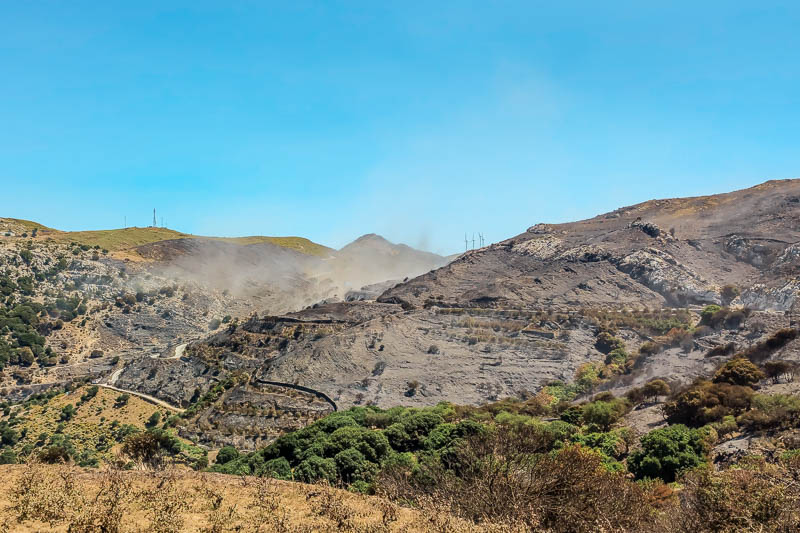
The fire in southern Crete was finally brought under control on July 4. What remained between Ierapetra and Makry Gialos was a blackened, scarred landscape. The heavy scent of ash lingered in the air for days afterwards. It will likely take years for this beautiful region, with its once-stunning pine-lined gorges, to fully recover its charm.
Forest fire in Rhodes 2023
The forest fires that ravaged the Greek island of Rhodes in the summer of 2023 were among the most ferocious seen in recent years. On the evening of July 18, a fire broke out in the hinterland of Rhodes, just below Mount Profitis Ilias. Arson is strongly suspected as the cause. Throughout the night, local fire brigades desperately attempted to contain the blaze in this highly inaccessible area.
By daytime, the battle continued from the air. The surrounding villages of Apollona and Eleousa, the settlement of Profitis Ilias, and the Ypseni nunnery were all evacuated. The dense pine forests surrounding these villages make this one of the most spectacularly scenic regions on all of Rhodes.
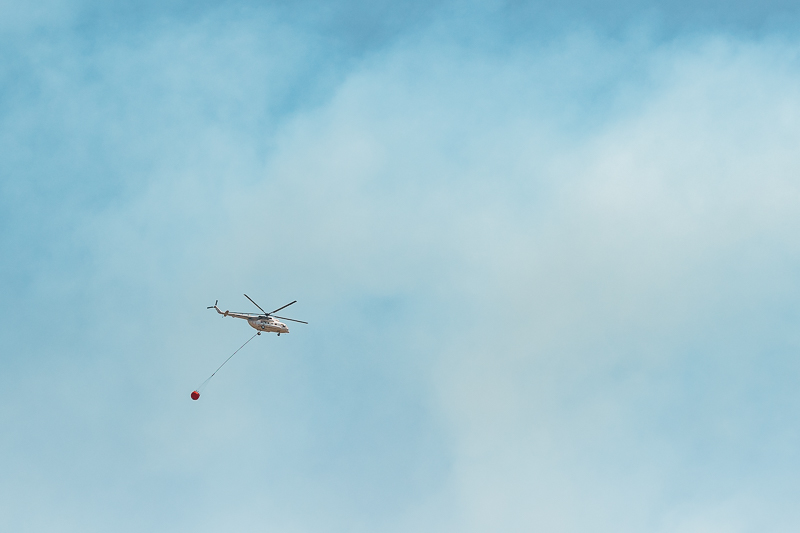
A massive cloud of smoke blanketed the central part of the island. By July 20, it seemed the fire had finally been contained, though several hectares of woodland and farmland were already lost. At that stage, widespread structural damage had thankfully been avoided.
However, during the night of July 21 to 22, fierce winds reaching force 6 on the Beaufort scale ignited an entirely new blaze. This outbreak was located just a few kilometres from the quaint mountain village of Laerma, an isolated region still home to many wild animals, including deer.
Throughout July 22, this towering wall of fire surged nearly 10 km towards the east coast of Rhodes. Driven by the island’s geography—with forested valleys funnelling south-east—and turbo-charged by strong north-westerly winds, the situation rapidly spiralled completely out of control.
Video footage captured terrifying ‘flying fires’, where burning debris was hurled metres into the air. That same day, the popular holiday resort of Kiotari was evacuated. Thousands of people, including vast numbers of tourists, fled the flames on foot, by bus, and even by boat. The selflessness shown by the locals towards the stranded holidaymakers was nothing short of heroic.
By evening, further villages were cleared, and during the night, even the famous seaside resort of Lindos had to be evacuated. Estimates suggest that over 30,000 people were directly affected as local fire brigades simply could no longer hold back the inferno. In Laerma, Kiotari, and Gennadi, homes and hotels alike were devoured by the flames.
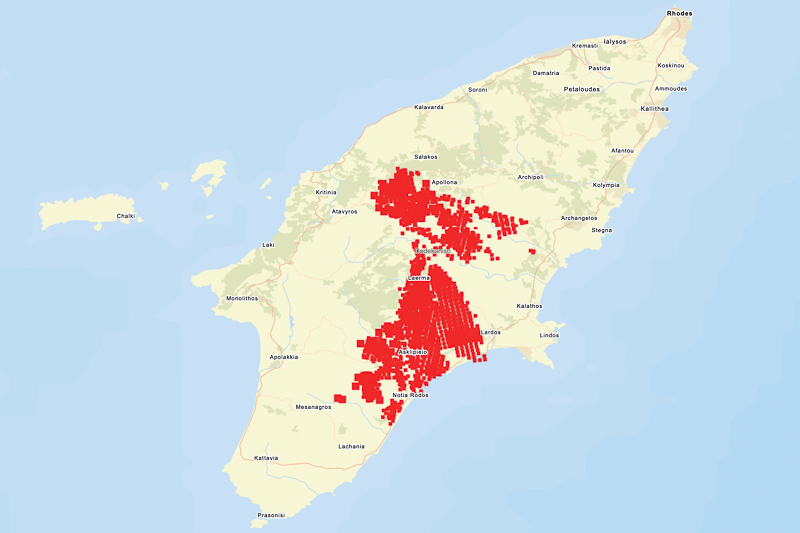
After 10 exhausting days of battling multiple fronts, countless wild and grazing animals had tragically lost their lives. Fortunately, northern resorts like Ialysos, Faliraki, and Rhodes Town were completely spared from the devastation of the great Fire on Rhodes.
→ Are you still looking for inspiration for your next holiday in Greece? Then you can find a comprehensive overview right here: Greek Islands Overview
*Support our blog Greece-Moments
In this post, you will find affiliate links marked with an asterisk (*). If you book or buy something through one of these links, we receive a small commission. For you, the price remains exactly the same. In this way, you help us continue to provide high-quality content for free. Did you like this post and would you like to say thank you? Then just buy us our next Greek coffee ☕️ To the coffee fund
Bookmark this post on Pinterest!