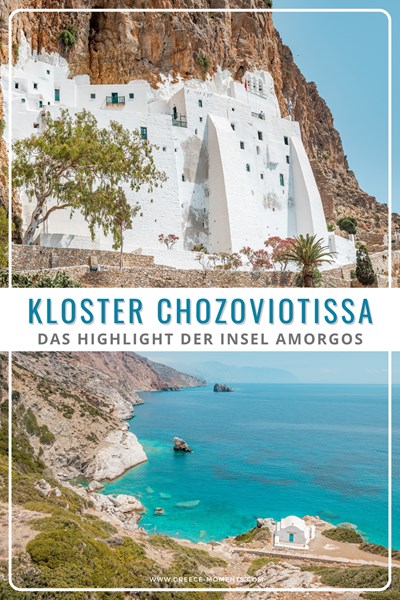

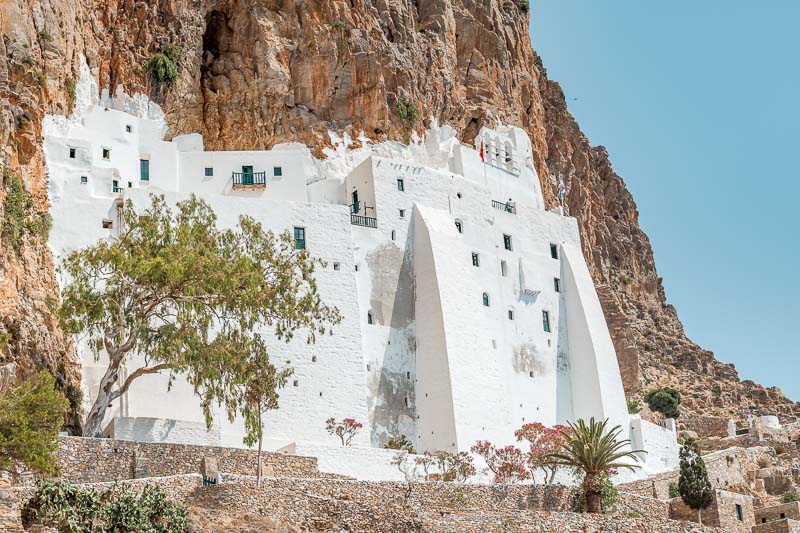
The bright white Chozoviotissa Monastery seems like a mirage, clinging to a steep rock face above the sea at dizzying heights. The fascinating church on the Cycladic island of Amorgos has already served as a film set and attracts more and more visitors from year to year.
»The most important sight on the island of Amorgos is one of the most important religious pilgrimage sites in Greece and a real visitor magnet due to its special location alone.«
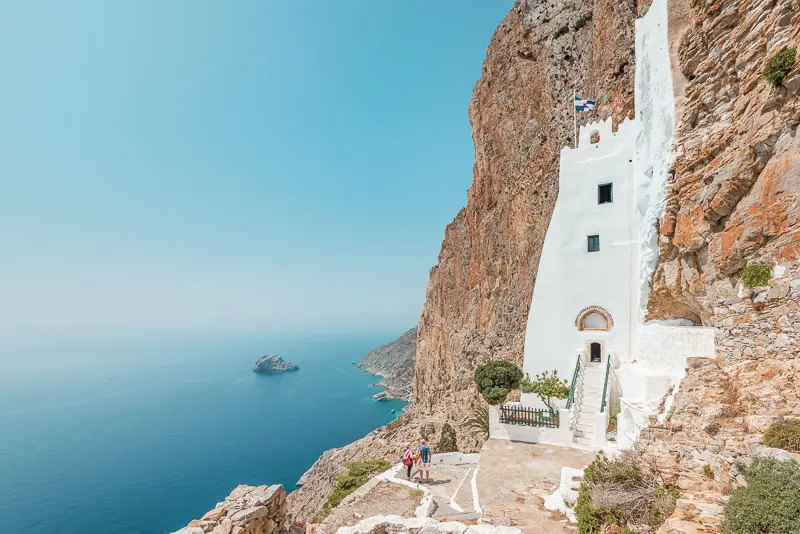
The name of the monastery, which is almost unpronounceable for Central Europeans, is known nationwide among Greeks and a visit is a must for an Orthodox Hellene. Panagia Chozoviotissa (pronounced “Choss-O-wjotissa”) is thus located next to Panagia Evangelistria on the Tinos Island one of the most popular pilgrimage sites on the Cyclades Islands.
A truly sacred place that you can imagine at a holidays in Amorgos not to be missed. Enclosed we give you important information and useful tips for your visit to the monastery:
#1 Arrival and location of the monastery
The monastery of Panagia Chozoviotissa (also Hozoviotissa) is located on the central east coast of the island of Amorgos below the main town of Chora. It was spectacularly built into a steeply sloping rock face at a height of about 300 m.

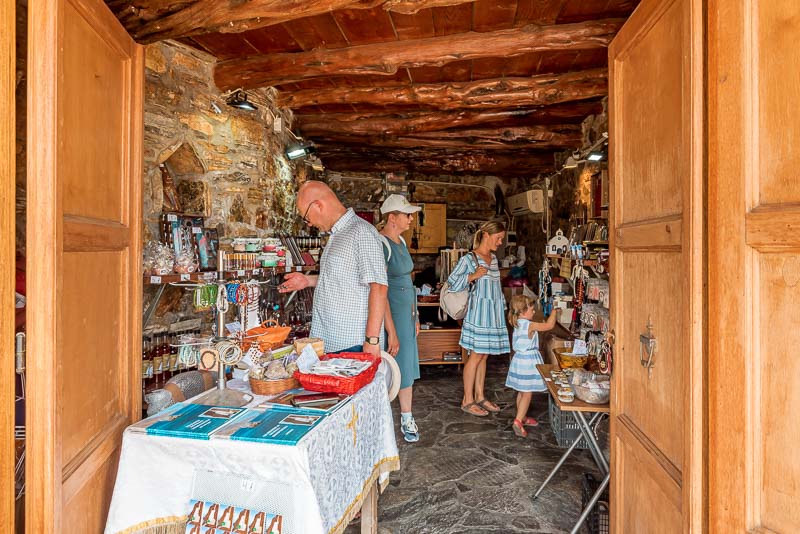
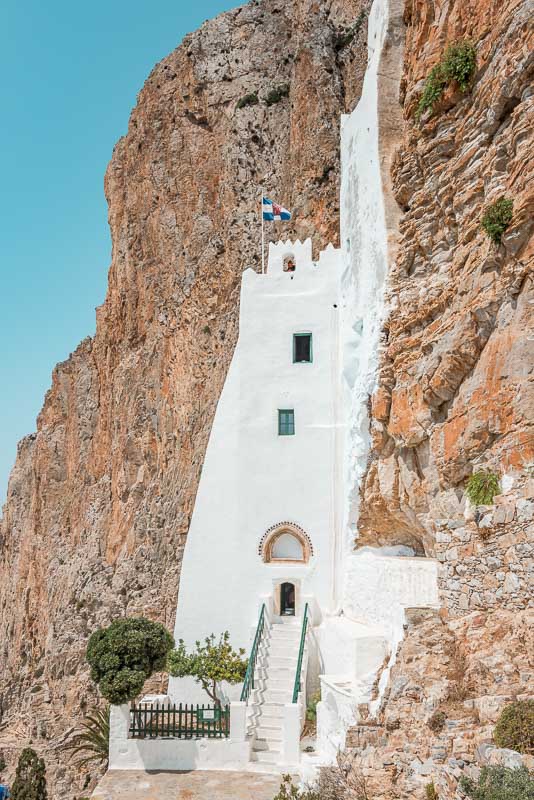
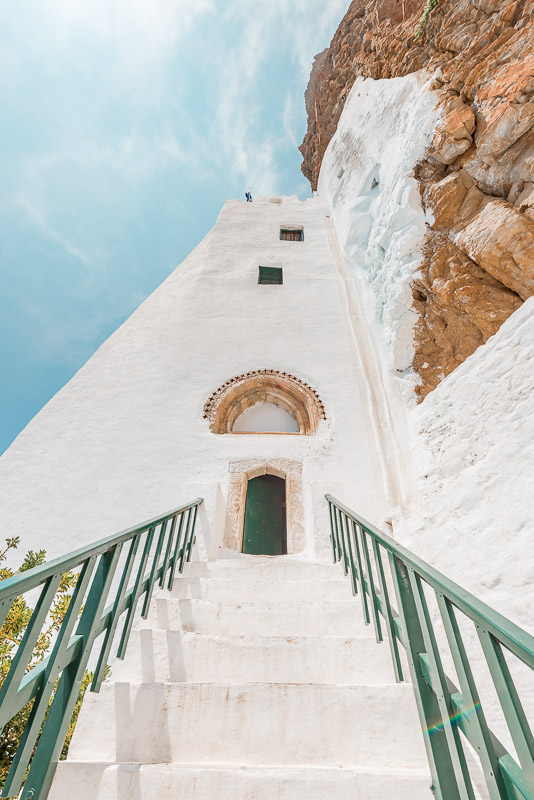
The pilgrimage site can be reached from Chora in just six minutes via a well-developed asphalt road. Below the monastery is next to the monastery shop with religious souvenirs and icons, a small parking lot that offers space for only a few cars. Then it goes up to the monastery in over 300 steps.
Alternatively, you can follow the old donkey path “Chora-Pr.Elijah-Monastery Hiking Trail” on foot from the eastern exit of Chora (see point #6). In summer, there are also buses from Chora to the Monastery of Chozoviotissa (Monastery). Bus timetables can be found at: Amorgos Bus
#2 Opening hours of Hozoviotissa Monastery
Chozoviotissa Monastery is open daily in the morning from 8 a.m. to 1 p.m. and in the evening from 5 p.m. to 7 p.m. Outside of these times, you can photograph it from a distance, but the gate remains closed.
We visited the monastery at the beginning of July around 11 a.m. and it was not very busy. According to the employees who work in the monastery, the biggest rush in August then more than 1,000 people make a pilgrimage to the holy place every day. The premises are very cramped, and long waiting times must be expected in midsummer.
Outside of the Greek holiday season, you can usually visit the monastery relatively undisturbed by crowds. The entrance to Amorgos Monastery is free, a donation for the maintenance of the facility is requested.
💡 Amorgos book tip: The travel guide Cyclades from Michael Müller Verlag contains an informative chapter about Amorgos with numerous tips and was a useful companion for us on our trip: View on Amazon*

#3 Interesting facts about the Amorgos Monastery
The Monastery of Panagia Hozoviotissa is one of the oldest monasteries in Greece and was officially founded in the 11th century. The ascent to the monastery with its magnificent coastal landscape is a highlight in itself, but also challenging and requires a good level of fitness.

The Monastery of Amorgos currently houses only two monks and four employees who coordinate the process during visiting hours and ensure that only a certain number of pilgrims enter the walls at the same time.
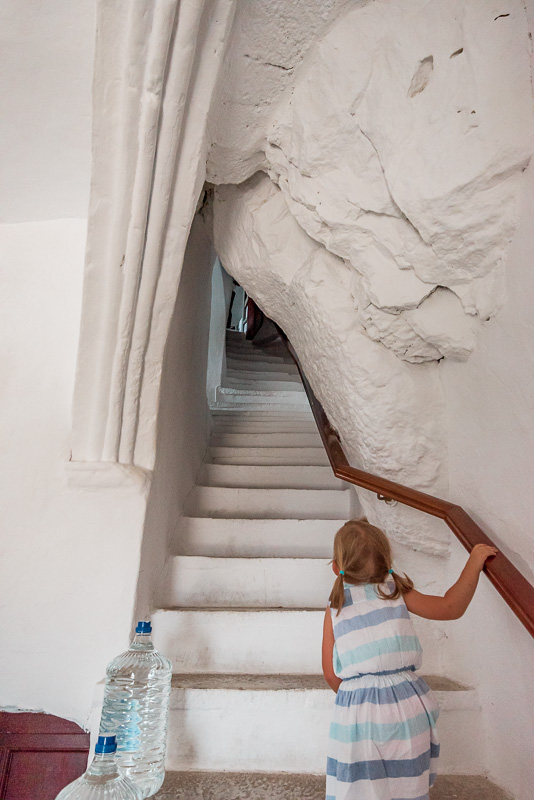
As soon as you have passed through the gate, you will find yourself in the entrance area of the monastery. A narrow, steep staircase, which you climb a little bent over, leads you to a long corridor.
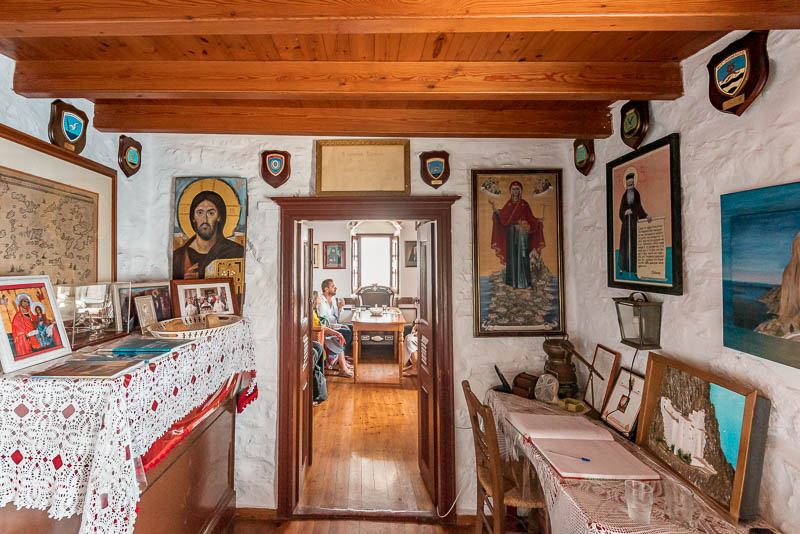
From here you will usually be guided to the monastery church and a prayer room with icons. In this part of the monastery, filming and photography not permitted. From the church you can access the light-flooded terrace of the monastery, from which you have a wonderful view.
You will then visit the living room and kitchen of the monks. Here you can take a seat and the staff will provide you with water, psimeni liqueur and loukoumi. From the small bench in the anteroom you can enjoy a magnificent view of the deep blue Aegean Sea through the window, a postcard motif of Amorgos.

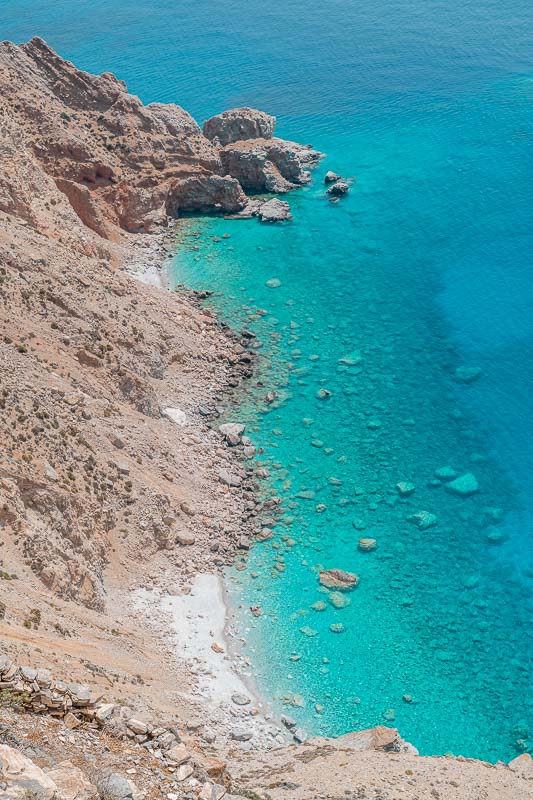
Our Lady of Hozoviotissa, in Greek Panagia Chozoviotissa, is the patron saint of the island of Amorgos. In her honour, a large church consecration festival takes place on the grounds every year on 20 and 21 November.
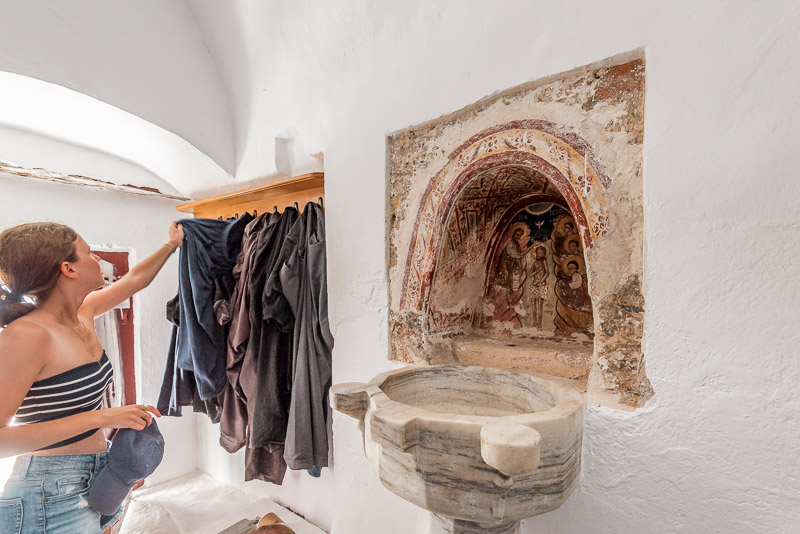
💡 Dress code at Amorgos Monastery: Since it is a sacred place, strict attention is paid to clothing. Women must wear long skirts and cover shoulders and décolleté. Men are only allowed to enter with long trousers. In the entrance area of the monastery hangs appropriate rental clothes in case you don’t have anything with you.
#4 Historical background
The Hozoviotissa Monastery looks back on a long history and was probably founded as early as 812 by monks from Palestine.
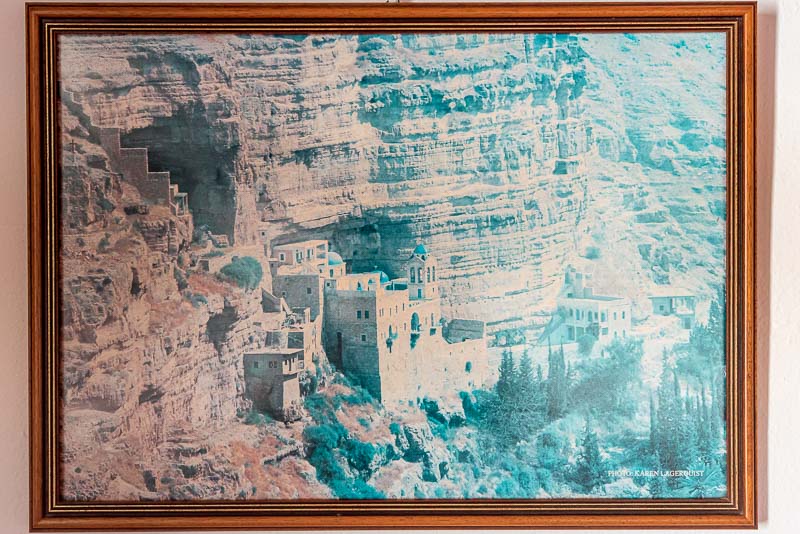
The name refers to the region Hozeva (Wadi Qelt) in today’s West Bank, where a monastery in honour of Saint George was founded as early as the 5th century. Like the Monastery of Amorgos, it was spectacularly built into the rock.
Until the 20th century, Chozoviotissa was considered one of the richest monasteries in Greece. Even today, it houses important finds such as parchment scrolls from the 11th and 13th centuries and icons from the 15th and 16th centuries.
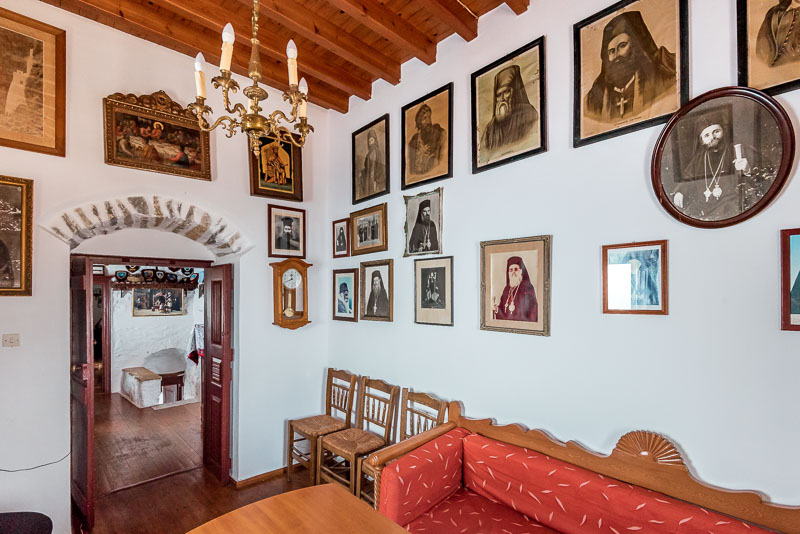
In order to understand the emergence of the Greek pilgrimage site there are numerous legends. Legend has it that during the Byzantine iconoclastic controversy, a precious icon of Mary was thrown into the sea on the coast of Palestine in desperation to save it from destruction.
On its way to Greece, the icon was divided into two parts, one half went to Amorgos on the current beach of Agia Anna, the other to the Patmos Island.
Churches and later monasteries were founded on both islands in honour of the important find. A rusty chisel at a height of 300 m still bears witness to the place where the rock face was first worked more than 1,000 years ago.
In the 9th and 10th centuries, the monastery of Chozoviotissa was repeatedly subjected to pirate attacks and was temporarily abandoned. The year of foundation is given as 1088, as the Byzantine Emperor Alexios I Komnenos donated a large part of the construction costs. In honour of the emperor, there is still a silver statue in the monastery.
The construction of the imposing building, which extends over eight levels, which are connected by corridors and stairs carved into the rock, took several decades. In total, the Amorgos Monastery is 40 meters high and 5 meters wide and looks like a fortified fortress from the outside.
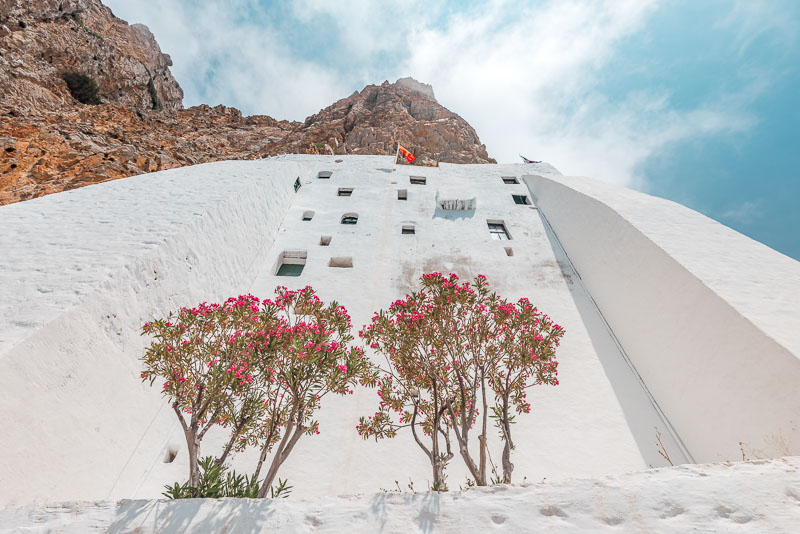
Originally dedicated to the Archangel Michael and later to the Virgin Mary, the monastery has been rebuilt and expanded several times over time. It is noteworthy that the monastery remained unscathed during the Ottoman rule (1579-1821), probably due to its high reputation in Constantinople.
In addition, for centuries the monastery was hardly noticeable from the sea, as it remained natural without paint and was built practically from the same stones as the rock face. At the beginning of the 20th century, it received its current white paint.
#5 Places of interest around the monastery
Agia Anna Beach
In the immediate vicinity of the monastery is the bay of Agia Anna. The beautiful bay with the church of the same name was made world-famous by the French Movie »Le Grand Bleu« from 1988, as some scenes were filmed here.

The crystal clear, deep blue water and the radiant white chapel, above the coast, make this place a popular destination for bathers and film fans. You can refresh yourself wonderfully on the narrow gray pebble beach or just take pictures of the beautiful scenery from the parking lot.
Alleys of Chora
A walk through the alleys of Chora offers a dreamlike view of the Cycladic scenery of white cube houses, hidden chapels and colourful wicker chairs. The place immediately enchants with its charming flair with many taverns, cafés and pretty little shops.
You can find more information about visiting Chora and other sights on the island in our article: Amorgos Highlights

#6 Hiking trails at Chozoviotissa Monastery
Amorgos is considered a popular Greek hiking island and so the area around the Chozoviotissa monastery also invites you to explore extensively on foot.
From the main town of Chora, you can hike to the monastery. It should be noted that Chora is already at an altitude of almost 400 m, while the monastery is about 100 m lower.
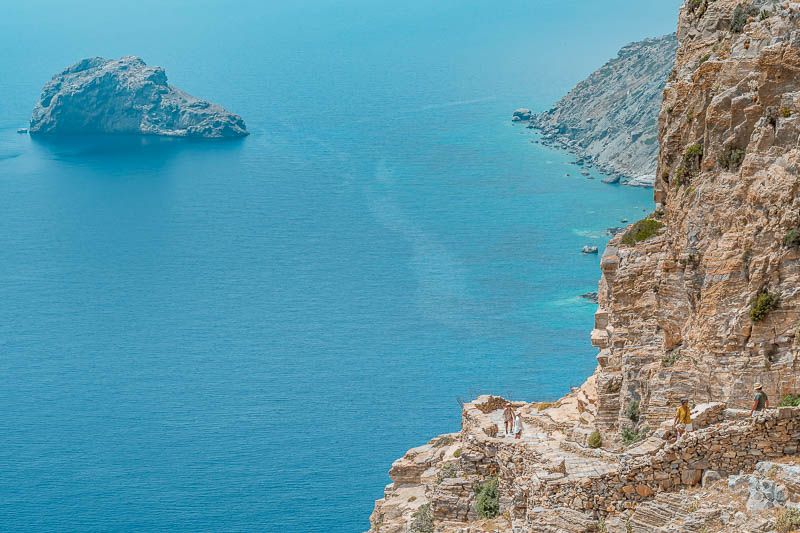
The starting point is the sports field in the upper village, where you can start from the Kalogerikos Viewpoint descend via a steep donkey path in several serpentines. After just under 20 minutes, you will reach the asphalt road that leads to the parking lot of the monastery. From here it is another 365 steps to the monastery.

The Old Strata Amorgos
A beautiful day hike that passes by the Chozoviotissa Monastery is the so-called Paleo Strata (old road), which is the centuries-old connecting route between the towns of Chora in the centre and Langada in the north.
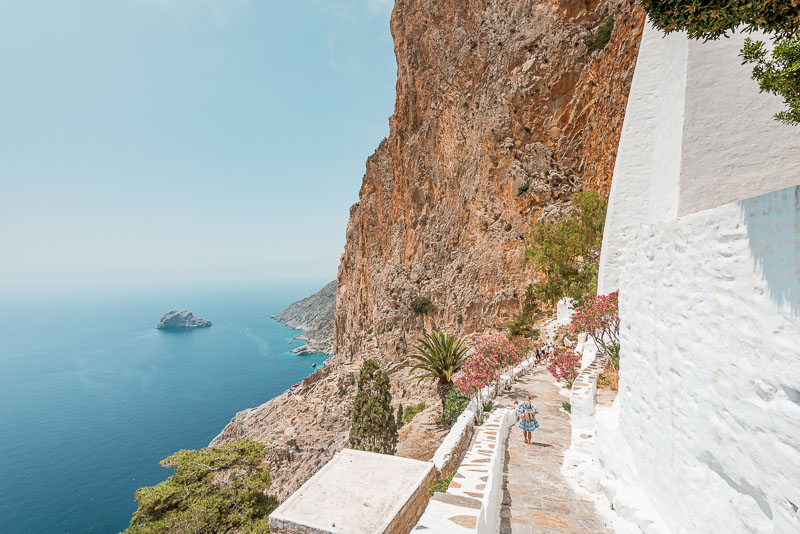
The tour starts either in Chora or Langada. For the way back, it is advisable to organize a taxi beforehand or study the bus schedules. The path offers spectacular views again and again, leads through untouched nature, past the monastery of Chozoviotissa, the almost deserted farming settlements Kapsala and Asfondilitis, as well as the hamlets of Potamos and Langada.
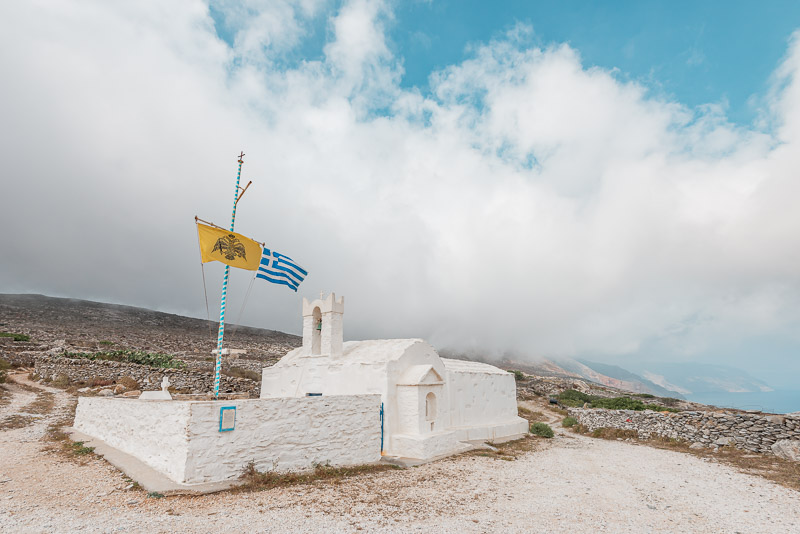
For the 14.5 km, at least 5 hours of walking time must be planned. On the way there are only refreshment stops at the beginning and at the end. The Tavern To Steki tou Machera halfway is only open by appointment by telephone (Tel. +306936671031).
The hike is moderate to difficult, should best be started in the early morning hours due to the largely shadowless area and requires a good level of fitness. More information about the tour and other Hikes on Amorgos can be found here: Amorgos walking paths

Amorgos Map: This card includes all Amorgos Highlights, 47 Places to Visit & Insider Tips, 13 Beaches & Bays, as well as personal recommendations for 24 restaurants & cafes. Ideal for holiday planning and local navigation. Can be used for smartphone, tablet and PC/Mac. Click here and start using it right away: To the Amorgos Map
Ascent of the Profitis Ilias
If you want to go high, a hike to the 698 m high Profitis Ilias above Chora recommended. The monastery of Chozoviotissa is located below the Profitis Ilias massif. The hike, which is quite easy to walk, starts either in Chora or at the turn-off to the cave chapel Theoskepasti on the main road to Aegiali.
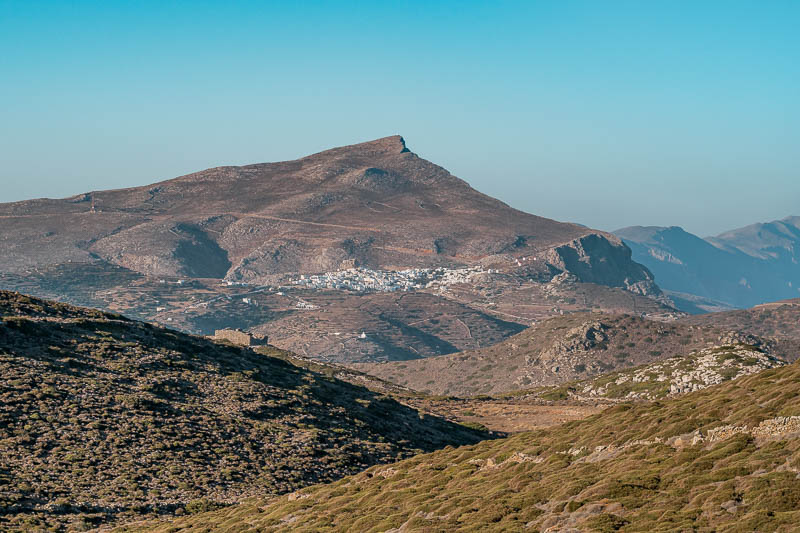
After about an hour on donkey paths through the dense maquis, you will reach the summit and be greeted with a magnificent 360-degree panorama of Amorgos. The last section of the trail is a bit confusing, cairns make it easier to find your way around. The hike should only be carried out in good visibility and little wind.
Would you like to get to know the island of Amorgos together with locals? At our partner GetYourGuide* you will find guided Amorgos Hiking Tours and other activities: Organized excursions*

#7 Spend the night near the monastery
If you want to be very close to the holy place, an overnight stay in the island’s capital Chora is recommended. It is only a five-minute drive from Hozoviotissa Monastery and is generally an ideal starting point for exploring the island.

In and around Chora there are smaller hotels, guesthouses as well as studios and apartments. We can recommend the following three accommodations in Chora on Amorgos. Click on the links to Booking.com* and get more details about the accommodation:
Vorina Ktismata, Chora
Luxurious 3-star hotel on the northern outskirts of Chora. Very tasteful décor in Cycladic style. Suites with kitchenette and terrace overlooking the Kastro of Chora.
Oasis Apartments, Chora
Beautiful grounds just outside the Chora. Modern apartments with kitchen and balcony. Quiet location and yet in 15 min. walk in the center.
Skopelitis Village, Kastelopetra
Located just outside Chora, this 4-star Cycladic style hotel offers modern apartments in a family atmosphere with stunning views of Katapola Bay. The friendly team around host Andreas gives many tips for exploring the island and prepares a delicious breakfast every morning.

You can find more travel reports and tips about the Cyclades archipelago on our overview page: Cyclades Overview
*Support our blog Greece-Moments
In this post, you will find affiliate links marked with an asterisk (*). If you book or buy something through one of these links, we receive a small commission. For you, the price remains the same. In this way, you help us continue to provide high-quality content for free. Did you like this post and you would like to say thank you? Then just buy us the next Greek coffee ☕️ To the coffee checkout
Bookmark this post on Pinterest!