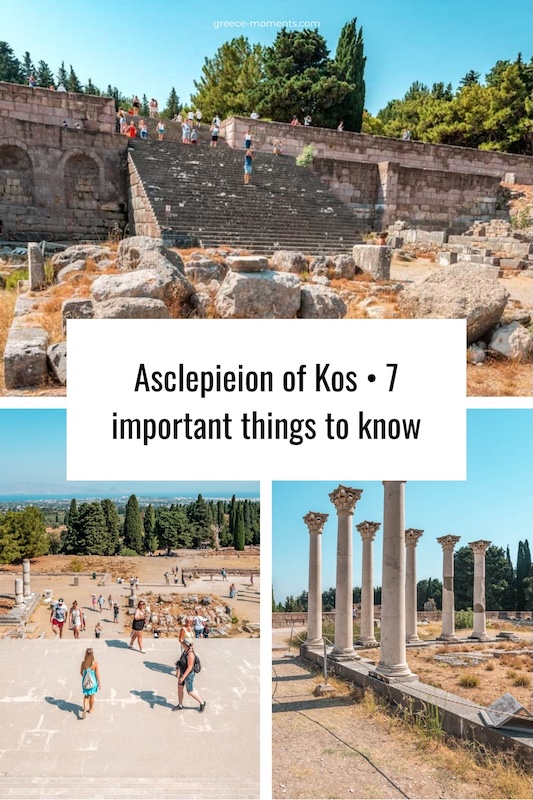

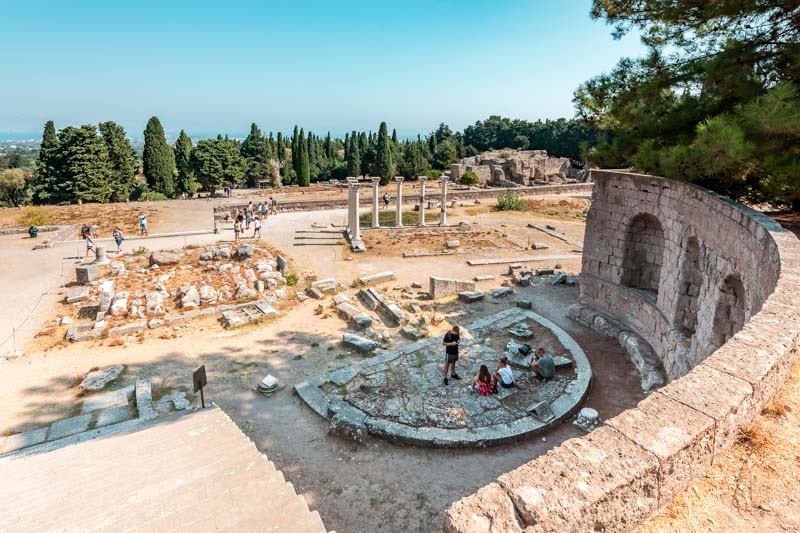
On the northeastern slopes of the Dikeos Mountains lie the remains of the most important archaeological site on the island. The Asklepieion of Kos was not only a sanatorium in ancient times, but also a sanctuary that served as a place of worship and healing for body and mind.
»The Asklepieion of Kos impresses with its picturesque location, which extends over several terraces and is framed by a dense coniferous forest.«
It was the Greek physician Hippocrates of Kos whose teachings were applied in the Asklepieion. The father of modern medicine was far ahead of his time and revolutionized healthcare with groundbreaking healing methods more than 2,000 years ago.
Today, you can walk in the footsteps of the ancient doctor and feel the energy that once emanated from this place. After all, the Asklepieion (also Asklepion) was an important place of pilgrimage and brought considerable prosperity to the island of Kos.
In this article, we’ll give you the most important information for a visit to the ancient site, along with plenty of background knowledge and tips for the Kos Asklepieion:
🏖️ Dream beaches & hidden bays
🍽️ Restaurants, tavernas & cafés
🏛️ Must-see highlights & ancient sites
🗺️ Worthwhile spots & insider tips
🚘 Practical info like rentals & parking
♾️ Lifetime access & updates

#1 How to Get to the Asklepieion of Kos
The Asklepieion of Kos is about 4 km southwest of Kos Town. Coming from the capital, you will pass through the small town of Platani. If you are travelling from Tigaki or Mastichari, take the expressway from Kos and branch off towards the excavation site just before Kos Town. Alternatively, you can get there via the village of Zia along a scenic mountain road.
Getting to the Asklepieion by rental car
Although bus tours are available to the Asklepieion on Kos, we recommend travelling by rental car. This gives you the flexibility to visit the site at quieter times. The route from Kos Town or Antimachia is well signposted and the road is fully paved. Only shortly before arrival, the one-way street layout can be a little confusing.
Our recommendation for car rental on Kos is Costas Car Rental — a friendly family business that we have known and appreciated personally for years. Well-maintained cars, straightforward service and top ratings on Google speak for themselves. From small cars to family vehicles, they have everything you need. Click here to find the right car for Kos:

What is the parking situation at the Asklepieion?
Free parking at the Asklepieion is available directly in front of the grounds. The spaces at the entrance are reserved for cars, while the spaces near the main road are for buses. As long as you arrive before 11 a.m., you should easily find a free spot. Since the Asklepieion is a popular destination on Kos, it gets busiest around midday in summer.
By Bus to the Asklepieion of Kos
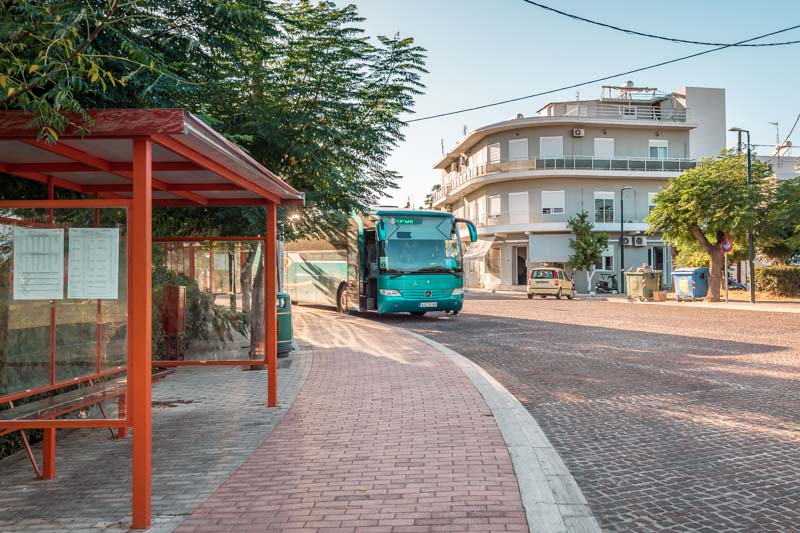
You can also reach the Asklepieion of Kos by public bus. It stops directly in front of the excavation site and departs from the stop at the Akteon, Akti Miaouli Square, not far from the Albergo Gelsomino Accommodation (Link to Booking.com*). You can buy the reasonably priced tickets directly at the counter. Please check with your hotel or host for current departure times.
→ The Municipality of Kos publishes the Bus timetables for Kos on: mobility.kos
#2 Opening Hours of the Asklepieion of Kos
Due to its great regional and national importance, the Asklepieion of Kos is open all year round. However, there are different opening hours in winter and summer. During the season (April – October), the site is open until 8 p.m. (last admission approx. 30 minutes before closing). Visitor numbers are noticeably lower at this time of day, and the evening sun bathes the entire complex in a wonderfully atmospheric light.
- Opening hours of the Asklepieion of Kos in summer (April – October): Mon-Sun from 08:00-20:00
- Opening hours of the Asklepieion of Kos in winter (November – March): Wed-Mon from 08:00-15:00
Ticket prices for the Kos Asklepieion:
- Adult: 15 €
- Reduced ticket (from 65 years): 8 €
- Children, young people and students up to 25 years of age: free admission for EU citizens
Days with free admission to the Asklepieion:
- March 6 (in memory of Melina Mercouri)
- 18 April (International Heritage Day)
- 18 May (International Museum Day)
- last weekend in September (European Heritage Days)
- 28 October (National Holiday – Ohi Day)
- every first Sunday from 1 November to 31 March
Closing days of Kos Asklepieion: 1 January, 25 March, Greek Easter Weekend, 1 May, 25 and 26 December
→ You can buy your entrance ticket to the Asklepieion of Kos either directly on site at the entrance or via the official ticket website: HHTICKET
💡 Weather on Kos: The weather on the north coast of Kos is influenced by the foothills of the Dikeos Mountains (864 m). In spring and autumn, clouds can form over the mountains and rain sometimes falls down to the north coast. In summer, on the other hand, it is very dry and extremely hot on some days. The Asklepieion of Kos offers almost no shade apart from a few trees, so good sun protection is essential. For more information about the weather on Kos, check out our separate post: Weather in Greece
#3 Interesting facts about the Asklepieion of Kos
Today, the Asklepieion of Kos is considered the most important archaeological site on the island. In ancient times, it served as a kind of spa and medical school, as well as a sanctuary, making it an important place of pilgrimage in the eastern Mediterranean. The name of this place of worship derives from the Greek god of healing Asclepius (also Asklepios).
Between 1901 and 1904, the site was first uncovered by Greek and German archaeologists. During the Italian rule of Kos (1912–1943), further excavations took place under the direction of the Italian Archaeological School in Athens, which gave the site its current reputation.
As early as 1,550 BC, long before it became a place of healing, there was a ritual cult site here. It was not until the 4th century BC that further buildings were systematically added, including several small and large temples, assembly halls, treatment rooms, quarters, baths, and fountains — enough to justify calling it a historic rehabilitation centre.

Around 242 BC, the Asclepieion of Kos gained great importance far beyond the borders of the island, and festivals were even held there. From 82 AD onwards, during Roman times, the Sanctuary on Kos attracted people from Rome to Istanbul (formerly Constantinople), who made pilgrimages to Kos in the hope of alleviating their suffering.
After the fall of the Roman Empire (395 AD), and further accelerated by severe earthquakes around 469 and 554 AD, the golden age of the Asclepieion came to an end. With the spread of Christianity and the abandonment of the polytheistic cult around Zeus & Co., temples were successively converted into churches. Components of the Asclepieion can even be found today in the Neratzia Fortress in Kos Town.
Hippocrates of Kos: Father of Medicine
Surrounding the Father of modern medicine and author of the famous oath, there are numerous myths and legends. Scientists today believe that the Asclepieion on Kos was only established as a therapeutic site after his death. During Hippocrates’ lifetime, only the Asclepius altar and temple existed, in front of which he passed on his methods and wisdom to his students, including:
“The most effective medicine is the natural healing power that lies within each of us.”
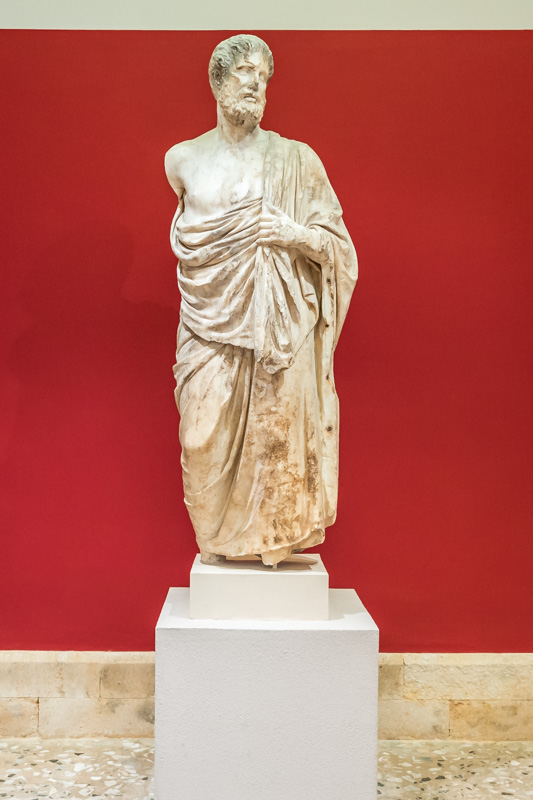
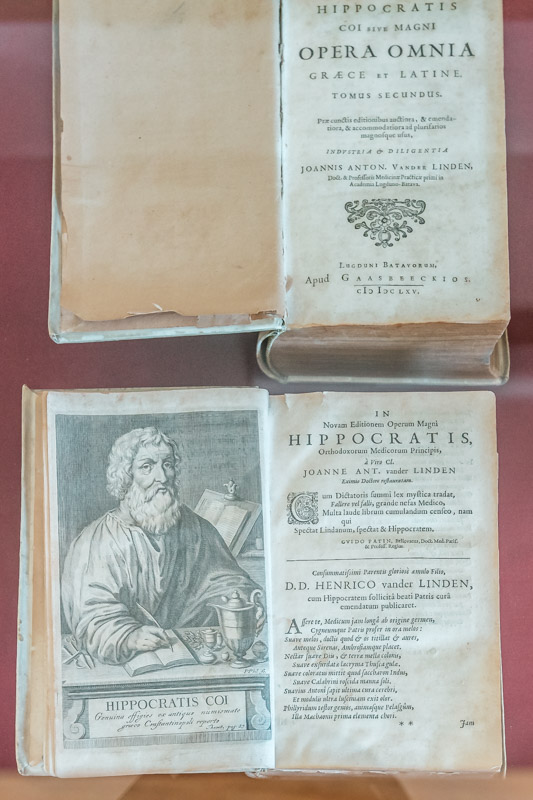
Hippocrates was born around 460 BC on Kos, in present-day Kefalos. Many of his teachings on alternative healing methods and a healthy mindset have been passed down and are fundamentally embedded in modern medicine today. Since he did not view health as dependent on the gods, he is considered the founder of medicine as a science.
Around 420 BC he probably left the island of Kos and travelled through the eastern Mediterranean as a travelling doctor with a priestly character. His sons and some of the medically trained students established the first Medical School on Kos. Many of today’s medical terms go back to the work of that time.
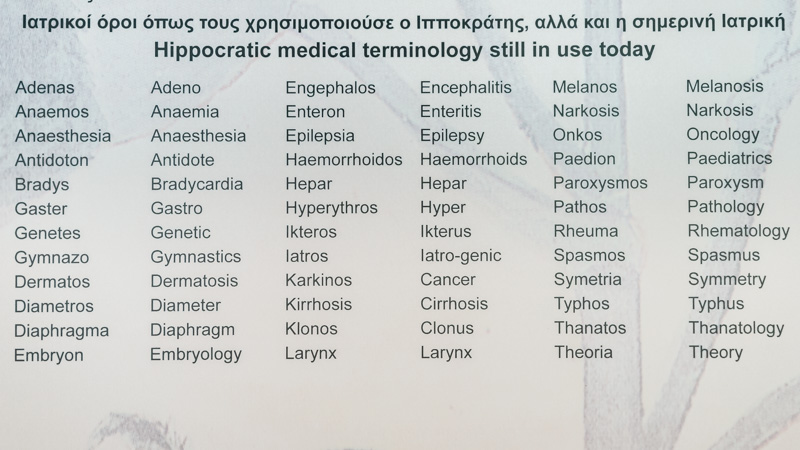
Basic medical principles were already developed during this period, such as a high standard of hygiene and the need for careful questioning and examination of patients, enabling systematic diagnosis and therapy. For the first time, the patient’s living circumstances and mental state were also taken into account in the treatment.
The most famous doctor of antiquity died at the remarkable age of 90 around 370 BC in Larissa on the Greek mainland. In the city of Larissa, a large monument was erected in his honour at the end of the 19th century. The Oath of Hippocrates, which remains a cornerstone of medical ethics to this day, was first mentioned in the 1st century AD and is also attributed to the legacy of Kos’s most celebrated son.
🗺️ 10 road trip routes with maps
🏖️ Beautiful beaches & swimming spots
🏛️ All top sights & attractions
🤫 Unpublished insider tips
🍽️ Accommodation, tavernas & cafés

#4 Walking tour of the ancient site
The Asclepieion of Kos was once one of approximately 300 healing sites in ancient Greece, among which it was at times the most important. Barely visible from the outside and sheltered by a dense pine forest, you will reach the entrance to the main complex shortly after the ticket counter.
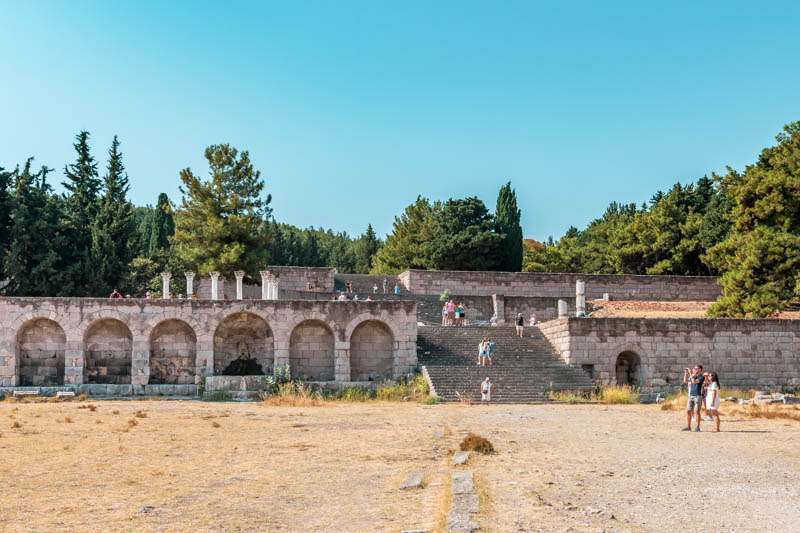
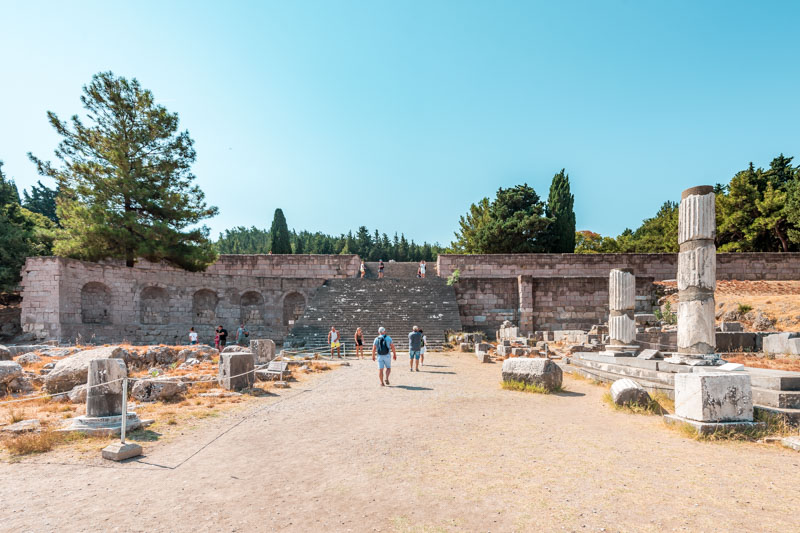
There was once a kind of gatehouse, the so-called propylon, through which every visitor entered and was greeted shortly afterwards by the expansive grounds. The three terraces are connected to each other by staircases, some of which are up to 12 m wide. If you like, you can download the smartphone app Digi-Past Asklepieio in advance and explore the Asklepieion in virtual 3D.
On each level there are information boards (in English and Greek) that tell you about the different components and buildings of the Kos Asclepieion. The first terrace was dedicated to the spa and was surrounded by a columned hall (stoa). Here were classrooms, anatomical exhibition halls and a kind of pathology. Remains of a Roman thermal bath can also be seen.

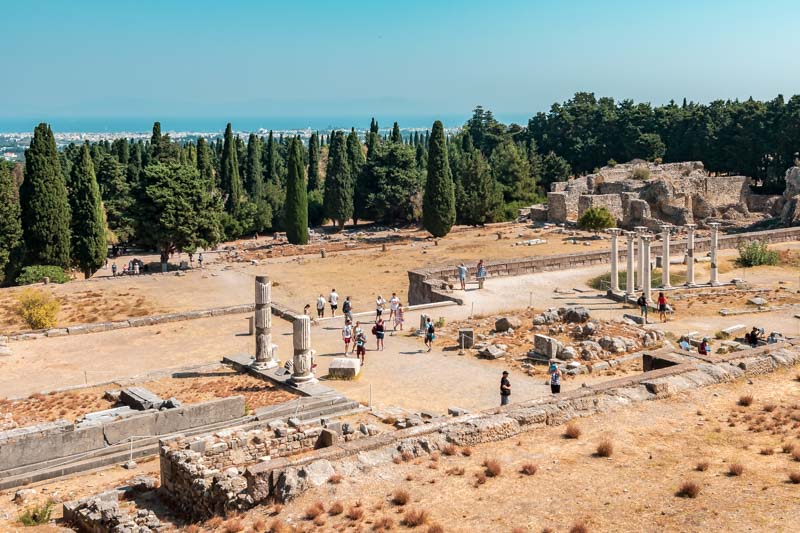
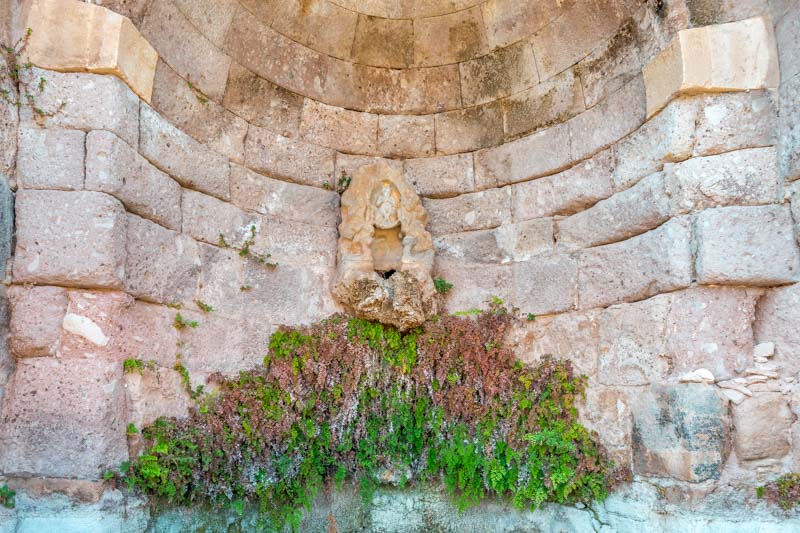
You are almost magically drawn to the huge steps in the center that lead to the next terrace. Before the ascent, there is an old fountain on the left with a stone relief of the shepherd god Pan. Once at the top, your gaze wanders for the first time over the pine forest to the north coast and the sea, giving a sense of why this place was chosen as a sanctuary back in those days.
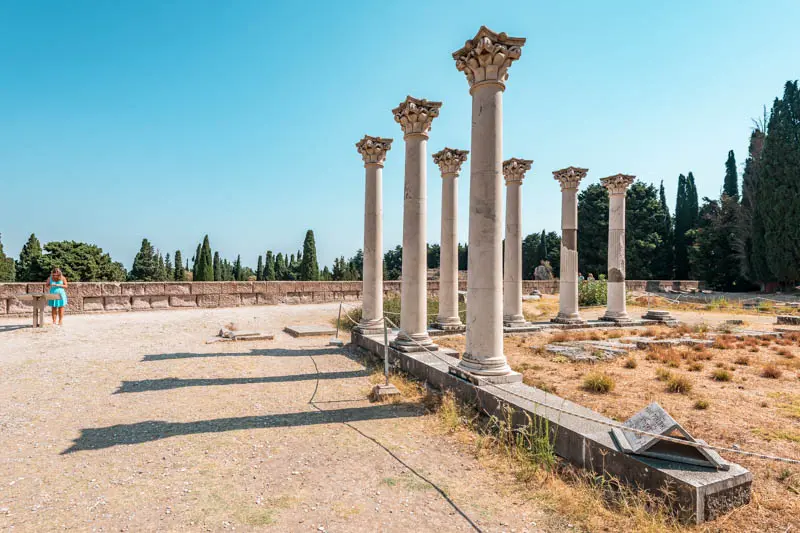
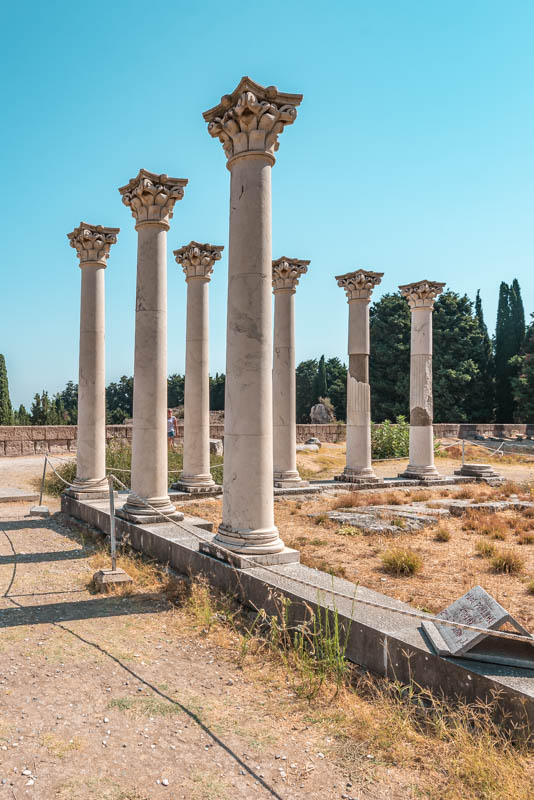
On this level, in addition to priests’ apartments, there was also a small temple of Asclepius and a temple in honor of the god Apollo, of which seven columns are still preserved. Of the actual altar of Asclepius in the middle of the terrace, only a few stumps remain. 60 marble steps then lead you up to the top terrace.
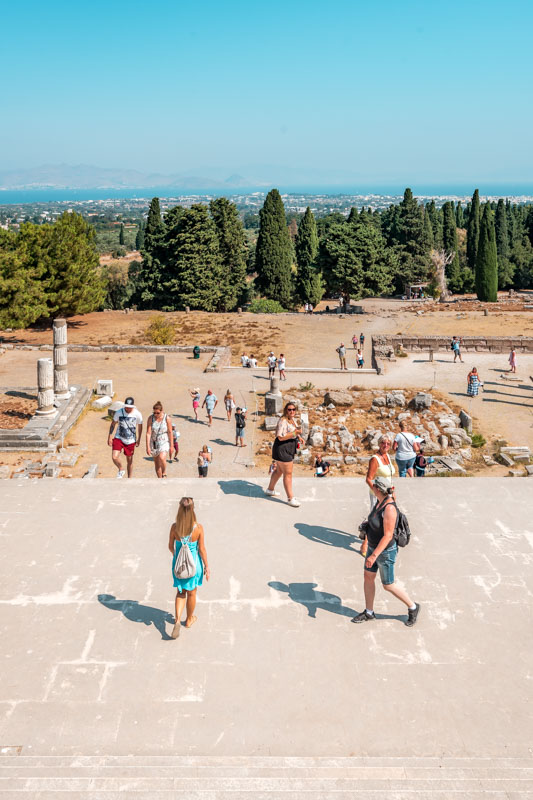
From up here you have the most beautiful view of the complex and its surroundings. In ancient times, the Asclepius Temple of Kos stood in the middle of the terrace, of which only sparse remains can be seen today. You can take a breather under the large trees on the right, but don’t sit on the ancient stones.
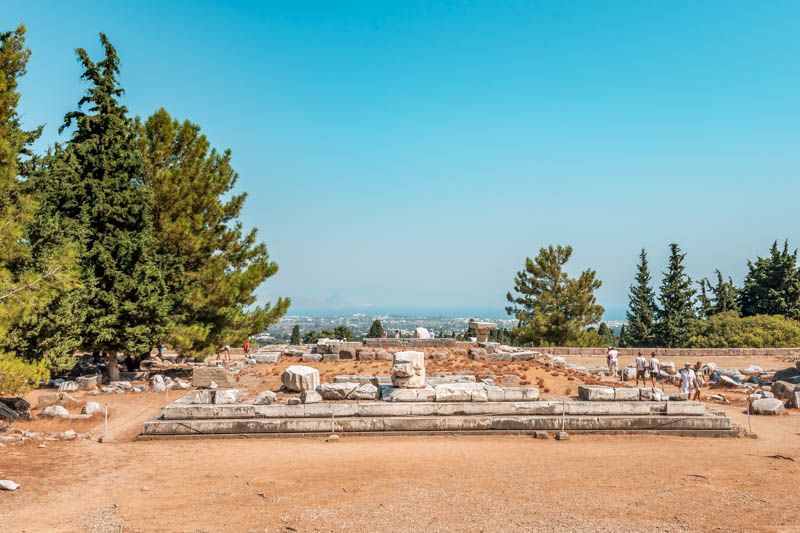
A few hard-to-spot ancient steps lead up into the pine forest, where a healing spring must have once been located and where the cult of the Asclepieion of Kos had its origins.
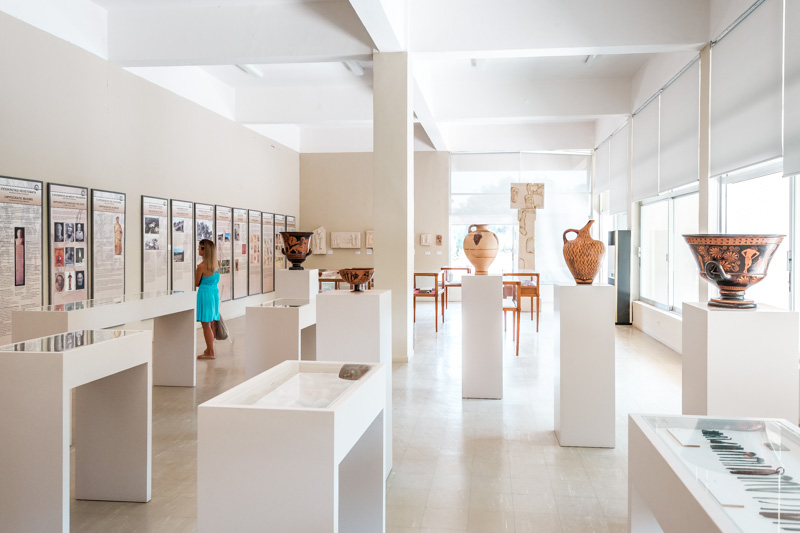
It is worth visiting the Hippocrates Museum of Kos, located slightly outside the town and known as the International Hippocratic Foundation. There you can find out more about the famous physician.
- Opening hours International Hippocratic Foundation: daily 8 a.m. – 4 p.m., Sun. closed, admission €4
#5 Guided Tours to the Asklepieion
The Asklepieion on Kos is a popular destination for independent travellers. If you don’t want to explore the island yourself with a rental car, you can join a guided tour to the Asklepieion. In addition to the Asklepieion, other highlights (including the village of Zia or the Kefalos region) are included in the island tour. All the Kos Tours can be booked directly through our partner GetYourGuide*:
➲ To the island tour incl. visit to Zia*
➲ To the island tour incl. visit to Kefalos*
#6 Restaurants near the Kos Asklepieion
Arap (Platani): A rustic tavern on the village square of Platani. Good Mediterranean cuisine with a Turkish touch, friendly service and generous portions (including set menu plates).

Lofaki Bar Restaurant (Giapili): A modern restaurant above Kos Town with a magnificent garden terrace. Fine dining that is also very popular with locals — reservations are recommended. The restaurant is only open in the evenings during the season (May to early October).
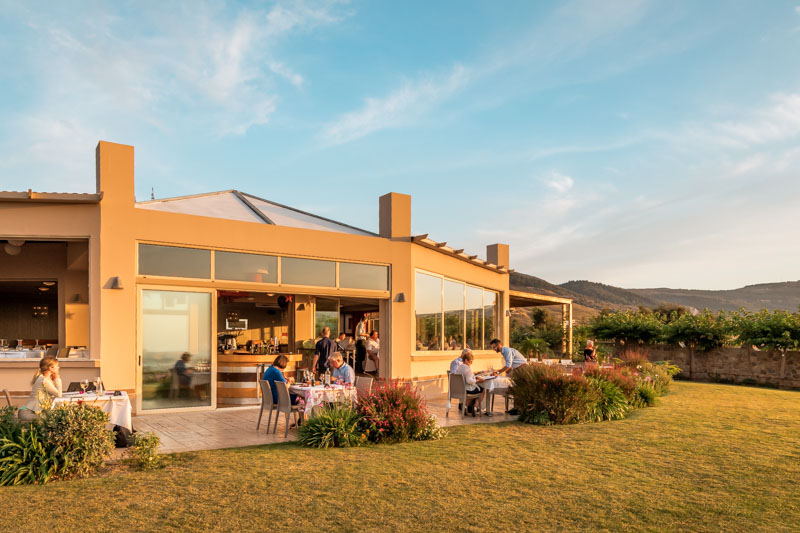
Karnagio Taverna (Zipari): Cozy, family-run tavern below the Asklepieion almost directly by the sea. Solid home cooking (mother and grandma cook together) and hearty grilled dishes at fair prices, plus a great view.
#7 Places of interest in the area
Embros Thermal Baths of Kos
Due to the volcanic origin of the island of Kos, there are two well-known thermal springs, although only the Embros Thermal Baths in the east of the island can be reached by land.

Right on Therma Beach, hot thermal water bubbles into a natural pool and is said to heal many ailments. In summer, it gets very busy here during the day. If you prefer it quieter, come in the early morning hours.
→ In this article, we’ve summarized everything you need to know for your visit: Embros Thermal Baths Kos
Visit to the mountain village of Zia
The highest mountain village on the island of Kos is a major tourist attraction in the Dikeos Mountains. A main street lined with many souvenir shops and stores runs through the small village. A visit to the village can easily be combined with the Askleipeon of Kos, thanks to its close proximity (10 km).

From the terraces of the numerous tavernas and cafés you have a magnificent view of the north coast of Kos. Every evening at sunset, Zia draws the crowds, as everyone wants to photograph the red fireball sinking on the horizon.
→ You can find the most important information about the most popular mountain village on the island in our article: Zia in Kos
Excursion to Kos Town
More than half of the island’s population lives in the capital in the northeast of Kos, so there is always something going on in Kos Town. Spend a day exploring the lively island metropolis. On a stroll through town, you’ll find many great shops, cozy cafés, and plenty of historical remnants of past cultures. Also connected to the Asclepieion of Kos is the Plane tree of Hippocrates, located in the heart of the capital.
→ In this post, we’ll take you on a tour of the capital: Kos Town
→ More articles and numerous Kos travel tips can be found here:
- Best Kos Hotels
- Kos Travel Guide
- Kos Highlights
- Kos with Children
- Kos Holidays
- Plaka in Kos
- Beaches in Kos
*Support our blog Greece-Moments
In this post, you will find affiliate links marked with an asterisk (*). If you book or buy something through one of these links, we receive a small commission. The price stays the same for you. This way, you help us continue to provide high-quality content for free. Did you enjoy this post and want to say thank you? Then just buy us a Greek coffee ☕️ To the coffee fund
Bookmark this post on Pinterest!