

With an area of almost 96 km², Skopelos is almost exactly twice the size of its neighbouring island Skiathos. Since there is no international airport on the island, there is only half the hustle and bustle here – perfect conditions for a relaxing stay.
“Skopelos became world-famous through the film, but the island has far more to offer than just the well-known Mamma Mia! filming locations.”
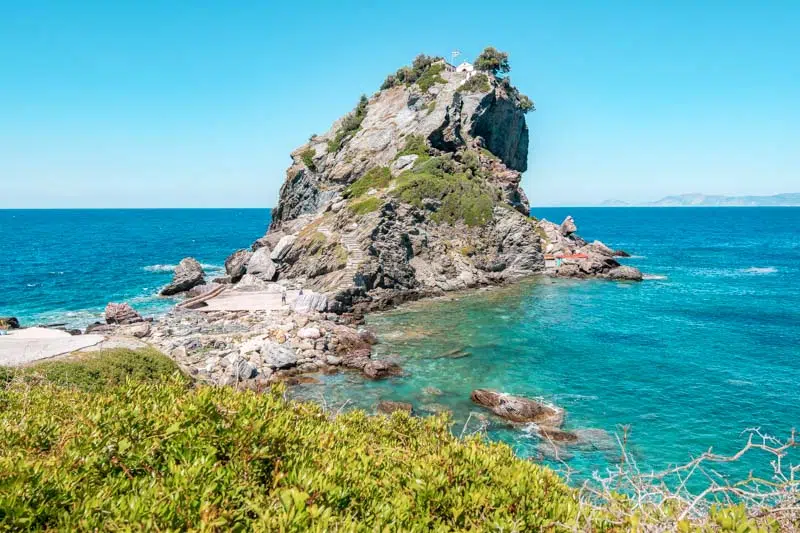
In 2008, the Greek island of Skopelos put itself on the map worldwide as a Mamma Mia! location. Fortunately, it has managed to preserve an authentic island life. Skopelos has resisted the urge to be exploited by tourism to the same degree as its neighbour Skiathos, just 30 minutes away by ferry.
We visited Skopelos Island at the end of May and explored it extensively for a week. We were absolutely thrilled by how green the island was. It never gets boring here: hidden monasteries, dense forests and dreamlike bays – an Eldorado for explorers! And Skopelos Chora is a capital town of rare beauty and charm.
In this article, we’ll tell you which Skopelos sights you can’t miss, share our favourite places, and help you decide whether a holiday on Skopelos is right for you:
- #1 Chora: Skopelos Capital
- #2 Skopelos Monastery at Palouki
- #3 Amarandos: The 3 Pines of Skopelos
- #4 Road trip along Skopelos’ west coast
- #5 Hike to Sedoukia
- #6 Mamma Mia Church: Agios Ioannis Kastri
- #7 Glossa: Balcony of the Sporades
- #8 Cape Gourouni: Wild north of Skopelos
- More Skopelos information for your holiday

Skopelos Map: This map of Skopelos includes all Skopelos Highlights, 36 Places to Visit & Insider Tips, 12 Beaches & Bays, as well as personal recommendations for 23 restaurants & cafés. Ideal for holiday planning and local navigation. Can be used on smartphone, tablet and PC/Mac. Click here and start using it right away: To the Skopelos map
#1 Chora: Skopelos Capital
With just under 3,000 inhabitants, Skopelos Town, also called Chora, is the largest town on the island. Most holidaymakers arrive at the ferry pier, although there are two other ports: Agnontas in the south and Glossa-Loutraki in the north.
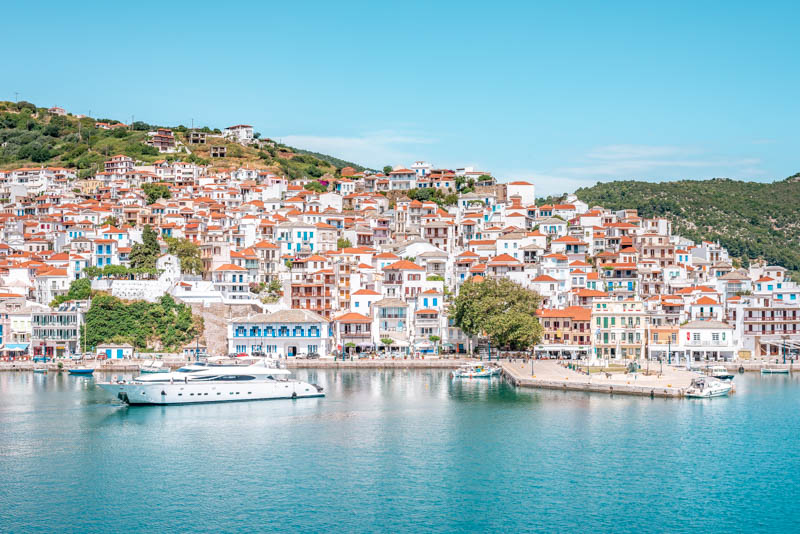
Chora inspires as soon as you arrive: like a picture book, the gleaming white houses with their blue windows, doors and red tiled roofs stretch up the hillside – the postcard image of the island! If you arrive by rental vehicle, you can park at the port. The large car park was still free of charge in 2025.
In the main town of Skopelos, it was quite relaxed during our visit in May, at least as far as visitor numbers were concerned. It was possible to stroll along the long waterfront promenade in peace and quiet, and almost all shops and restaurants had already opened for the season. In midsummer, on the other hand, it is said to be very lively.


Nevertheless, everything feels perfectly in place: a charming promenade with cafés and restaurants to stop at, and behind it paths branch off into a labyrinth of alleys where shops of all kinds invite you to browse. Nothing feels staged or designed purely to lure tourists. Mamma Mia posters can only be found at the harbour, where vendors offer tours to the Mamma Mia! Church (see point #6).

The alleys of Chora are very picturesque and above all clean. Here and there, bougainvillea climbs the house facades, while cats doze in front of doorways. Flower pots overflow with plants of all kinds, and countless gleaming white chapels are hidden between the houses – most, unfortunately, locked.

The many steps also keep mopeds at bay – something we particularly appreciated, having found the noise on Skiathos quite disruptive. In short: Skopelos Town won us over completely. Who wouldn’t dream of living in one of those little white houses with their colourful doors? For us personally, Skopelos Chora is one of the most beautiful places in Greece!
Kastro of Chora
Once you’ve strolled along the waterfront, you’ll come to the marina, where luxury yachts and colourful fishing boats bob gently. From here, a staircase leads past the mezebar Kafeneio i Chadoula up to the Church of the Holy Virgin (Panagitsa Tower) and on into the winding Kastro district.
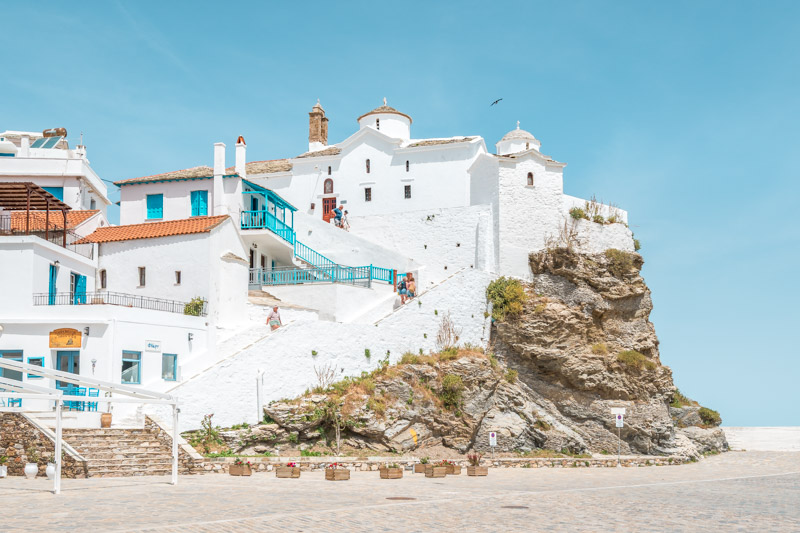
The many steps will take you about 15 minutes. It’s a sweaty climb, but well worth the effort. You will pass bright white houses with colourful windows, doors and balconies, and medieval chapels at every turn. Below the Donkee Bar is a popular vantage point. The view of Chora and the harbour bay across to the neighbouring island of Alonissos is magnificent.


From the highest point of the Kastro of Skopelos, apart from a few medieval walls, there are hardly any remnants of the Venetian fortress to be seen – but the scenery high above the rooftops of the small town is impressive. In ancient times, the acropolis of the city of Peparithos stood on this site.

In the evening, the tavernas Anatoly and, a little further north, Castello open their doors, where rebetiko music is played live. In summer, you can enjoy the Skopelos Rembetiko Festival, during which large concerts are held at the harbour. At the top you will also find the boutique Mermaid Kastro, which offers a carefully curated collection of dresses and souvenirs.

From here, you can wander at leisure through the maze of alleys – ideally keeping a little in a south-westerly direction. After about ten minutes you will reach the best ice cream parlour in town, Scoopelaki. Right next door is Skopelitikes Tiropites Michalis, the well-known purveyor of Skopelos cheese pies.

In contrast to Skiathos, the puff pastry rolls on Skopelos are not baked in the oven, but deep-fried. They are available classically with feta cheese, with a savoury filling, and for those with a sweet tooth, a dessert version reminiscent of bougatsa. One of these generously sized rolls is easily enough for one person!

Follow the alley further south and you will pass authentic shops that are quite different from the simple tourist stalls at the harbour. We particularly liked the delicatessen Mediterraneo Deli Skopelos (island products including Skopelos honey and good wine), Thome Kontsioti (tasteful boutique) and Skopelos Sandals (leather sandals and bags).

If you loved Skopelos Town during the day, be sure to come back in the evening when the alleys are atmospherically illuminated. From 6 p.m., most shops reopen after the afternoon siesta, and you can go shopping in Skopelos Chora once more. In the evening, a cocktail at the Tikiti Maji Bar is an absolute must – Elektra & Co. create a fantastic atmosphere!

Where we stayed on Skopelos
Villa Politimi (Skopelos Luxury Retreats)
Just outside Chora are the luxurious villas of the lovely hosts Marianna and Nikos. Our holiday home, Villa Politimi, offered everything a holidaymaker’s heart desires: two bedrooms, a fully equipped kitchen with washing machine and dishwasher, and a fantastic terrace with its own pool and sea view. Ideal for the whole family!
On Booking.com* you will find more information about Villa Politimi (Skopelos Luxury Retreats) and can check availability and prices right away:


#2 Skopelos Monastery at Palouki
Directly opposite the main town of Skopelos, the densely forested hilly landscape of Palouki stretches out. In the distance, medieval Orthodox monasteries can be seen. Some of the monasteries of Skopelos have fallen into disrepair, while others have been rebuilt in recent years and are now inhabited.

The centuries-old convents are connected by dirt roads. They are a popular destination for visitors to Skopelos and anyone with an interest in Greek religious culture. Currently, you can visit the monasteries of Moni Evangelismou tis Theotokou, Iera Moni Metamorfeseos tou Sotiros, Iera Moni Agias Varvaras, and Iera Moni Timiou Prodromou.
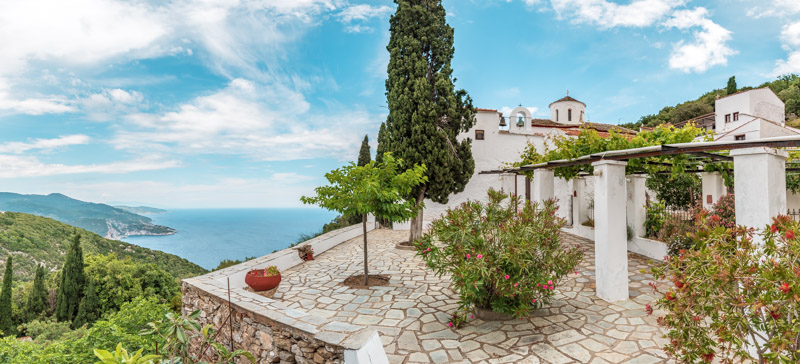
To the Holy Monastery of the Annunciation (Moni Evangelismou), a new asphalt road leads up. It is the closest monastery to Skopelos Town and is therefore often visited by day-trippers. There are rules of conduct for visiting: maintain silence in the complex, take photographs only with permission, and cover shoulders and knees (long trousers or a wrap). A small donation is welcome in all monasteries.
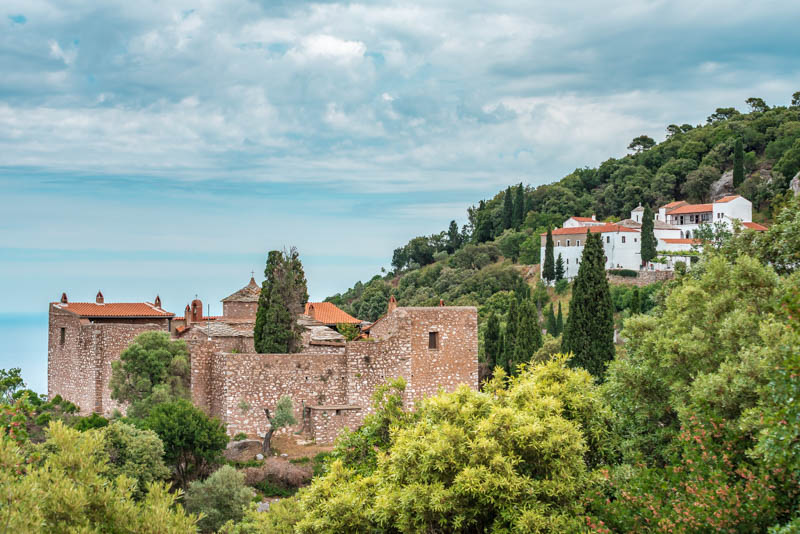
The monastics respond to visitors in different ways. At the Monastery of Agia Barbara, we had a very stimulating and wide-ranging conversation with the nun Ioanna. Having lived and travelled widely – including in America and Egypt – she had a fascinating perspective on the world, showed us around the monastery and explained all the background.


The monastery, dedicated to St. Barbara of Nicomedia, was renovated a few years ago in the traditional style. Inside the Katholikon, wall paintings from the Middle Ages can still be seen. Unfortunately, a theft in 1995 saw valuable icons and church objects stolen – to this day, the stolen items have never been recovered.
✓ Full coverage & unlimited mileage included
✓ Free cancellation until 24h before pickup
✓ Best price guarantee via Discover Cars
Hike to Mount Palouki
The Sporades do not have the barren, rocky landscape found on the Cycladic islands. Skopelos is one of the greenest islands in Greece – more than three-quarters of its land area is said to be forested. The lush trees reach close to the sea, giving Skopelos something truly special. Even in summer, the shade of the mighty pine trees keeps the temperature pleasantly cool for hikers.

In the east, hiking enthusiasts head for Mount Palouki. The hike follows a partly stony gravel path to the 567-metre summit. Views of the neighbouring island of Alonissos in the north and Euboea in the south open up along the way. Hidden in the forest are small chapels and monasteries, including Agia Triada, Agia Anna and the uninhabited Archangel Monastery.
This hike on Skopelos starts at the church of Agia Polyxenis, in front of the Prodromou monastery, and takes about three hours. Incidentally, one of the finest views of Skopelos Town can be enjoyed without great effort from the recently renovated church of Moni Panos Panagias.

#3 Amarandos: The 3 Pines of Skopelos
Only twelve minutes (8 km) south of Skopelos Town, not far from the hamlet of Agnontas, lies Amarandos Cove – one of the most famous Mamma Mia! filming locations. Agnontas can be reached either via a winding country road through the mountains or along a well-developed coastal road via the seaside resort of Staphylos.

The hamlet of Agnontas itself is not particularly spectacular: two tavernas, a fine restaurant and a café bar, behind which a few holiday homes are tucked away. In summer, the concrete jetty serves as a replacement port for Chora in strong northerly winds.
Here stands a statue of the village’s namesake, Agnon of Peparethus, who returned to Skopelos in 568 BC as an Olympic champion. Scenes from Mamma Mia! were also filmed on Agnontas Beach with its distinctive jetty. The water shimmers in the most beautiful shades of blue and the narrow beach invites you to cool off.

The real highlight, however, is the lush pine forest that reaches right down to the turquoise-blue sea, separated from the water only by a narrow strip of white rock. From Agnontas, a gravel road – passable with an off-road vehicle – leads about one kilometre along the coast to Amarandos Cove. On foot it takes about 20 minutes.


There, on a weathered rocky outcrop, stand what are probably the most famous three pine trees of Skopelos. This striking trio of trees has served as a filming location for Mamma Mia! on several occasions – including the scene in which Sophie faces her three potential fathers (see Point #6). The scenery is truly magical: pale grey rock, crystal-clear water and a secluded pine forest.

The one downside: in 2018, a severe fire destroyed large parts of the surrounding forest – but the three pines survived. Although some young trees have now grown through reforestation, it will probably take years before the landscape shines in full splendour again.
South of the Amarandos pine trees there is an enchanting gorge and a sea grotto, where, according to mythology, nymphs once lived. Take care: the path down is slippery and largely unfenced. The small sandy beach of Amarandos can only be reached by swimming from the grotto.

Swimming stop at Limnonari Beach
West of Agnontas, a narrow road leads to Limnonari Beach. The wind-protected bathing bay is one of the few on Skopelos that is ideal for children due to its shallow shore area.
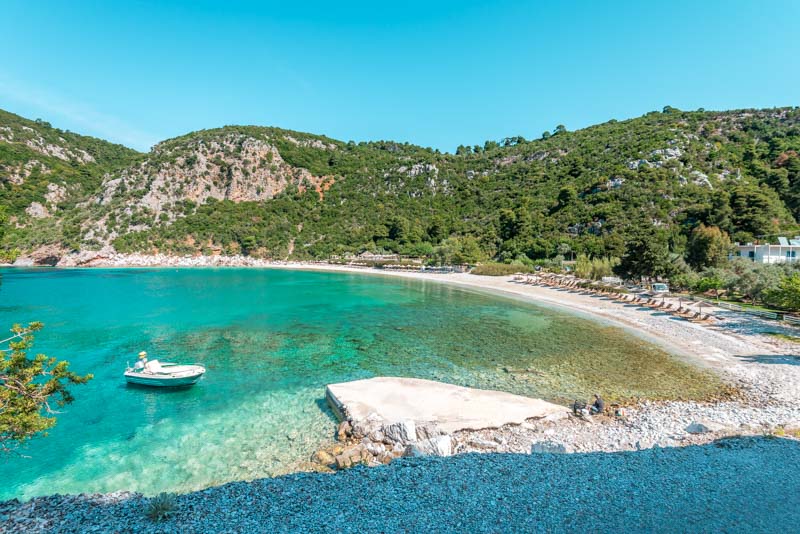
The beach has sandy sections, the rest is pebbly to rocky. Due to slippery stone slabs, caution is advised when entering the sea, and water shoes are recommended. There are two tavernas on site that rent sunbeds and umbrellas – though they have received rather mixed reviews.
Drakontoschisma and Agios Riginos
Hikers or holidaymakers with an off-road vehicle can explore the so-called Dragon Rift of Skopelos, Drakontoschisma. It is located about three kilometres east of Amarandos Bay and can be reached via a dirt road. Above the crevasse, a vantage point and memorial chapel were built in honour of Saint Riginas.

He is considered the patron saint of Skopelos and is said to have defeated a man-eating dragon at this very spot in the Middle Ages, which then fell into the depths and left the fissure in the rock. In his honour, a monastery was founded in which his bones are kept. The Monastery of Agios Riginos is located about five minutes from Skopelos Town.

To explore this stretch of coast properly, renting a motorboat or kayak is recommended, as there are no barriers and the rocks drop steeply into the sea. You can even glide into Dragon Bay by boat and marvel at the lush green rock slopes. We recommend the provider Kayaking Skopelos, based in Nea Klima.
Lunch break at Skopelos Experience
If you come from Agnontas and follow the main road, you will reach one of our favourite spots on Skopelos – the Skopelos Experience. If you appreciate alternative restaurants and delicious food off the beaten track, you should definitely stop here.

Here you will find a kind of beer garden in the forest. Whether you come as a solo traveller, a couple or a family, if you give it a chance, you will love it. A few years ago, owners Andonis and Linos created a meeting place that attracts both locals and tourists in equal measure.
It all started with a rustic roadside canteen and the idea of offering quick but healthy food. Over the years, the two have built seating areas, put up swings and an obstacle course, and planted fruit trees. Organic vegetables are grown on the spot.


We stopped here three times in total, as it was an ideal base for exploring the south of the island. The food is imaginative and the prices for Greek salad, bifteki and the like are absolutely fair. Music from another era plays in the background, inviting you to slow down and daydream. For our little daughter, every visit was a highlight – the free-range chickens and the enormous rooster alone are adorable.
💡 Skopelos Travel Guide: The travel guide from Michael Müller Verlag contains a wealth of information and useful travel tips about the island, as well as hiking routes off the beaten track. Order here: View on Amazon*

#4 Road trip along Skopelos’ west coast
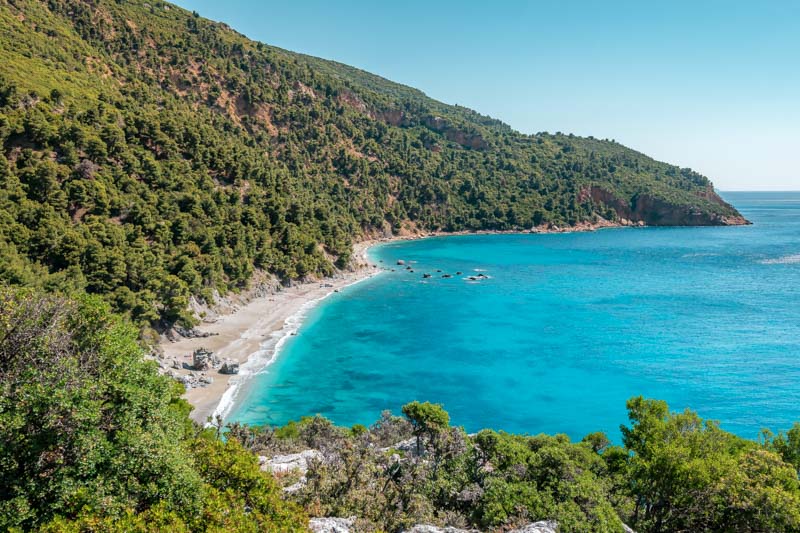
Along the west coast lie the most beautiful beaches of Skopelos. Those who come expecting the golden sandy beaches of Skiathos will likely be disappointed on Skopelos. The bathing areas here are almost always made of colourful or white pebbles or fine grey gravel.

However, this does not spoil the bathing fun at all: many beaches in the west are well developed, the water is crystal-clear, and the pine forests above the shoreline give the coast a wildly romantic atmosphere. You can do without sand. To enter the sea, we recommend wearing water shoes (our tip on Amazon*).

Panormos
Panormos is considered the most popular resort on the west coast. In summer, some tavernas and beach bars open their doors. During our visit, most were still preparing to open for the season, but one or two restaurants were already up and running. We enjoyed the peace and quiet on the bright pebble beach and quickly got into conversation with locals.

The sea at Panormos Beach shimmers in an appealing blue-green. In the low season, sun loungers are even free of charge if you eat at the restaurant (tip: Octopuses). Along the coast there are numerous other beaches stretching up to Nea Klima, reachable via winding roads of varying quality.

Melia Beach
Our favourite among the easily accessible beaches of the west coast is Melia Beach. There is a taverna and two beach bars on site. Fortunately, the grey pebble beach is not completely taken over by sunbeds. The highlight is the cluster of grey boulders in the sea, which catch the eye as soon as you approach from the road. Thanks to the beach’s generous length, everyone can find their own peaceful spot.

Kastani Beach – Mamma Mia! Beach
A rather narrow beach of grey, coarse sand, surrounded by a picturesque natural backdrop. The scene in which Sophie (Amanda Seyfried) and her boyfriend Sky (Dominic Cooper) joyfully sing “Lay All Your Love on Me” was filmed here, which is why Kastani Beach is known as the Mamma Mia! Beach.
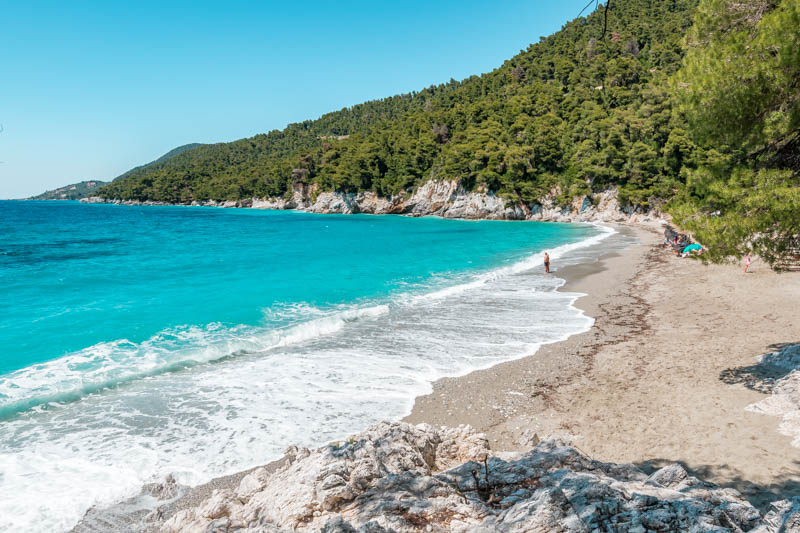
The Kastani Beach Bar has laid down artificial grass and installed sun loungers on it – not exactly what you come here for. At least the beach section itself remains free of umbrellas. In season, the Mamma Mia! boat tours from Skiathos pull in here, ABBA blares across the beach, and the flower-power atmosphere is in full swing.

Ftelia Beach
Unfortunately, we are no longer able to recommend it. The local beach bar has laid down artificial grass directly on the beach and set up loungers everywhere. The entire area is now occupied by the current operators, and the original natural character of the spot has sadly been ruined.
Nea Klima
Nea Klima, with 450 inhabitants, is the third largest village on the island after Glossa. There is no dressing up for tourists here – you can still experience genuine Greek village life. Nea Klima was founded by the sea after the village of Palea Klima (Greek: palea = ancient) in the mountains was severely damaged by the earthquake of 1965.

The village now offers a handful of tavernas and café bars (tip: Madalaki) at very fair prices, as well as some studios and smaller hotels. South of the village lies Hovolo Beach, one of the most beautiful beaches on Skopelos. Unfortunately, it is difficult to access – either by scrambling along the rocky coastline or arriving by boat. With fairly strong waves during our visit, we decided not to attempt the coastal route on foot.

Located about two kilometres north of the village, Paralia Armenopetra can be reached via a gravel path. We recommend going on foot, as the track is very narrow and bumpy. The beach impresses with its striking, bright limestone cliffs – it was very quiet when we visited and appeared clean and well-maintained.

Stafylos (Stapylos)
The small village of Stafylos is located about ten minutes by car south of Skopelos Town. Its grey sand-and-pebble beach is well visited on hot weekends. The shady pine trees reach right down to the sea, which shimmers in fairytale shades of blue. Unfortunately, the local beach bar has covered almost everything with umbrellas.

On the distinctive, rocky headland lie the remains of the ancient city of Velanio. According to legend, the wealthy prince Staphylos, son of the god Dionysus and Erigone, was buried here – though we could not discover any traces of the grave.
The back section is called Velanio Beach. It is a perfect place for young and old explorers alike: wild, almost deserted and full of mysterious rock formations. Due to very limited parking, it is advisable to leave the rental vehicle at the side of the road above the village and walk down to the beach.
#5 Hike to Sedoukia
Wild and untamed is the central mountain range of Skopelos, locally known as Delphi. Its highest peaks reach 681 metres and are almost completely overgrown with pines, with grey rock protruding only in places. An ascent to the highest point of Skopelos is possible, but requires some stamina.

Due to the dense vegetation, views of the surrounding Greek Islands are mostly obscured. A much easier hike leads to the Sedoukia Tombs (also known as the Sendoukia Carved Graves). It starts at a gravel car park above the farming settlement of Karya and is well signposted with red and white markers.

The monopati (traditional footpath) leads through dense coniferous forest. In May, bees and butterflies darted around us, and the scent of wild herbs was wonderful. After about 15 minutes, you reach a clearing cut through with the typical grey rock, from where the first views of the eastern part of the island open up.

After another ten minutes across the scree field, you reach the three graves, whose stone lids, weighing several tonnes, lie open. They probably date from Roman or early Christian times and were plundered decades ago. From here you have an excellent view of the neighbouring island of Alonissos and the Marine National Park.
→ All tips for Alonissos can be found in this article: Alonissos


The silence up here at around 660 metres is meditative – ideal for an extended picnic. Then we make our way back down. There are other hiking destinations in the area, including the remote Agiou Efstathiou Monastery, which can already be spotted from the Sedoukia summit. Unfortunately, it is completely closed and only opens for the feast day on 20 September.

#6 Mamma Mia Church: Agios Ioannis Kastri
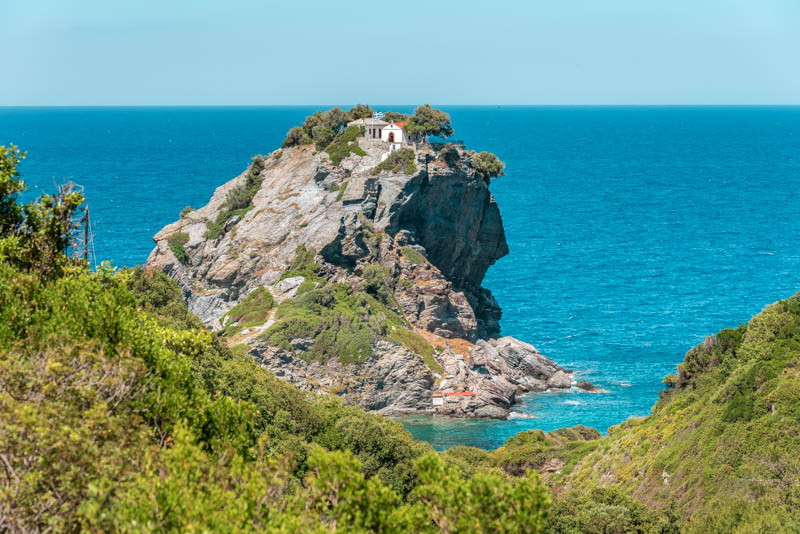
The most famous attraction on Skopelos is the church of Agios Ioannis Kastri, located in the north of the island. It is known as the “Mamma Mia! Church”, as several scenes from the 2008 film were shot here. So what is this beloved film, set to the music of ABBA, actually about?
In a nutshell: 20-year-old Sophie wants to get married on the Greek island of Portokali, where her mother Donna lives alone and runs a fading hotel. While going through her mother’s diary, Sophie discovers the names of three possible fathers – whom her mother has always refused to reveal.
Without further ado, Sophie secretly invites all three potential fathers to her wedding. The comical spectacle about Sophie’s big day, her mother Donna and her former lovers then takes its course. You don’t need to have seen it – but as a fan of Greece, it’s great fun. Click here for the film: Prime Video*


The Mamma Mia! Church served as the filming location for the scene in which Donna (played by Meryl Streep) runs up the stairs and sings “The Winner Takes It All” by ABBA, as well as for Sophie’s wedding. The ceremony itself was recorded at film studios in London, as barely ten people fit inside the tiny chapel.

Whether you are a Mamma Mia! fan or not, this church is a must on Skopelos – it is picturesquely perched on a boulder rising from the sea. A well-maintained staircase with 198 steps leads up to a height of around 100 metres and has a dizzying incline in places.
But this much can be said: our 4-year-old daughter managed the ascent twice on her own – perhaps spurred on by the film music. Although she hadn’t seen the film, we played ABBA music in the car on the way there – and that makes the seven-kilometre winding journey from the village of Glossa (see point #7) quite the experience.


As you drive, the church comes into view again and again from different angles, as does the deep blue sea below. Take care – the road has no crash barriers in places and is in poor condition. Directly in front of the church there is a small car park and a snack bar.
The beach to the east of the church, Agios Ioannis Beach, is wild but perfectly suited for a cooling dip in summer. If you like, you can also join a guided “Mamma Mia!” tour to the most beautiful filming locations on Skopelos, bookable via our partner GetYourGuide*:
➲ To the Mamma Mia Island Tour*
#7 Glossa: Balcony of the Sporades
A trip to the large village of Glossa can easily be combined with a visit to the Mamma Mia Church. It nestles against a hillside like a balcony, with the white houses and their red tiled roofs seeming to cling to the slope. Even though Glossa is not quite as pretty as Skopelos Chora, it is well worth a stroll.

Up and down countless steps, you can explore the village, which is home to around 1,000 people. Tucked away among the many houses – some of them empty – are tavernas, cafés and a few shops. Of course, there are also the typical photo opportunities: colourful bougainvillea climbing up whitewashed walls.


Even in summer, Glossa remains tranquil – making it a favourite retreat for those seeking peace and quiet. There is no rowdy nightlife here, but the local tavernas offer hungry visitors excellent home cooking (tip: Rouga). At around 250 metres above sea level, a view stretches across the sea towards the island of Euboea – deeply calming.

You can park your rental vehicle in the lower village near the petrol station or in the upper village at the playground. The alleys of Glossa are largely traffic-free, though the occasional moped disturbs the peace. Incidentally, the best sunset on Glossa can be enjoyed from the church of Panagia Eleftherotria, right next to the taverna Iliovasilema.
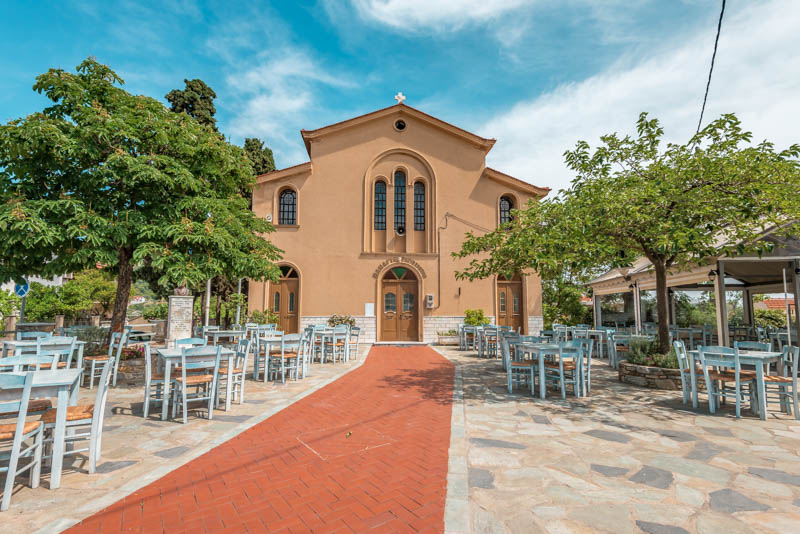
On the eastern outskirts of the village, at the junction to the church of Agios Ioannis Kastri, you can stop at the Antoniou family farm to discover and buy their award-winning organic olive oil from Skopelos and other local products. A short film in the production hall takes you through all the steps involved in creating this liquid gold. More information at: Antoniou Olive Oil

Coastal town of Loutraki
The former fishing village of Loutraki is located directly below Glossa and has been enjoying growing popularity for several years. The reason: the port is served by fast catamarans from Skiathos, Volos and Mantoudi (Euboea), making it possible to get from Skiathos to Skopelos in just 15 minutes – island hopping in the fast lane!

Today, Loutraki offers a few tavernas and café bars (tip: Briki), two minimarkets, and a charming waterfront promenade with a large children’s playground. Small hotels and studios are available for those who prefer accommodation directly by the sea without requiring luxury.
Loutraki Beach is a typical Skopelos pebble beach, well suited for sunbathing. Take care when catamarans arrive or depart, as they can create significant wash. In the area around Loutraki, history buffs can explore two historical sites.

West of the village, in an olive grove, lie the remains of the ancient city of Selinus in the form of individual walls and ruined houses. On the eastern edge are fragments of a Roman bathhouse (2nd century AD). Loutraki owes its name to the ancient Greek word “Loutra”, meaning thermal bath. You can find all the details in the History Pavilion (Istoriko Periptero) on the waterfront.
#8 Cape Gourouni: Wild north of Skopelos
Skopelos reveals its wildest side in the area north of Glossa, where the forests are exceptionally dense and almost primeval in character. The reason is the region’s high rainfall. While driving along the narrow, bumpy asphalt and concrete tracks, springs suddenly emerged from the rockface at the roadside on several occasions.

There are only olive groves and a few scattered farmsteads up here, where, among other things, the typical Skopelos plums are grown. The fruits are available in dried form as “Damaskina Skopelou” in many shops in Skopelos Chora.
On the way north from Glossa, you will also come across the uninhabited but impressive Taxiarchis Monastery, dating from 1672. It stands like something from a fairy tale, deep in the forest, and is worth a photo stop. You can even step inside the small church.


Perivoliou Beach
Perivoliou Beach is the most popular beach in this remote region. It is easily accessible via an asphalt road, with only the last stretch unpaved. A small canteen of the same name offers snacks and cold drinks from June onwards. A real highlight is the path from the car park down to the beach: natural stone steps have been meticulously laid out, winding down the slope in a series of switchbacks.


When we arrived at the bottom in May, we were greeted by a small waterfall fed by a mountain spring. Dragonflies, butterflies and bees darted about, and flowering herbs scented the deserted beach. While the neighbouring island of Skiathos was already buzzing, here there was heavenly peace.
We immediately fell in love with the coast of Perivoliou, with its rugged rocks and lush green slopes. A little further east is the Angeletou Beach, equally gorgeous but slightly harder to reach.

Chondrogiorgi Beach
Just a few minutes further east is Chondrogiorgi Beach. The approach is over a bumpy track and is only recommended for four-wheel-drive vehicles – it is best to leave your vehicle at the main road and walk the last stretch.

Once down on the pebble beach, freshwater springs bubble out of the rock and ducks visibly feel at home in the crystal-clear water. We dipped our toes in – it was bitterly cold, but deserted and beautiful all the same. Maybe you’ll take the plunge for us in the summer! 🙂
Cape Gourouni Lighthouse
Until 2024, the northern tip of Skopelos was only accessible by four-wheel-drive vehicle or on foot. The road is now well paved, so you can enjoy a carefree, scenic drive through dense greenery. Clearings offer occasional glimpses of the sea.

At the end of the road stands Cape Gourouni with its white lighthouse (closed to visitors) – a wonderful photo opportunity. It is particularly atmospheric at sunset, when the sun sets behind the island of Skiathos and the Pelion Peninsula. A fitting place to end your Skopelos adventure on a memorable note!
More Skopelos information for your holiday
To make your trip to this Sporades gem an unforgettable experience, here are some helpful links. For everything about travel, car hire, weather and accommodation on Skopelos, read our dedicated article: Skopelos Travel Tips
→ Accommodation on Skopelos: To Booking.com*
→ Ferry connections to Skopelos: Go to Ferryhopper*
→ Car hire for Skopelos: To Discover Cars*

→ More articles and Sporades travel tips can be found here:
- Sporades Blog – The archipelago at a glance
*Support our blog Greece-Moments
In this post, you will find affiliate links marked with an asterisk (*). If you book or buy something through one of these links, we receive a small commission. For you, the price remains the same. In this way, you help us continue to provide high-quality content for free. If you enjoyed this post and would like to say thank you, why not buy us a Greek coffee ☕️ To the coffee fund
Bookmark this post on Pinterest!


