

The symbol of Athens stands impressively 156 meters above the city’s rooftops. At first glance, you might think that the large Parthenon temple on the hill in the metropolis is the Acropolis of Athens, but this name actually refers to the entire castle hill with its numerous buildings.
The view from the mighty temple hill over the metropolis is spectacular and impresses even those who are not particularly interested in history.
Tom & Ella

The word Acropolis comes from ancient Greek and is composed of “akros” (highest, uppermost) and “polis” (city). The “upper city” was usually the highest point in the city, where castles and fortifications were built for defensive purposes.
In addition, the Acropolis was also a sanctuary and place of worship with temples where Greek deities were worshipped. The goddess Pallas Athena (also Athena) was not only the namesake of the capital, but was also worshipped on the Acropolis of Athens as the goddess of wisdom, strategy, and battle, among other things.
For us personally, a visit to this monumental building is a must on any city trip to Athens. You don’t have to be a history nerd to warm to Greece’s most popular attraction.
Here you will find all the important information and the best tips about the Acropolis of Athens and how to get the most out of your trip to Athens.
- #1 Getting to the Acropolis of Athens
- #2 Opening hours of the Acropolis in Athens
- #3 Best time to visit the Acropolis
- #4 Acropolis tickets and prices
- #5 Acropolis tour on your own
- #6 Important Acropolis temples and buildings
- #7 Visit the Acropolis Museum
- #8 The most beautiful view of the Acropolis
- #9 History of the Acropolis of Athens
- #10 More tips on the Acropolis of Athens
- FAQs about the Acropolis of Athens
🏖️ Dream beaches & hidden bays
🍽️ Restaurants, tavernas & cafés
🏛️ Must-see highlights & ancient sites
🗺️ Worthwhile spots & insider tips
🚘 Practical info like rentals & parking
♾️ Lifetime access & updates
#1 Getting to the Acropolis of Athens
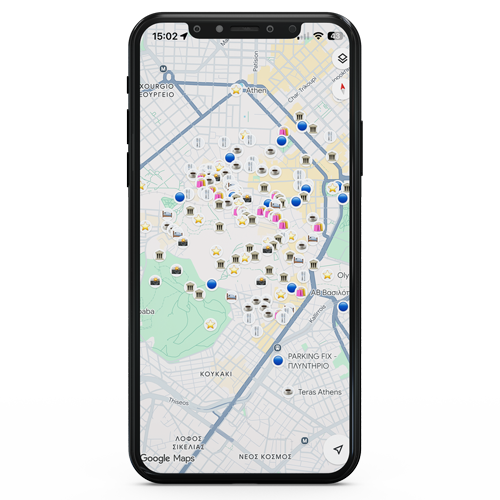
The Acropolis is located in the heart of Athens’ historic old town and is within walking distance of the Plaka, Monastiraki, Psyri, Thissio, and Makrygianni districts.
Alternatively, there are two metro stations near the Acropolis, from which you can reach the two entrances in less than 10 minutes.
To the south, the Acropoli metro station is located directly at the entrance to the Acropolis Museum. Here you are in the pretty district of Plaka. It is only a two-minute walk to the south entrance of the Acropolis.
North of the Acropolis is the Monastiraki metro station, right next to Monastiraki Square. From here, it’s about an 8-minute walk through the historic old town to the north entrance.

From the Thissio and Syntagma metro stations, you can reach the Acropolis in about 12-15 minutes on foot. You can’t miss the Acropolis in Athens, as it towers above the modern skyscrapers.
If you’re still looking for a nice hotel near the Acropolis, check out our partner Booking.com*: Hotels near the Acropolis*
The entrances to the Acropolis
The main entrance to the Acropolis is located to the west of the site, but is usually referred to as the north entrance. This is where you can usually expect the largest crowds, as there is a large parking lot for tour buses not far from the entrance.
Long queues at the ticket office are the norm from May to October, so we recommend booking your Acropolis ticket online in advance. For more information, see: Tickets and prices for the Acropolis
The south entrance at the Acropolis Museum is usually less crowded. However, it is no longer an insider tip, and in summer there are also long queues here to buy tickets.
💡 Visiting the Acropolis with children: You cannot take a stroller onto the Acropolis of Athens. It must be left at the entrance and the little ones have to walk (if possible). If you have small children, you should definitely bring a baby carrier.
#2 Opening hours of the Acropolis in Athens
You can visit Greece’s most popular attraction at almost any time of day, as it is open from morning to evening. There are two opening hours schedules, one for summer and one for winter. The site closes at sunset. Last admission is 30 minutes before closing time.

Acropolis Athens opening hours in summer
During the summer months from April to October, the Acropolis in Athens is open as follows:
- Daily from 8 a.m. to 8 p.m. (last admission at 7:30 p.m.)
Acropolis Athens opening hours in winter
In winter, from November to March, the Acropolis in Athens is open as follows:
- Daily from 8 a.m. to 5 p.m. (last admission at 4:30 p.m.)
Closing days of the Acropolis in Athens
The Acropolis is closed on the following Greek public holidays:
- January 1
- March 25
- May 1
- Orthodox Easter Sunday
- December 25/26
#3 Best time to visit the Acropolis
We would like to share our experiences at the Acropolis with you. We have visited the Acropolis of Athens at different times of the year and at different times of the day. The first time we were there was probably the worst possible time: in August at midday.
It was hell! Crowds of people and sweltering heat made our visit a disaster. Save yourself such an experience; you will hardly have fond memories of the Acropolis of Athens.
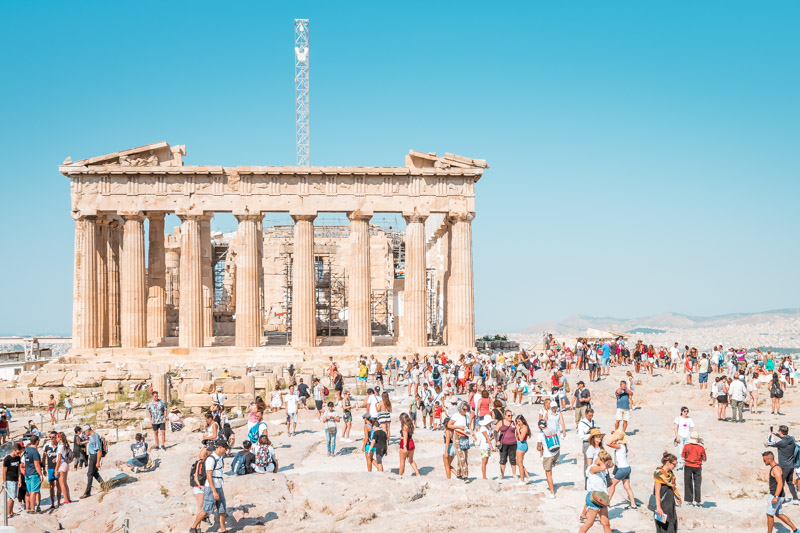
On our second visit, we were at the Acropolis on the first Sunday in March. It was a day with free admission to the Acropolis. The entire complex was bursting at the seams and a visit was like a mass migration.
On our last visits, we were at the Acropolis in Athens in early December on a normal weekday afternoon in bright sunshine. For the first time, we were able to enjoy the peace and quiet and really appreciate the full extent of the complex.
💡 New Acropolis ticket system: To reduce overtourism at the Acropolis, one-hour time slots for visits were introduced in September 2023, and the maximum number of visitors was limited to 20,000 per day. If you want to visit the Acropolis on a specific day at a specific time, we strongly recommend booking your ticket online a few days in advance! In summer, the time slots sell out very quickly. You can reserve your ticket on GetYourGuide*: To online ticket without queuing*
Our recommendation for your visit to the Acropolis
Especially in summer, take advantage of the early morning hours for a visit. First, it is still pleasantly cool when the Acropolis opens at 8 a.m. and second, you can be sure that you will be able to explore the site largely undisturbed.
This allows you to take photos undisturbed in the beautiful morning light and let the impressive site work its magic on you. You’ll also avoid the long queues that form at the entrances from around 10 a.m. onwards.

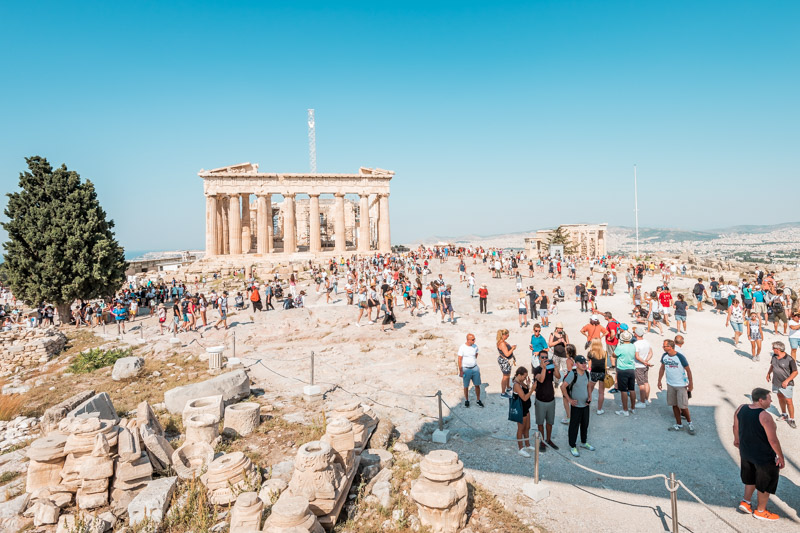
Most guided tours and bus groups arrive from 10 a.m. onwards. Especially at lunchtime and in the afternoon, the Acropolis in Athens is packed and you will hardly be able to move! It is worth waiting until the late afternoon and joining a guided Acropolis tour, which can be booked via GetYourGuide*:
➲ To the Acropolis ticket with guide*
It is a little less crowded in the evening at sunset on the Acropolis. Nevertheless, many people want to marvel at the spectacle from the Acropolis entrance. When the sun has set, the last visitors head for the exit. This can also take a long time under certain circumstances.
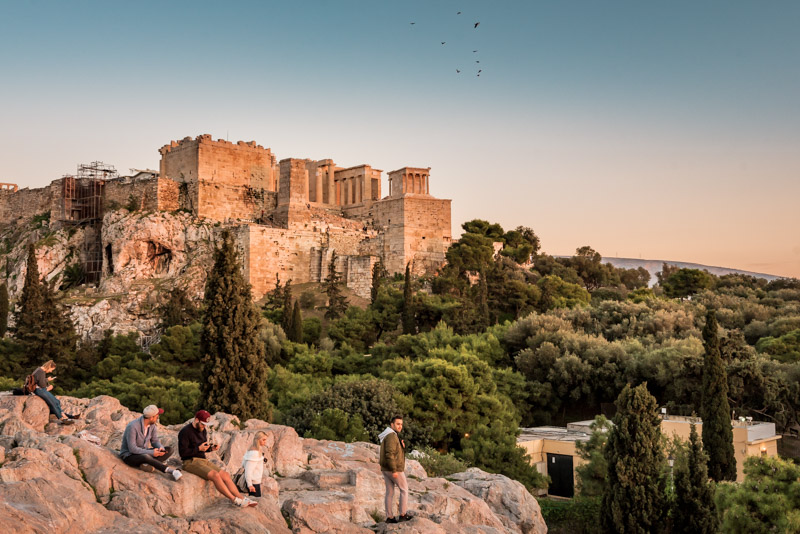
You can enjoy a magical sunset from the Areopagus Hill in front of the Acropolis in Athens. From the small rocky outcrop, you have the most beautiful view of the archaeological site, which is bathed in warm evening light by the sun. Pure romance!
During the winter months, the Acropolis of Athens is least crowded outside of holiday periods and during the week. The exception is the first Sundays between November and March, when admission is free. Then it feels like everyone in Athens wants to visit the Acropolis for free.
#4 Acropolis tickets and prices
Since spring 2025, you can only purchase a single-use ticket for the Acropolis when visiting. The lucrative Acropolis combination tickets (Special Ticket Package) are no longer available. They offered culture fans a significant price advantage.
On September 4, 2023, a new ticket system for the Acropolis was introduced to reduce overtourism. The number of visitors to the Acropolis is limited to 20,000 per day.
To this end, one-hour time slots with a limited number of tickets have been introduced. This measure is intended not only to limit the flow of visitors but also to protect the monument. Here you find the official website for Acropolis tickets: tickets.hh.gr
Acropolis ticket summer prices (April-October)
- Adults: €30
- Reduced: €15 (seniors over 65)
- Free admission for EU citizens under 25 and non-EU citizens under 18 upon presentation of ID (passport)
Acropolis Ticket Winter Prices (November-March)
- Adults: €30
- Reduced: €15 (seniors over 65)
- Free admission for EU citizens under 25 upon presentation of ID (passport)
Through our partner GetYourGuide*, you can book your Acropolis ticket in advance for your desired time slot and skip the line at the entrance:
➲ To the ticket without queuing*

Acropolis combo ticket prices (special ticket package)
Since 2025, there are no longer any combination tickets for the Acropolis and other attractions in the area.
Perhaps in the future it will be possible to purchase such an Athens ticket again. This would be a great advantage for culturally interested vacationers who want to see as many sights in Athens as possible. The Athens combination ticket was valid for the following sights:
- Acropolis of Athens
- Ancient Agora of Athens
- Kerameikos Archaeological Museum
- Archaeological site of Lykeion
- Hadrian’s Library
- Kerameikos
- Museum of the Ancient Agora
- North Slope of the Acropolis
- Olympieion
- Roman Agora of Athens
- South slope of the Acropolis
If you don’t want to join the long queues at the Acropolis, it’s worth buying your ticket online in advance. This way, you can go straight in to the Acropolis and save yourself the hassle of queuing.
Days with free admission to the Acropolis
- March 6
- April 18
- May 18
- Last weekend in September
- October 28
- Every first Sunday between November 1 and March 31
#5 Acropolis tour on your own
You can start your Acropolis tour from two different entrances. It is up to you whether you visit the inner part of the Temple Mount first or start with the outer area of the Acropolis.
💡 Food and drinks on the Acropolis: Take enough water with you to explore the Acropolis in Athens. There are no drinks available on the site itself, and at the entrance, the price of €4 for a 0.5 l bottle of water is pure extortion!
Important: If you arrive by metro at Monastiraki Square, it is recommended to start the tour at the north entrance.
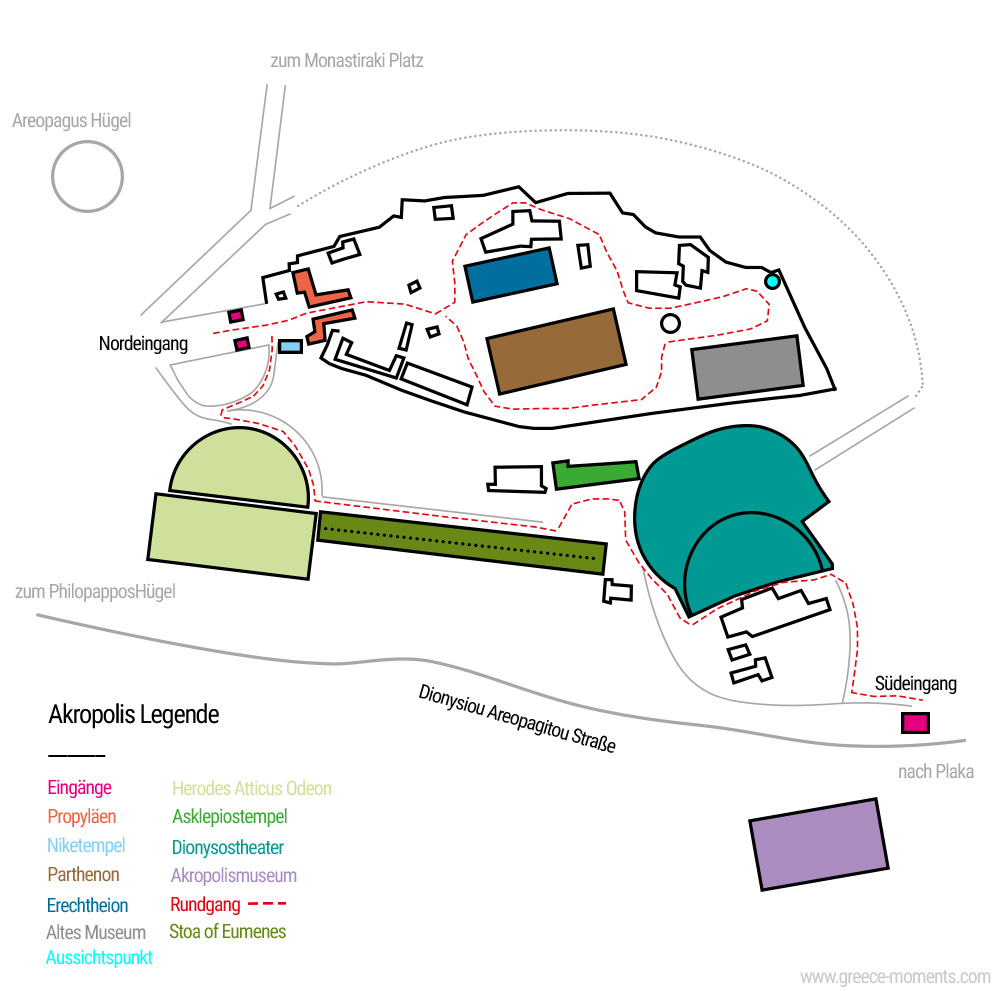
Ideally, you will have already purchased an online Acropolis ticket (book on GetYourGuide*) in advance, allowing you to skip the queue at the north entrance to the Acropolis.
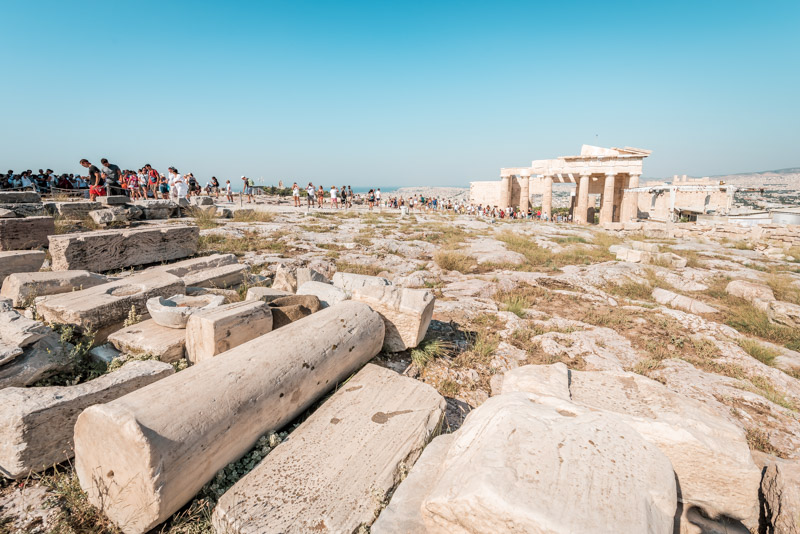
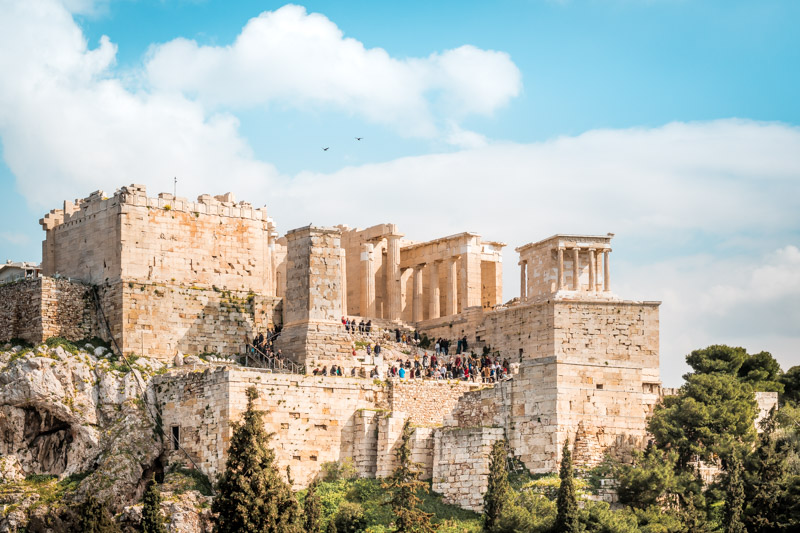
A path leads up to the Propylaea of the Acropolis, a kind of gate structure made of columns that marks the entrance to the Acropolis. In front of it, on the right-hand side, stands the Temple of Athena Nike.
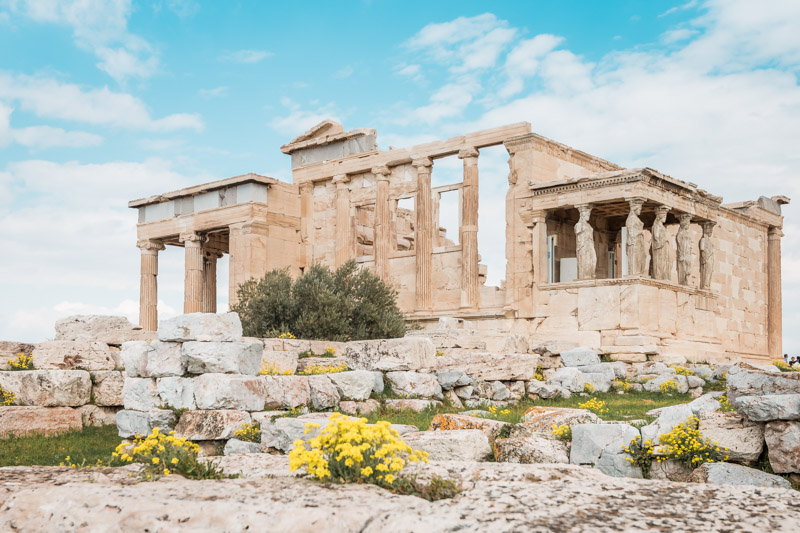
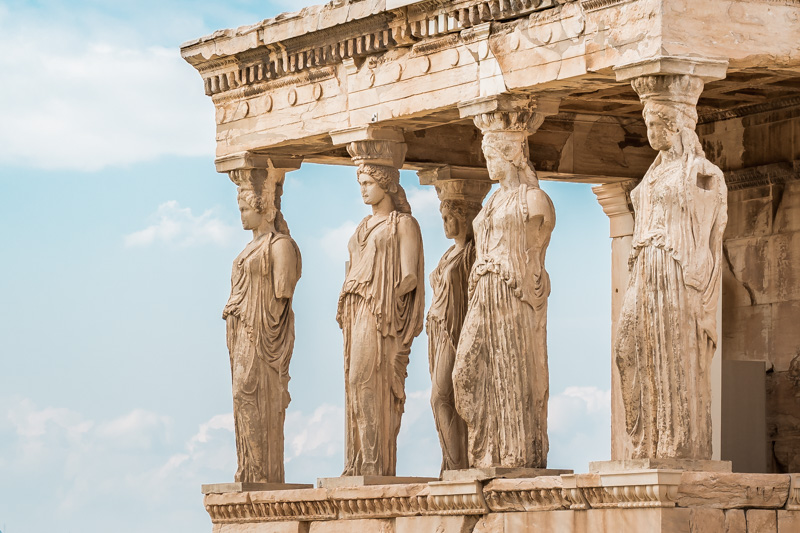
We pass through the Propylaea and immediately see the imposing Parthenon temple, the centerpiece of the complex. Opposite, on the left, is the Erechtheion with its large female figures, the Caryatids. Here we can turn in front of it and walk behind the Erechtheion.

In the eastern part of the complex, we come to the Acropolis viewing platform, from where we can enjoy a magnificent view of the city. The Parthenon can also be photographed beautifully from here. On the left is the old Acropolis Museum, which is now closed.
We walk south of the Parthenon along the Acropolis, encountering fragments and remains of individual temples that have not yet been reconstructed.
Along the fortification wall of the Acropolis, we enjoy a great panorama of Athens. By the way, climbing the wall is prohibited. Violations are noticed by the shrill whistles of the guards.
The outer part of the Acropolis
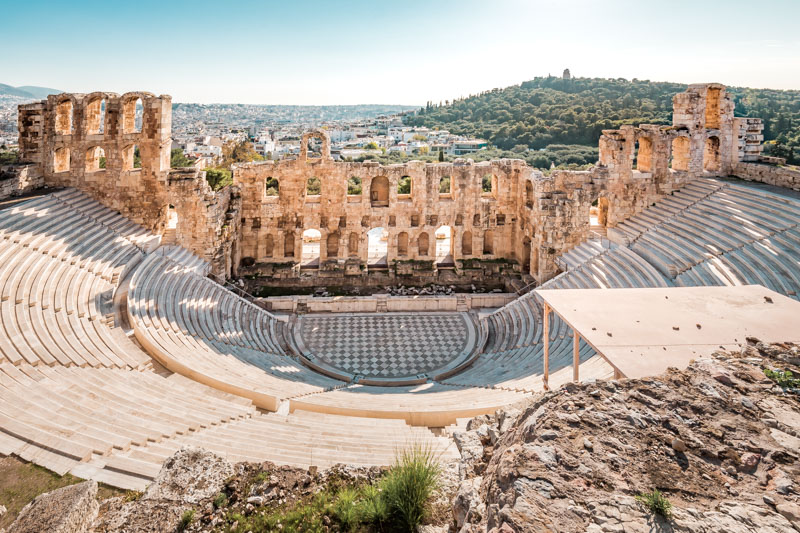
Back at the Propylaea, we pass through the passageway and head towards the south exit. Here, a few more historical treasures await us. First, we pass the Odeon of Herodes Atticus, a once-roofed amphitheater.
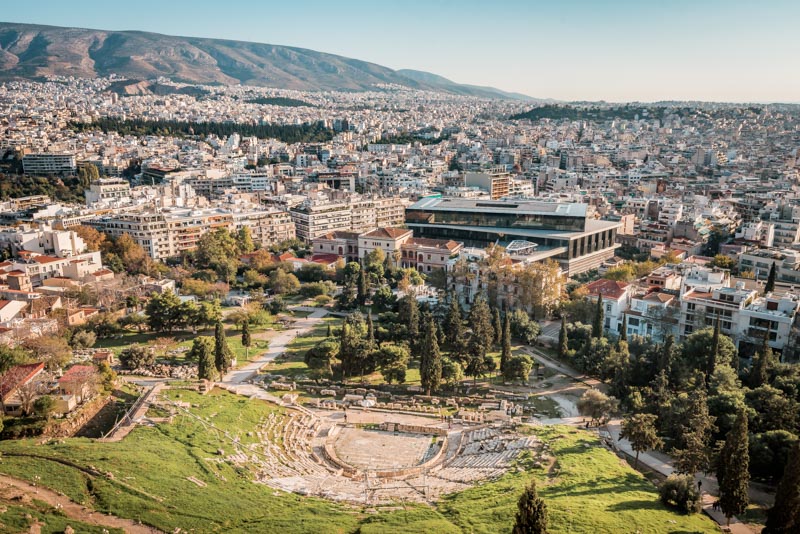
A path continues at the foot of the Acropolis through a small forest of conifers. The ruins we can see here are from the sanctuary of Asclepius. Directly behind it is the Theater of Dionysus, where the first drama in world history was performed.
Our tour is coming to an end and we are heading towards the south entrance. Directly behind it is the Acropolis Museum, which is also worth a visit. Here, many individual pieces of the Acropolis of Athens puzzle come together to form a whole.
Alternatively, you can take a detour to the hills of Athens, from where you can photograph the Acropolis in all its glory.
You should plan at least an hour for a visit to the Acropolis. If you want to learn more and study the individual information boards (in English) in more detail, it’s best to plan at least two hours.
Would you prefer to take a guided tour of the Acropolis and have all the details about the Temple Mount explained to you in detail? Then take a look at these two Acropolis tours on GetYourGuide*, which offer multi-language guides at various times of the day:
➲ To the day tour with English-speaking guide*
➲ To the evening tour with English-speaking guide*
#6 Important Acropolis temples and buildings
Throughout its historic past, the Acropolis complex has been continuously expanded. Various ethnic groups and diverse eras have shaped the face of the Acropolis.
As a result, it has changed over time and had a different effect on visitors. Interestingly, the Temple Mount was largely in very good condition until 1687.
It was only an attack by the Venetians against the Ottoman occupiers at the time that damaged the Acropolis of Athens and large parts of the Parthenon.
In addition to the striking temple, you will find other impressive buildings on the Acropolis, which have been extensively restored in recent years. Below is an overview of the most important sights on the Acropolis of Athens.
The Parthenon Temple
⤷ Built around 447-438 BC ⭔ Width: 30.9 m ⬝ Length: 69.5 m ⬝ Height: 10.4 m

The Parthenon Temple is the most imposing building on the Acropolis and also the largest of its kind on the Greek mainland.
It is located at the highest point of the Acropolis (156 m) and has 8 mighty columns at the front and rear, as well as 17 on each of the long sides.
The temple was dedicated to the goddess Pallas Athena. Inside, there was once a statue of the goddess made of bronze and ivory.
Temple of Nike (Temple of Athena Nike)
⤷ Built around 432-421 BC ⭔ Width: 5.4 m ⬝ Length: 8.3 m ⬝ Height: 6.9 m
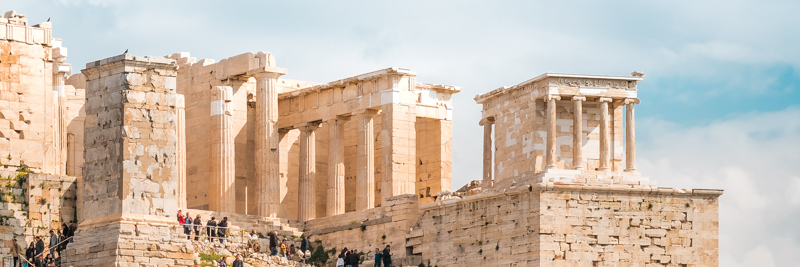
The Temple of Nike is one of the most characteristic buildings on the Acropolis in Athens. The small temple has been “rebuilt” three times. In the 17th century, the Ottomans used the temple marble as building material.
In 1836, the individual parts were found in the Beule Gate and rebuilt. Due to construction errors, it was rebuilt again in 1939. Most recently, the Temple of Nike was reconstructed between 1998 and 2010.
Propylaea (Propylon) at the Acropolis entrance
⤷ Built around 437-432 BC ⭔ Entrance height: 7.4 m ⬝ Entrance width: 4.1 m

The Propylaea are located at the entrance to the Acropolis temple district. The name means “something in front of the gate.” In fact, the gate structure looks like a temple in front of the actual entrance to the Acropolis.
The marble columns are between 8 and 10 meters high. It is the most complex and significant column structure of its kind. The Propylaea were only built after the Parthenon temple was completed.
Erechtheion and the Caryatids
⤷ Built around 421-406 BC ⭔ Width: 11.6 m ⬝ Length: 22.8 m
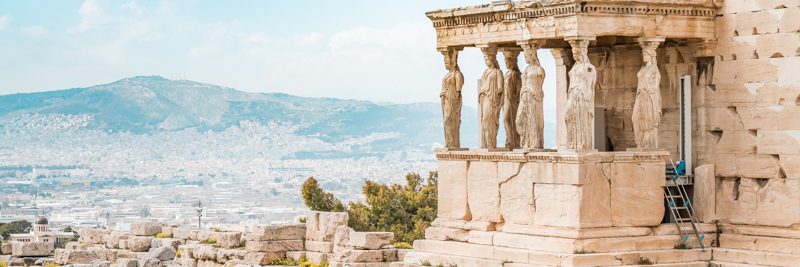
The Erechtheion stands on the remains of the Mycenaean royal palace and was a place of worship for 13 gods and heroes in ancient times. It is probably one of the most photogenic temples on the Acropolis.
The reason for this is the Caryatids (also known as Korai), six female figures (2.3 m high) posing in front of the temple. However, only copies stand on the Acropolis.
The five original Graces can be found in the Acropolis Museum. One lady was “abducted” to England by Lord Elgin in 1811 and is now on display in the British Museum.
Odeon of Herodes Atticus
⤷ Built in 161 AD ⭔ Diameter: 80 m ⬝ Spectators: 5,000
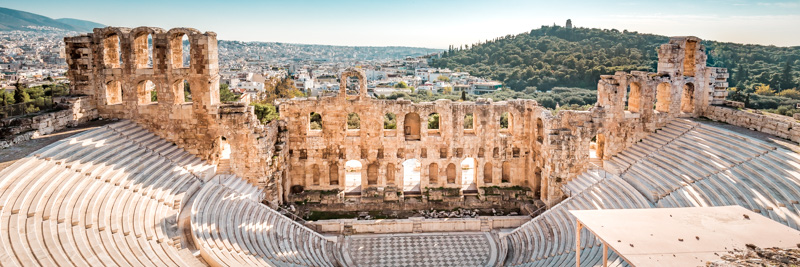
The Odeon of the former governor Herodes Atticus was donated by the Roman emperor Hadrian. Hadrian was a true philhellene and a great sympathizer of Athens.
The Roman theater is located not far from the north entrance to the Acropolis and was designed to seat 5,000 spectators. In 267 AD, the wooden roof was destroyed. Since the 1930s, performances have been held regularly in the Odeon.
The Dionysus Theater
⤷ Built in the 5th century and expanded in 330 BC ⭔ Diameter: 27 m
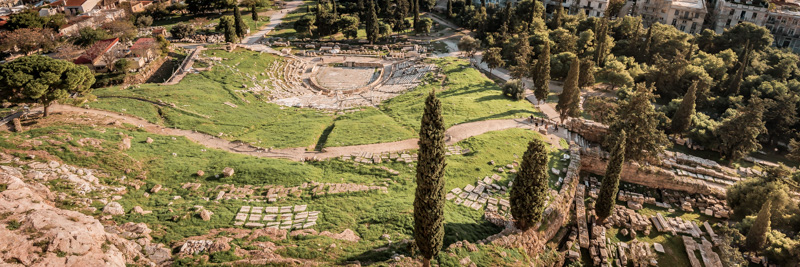
At the foot of the Acropolis, near the south entrance, is the Theater of Dionysus. It was considered the most important amphitheater in ancient Greece. It was named after Dionysus, the god of wine and ecstasy.
Over time, the theater was rebuilt many times. It was not discovered and excavated until 1863. Originally, it had 78 rows of seats and a capacity of 17,000 spectators. A throne belonging to a priest of Dionysus can also be admired here.
The Stoa of Eumenes
⤷ Built in 160 BC ⭔ Width: 16 m ⬝ Length: 163 m
The once-covered colonnaded hall (stoa) is located between the Theater of Dionysus and the Odeon of Herodes Atticus. The hall, which is over 160 meters long, was donated to Athens by Eumenes II of Pergamon.
It was probably used as a waiting hall in front of the Odeon. The Stoa also served as a retaining wall below the Acropolis and was reinforced with pillars and round arches.
Are there any other buildings on the Acropolis?
In addition to the buildings mentioned, there are other historical sites and temples on the Acropolis. However, many of them are now just ruins. Restoration and excavation work on the Acropolis is ongoing.
It is very important to stay behind the barriers and on the marked paths so as not to destroy protected excavation sites.
💡 Greece insider fact: If you want to know what the Parthenon temple looked like or should look like in its entirety, take a look at the replica in Nashville (USA). There, the temple has been reconstructed true to the original, including a statue of the goddess Athena inside. The Walhalla memorial in Donaustauf near Regensburg was also built based on the Parthenon.
#7 Visit the Acropolis Museum
The Acropolis Museum, newly opened in 2009, is located in the south, directly below the Acropolis. Finds and objects from the Acropolis in Athens are displayed on over 14,000 m² and four floors.
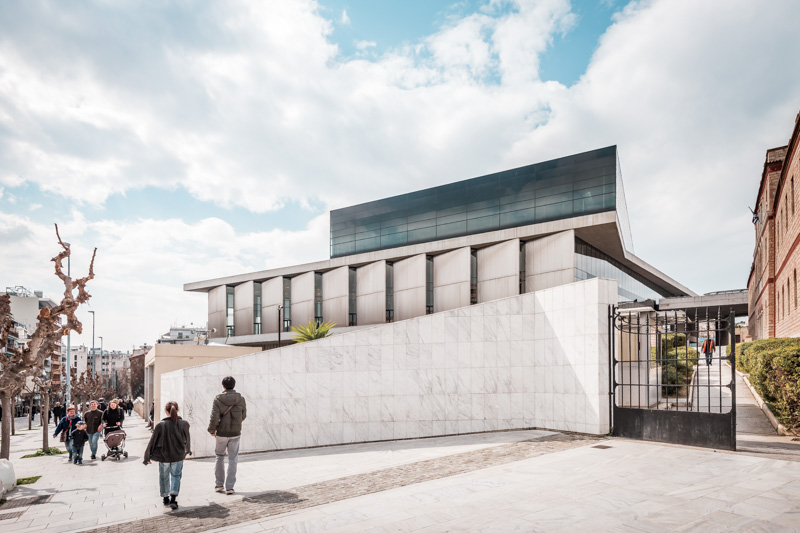
A visit to the museum is particularly recommended immediately before or after visiting the Acropolis. Many connections become clear during a tour, providing a more comprehensive picture of Athens’ landmark. Here, too, it is worth booking an online ticket for the museum in advance via GetYourGuide*:
➲ To the online ticket for the museum
You can visit the museum restaurant on the second floor without paying admission to the Acropolis Museum. You can get a free admission ticket to the restaurant directly at the ticket counter. From the roof terrace, you can enjoy a beautiful view of the Acropolis.
Acropolis Museum summer opening hours
- Mon. 8 a.m. to 4 p.m.
- Tue-Sun 8 a.m.-8 p.m.
- Fri. 8 a.m.-10 p.m.
- Adults: €20
- Concessions: €10
- (Apr-Oct)
Acropolis Museum winter opening hours
- Mon-Thu 9 a.m.-5 p.m.
- Fri. 9 a.m.–10 p.m.
- Sat-Sun 9am-8pm
- Adults: €20
- Concessions: €10
- (Nov-Mar)

#8 The most beautiful view of the Acropolis
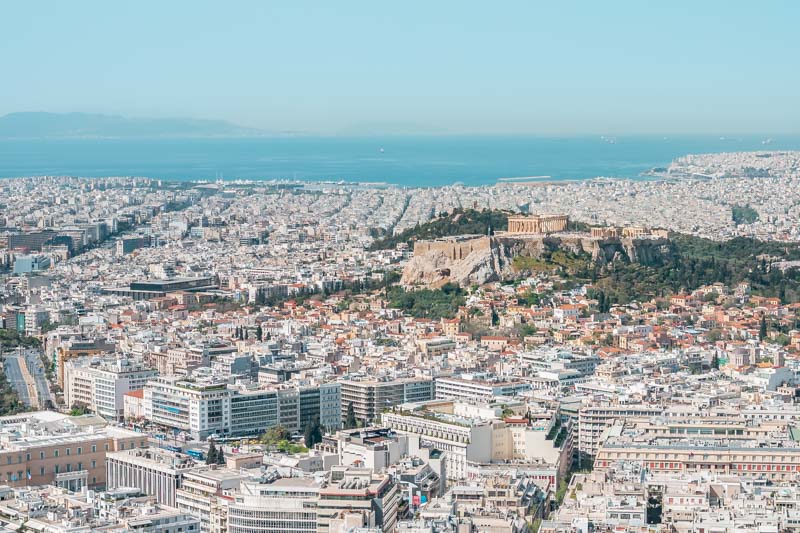
Magnificent views of the Acropolis of Athens are guaranteed from the three city hills of Philopappos, Areopagus, and Lycabettus. This is the best place to photograph the monumental buildings and the Parthenon.
Philopappos Hill is located southwest of the Acropolis in a small forest. Even in midsummer, it is idyllic here and only a few people stray up to the Philopappos Monument. From up here, the view of the Acropolis is magical, especially in the evening hours!

Directly opposite the north entrance to the Acropolis is Areopagus Hill. This is a particularly popular spot for watching the sunset, so it is usually very crowded. However, it is a wonderful place to take photos of the Propylaea of the Acropolis.
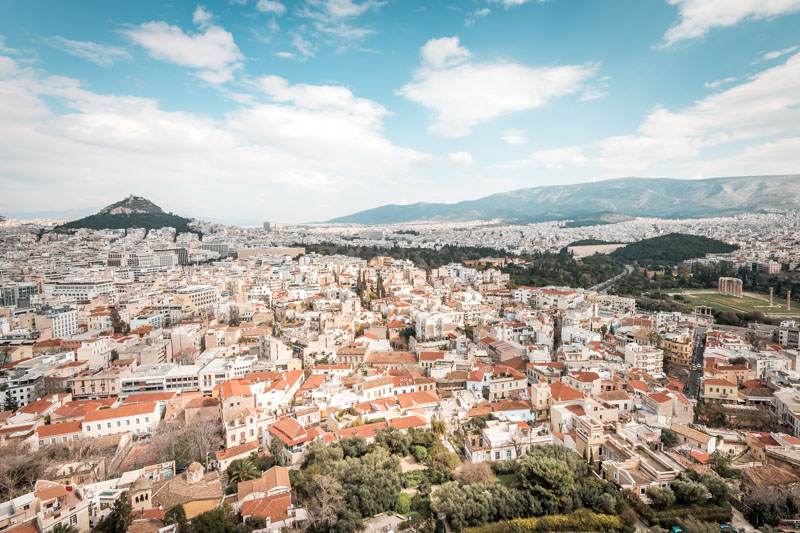
Lycabettus Hill is located north of the Acropolis. The best view is from the observation deck at the rear of the Acropolis. Surrounded by a sea of white houses, the hill is a little further away than the other two. Nevertheless, it offers a great panorama of Athens and the Acropolis.
#9 History of the Acropolis of Athens
The Acropolis of Athens is the most famous of its kind in Greece and has been a UNESCO World Heritage Site since 1986. Many other places in Greece also have ancient upper cities, most of which are now just ruins. The coastal town of Lindos on the island of Rhodes even has a well-preserved acropolis.
The history of the Acropolis has always been closely linked to the city of Athens. Excavations around the Temple Mount bear witness to thousands of years of settlement.
With Greece’s independence in 1832, the national sentiment of the Greeks grew stronger. Today, the Acropolis of Athens is considered a symbol of freedom and democracy.
Greek mythology ⥋ Kekrops I (also known as Cecops) is considered the founder of the once nameless city around the castle hill. The goddess Pallas Athena recommended herself as patroness by donating an olive tree. The tree provided the citizens with food, oil, and wood. In gratitude, the people named the city after the goddess—Athína.
From 5,000 BC ⥋ Excavations on the castle hill revealed traces of settlements from the Neolithic Age. This shows that the region was already highly attractive to people 7,000 years ago. Over time, an altar was erected on the hill in honor of the patron god Zeus.
Development from castle hill to temple hill
Around 1,500 BC ⥋ The first levelling of the mountain surface was carried out. In the following decades, a royal palace was built for the Mycenaean ruler of Attica.
1,300 BC ⥋ A cyclopean wall (Pelargikon) with a height of 10 meters and a thickness of up to 6 meters is built around the castle hill. A water source is enclosed to ensure supplies in the event of an enemy siege. For additional protection, a large outer bailey with nine gates (Ennéa Pýles) is integrated.
1200–800 BC ⥋ Large migrations take place during the Dark Ages. After the decline of Mycenaean culture, the Athenian Acropolis loses some of its importance. However, the royal palace is not destroyed and the region around the castle hill remains inhabited.
600 BC ⥋ The Acropolis is expanded into a sanctuary and thus becomes a temple mount. An Athena temple (the original Parthenon) is built. A wooden statue of the goddess Athena is said to have already stood there. According to legend, this was a gift from the goddess to the people and fell from the sky. Several village communities now surround the Acropolis.
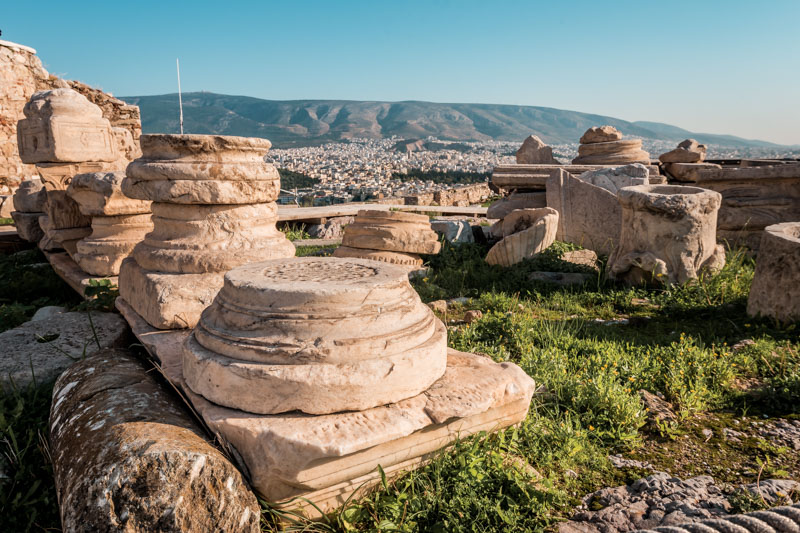
Around 500 BC ⥋ The Persians launch their first attacks on the Attica region. Many Athenians flee to the island of Salamis. In the following years, most of the Acropolis, including the main temple (ancient temple of Athena), is destroyed. The many individual pieces are referred to as “Persian rubble” and later form the foundation of the new temples.
Redesign under Pericles and Rome
448 BC ⥋ After its victory over the Persian Empire, Athens is considered the center of the Hellenic world. The city’s ruler, Pericles, commissions the best architects to redesign the Acropolis, including the brilliant sculptor Phidias. Construction of the Parthenon (new Temple of Athena) begins.
Around 420 BC ⥋ More buildings are added to the Temple Mount, including the Erechtheion and the Temple of Nike. Athens’ reputation as the seat of Attic democracy grows. Up to 40,000 people live around the Temple Mount.
From 86 BC ⥋ Athens is conquered by the Romans. After initial looting in the city, however, the sanctuaries on the Acropolis are revered as cultural treasures. New buildings are constructed, including the rotunda temple of Roma and Augustus.
2nd century AD ⥋ The Roman emperor Hadrian stays in Athens several times and donates a number of buildings to the “City of Hadrian,” such as the Odeon of Herodes Atticus below the Acropolis.
49 AD ⥋ During his visit to Athens, the Apostle Paul is said to have spread his Christian teachings on the Areopagus hill in front of the Acropolis.
267 AD ⥋ After the warlike invasion of Germanic tribes, the Acropolis of Athens is reinforced with additional bastions and expanded into a fortress.
4th–6th century ⥋ After Christianity was proclaimed the state religion in 380 AD and the Eastern Roman Empire became the Byzantine Empire, temples were converted into churches. The Parthenon, once dedicated to the virgin goddess Athena, became the Church of the Virgin Mary.
9th century ⥋ In the Byzantine Empire, the Acropolis was used as a fortress. Athens was given a bishopric. The Parthenon temple was declared the supreme bishop’s church of Athens.
➯ You can find more helpful travel information and facts about Greece in the Greece profile.
The Acropolis between the Crusaders and the Ottomans
13th century ⥋ The first Crusaders besiege Athens. The city is incorporated into the Frankish Duchy. Under Frankish rule, the Parthenon is declared a Catholic church, changing its status from an Orthodox place of worship.
1456 ⥋ Under Sultan Mehmed II, the Ottomans conquer Athens. The Parthenon is subsequently converted into a mosque and a minaret is added. Most of the temples remain intact.
1687 ⥋ As part of their expansion policy, the Venetians besieged the city of Athens. At that time, there was an ammunition depot on the Acropolis. The Venetians’ cannon fire caused a devastating explosion that destroyed the entire face of the temple hill.
1801-1816 ⥋ The British ambassador to the Ottoman Empire, Lord Elgin, shipped numerous precious marble relics from the Acropolis to Great Britain. They remain there to this day, in the British National Museum in London.
1821–1829 ⥋ During the Greek War of Independence against the Ottomans, Athens and the Acropolis were severely damaged. The city was largely abandoned, with fewer than 10,000 inhabitants remaining.

Recent history of the Acropolis of Athens
1832 ⥋ Greece’s independence is proclaimed. The mosque that the Ottomans had built in the Parthenon is the first thing to be removed. On December 25, 1833, Athens is declared the capital of the country. 100 years later, 450,000 people are once again living around the Acropolis.
Since 1980 ⥋ Extensive (modern) restoration work begins. The aim is to restore the complex to its original condition as far as possible, including the historical stone and marble elements. Serious restoration errors from the past are corrected.
June 20, 2009 ⥋ The new Acropolis Museum at the foot of the Temple Mount is opened, replacing the old museum (built in 1937) on the Temple Mount. It was designed by architect Bernard Tschumi.
Today ⥋ Air pollution from car and industrial emissions, as well as the increasing influx of visitors, pose the greatest challenge to the Acropolis of Athens. With over 3.5 million visitors, the 2,500-year-old archaeological site is considered a top attraction in Greece.
#10 More tips on the Acropolis of Athens
Your questions about the Acropolis have not been answered in our article? Here we have summarized more information about the Acropolis of Athens for you.
When is the Acropolis open?
The Acropolis is open to visitors every day. In summer from 8 a.m. to 8 p.m. and in winter from 8 a.m. to 5 p.m. The Acropolis is closed on certain days of the year (see opening hours).
How much does it cost to enter the Acropolis?
A single ticket costs €30 for adults and €15 for concessions in summer and winter. Admission is free for EU citizens under the age of 25 upon presentation of ID. A combination ticket offering discounted admission to the Acropolis and other attractions is no longer available.
Do tickets for the Acropolis have to be booked in advance?
You can book your ticket in advance with a guided tour directly online via GetYourGuide: Acropolis Ticket with Tour*. Alternatively, you can purchase your ticket at the two entrances to the Acropolis. You can buy the combination ticket at all attractions included in the ticket.
What hotels are there near the Acropolis?
There are numerous hotels in all price ranges near the Acropolis in Athens. We have listed hotels in the immediate vicinity of the Acropolis below. This way, you can reach the historical attraction in less than 10 minutes. Click on the links to Booking.com* to view the hotels:
- 5-star hotels near the Acropolis*
- 4-star hotels near the Acropolis*
- 3-star hotels near the Acropolis*
→ We’ve put together a list of the best hotels in central Athens for you here: Athens Hotel Tips
What restaurants are there near the Acropolis?
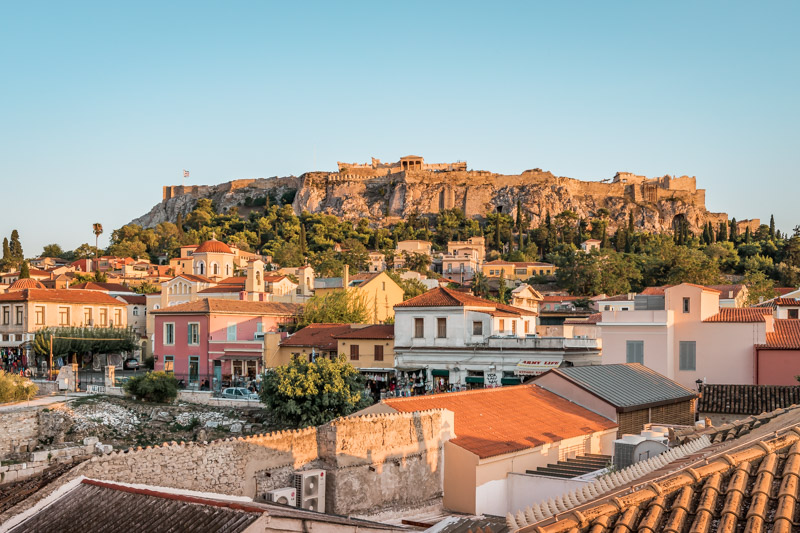
There are countless restaurants and cafés around the Acropolis. The alleys of Plaka are particularly beautiful in the evening. An absolute highlight is dining at one of the numerous Athens rooftop bars or restaurants with a panoramic view of the Acropolis. Here are our favourite tavernas, cafés and bars in central Athens: Athens Restaurants
Sights near the Acropolis
There are many other sights to discover near the Acropolis in Athens. In addition to historical sites, museums and the botanical garden of Athens await visitors. Here we have compiled a selection of Athens sights in the immediate vicinity of the Acropolis for you:
- Prison of Socrates
- Pnyx Hill and Sanctuary
- Philopappos Hill and Monument
- National Observatory of Athens
- Ancient and Roman Agora
- Stoa of Attalos
- Temple of Hephaestus
- Tower of the Winds
- Hadrian’s Library
- Hadrian’s Gate
- Olympieion Temple of Zeus
- Panathinaiko Stadium (Old Olympic Stadium)
- Kerameikos Ancient Site
- Syntagma Square and Government Buildings
- National Garden and Botanical Garden
- The Zappeion Building
→ You can find more useful travel tips for the Greek capital Athens and interesting excursions in the surrounding area here:
FAQs about the Acropolis of Athens
What is the difference between the Acropolis and the Parthenon?
The Acropolis is the entire castle hill with all its buildings. The Parthenon is the striking main temple on the Acropolis, which was dedicated to the goddess Athena.
Is the Acropolis Museum worth visiting?
Yes, the museum is very worthwhile. Originals from the Acropolis are displayed across 14,000 m², including the real Caryatids from the Erechtheion.
Where is the best view of the Acropolis?
The best vantage points are Philopappos Hill and Pnyx Hill at sunset, Areopagus Hill opposite the north entrance, and Lycabettus Hill.
Can you take a stroller onto the Acropolis?
No, strollers are not allowed and must be left at the entrance. For small children, you should bring a baby carrier.
When is admission to the Acropolis free?
Free admission is on March 6, April 18, May 18, the last weekend in September, October 28, and every first Sunday from November to March.
How do you get to the Acropolis?
Take the metro to Acropoli station (south entrance, 2 min) or Monastiraki station (north entrance, 8 min). The Acropolis is centrally located and easily accessible on foot.
Is there still a combination ticket for the Acropolis?
No, the discounted Athens combo ticket has not been available since 2025. You can only buy a single ticket at the Acropolis entrances or online.
When is the best time to visit the Acropolis?
The best time is early in the morning from 8 a.m., when it is still cool and less crowded. From 10 a.m., the first bus groups arrive and it gets very crowded.
How long does a visit to the Acropolis take?
You should plan on at least an hour. If you want to explore everything thoroughly, it’s better to plan on two hours.
What should you take with you to the Acropolis?
Sturdy shoes are a must, as the paths are rocky and slippery. You should also bring sunscreen, a hat, and plenty of water.
*Support our blog Greece-Moments
This post contains affiliate links, which are marked with an asterisk (*). If you book or purchase something through one of these links, we receive a small commission. The price remains the same for you. This helps us to continue providing high-quality content free of charge. Did you enjoy this post and want to say thank you? Then treat us to our next Greek coffee ☕️ To the coffee fund
Save this post Also on Pinterest!


