
Hidden away on the central east coast of Corfu is a palace that, at first glance, doesn’t seem to fit in with Greece. Empress Elisabeth of Austria had it built at the end of the 19th century in the lush green hills of the island. The Achilleion on Corfu, which was once Sisi’s retreat, is now a magnet for visitors to the region.
When it is still quiet in the garden of the Achilleion early in the morning, the place has an almost reverent atmosphere. How wonderful it would be to meet Empress Sisi on a walk and philosophize with her about gods, the world, and Achilles.
Tom & Ella

But it wasn’t just Sisi who left her mark on the Achilleion; German Emperor Wilhelm II also stayed here. Anyone traveling in Corfu can hardly miss the Achilleion, as it is one of the island’s top attractions. Accordingly, it is very crowded, and in summer there are sometimes traffic jams in the small village of Gastouri, on the outskirts of which the palace is located.
⚠️ Achilleion current status 2026: The interior of the Achilleion Palace has been closed since 2021 due to renovation work. There is still no specific reopening date. Visitors unanimously report that there is hardly any visible progress on the construction work. Currently, only the exterior of the Achilleion can be visited.
Here are our best tips for your visit to the Achilleion in Corfu:
- #1 Is the Achilleion worth visiting despite being closed?
- #2 Getting to the Achilleion
- #3 Garden of the Achilleion
- #4 The Achilleion Palace
- #5 History of the Achilleion
- #6 Sights in the surrounding area
- #7 Restaurants & cafés in the area
- More Corfu tips for your vacation
- FAQ: Frequently asked questions about the Achilleion on Corfu
🏖️ Dream beaches & hidden bays
🍽️ Restaurants, tavernas & cafés
🏛️ Must-see highlights & ancient sites
🗺️ Worthwhile spots & insider tips
🚘 Practical info like rentals & parking
♾️ Lifetime access & updates

#1 Is the Achilleion worth visiting despite being closed?
We are currently often asked: “Is the Achilleion on Corfu even worth seeing at the moment?”
Those who wanted to visit the Achilleion as a contemporary museum with historical furniture, artistic exhibitions, and the empress’s inventory will be disappointed. The interior of the Achilleion is currently closed, and only the outdoor area is accessible at this time. Objectively speaking, for the reduced admission price, you get a few nice statues in a park and a great view – that’s it.


The garden of the Achilleion is accessible and, unlike in winter, well maintained during the tourist season. From the terrace, you have one of the most beautiful views on the entire island of Corfu. The statues, especially the colossal victorious Achilles, are impressive even without the museum context. If you are a fan of Sisi, you cannot avoid visiting the Achilleion. The emotional value of this place remains, regardless of whether the palatial villa is closed or not.
Our recommendation for the Achilleion: Plan the Achilleion as part of a larger day trip on Corfu. After your visit, you can stroll through the village of Gastouri or stop by the coast in Benitses. As a sole destination for the day, the risk of disappointment would be too great. As a stopover on a beautiful tour of southern Corfu, it fits in quite well. In our Corfu travel guide, you’ll find even more tips for worthwhile destinations in the south of the island.
#2 Getting to the Achilleion
The Achilleion is located in the municipality of Achilleio on the outskirts of the village of Gastouri, about ten kilometers south of Corfu Town. It takes about 20 minutes to get there from the capital by rental car. The road to the Achilleion leads past olive groves and pine forests and over gently rolling hills.

We recommend taking country road 25, which passes through the village of Souleika. This will take you to Gastouri from the northwest. Another option is to take coastal road 23 from the southeast, just before Benitses, to Achilleion. The last stretch uphill is challenging, as the road is quite narrow. In summer, there can be traffic jams around lunchtime in Gastouri. Early in the morning, it is much less busy at the Achilleion.
Parking at Achilleion: A few meters from Achilleion, there is a small, free parking lot (Free Parking Achillion), which fills up quickly in high season. If you arrive late, you will have to park on the side of the road. You can always find a spot early in the morning.
Best time to visit Achilleion: The morning hours until 10 a.m. are ideal for taking beautiful photos in a peaceful atmosphere. In summer, the first tour buses arrive at noon, and then the paths become crowded and the garden quite noisy.
By bus to Achilleion: City bus line 10 runs regularly to Achilleion from San Rocco Square in Corfu Town. The bus ride takes about 30 minutes. This is the most convenient option for anyone who wants to visit Achilleion without a rental car.
Our reliable car rental partner Discover Cars* offers everything you need to explore Corfu by rental car – from small cars to family cars:
➲ Compare rental cars on Discover Cars*

#3 Garden of the Achilleion
Even though the interior of the Achilleion Palace is currently inaccessible, the Achilleion Palace Garden has its own undeniable magic. The chic outdoor area was created between 1890 and 1892 for Empress Elisabeth. The 82,000 square meter garden surrounds the palace, with the largest and most interesting part located to the north of the villa.

The Achilleion Garden is crisscrossed by a wide avenue and is home to many native and exotic plants, including kumquats, as well as a variety of ancient-style statues that are well worth seeing. In between are rose beds, hibiscus bushes, and fountains. Large palm trees and cypresses frame the garden. No wonder Sisi felt so at home here.

The Sisi statue: At the exit to the palace stands a lifelike marble representation of the empress. Her gaze is neutral, almost stern, and somehow you can’t shake the feeling that she didn’t really like her role as empress. For anyone familiar with the history of the place and the empress, this is a real emotional highlight.
The Nine Muses: Nine marble statues are lined up along a colonnade in the so-called Muses’ Garden at the rear of the palace, including the famous muses Clio, Thalia, and Calliope with their sisters. Their names sound like music, and the sight of the marble graces is truly impressive. You can also take great photos in front of the muses and the colonnade.

The Dying Achilles: This simple and touching sculpture was Sisi’s personal favorite. The statue was created by Berlin sculptor Ernst Herter and depicts Achilles in his final moments. During the battle against Troy, he was struck by an arrow fired by the enemy hero Paris and is now pulling it out of his heel. Anyone familiar with the legend of Achilles will understand why Sisi identified with this statue.

The Victorious Achilles: The eight-meter-high statue was commissioned by Emperor Wilhelm, who resided here after Sisi. Standing in front of it, it appears huge and almost somewhat boastful. Achilles’ helmet was once covered in gold and is said to have been visible as far away as Corfu Town. Although the gold has weathered away, the sheer size of the bronze statue is still impressive and it is, of course, the top photo opportunity in the gardens of the Achilleion.


Balcony of the Achilleion Garden: Directly behind the large statue of Achilles at the end of the garden, you have one of the most beautiful views on the entire island. You can look out over the green hills of Corfu down to the shimmering Ionian Sea. If you look closely, you can see Corfu Town with its two Venetian fortresses. By the way: there is a public toilet in the south of the garden.
💡 Who was Achilles? Achilles is the greatest hero of Greek mythology. He became immortalized in Homer’s Iliad, in which he goes to war in the Trojan War as a supposedly invincible commander. Born to the mortal king Peleus and the immortal sea nymph Thetis, his mother dipped him in the underworld river Styx as an infant to make him invulnerable. The heel she held him by was the only part that hadn’t been bathed. Despite being regarded as virtually immortal, it was this one spot, now known as the ‘Achilles’ heel’, that ultimately led to his downfall. He died when he was struck by an arrow there. His story is a tragedy, for he consciously chose a short, glorious life over a long, meaningless one. Sisi admired him not for his strength, but for his dignity in the face of fate. She had passages from the Iliad written on the walls of the palace, in Greek, of course, which she had learned especially for Corfu. For an empress who never really felt at home in Europe and was always on the run, Achilles was probably more than a hero. His myth was like a mirror for the empress, who never wanted to take on this role.
#4 The Achilleion Palace
When you enter the Achilleion, you immediately sense that the palace was not simply built for representation, but was also a very personal retreat. The decoration of the entire Achilleion villa was in Sisi’s own hands. Inside and out, everything is imbued with her admiration for classical Greece. Statues of ancient philosophers, mythical gods, and heroic warriors greet you at every turn.
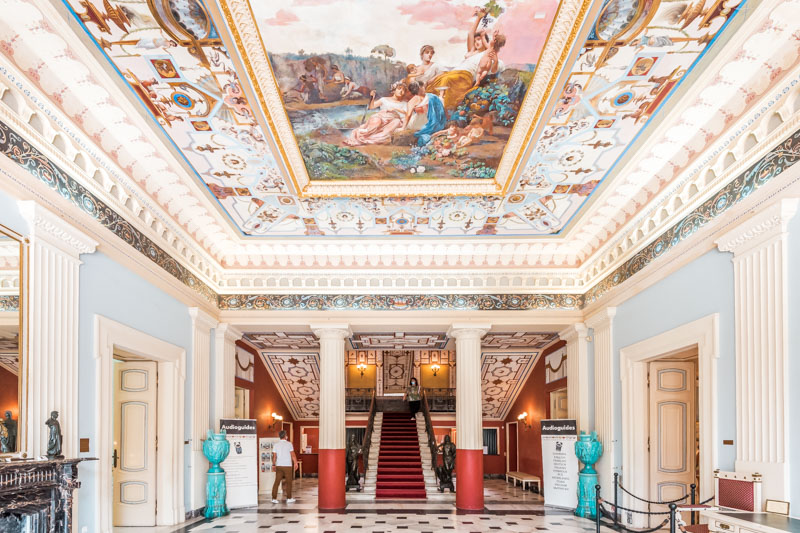
The colorful entrance area with its ceiling paintings and stucco work is impressive as soon as you enter. On the ground floor, you can visit the personal rooms of Sisi and Emperor Wilhelm II, with original furnishings that are amazingly well preserved. Sisi had many pieces of furniture brought from Vienna to Corfu especially so that the palace would truly reflect her taste. The original bedroom of Empress Sisi with her real bed from the time she stayed on Corfu is particularly memorable.

The central great hall is dominated by the painting “The Triumph of Achilles” by the Austrian painter Franz Matsch. The enormous work depicts the hero Achilles after the fall of Troy. Next to it is a curiosity from the time of Wilhelm II, namely a wooden desk chair equipped with a horse saddle. The emperor did not want to do without his riding seat from home and therefore had a saddle made as an office chair.
On the balcony on the first floor, Ionic columns connect busts of philosophers with statues of the nine muses. Two centaurs guard the balcony on the first floor, and four brass figures guard the one above. At the top of the façade sits a brass statue of Hermes, the messenger of the gods, who protects travelers and border crossers. This was no coincidence for Sisi, who herself traveled between worlds.
Our personal highlight right at the beginning is the magnificent staircase inside the Achilleion. The walls and ceilings are covered with impressive paintings and partly with mirrors. The light refracts in all directions, making the epic murals seem almost real. Walking down these stairs, you inevitably feel like royalty. Here, you understand with all your senses why Sisi loved this place so much.

Achilleion opening hours and admission
Admission to the Achilleion costs €7 per person, but only the garden area is accessible. Until 2020, admission was €10, which also included access to the interior of the palace. The admission price when the palace reopens after renovation has not yet been determined. Due to the new pricing policy for museums in Greece, we expect it to be at least €20. There is no specific opening date yet.
- Achilleion opening hours: daily from 8:00–20:00 in summer (01 Apr–31 Oct) and 8:00–16:00 in winter (01 Nov–31 Mar)
- Achilleion entrance ticket: €7 for visiting the garden (€5 reduced, up to 18 years or from 67 years)
- Free admission to the Achilleion: children under 6 years
You can see the garden in about 30 minutes, or longer if you are interested in mythology, art, and plants. For a complete tour of the Achilleion, you should plan at least two hours, including about 1.5 hours inside. Until it reopens, it is worth taking a look at the official website achillion-corfu.gr.

#5 History of the Achilleion
When Sisi first came to Corfu in 1861, it was on the recommendation of her travel companion Alexander Freiherr von Warsberg. He had described the island so impressively in his book “Odyssean Landscapes” that Elisabeth was determined to see it for herself. After her first visit, Corfu became a place where she could relax and unwind. She returned here again and again for many years, until she finally decided to buy a piece of Corfu.

She purchased a plot of land on a hill above the village of Gastouri and had the Italian architect Raffaele Carito build a palatial villa there between 1890 and 1892. She chose the name after her favorite mythological hero: Achilles, the hero from Homer’s Iliad. Sisi herself supervised the entire decoration and had statues delivered from Italy, including copies of important works from the museums of Naples and Florence.
In 1907, Emperor Wilhelm II bought the Achilleion from Sisi’s heirs and used it as his summer residence for almost every spring until the First World War. He had the garden redesigned, replaced the Heine monument with a bust of the empress, and commissioned the Potsdam sculptor Johannes Götz to create the colossal Victorious Achilles. Under Wilhelm, the Achilleion developed into a center of European diplomacy.
During the world wars, the Achilleion Palace served as a military hospital and military quarters. Afterwards, it was used temporarily as a kindergarten and orphanage before the Greek state leased the building to a private company in 1962, which promptly set up a casino in the basement of the Achilleion.

Anyone familiar with the James Bond movie “For Your Eyes Only” (1981) will have seen the Achilleion on the big screen. Some of the scenes were filmed there, including on the terrace, where Roger Moore as 007 enjoys the view with Bond girl Carole Bouquet. The palace has been back in state hands since 1983. Extensive renovations started in 2021 and the completion date has not yet been officially announced.

Empress Sisi and the island of Corfu
Elisabeth Amalie Eugenie von Wittelsbach was born in 1837 as the daughter of the Bavarian Duke Maximilian Josef. She spent her childhood far away from the constraints of court life, growing up freely, riding, writing poetry, and hiking. It was not planned that she would one day become Empress of Austria. Her older sister Helene was actually intended for Emperor Franz Joseph. But when the two sisters met him in Bad Ischl in 1853, the emperor fell in love with the then 16-year-old Elisabeth and married her.
What inevitably followed was a life in a gilded cage for Sisi. The Viennese court was steeped in strict protocol, every step was regulated and every appearance was staged. Even the upbringing of her children was taken over by her mother-in-law, Archduchess Sophie, as she did not trust Elisabeth to be a mother. Sisi suffered greatly from this, withdrew from court and eventually fled further and further away.


She learned Greek, Hungarian, and English, exercised excessively, and occupied herself with philosophy and poetry. Heinrich Heine became her favorite author. She saw parallels between herself and Heine, as traveling also offered him an opportunity to escape everyday life and social constraints. For her, Corfu was not a vacation destination, but a place of longing and refuge. No protocol, no court, and no waiting for the next audience.
In Corfu, she could wander incognito through the markets, ride horses, go for walks, breathe deeply, and simply be human. Surrounded by cypress trees and marble statues, she was perhaps closer than ever to the life she had deeply desired. On September 10, 1898, she was stabbed in Geneva by the anarchist Luigi Lucheni and died of her injuries on the same day at the age of 60.
🗺️ 10 road trip routes with maps
🏖️ Beautiful beaches & swimming spots
🏛️ All top sights & attractions
🤫 Unpublished insider tips
🍽️ Accommodation, tavernas & cafés
#6 Sights in the surrounding area
The Achilleion is ideally located for an extended day trip in the south of Corfu. There are several interesting places in the immediate vicinity that can be combined wonderfully. The best thing about it is that most Corfu vacationers are not even aware of these spots. If you don’t want to go exploring on your own with a rental car, you can also take part in a guided tour via GetYourGuide*:
➲ To the bus tour with Mon Repos & Old Town*
➲ To the island highlights tour*
Time out in Gastouri
The village of Gastouri is located right next to the Achilleion and is usually just a stopover. A short walk through the village of 500 souls is really worthwhile. Gastouri was founded in Venetian times and has preserved its historic buildings to this day. You’ll find great photo opportunities among the old stone houses and winding alleys. The traditional bakery offers sweet and savory snacks for on the go, as well as exceptionally delicious bread.


We would like to recommend two special places to visit in Gastouri. The Olive Wood Workshop on the main street, where handmade household items are made from olive wood. Here you will find authentic souvenirs, from salad servers to cutting boards to wooden chess games, and none of the typical tourist stuff you find in other shops on Corfu.
Right next door is the Tsami Ceramics pottery, where Loula and her daughter Anna have been producing high-quality ceramics since 1991. From cups and plates to bowls and tea lights, everything looks simply superb. We’ll probably stock up on everything during our next stay in Corfu. Our favorite is the beautiful lemon design, a classic that never gets boring. More information about the Corfu pottery can be found at tsamiceramics.gr
Hiking enthusiasts can visit the Agia Kyriaki chapel, located just outside the village to the southeast. The path there is a bit arduous, but the view of the landscape below is one of those moments that make traveling to Greece worthwhile. The best part? Even Empress Sisi used to visit this heavenly place from time to time, as a marble inscription on the church confirms.
✓ Full coverage & unlimited mileage included
✓ Free cancellation until 24h before pickup
✓ Best price guarantee via Discover Cars
Swim stop in Benitses
Just a few minutes south of Achilleion lies the coastal village of Benitses. It was once a tranquil fishing village with a small harbor and a winding upper village full of old stone houses. However, it was marketed to tourists early on in the 1980s. Today, it is a relaxed mix of taverns and hotels built higgledy-piggledy, as well as a small tranquil harbor and a modern marina.

Those interested in history should visit the Benitses Roman Baths, located north of the town center, which are more of a surprising discovery along the way than a historical highlight. The sparse remains of a Roman bath complex from the 2nd century AD have unfortunately not been well maintained in recent years. They are not well labeled, but they are a nice find for tireless explorers.
Benitses Beach is not a dream beach, but rather a narrow stretch of coastline with pebbles, clear water, and views of fishing boats and sailing ships. The beach is shrinking every year because it was built too close to the main road, which runs directly along the sea. It’s enough to cool off after visiting the Achilleion. There are taverns scattered along the shore offering fresh fish. For us, dinner here with a view of the sea is simply a must.
→ Find out about all the beaches in Corfu and our favorite swimming spots here: Corfu beaches
Agii Deka
Agii Deka is located further inland, surrounded by lush forests, rarely visited, and therefore well worth a detour. The village is home to just under 100 people, and here you can still feel the authentic soul of Corfu. The village church is a miniature version of the Agios Spyridon Church in Corfu Town. The pastel-colored houses also make for great vacation photos.
The tavern Aretis Place caters to hungry visitors with fresh home cooking, hospitality, and fair prices. Those who want to be active can start a hike to the waterfall of Agii Deka, one of the lesser-known but all the more beautiful excursions in the south of the island. The trail leads through olive groves and cool gorges, and the view at the destination is wonderful.
→ All the sights on Corfu and lots of travel tips can be found here: Corfu Highlights
Pontikonisi and Vlacherna Monastery
If you have traveled along the coastal road to Achilleion, you will certainly have already spotted the small island of Pontikonisi. Empress Sisi was so enchanted by this setting that she is said to have often swum here to enjoy the secluded tranquility of Pontikonisi. It was certainly quiet here all year round in the past, but today holiday planes thunder directly over the island, which has become a mecca for plane spotters.

The islet is really tiny, but it’s worth a visit in combination with the Vlacherna monastery. From there, excursion boats run daily to Pontikonisi. There is a church and a shop/snack bar on the island. It takes ten minutes to walk around the island, which is even home to peacocks and turtles. Ideally, you should plan to visit Pontikonisi after visiting the Achilleion, as you have to drive around the airport (25 minutes).
→ Everything you need to know about Mouse Island Pontikonisi and the Vlacherna monastery can be found here: Vlacherna Corfu
#7 Restaurants & cafés in the area
Right next to the Achilleion, there are a few unimaginative souvenir shops and a snack bar that we would not recommend. However, there are a few places in the surrounding area that we have visited ourselves and found to be good.
Elia Taverna Grill House
This grill tavern is located right in Gastouri. Our recommendation for anyone looking for a hearty lunch or a good barbecue evening in a relaxed atmosphere. They serve Greek meat from the grill at reasonable prices and there are no tourist crowds.

Chill Bean Gastouri
Just before the Achilleion, on the road coming from Benitses, there is a new café. It is perfect for a relaxing coffee before or after visiting the Achilleion, and they also serve cakes and sandwiches. There is a simple outdoor area on the street and the staff are friendly. Just the thing for a short break between sightseeing and continuing your journey.
Paxinos
This classic Greek taverna in the old town center of Benitses has been known for decades for its down-to-earth cuisine. The family who runs it attaches great importance to freshly prepared dishes and typical Corfiot fare. The interior is rustic but inviting. In the evening, it is also very popular with locals.
Would you like more restaurant tips for the region?
→ You can find all recommended cafes and taverns on Corfu on our Google map: To the Corfu map
More Corfu tips for your vacation
To make your trip to Corfu unforgettable, we have compiled a helpful list of portals that we also use to plan and book our trips to Corfu:
- You can find accommodation for Corfu here: To Booking.com*
- Check ferries for Corfu here: To Ferryhopper*
- Find cheap flights to Corfu here: Go to Skyscanner*
- Book excursions and tours on Corfu: Go to GetYourGuide*
→ Here you can find more tips about the region and all articles about the island of Corfu: Corfu Blog

FAQ: Frequently asked questions about the Achilleion on Corfu
Is the Achilleion on Corfu currently open?
The interior of the palace has been closed since 2021 due to renovation work. Currently, only the garden and outdoor areas can be visited. Admission is €7. Please check the official website in advance.
How much does it cost to enter the Achilleion?
Currently, admission to the garden costs €7. Opening hours are daily from 8 a.m. to 8 p.m. in summer and 8 a.m. to 4 p.m. in winter.
When will the Achilleion be fully open again?
No official date has been confirmed yet. Visitors report that the progress of the construction work on the building is hardly visible. It is best to check the current status at achillion-corfu.gr shortly before your visit.
How can I get to the Achilleion without a car?
From San Rocco Square in Corfu Town, city bus line 10 runs regularly to the Achilleion. The journey takes about 30 minutes. Alternatively, the Achilleion is part of many day tours from Corfu Town.
Is the Achilleion worth visiting despite the closure?
For fans of Sisi and history buffs, yes. The garden with its statues and the view of the Ionian Sea are impressive. As a single destination, it can be very disappointing, so it’s best to plan it as part of a larger tour of southern Corfu.
What can you currently see at the Achilleion?
The extensive garden with its statues (dying & victorious Achilles, the nine muses, Sisi statue), the exterior facade of the palace, and the terraces with fantastic sea views. The interior is closed.
What is there to see near the Achilleion?
The village of Gastouri right next door, the coastal town of Benitses with its beach, Roman Baths, and harbor taverns, as well as the mountain village of Agii Deka with its waterfall hike and the viewpoint of the Agia Kyriaki chapel.
*Support our blog Greece-Moments
This post contains affiliate links, which are marked with an asterisk (*). If you book or purchase something through one of these links, we receive a small commission. The price remains the same for you. This helps us to continue providing high-quality content free of charge. Did you enjoy this post and want to say thank you? Then simply buy us our next Greek coffee ☕️ To the coffee fund
Save this post on Pinterest!